COG PSYCH - 12 Judgment and Reasoning
 Call Kai
 Learn
Learn Practice Test
 Spaced Repetition
 Match
Match Flashcards
 Knowt Play
1/29

There's no tags or description
Looks like no tags are added yet.
Name | Mastery | Learn | Test | Matching | Spaced | Call with Kai | Chat |
|---|
No analytics yet
Send a link to your students to track their progress
30 Terms
What is Judgment?
“Judgment” is the process through which people draw conclusions from the evidence they encounter.
What do many judgments begin with?
A frequency estimate.
They are assessments of how often various events have occurred in the past.
But often, people do not have access to frequency information.
What is Attribute Substitution?
Strategies of relying on easily assessed information as a proxy for needed information. It involves:
Availability Heuristic
Representativeness Heuristic
What are Heuristics? Are they prone to errors?
Heuristics are efficient strategies that usually lead to the correct answer.
Yes. They can still result in errors.
EX) Does cancer or heart disease cause more deaths? Heart disease kills more, but since cancer is a publicized illness, we can assume that cancer kills more people.
What is the Availability Heuristic?
Making judgments of something happening by relying on frequency and likelihood.
It is typically accurate because frequent events are likely to be easily available in memory.
Do people regularly overestimate the frequency of rare events?
Yes.
EX) Physicians overestimate the likelihood of rare diseases and thus fail to pursue more likely diagnoses.
Rare events are likely to be well-recorded in memory, and thus more available than common events.
What happened in the Schwarz et al. (1991) experiment?
Students were asked to recall past episodes in which they had been assertive.
One group was asked to give 6 examples, and the other group was asked to give 12 examples.
Those who gave only 6 examples judged themselves as more
assertive than those who gave 12.It is easier to come up with 6 examples than 12.
What is the Representativeness Heuristic?
The assumption that resemblance to the prototype reflects probability. How close does the person/situation match the prototype/stereotype?
It has the assumption of homogeneity — an expectation that each individual is representative of the category overall.
There is a likelihood of category membership being judged by resemblance.
What is the Gambler’s Fallacy?
The false belief that if something random happens a lot right now, it is likely to continue happening.
EX) Coin flips. If a coin flips to heads 5 times, will it become heads a 6th time? No. It’s still 50/50.
What is Covariation?
A statistical way of seeing i two things change together.
It could be either positive or negative, vary in magnitude (i.e. strength), and it is necessary in order to check a belief about cause and effect.
EX) Exercise and risk of heart attacks. Will there be a positive or negative covariation?
What is Base-Rate Information?
Tells us how frequently something happens in general.
When we neglect this, it causes illusions of covariation.
Base-rate neglect is partly a consequence of attribute substitution.
An overreliance on the representativeness heuristic
Incorrect perceptions that one variable predicts another, a good example is superstition or social stereotypes.
What is the Confirmation Bias?
Tendency to be more alert to evidence that confirms one’s beliefs than to evidence that challenges them
Does heuristics rise above human judgment?
No. Human judgment rises above heuristics (sometimes)
In some contexts, people seek out more accurate base-rate information, are sensitive to sample size, and potential sources of bias.
What are our two ways of thinking?
We use the Dual-process Model.
Type 1 — fast and automatic. It relies on heuristics.
Type 2 — slower and effortful. More likely to be correct.
Using either type 1 or type 2 depends on the context. Like if you have a time pressure or are distracted, you are more likely to use Type 1.
What does the Green and Blue Cab study tells us?
It shows how people fail to use background statistics (base rates) when making quick guesses, relying instead on specific witness testimony.
In the study:
Green cabs dominated the city as 85% and the blue cabs had 15%.
When a witness saw a blue cab in a hit-and-run, they guessed right 80% of the time, ignoring that green cabs are far more common.
It showed that they ignored general facts (the bast rate) about how rare blue cabs were.
What kind of thinking does Type 1 associate with?
Sophisticated thinking.
Base-rate neglect is less likely for frequencies than probabilities/proportions.
There is an emphasis on random chance in Type 1 judgements.
EX) “Trying one dish” vs “Trying a dish randomly”
????
What influences Type 2 thinking?
Education.
Participants can be trained to understand that large samples of data are more reliable than small samples.
Why do people still use Type 1 thinking when Type 2 is more accurate?
Importance of the issue.
Time
Pressure
Amount of effort available
What is Induction? Deduction?
Induction:
Process through which you forecast about new cases based on observed cases
Starts with specific observations and builds a likely general rule.
EX) Seeing multiple dogs bark, you can conclude that all dogs probably bark. But a new observation (dog no bark) could prove it wrong later.
Deduction:
Process through which you start with ‘givens’ and ask what follows from these premises.
Uses certainty.
EX) Being at a park, noticing that every dog in the park barks, you have a dog in the park, therefore you are certain that your dog barks. (If the first two fats are true, the conclusion must be true)
What is the Confirmation Bias?
A greater sensitivity to confirming evidence and a tendency to neglect disconfirming evidence.
Our tendency to notice and accept facts that we think is correct, but ignore facts that prove us wrong.
What happens when we are presented with info that is consistent/inconsistent with our beliefs?
Information that is consistent with one’s beliefs is often accepted without challenge.
Information inconsistent with one’s beliefs is often scrutinized for flaws.
What is Belief Perseverance?
A tendency to continue endorsing a belief even when disconfirming evidence is undeniable.
What are Conditional Statements?
“If X, then Y.”
What is Wason’s four-card task? What does it tell us?
There are cards in front of participants and are given a rule to test: “If a card has a vowel on one side, then it has an even number on the other side.”
Most people choose the card that aligns with their beliefs, trying to prove the rule as right (confirmation bias) rather than trying to falsify it.
What is the Principle of Utility Maximization?
Choosing the option with the greatest expected value. You balance the cost and benefits.
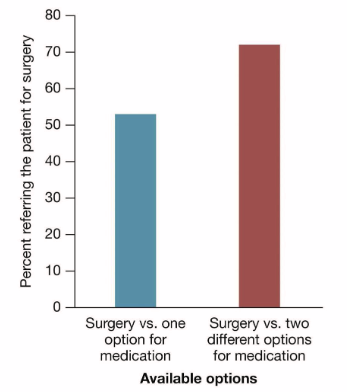
What should we do for reason-based choices?
Decision-making instead of utility maximization.
The goal is to simply make decisions that we feel good about because we feel that they are reasonable and justified.
How are people’s decisions when it comes to emotions?
Decisions are powerfully influenced by emotions.
We tend to assess risk in emotional terms.
They use somatic markers (i.e. fast heartbeat from fear) to evaluate options
There is a reliance on a ‘gut feeling’ that may favor options that trigger positive feelings.
What is Affective Forecasting?
Making predicts based on your future emotions.
EX) How would you feel after breaking up with your romantic partner?
People usually can predict whether their reaction would be positive or negative BUT often inaccurate when estimating the duration of their feelings.
However, people also tend to overestimate the extent of their future feelings.
What does framing do?
It can leave people open to manipulation and self-contradiction.