Ch. 3 Nucleic Acids, Identity of DNA as Molecule of Inheritance
 Call Kai
 Learn
Learn Practice Test
 Spaced Repetition
 Match
Match Flashcards
 Knowt Play
1/75

There's no tags or description
Looks like no tags are added yet.
Name | Mastery | Learn | Test | Matching | Spaced | Call with Kai | Chat |
|---|
No analytics yet
Send a link to your students to track their progress
76 Terms
Nucleic acids
large biological molecules that store and pass on genetic information in all living things

What are the 2 main types of nucleic acids?
deoxyribonucleic acid (DNA): usually double-stranded
Ribonucleic acid (RNA): usually single-stranded

Where is DNA located in eukaryotes?
in the nucleus and certain organelles (mitochondria and chloroplasts)
Where is DNA located in prokaryotes?
DNA is not enclosed in a membranous envelope
Nucleotides
DNA and RNA are made up of monomers that are connected together in a chain with covalent bonds

Nitrogenous bases
They contain nitrogen. They are bases because the contain an amino group that has the potential of binding an extra hydrogen, and thus, decreases the hydrogen ion concentration in its environment, making it more basic.
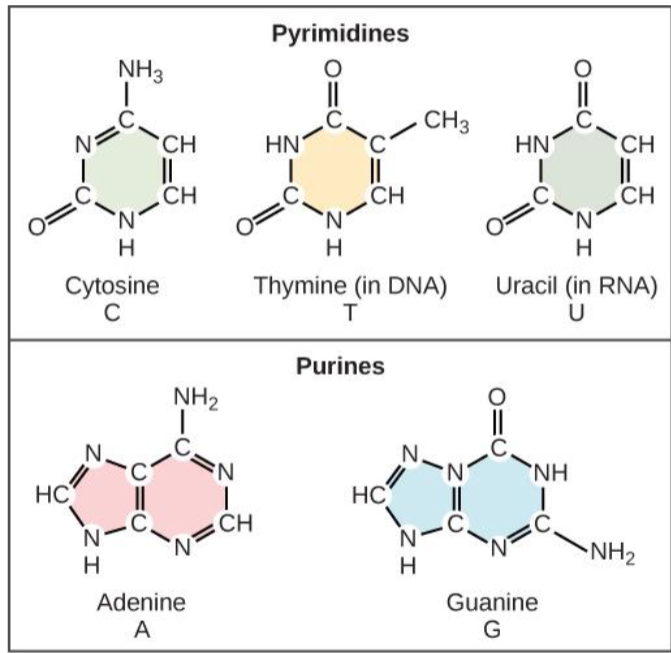
Pyrimidines
bases with a single-ring structure
Cytosine (C): Found in both DNA and RNA
Thymine (T): Found in DNA
Uracil (U): Found in RNA and replaces thymine
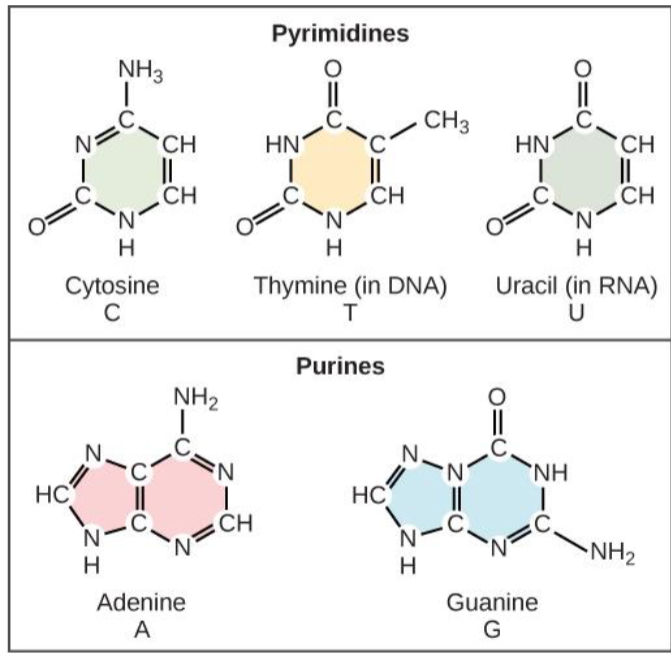
Purines
Bases with a double-ring structure
Adenine (A): found in both DNA and RNA
Guanine (G): found in both DNA and RNA

Pentose sugar
a sugar molecule containing 5 carbon atoms (the carbons on these sugars are labeled 1’ to 5’)

What 2 sugars are found in nucleotides?
deoxyribose: an -H at the 2’ carbon
ribose: an -OH at the 2’ carbon
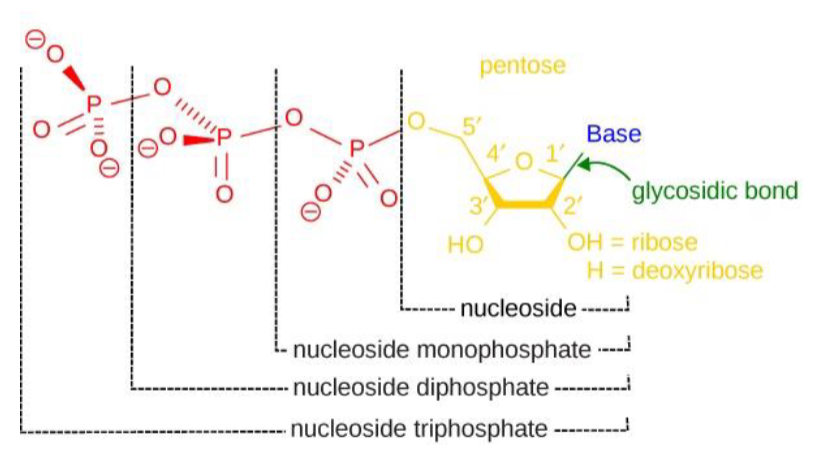
deoxyribonucleotides
nucleotides containing deoxyribose and are found in DNA

ribonucleotides
nucleotides containing ribose and are found in RNA

nucleosides
molecules that contain only sugar and a nitrogenous base (no phosphate)

nucleoside phosphates
Nucleotides are often referred to as this. The number of phosphates in the nucleotide is indicated by the appropriate prefixes (mono, di, or try)


What would be the nomenclature of a nucleoside for RNA that has adenine?
adenosine
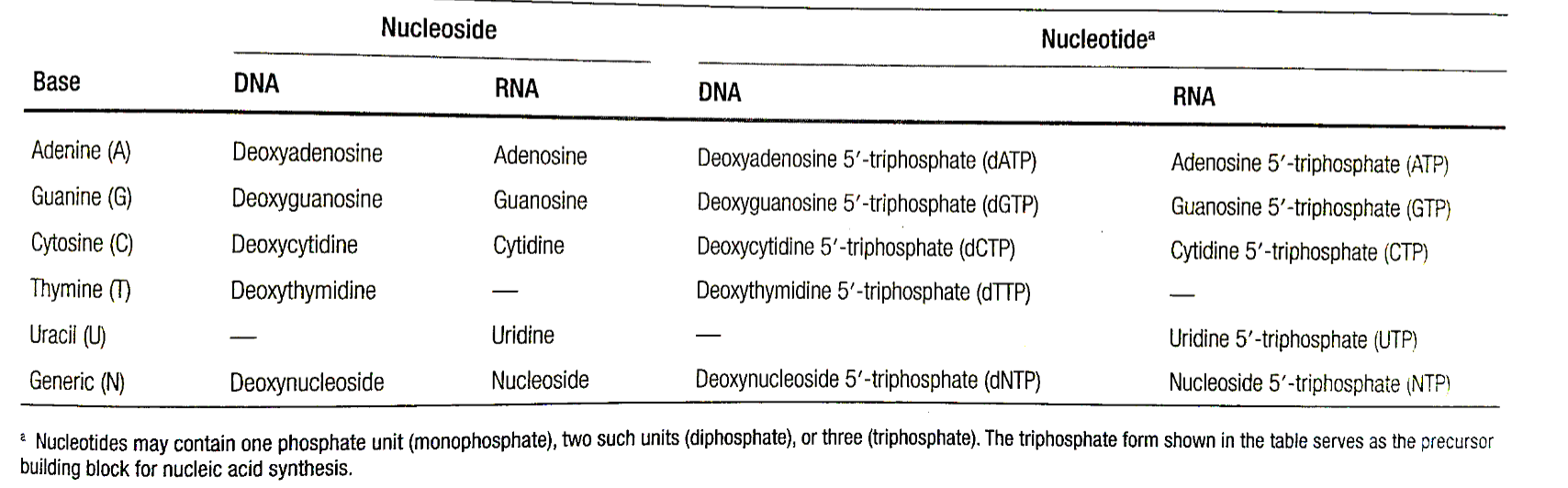
What would be the nomenclature of a nucleotide for RNA that has adenine?
adenosine mono/di/triphosphate (AMP/ADP/ATP)
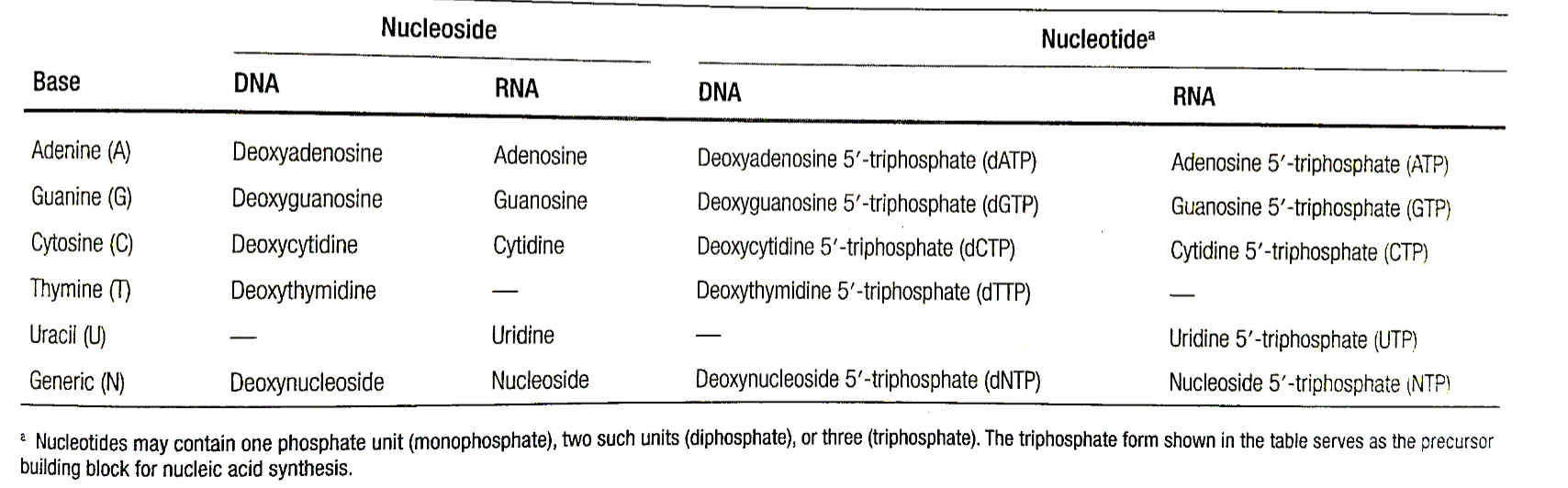
What would be the nomenclature of a nucleoside for DNA that has adenine?
deoxyadenosine
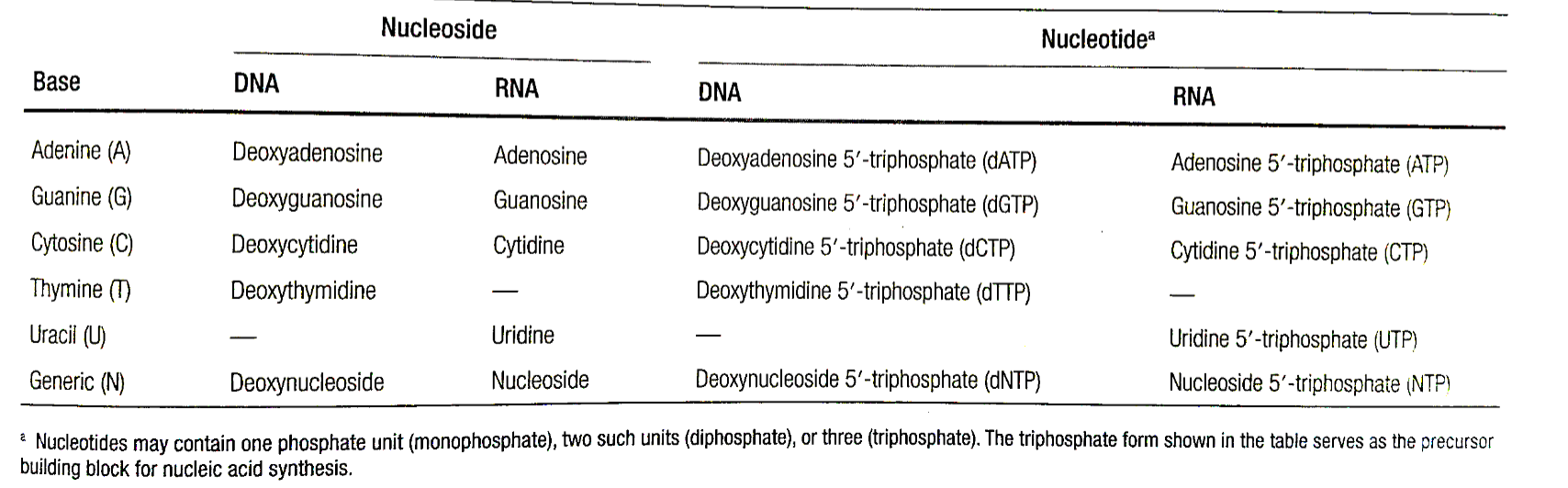
What would be the nomenclature of a nucleotide for DNA that has adenine?
deoxyadenosine mono/di/triphosphate (dAMP/dADP/dATP)
How to build the nucleic acid strand?
The substrates for making DNA or RNA polymers are dNTPs (deoxyribonucleoside triphosphate, for DNA) or NTPs (ribonucleoside triphosphate, for RNA)


What is the name for this polymer?
NTPs (ribonucleoside triphosphate)
The 3 phosphates are named using what 3 Greek letters?
a (alpha), B (beta), and Y (gamma)
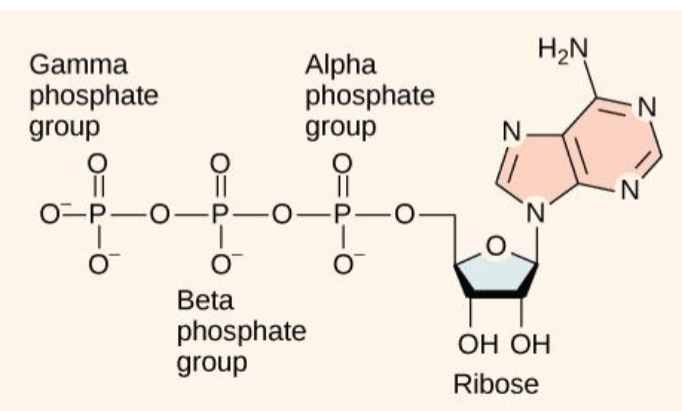
What phosphate is linked to the 5’ carbon?
alpha phosphate group

Each DNA strand is built from dNTPs by the formation of what bond?
phosphodiester bond, catalyzed by DNA polymerase, between the 3’OH of one nucleotide and the 5’ phosphate of the next
Bond formation occurs by what reaction?
condensation reaction; involving the removal of H2O and pyrophosphate

DNA synthesis proceeds in what direction?
5’ —> 3’ direction, and each DNA strand has polarity:
5’ end: has a free 5’ phosphate group
3’ end: has a free 3’-OH group

How was DNA identified as the genetic material?
DNA was 1st isolated from white blood cells by Friedrich Miescher, who called it nuclein because it was isolated from nuclei
Fredrick Griffith’s experiments with strains of S. pneumonia provided the first hint that DNA may be the transforming principle
Avery, MacLeod, and McCarty showed that DNA is required for the transformation of bacteria
Later experiments by Hershey and Chase using bacteriophage T2 proved that DNA is the genetic material
Chargaff found that the ratio A=T and C=G, and that the percentage content of A, T, G, and C is different for different species
X-ray crystallography
a technique that uses X-ray diffraction patterns to determine the 3D structure of molecules. It provided critical clues about the 3-dimensional structure of DNA
William Astbury used X-ray diffraction to show what about DNA?
that it was a linear polymer of stacked bases, each nucleotide separated from the next by 0.34 nm
Rosalind Franklin was able crystalize this DNA and produce very high-resolution X-ray diffraction images of the DNA crystals. She found:
0.34 nm between adjacent stacked bases
3.4 nm per complete helical turn
~2 nm diameter of the DNA helix
Which scientist was trained at IU?
James Watson
DNA is made up of 2 strands that are twisted around each other to form a…
right-handed helix
What is a right-handed helix?
Use your right hand: point your thumb along the direction of the helix; the curl of your fingers shows the direction of the twist
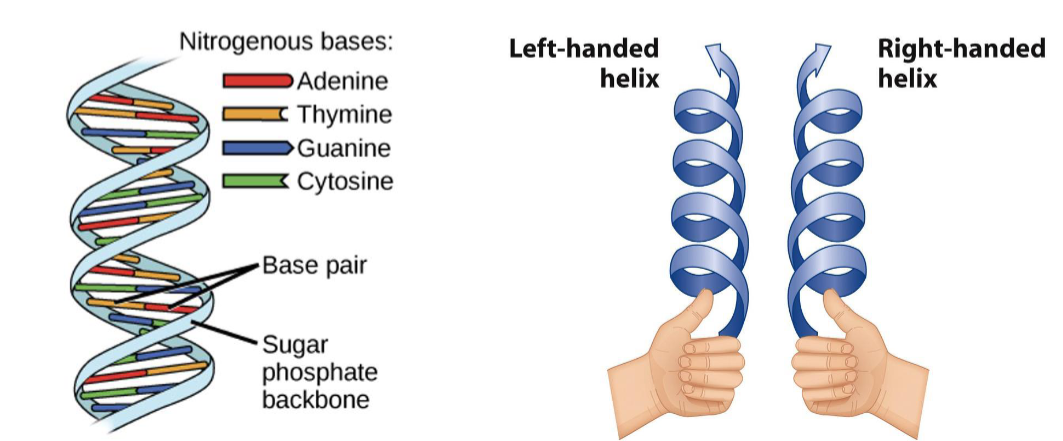
Base pairing takes place between a purine and pyrimidine on opposite strands, so that A pairs with what and G pairs with what?
Complementary base pairs:
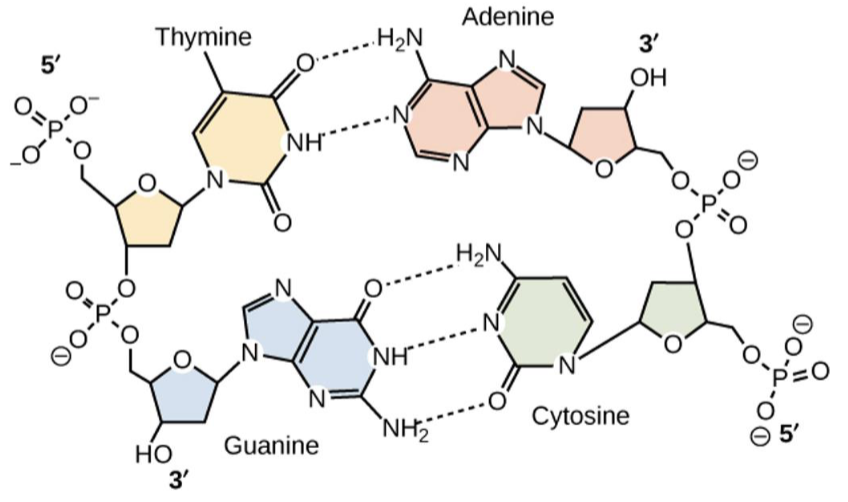
Adenine (A) and thymine (T)
Cytosine (C) and guanine (G)
Base pairs are stabilized by hydrogen bonds. How many hydrogen bonds do A and T form and C and G form?
A and T form 2 hydrogen bonds
C and G form 3 hydrogen bonds

Are the 2 DNA strands parallel or antiparallel?
antiparallel
Where on the double helix are the sugar-phosphate backbones located?
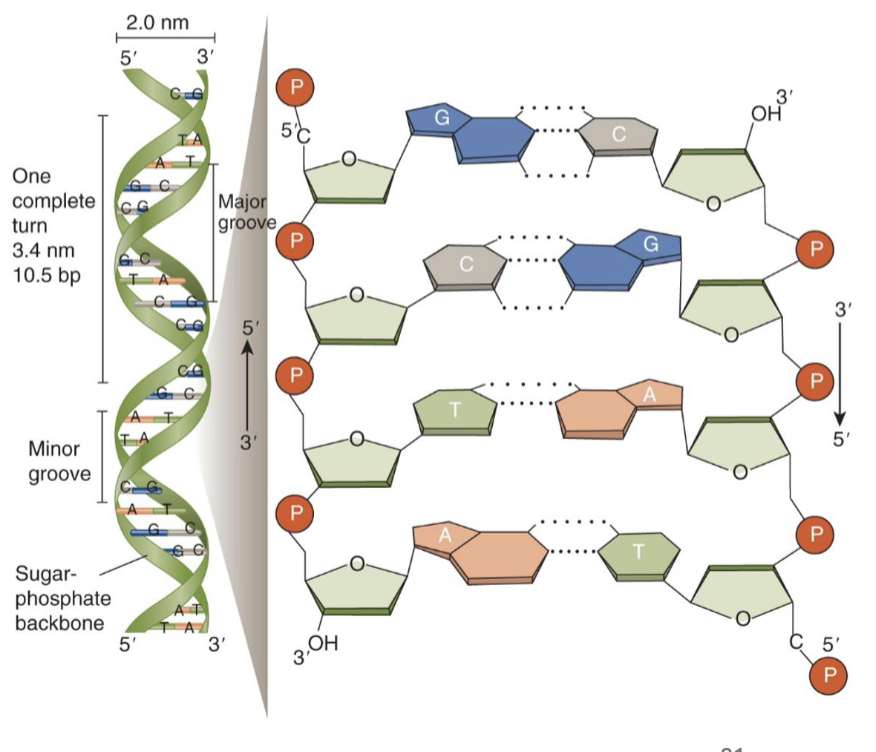
on the outside of the helix

Where on the double helix are the nitrogenous bases located?
They’re stacked on the inside; like the rungs of a ladder
What helps maintain a uniform diameter of DNA double-helix model?
Pairing of a purine with a pyrimidine (A-T or G-C)
What are the major and minor grooves?
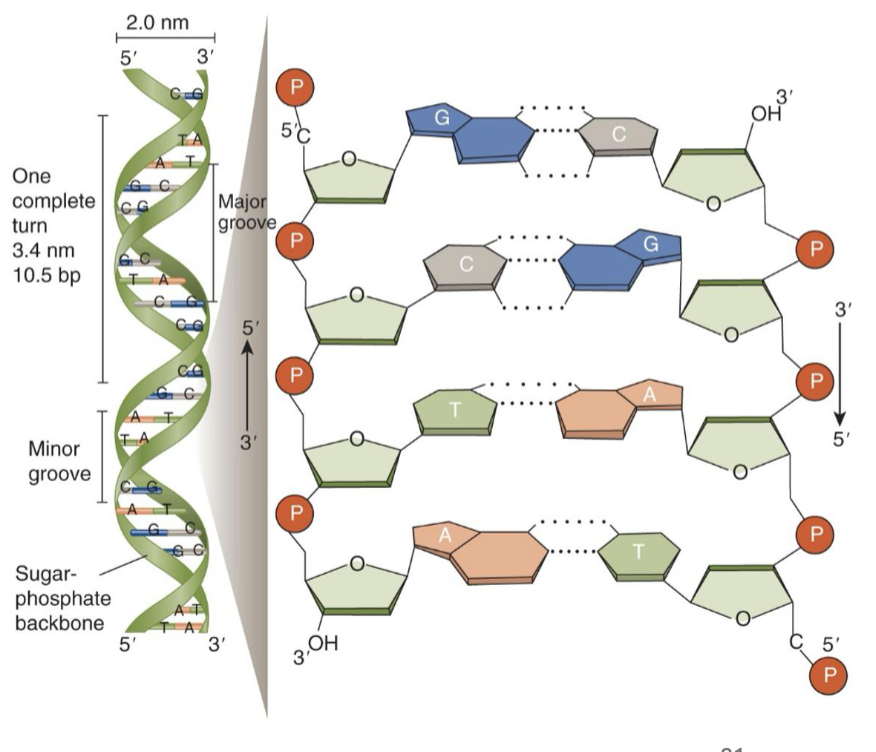
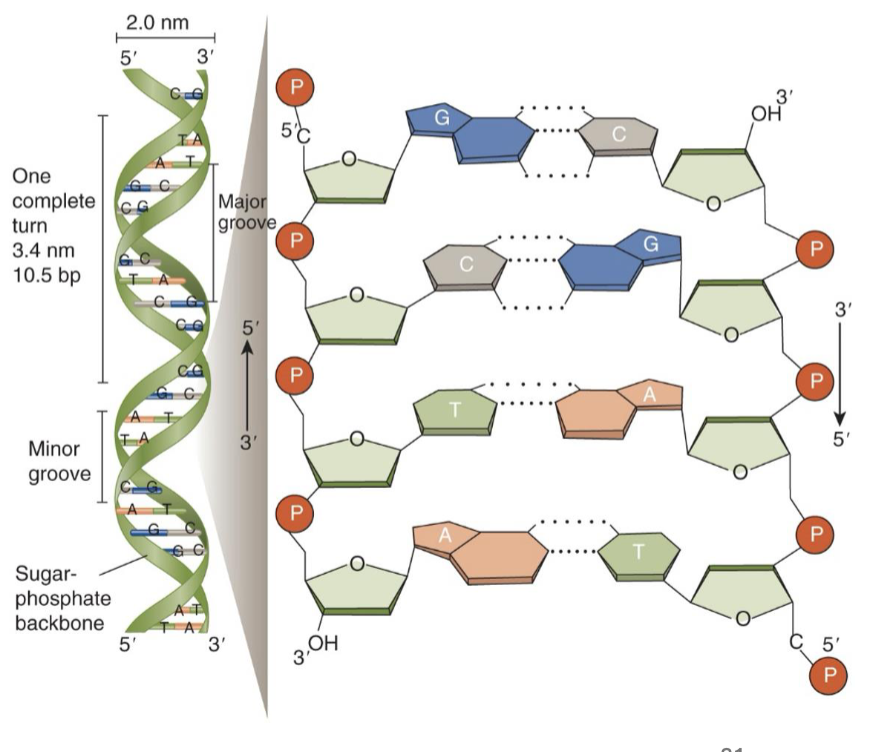
Twisting of 2 DNA strands results in the formation of uniformly spaced major and minor grooves on the sides of the helix

What function do the grooves have?
the grooves expose the edges of the bases to the external environment, making them accessible for protein binding

Where do protein-DNA interactions occur?
in the grooves

True or False: The exposed bases in the grooves create distinct chemical patterns that allow proteins to recognize specific DNA sequences without opening the double helix.
True
Which groove (major or minor) generally provides more sequence information and is a common site for sequence-specific protein binding?
major groove
denaturation
the separation of 2 DNA strands of the double helix into single strands

hyperchromic affect
Single strands absorb light at 260 nm more strongly than double strands. This effect is a consequence of the disruption of interactions among the stacked bases. The changes in absorbances allow one to easily follow the course of DNA denaturation.
Denatured duplexes can readily renature when?
the temperature is lowered below the “melting temperature” or Tm

melting temperature
The temperature at which half of the DNA strands are in duplex form. Under such conditions, the 2 strands can re-form hydrogen bonds between the complementary sequences, returning the duplex to its original state.

In most organisms, the Tm of the chromosomal DNA ranges from 85-100°C. It is possible to determine the composition of the DNA experimentally from…
its Tm because the Tm of DNA is directly proportional to the GC content of the DNA
DNA with higher GC content generally has…
a higher Tm
G-C base pairs form 3 hydrogen bonds, compared with 2 for A-T
GC-rich sequences generally have stronger base-stacking interactions
These interactions increase DNA duplex stability. More thermal energy is therefore required to separate the 2 DNA strands
Renaturation can also be called what?
hybridization or annealing
For DNA, this principle of strand separation and renaturation are important for many techniques such as…
polymerase chain reaction (PCR)
The separation and renaturation was used to assess the complexity of what…
the genome, % GC content, and similarity between sequences
How do you examine different DNA molecules?
Agarose gel electrophoresis

Agarose gel electrophoresis
a technique to separate DNA fragments based on their size as they migrate through an agarose gel under an electric field

Is DNA positively or negatively charged?
Negatively

DNA migrates toward the positively or negatively charged electrode?
positively
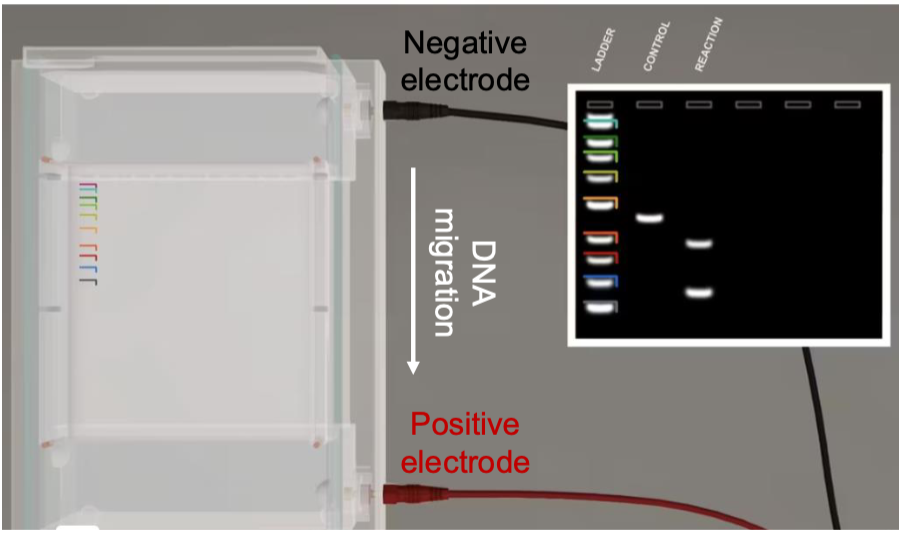
Negative and positive electrode is placed where?
Negative electrode is placed near where the sample is loaded, and positive electrode is placed on bottom

What is agarose?
A polymer with ideal pore size for separating DNA molecule is usually run horizontally.
Large DNA fragments have a difficult time navigating through the gel, whereas small DNA fragments slip through the gel quickly and easily
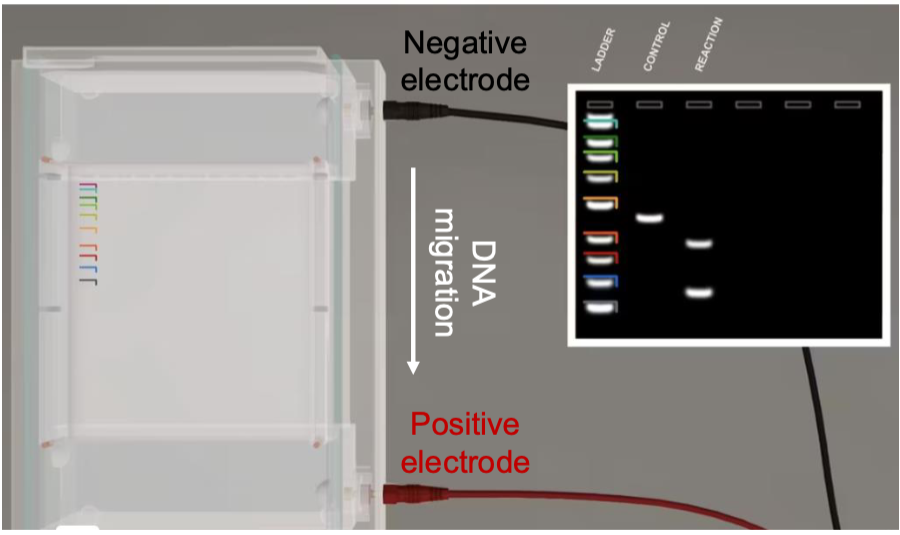
DNA in the gel can be visualized using a fluorescent dye ethidium bromide, which become fluorescent under
UV light source when it intercalates into double-stranded (dsDNA)
Reference/Control DNAs of known sizes are run where?
alongside the samples

What is the purpose of reference DNAs?
To determine the sizes of the DNA fragments in the sample
DNA fragments are reported in…
base pairs (bp) or kilobases (kb), not by their molecular weights (kDa)
genome
all of the genetic material of the cell
What is the Human Genome Project (HGP)?
International effort to sequence and map the human genome.
Provided the first reference sequence of nearly the entire human genome.
Accelerated development of DNA sequencing technologies.
Helped establish Genomics as a major field of biology.
Genomics
the comprehensive study of whole sets of genes and their interactions
Computational biology and Bioinformatics
use computational tools to analyze and organize the data in a way that helps biologists understand what the information in DNA means in the cellular context
True or False: Genome sizes vary slight among organisms.
False

Viruses, archaea, and bacteria generally have smaller or larger genomes?
smaller
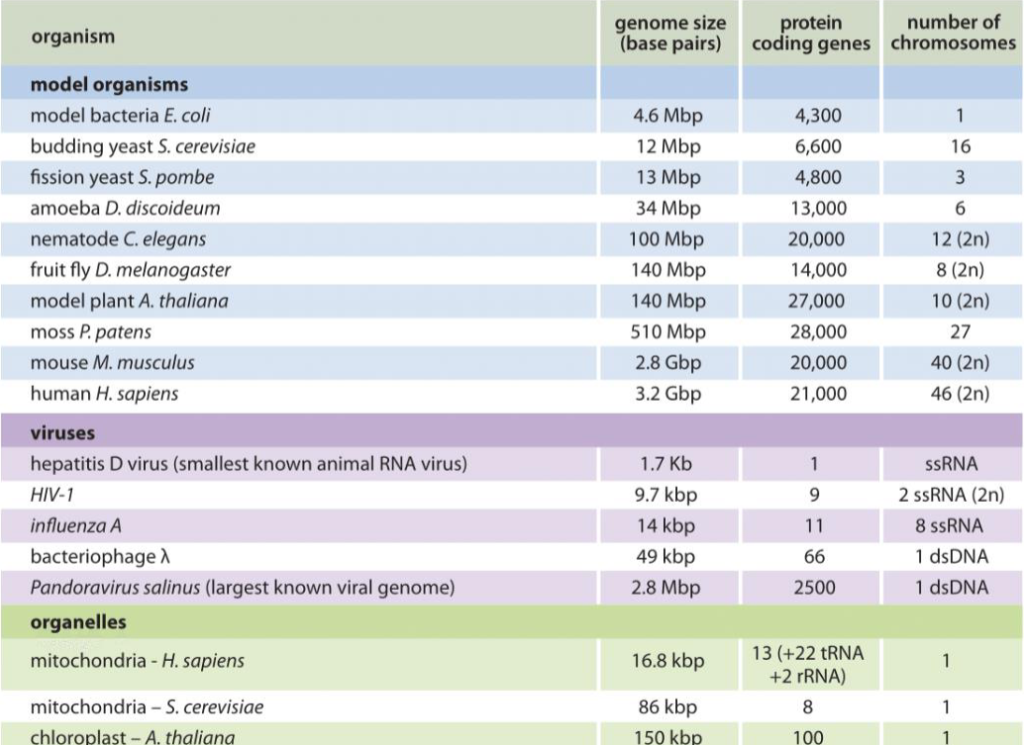
Multicellular eukaryotes generally have smaller or larger genomes?
larger

True or False: Number of genes and chromosomes vary among organisms.
True
What is all the “extra stuff” in the eukaryotic genomes?
Less than 2% of human genome consists of protein-coding DNA, while the vast majority is non-coding DNA
What are the 3 components of non-coding DNA?
Intron
Regulatory sequence
Repetitive DNA
Intron
A non-coding sequence within a gene that is transcribed into the initial RNA transcript but removed by RNA splicing before the mature RNA is produced

Regulatory sequence
specific when and to what extent a gene is expressed
each gene has one or more regulatory sequences (promoter and enhancer) that control its expression
Repetitive DNA
Repeated DNA sequences that make up a large portion of the intergenic DNA
Some contribute to chromosome structures, including centromeres and telomeres
Many of the repetitive sequences are known to be transposable elements (transposons), sections of DNA that can move around within the genome
intergenic DNA
the non-coding DNA located between genes