Development of Nervous System
 Call Kai
 Learn
Learn Practice Test
 Spaced Repetition
 Match
Match Flashcards
 Knowt Play
1/115

There's no tags or description
Looks like no tags are added yet.
Name | Mastery | Learn | Test | Matching | Spaced | Call with Kai | Chat |
|---|
No analytics yet
Send a link to your students to track their progress
116 Terms
*Don't need to know*
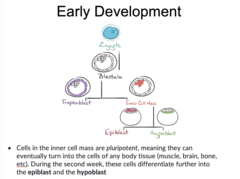
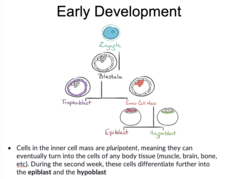
Cells in the inner cell mass are ________________, meaning they can eventually turn into the cells of any body tissue (muscle, brain, bone, etc)
Pluripotent
*Don't need to know*
During the second week of development, these cells from the inner cell mass differentiate further into the ____________ and the ________________
- Epiblast
- Hypoblast
*Don't need to know*
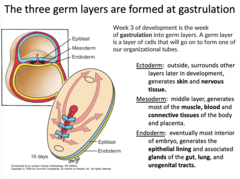
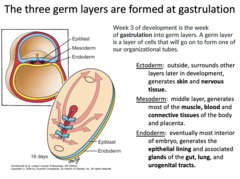
The three germ layers are formed at __________________, which is Week 3 of development
Gastrulation

What is a germ layer?
A layer of cells that will go on to form one of our organizational tubes

What are the 3 germ layers?
Ectoderm, Mesoderm, and Endoderm

What is the ectoderm and what does it generate?
- Outside
- Surround other layers later in development
- Generates skin and nervous tissue

What is the mesoderm and what does it generate?
- Middle layer
- Generates most of the muscle, blood, and connective tissues of the body and placenta

What is the endoderm and what does it generate?
- Eventually most interior of embryo
- Generates the epithelial lining and associated glands of the gut, lung, and urogenital tracts
What layer does the nervous system develop from?
Ectoderm
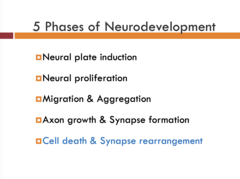
What are the five phases of Neurodevelopment?
1. Neuroplate induction
2. Neural proliferation
3. Migration and Aggregation
4. Axon growth and Synapse formation
5. Cell death and Synapse rearrangement

What is the neural plate?
Dorsal midline thickening of the ectoderm overlying the notochord (Neuroectoderm)

What is below the neural plate?
Notochord
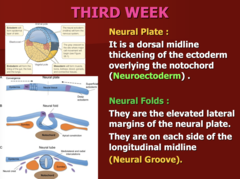
How is the neural tube formed?
- Neural plate folds from each side towards the Notochord
- Groove develops in between
- Neural folds come together and become neural tube
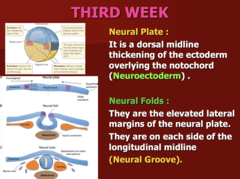
What causes inward folding of the neural plate?
Signals from the notochord

What are Neural Folds?
- Elevated lateral margins of the neural plate
- They are on each side of the longitudinal midline (Neural Groove)

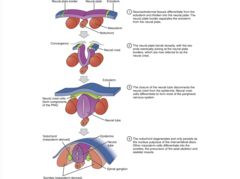
Neural Plate Induction:
1. Neuroectodermal tissues differentiate from the ________derm and thicken into the neural plate. The neural plate border separates the ________derm from the neural plate
2. The neural plate bends dorsally, with the two ends eventually joining at the neural plate borders, which are now referred to as the _____________ ____________
3. The closure of the neural tube _____________________ the neural crest from the epidermis. Neural crest cells differentiate to form most of the __________________ nervous system
4. The _________________ degenerates and only persists as the nucleus pulposus of the intervertebral discs. Other ________derm cells differentiate into the somites, the precursors of the axial skeleton and skeletal muscle
Neural Plate Induction:
1. Neuroectodermal tissues differentiate from the ectoderm and thicken into the neural plate. The neural plate border separates the ectoderm from the neural plate
2. The neural plate bends dorsally, with the two ends eventually joining at the neural plate borders, which are now referred to as the neural crest
3. The closure of the neural tube disconnects the neural crest from the epidermis. Neural crest cells differentiate to form most of the peripheral nervous system
4. The notochord degenerates and only persists as the nucleus pulposus of the intervertebral discs. Other mesoderm cells differentiate into the somites, the precursors of the axial skeleton and skeletal muscle
What germ layer is the Notochord a part of?
Mesoderm

What germ layer is the Neural plate a part of?
Ectoderm
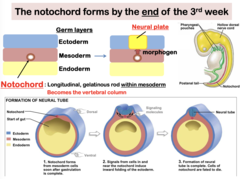
The ______________ is a longitudinal, gelatinous rod within mesoderm
Notochord
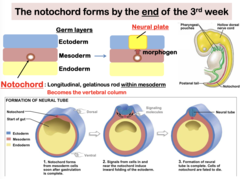
What does the Notochord eventually become?
The vertebral column

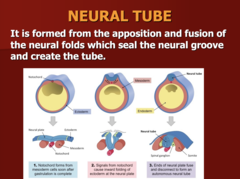
The neural tube is formed from the apposition and fusion of the neural ___________ which seal the neural ______________ and create the tube
- Neural folds
- Neural groove
*Don't need to know*
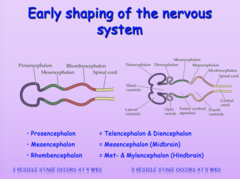
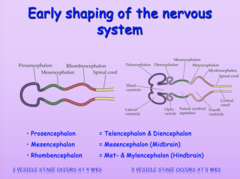
What are the three vesicle stages of the nervous system at 4 weeks?
1. Prosencephalon
2. Mesencephalon
3. Rhombencephalon

*Don't need to know*
What does the prosencephalon become at 5 weeks of nervous system development?
Telencephalon & Diencephalon

*Don't need to know*
What does the mesencephalon become at 5 weeks of nervous system development?
Mesencephalon (Midbrain)
*Don't need to know*
What does the rhombencephalon become at 5 weeks of nervous system development?
Metencephalon and Mylencephalon (Hindbrain)
What two structures of the CNS develop from the Telencephalon?
1. Cerebral hemispheres
2. Lateral ventricles

What three structures of the CNS develop from the Diencephalon?
1. Thalamus
2. Hypothalamus
3. 3rd ventricle

What two structures of the CNS develop from the Mesencephalon?
1. Cerebral aqueduct
2. Periaqueductal gray
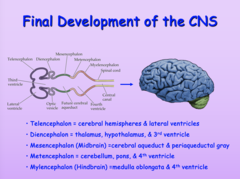
What three structures of the CNS develop from the Metencephalon?
1. Cerebellum
2. Pons
3. 4th ventricle

What two structures of the CNS develop from the Mylencephalon (hindbrain)?
1. Medulla oblongata
2. 4th ventricle

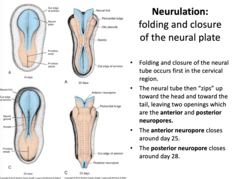
What is Neurulation?
Folding and closure of the neural plate

Neurulation:
1. Folding and closure of the neural tube occurs first in the ______________ region
2. The neural tube then "zips" up toward the head and toward the tail, leaving two opening which are ____________ and ____________ neuropores
3. The ____________ neuropore closes first around day 25
4. The ____________ neuropore closes later around day 28
Neurulation:
1. Folding and closure of the neural tube occurs first in the cervical region
2. The neural tube then "zips" up toward the head and toward the tail, leaving two opening which are anterior and posterior neuropores
3. The anterior neuropore closes first around day 25
4. The posterior neuropore closes later around day 28
Failure of neuropores to _________ can cause neural tube defects
Close

What happens if the anterior neuropore fails to close?
Anencephaly
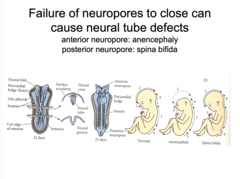
What is anencephaly?
- Lack of brain
- The fetus doesn't survive birth
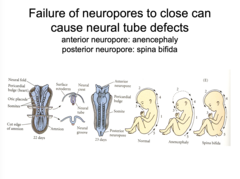
What happens if the posterior neuropore fails to close?
Spina bifida
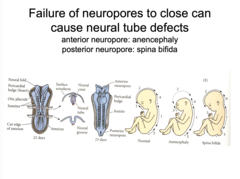
What is spina bifida?
Exposure of the spinal cord outside the vertebral column
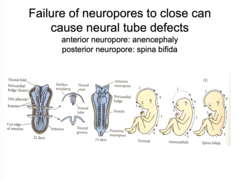
What are four forms of spina bifida?
1. Spina bifida occulta
2. Spina bifida with meningocele
3. Spina bifida with meningomyelocele
4. Spina bifida with myeloschisis
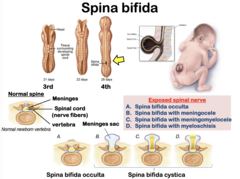
What form of spina bifida is most mild?
Spina bifida occulta

In the fourth week, the neural tube is completed and transformed into the __________ _______
Adults CNS

In the fourth week, the growth of neural tube is maximal at the rostral part, which becomes the _________
Brain

In the fourth week, the caudal portion of neural tube becomes the ____________ ________
Spinal cord

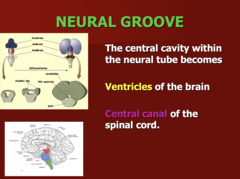
The __________ __________ is a central cavity within the neural tube
Neural groove
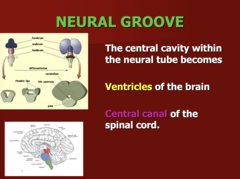
What two structures does the neural groove become?
1. Ventricles of the brain
2. Central canal of the spinal cord
____% of all neonatal congenital birth defects are neural
33%

____% of spontaneous fetal deaths are neural
75%

____% of deaths in first year of life are at least partially neural
40%

What are three causes of congenital malformations?
1. Genetic factors
2. Environmental factors
3. Combination
Environmental insults are ____________________ (________________________)
- Teratogens
- Teratogenesis

What is the time and stimulus for teratogens?
- Time: Specific
- Stimulus: Largely unknown (hundreds of teratogens)

Most development anomalies occur within the first _____ months!
First 4 months!

What is the second phase of neurdevelopment?
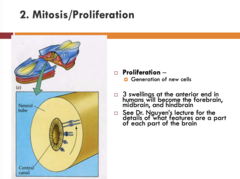
Neural proliferation
What is neural proliferation?
Generation of new cells

During neural proliferation, the three swellings at the anterior end of humans will become what three structures?
1. Forebrain
2. Midbrain
3. Hindbrain
What is the third stage of neurodevelopment?
Migration and Aggregation

What is migration (neurodevelopment)?
The slow movement to the "right place"

During migration, developing neurons only have a cell ____________ and an immature _________ at this point
- Cell body (soma)
- Immature axon

Neurons are __________________________ at the start of migration, but _______________________ begins as neurons migrate
- Undifferentiated
- Differentiation
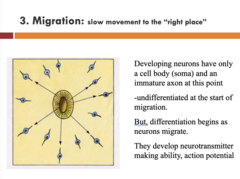
As neurons differentiate during migration, they develop __________________________-making ability, action potential
Neurotransmitter

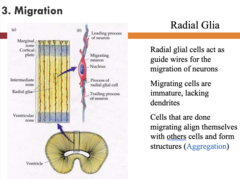
What are radial glia?
Act as guide wires for the migration of neurons

Migrating cells are immature, lacking ____________________
Dendrites

What is aggregation (neurodevelopment)?
Cells that are done migrating align themselves with other cells and form structures (aggregation)
What are growth cones?
Tips of axons on migrating, immature neurons

Growth cones crawl forward as they help _____________ the axons trailing behind them
Mature the axons

The growth cones extension is controlled by ________________ cues in their outside environment that ultimately direct the towards their appropriate targets
Chemical cues

What are the two chemical cues that direct the developing neurons to appropriate targets?
1. Chemoattractants
2. Chemorepellants

What is the fourth stage of neurodevelopment?
Axon growth and Synapse formation

During axon growth/synaptogenesis, once migration is complete and structures have formed (aggregation), __________ and __________________ begin to grow to their "mature" size/shape
- Axons
- Dendrites
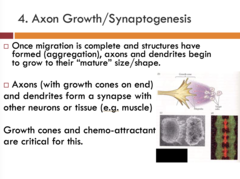
During axon growth/synaptogenesis, axons (with growth cones on end) and dendrites form a ________________ with other neurons or tissue (e.g. muscle)
Synapse

What two things are critical for axon growth/synaptogenesis?
1. Growth cones
2. Chemo-attractant

What is Synaptogenesis (neurodevelopment)?
Formation of new synapses
Synaptogenesis depends on the presence of ____________ cells - especially ___________________
- Glial cells
- Astrocytes
TRUE/FALSE
Chemical signal exchange between pre- and postsynaptic neurons is needed
TRUE

Can one neuron have more than one synapse?
Yes
What is the fifth phase of neurodevelopment?
Cell death and Synapse rearrangement
Between 40-75% neurons made will ______ after
migration - _________ is normal and necessary !!
- Die
- Death

Why do neurons die during/after the migration phase of neurodevelopment?
Neurons die due to failure to compete for chemicals provided by targets

What are the three functions of neurotrophins?
1. Promote growth and survival
2. Guide axons
3. Stimulate synaptogenesis
How does synaptic rearrangement occur?
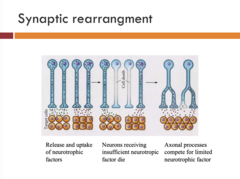
- Neurotrophic factors can help things proliferate or not
- Decides which neurons to keep and get rid of
Synaptic Rearrangment:
1. ________________ and ____________ of neurotrophic factors
2. Neurons receiving insufficient neurotropic factor _______
3. ______________ __________________ compete for limited neurotropic factor
Synaptic Rearrangment:
1. Release and uptake of neurotrophic factors
2. Neurons receiving insufficient neurotropic factor die
3. Axonal processes compete for limited neurotropic factor

Postnatal growth is a consequence of what three things?
1. Synaptogenesis
2. Increased dendritic branches
3. Myelination (prefrontal cortex continues into adolescence)

Overproduction of synapses may underlie (cause) the greater "_______________" of the young brain
"Plasiticty"

What is the significance of the greater plasticity of a young brain?
Young brain more able to recover function after injury, as compared to older brain
TRUE/FALSE
Mature brain changes and adapts
TRUE

In adult mammals, neurogenesis (birth of new neurons) is seen only in __________________ _________ and ________________________
- Olfactory bulb
- Hippocampus

TRUE/FALSE
It is not clear if neurogenesis is critical for "normal" adult behavior
TRUE

Where does the spinal cord terminate?
L1-L2

The spinal cord and the vertebral column are the same ____________ up until the third month
Same length
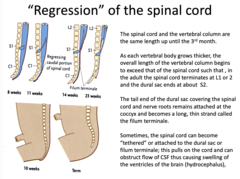
As each vertebral body grows thicker, the overall length of the vertebral column begins to _____________ that of the spinal cord such that, in the adult the spinal cord terminates at _____ or _____ and the dural sac ends at about _____
- Exceed
- L1 or L2
- S2

The tail end of the dural sac covering the spinal cord and nerve roots remains attached at the coccyx and becomes a long, thin strand called the ___________ __________________
Filum terminale
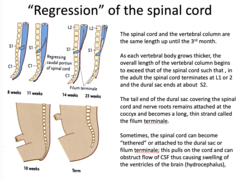
Sometimes, the spinal cord can become "tethered" or attached to the dural sac or filum terminale; this pulls on the cord and can _______________ flow of CSF thus causing ________________ of the ventricles of the brain (hydrocephalus)
- Obstruct flow of CSF
- Swelling of the ventricles of the brain (hydrocephalus)

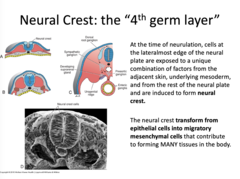
At the time of neurulation, cells at the lateral most edge of the neural plate are exposed to a unique combination of factors from the adjacent skin, underlying mesoderm, and from the rest of the neural plate and are induced to form __________ _______
Neural crest

The neural is also known as the _______ germ layer
4th germ layer

The neural crest transform from _______________ cells into ____________ _________________ cells that contribute to forming MANY tissues in the body
- Epithelial cells
- Migratory mesenchymal cells

Where are the neural crest cells in relation to the neural tube?
On top of the neural tube
Neural crest are separated cells from the apices of the neural __________
Neural folds
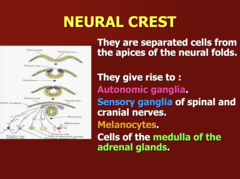
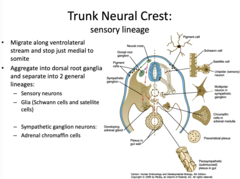
The neural crest gives rise to what four structures?
1. Autonomic ganglia
2. Sensory ganglia of spinal and cranial nerves
3. Melanocytes
4. Cells of the medulla of the adrenal glands

Cells separate from the neural _______ to form the neural ________
- Neural tube
- Neural crest
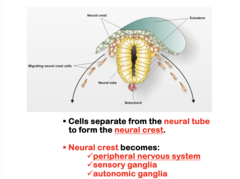
Neural crest becomes the ________________ nervous system, ___________ ganglia, and ________________ ganglia
- Peripheral nervous system
- Sensory ganglia
- Autonomic ganglia

_____________ neural crest cells migrate along ventrolateral stream and stop just medial to somite
Trunk neural crest