Mendelian Inheritance and Population Genetics
 Studied by 0 people
 Knowt Play
 Learn
Learn Practice Test
 Spaced Repetition
 Match
Match Flashcards
1/23

There's no tags or description
Looks like no tags are added yet.
Name | Mastery | Learn | Test | Matching | Spaced |
|---|
No study sessions yet.
24 Terms
List out the causes of single gene defects
missense
sickle cell
nonsense
Duchenne muscular dystrophy
RNA synthesis/processing mutation
β thalassemia
small deletions/insertion
large deletions/insertion
recombination
Duchenne muscular dystrophy
α thalassemias
unequal crossover
hemoglobin a genes
abnormal recombination
severe hemophilia A due to inversion of
coagulation factor VIII gene from exon 1 to exon 22
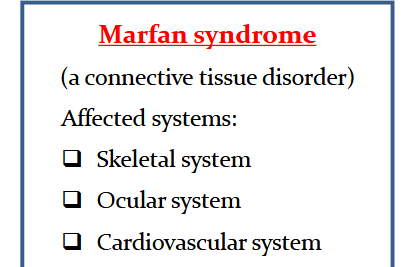
What is Pleiotropy; describe how this relates to Marfan syndrome
A single variant allele can cause more than one distinct
phenotypic trait. Expression of the distinct traits might differ from one
individual to another.
In the case of Marfan, different patients may exhibit different symptoms
Describe Penetrance vs. Expressivity
Penetrance: The probability that a variant allele has any phenotypic expression.
Expressivity: The severity of the expressed phenotype. (mild versus severe symptoms)
Describe incomplete dominance vs Codominance
Incomplete dominance: homozygotes have more severe symptoms
Codominance: At least two alleles expresses the phenotype
What is the formula to calculate inheritance probabilities
Pchild = Ppunnett X Pmother X Pfather
describe the characteristics of autosomal recessive disorder
Phenotype manifests only homozygotes
Phenotype usually manifests in siblings and not in parents or offspring
Both parents have to be at least heterozygote
Equally affects males and females (most cases)
What are factors that increase incidence of autosomal recessive disorders? Give examples
Consanguinity: Union between individuals who are second cousins or closer relatives
Founder Effect: Isolated population retains high frequency of a variant allele.
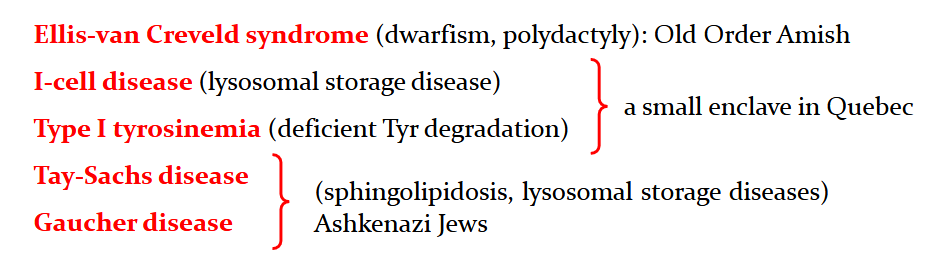
What are the four high yield autosomal recessive diseases for board?
Cystic fibrosis (chloride ion channel deficiency)
Sickle cell disease (hemoglobin mutation)
Phenylketonuria (phenylalanine metabolism deficiency)
Tay-Sachs, Gaucher diseases (lysosomal glycolipid degradation deficiencies)
describe the characteristics of autosomal Dominant disorder
The phenotype usually occurs in every generation
One parent of an affect child is usually affected (except nonpenetrant cases and new mutations)
Equally affects males and females (usually). Both sexes can transmit the disease
Frequent cause: New mutations occuring in one the patient’s gamete
Describe the pathology of Achondroplasia and its symptoms
Example of incomplete dominance
Gain of function mutation in fibroblast growth factor receptor 3
Heterozygotes
Abnormal bone growth
Short stature (limbs)
Large head, characteristic face
Usually normal intelligence
Usually normal life span
Homozygotes
More severe bone deformities
Early death
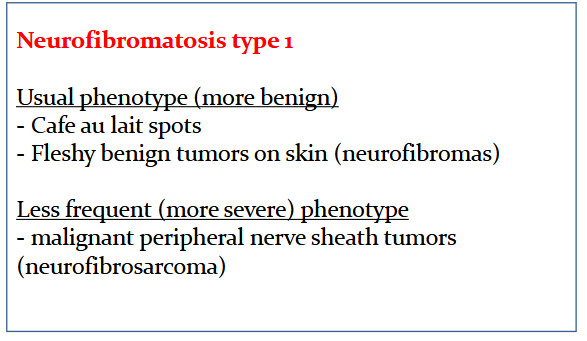
Give an example of how a disease could have different expressivity
What are Well-Known Autosomal Dominant Diseases
Familial hypercholesterolemia (LDL-receptor mutation)
Marfan syndrome (fibrillin-1 mutation)
Achondroplasia (fibroblast growth factor 3 receptor mutation)
Huntington disease (neurodegenerative disorder)
Hereditary breast and ovarian cancer
Familial adenomatous polyposis (colon cancer)
Retinoblastoma (Rb mutation)
Neurofibromatosis type 1 (NF-1 mutation)
Describe the characteristics of X-Linked Recessive Disorders
Much higher incidence in males
Heterozygote females might be affected depending on the pattern of X-linked inactivation
No male-to-male transmission
Daughters of an affected father are obligate carriers
Isolated cases can be caused by new mutations
explain how females could exhibit symptoms of a X-linked recessive disease despite having one normal allele
if the normal allele is inactivated during X-inactivation, then the female will express only the variant allele in some of her cells (mosaicism) and will have the phenotype (usually less severe)
What are well known X-linked recessive disorders
Hemophilia A and B (coagulation factor VIII and IX deficiency)
Glucose-6-phosphate dehydrogenase deficiency (acute hemolytic anemia)
Ornithine transcarbamoylase deficiency (urea cycle)
Duchenne muscular dystrophy (dystrophin gene defects)
Describe the characteristics of X-linked Dominant Disorders; What are the best known X-linked dominant disorders?
There is no male-to-male transition
The daughter of an affected male will be affected
Affected females can transfer the disease to sons and daughters
About twice as frequent in females than males
In affected females, some cells inactivated the mutant gene
(mosaicism), so the females havemilder symptoms
The best-known X-linked dominant diseases are Rett syndrome,
Fragile X syndrome and the vitamin D resistant rickets.
Describe the symptoms of Rett Syndrome
X-linked Dominant Disorder
Developmental stagnation
Intellectual disability
Characteristic flapping movements of the hand
Females probably survive this condition because of X inactivation
What is Psuedoautosomal Inheritance and how can they occur
Inheritance of variant alleles in the pseudoautosomal regions of the sex chromosomes (Xp and Yp)
Meiotic recombination can occur between the pseudoautosomal regions on the X and Y chromosomes
differentiate between somatic and germline mosaicism
Somatic: (after conception)
Can affect large segments of the body (segmental neurofibromatosis)
The cause of sporadic cancers
Cannot be inherited (a single affected individual in pedigrees)!!
Germline: (mosaic gametes)
Produced in germline during development
Can be inherited (the disease is passed down in the pedigree)
The same mutation in two children from the same father but
different women.The father does not have the mutation in his somatic cells.
The father must have germline mosaicism.
Define Carrier Frequency; How do we calculate it?
the portion of the population that are heterozygous for an autosomal
recessive trait.

What are the conditions for Hardy-Weinberg Law
population large and random mating
allele freq. is constant because
no selection
departing individuals from population have similar allele freq. than original population
no significant rate of new mutations in population
What is the Hardy-weinberg law
p2 : 2pq: q2 ; P + Q = 1
p2 is the frequency of the genotype homozygous for the P allele
2pq is the frequency of the heterozygotes
q2 is the frequency of the genotype homozygous for the Q allele
Explain how to do weinberg-calculation for X-linked disease
Males: The frequency of the mutant allele in males (q) equals the disease frequency
Females
X-linked recessive: q + q2 ≈ q (q2 << q). Disease frequency equals affected male frequency (q).
X-linked dominant: Affected total frequency: q + 2q = 3q. Twice as many females (2q) than males (q) are affected.
Explain how the Hardy-Weinberg Law could deviate
stratificatoin
Subgroups in a population tend to mate within the subgroup
Assortative Mating
Choice of the mate is based on a particular trait
Consanguinity and inbreeding
Mating between related individuals
Mating within genetic isolates (for cultural, geographical, or religious reasons)
Impaired reproductive fitness
The variant allele causes infertility, reduced fertility, or death before reproductive age
Genetic Drift
Random (non genetic) changes in a small population change allele frequencies
Migration and gene flow
Changing of allele frequencies in mixing populations
Heterozygote advantage
Positive evolutionary selection for a heterozygote genotype as in how SIckle Cell protects against malaria