Dairy Heifer Production
 Call Kai
 Learn
Learn Practice Test
 Spaced Repetition
 Match
Match Flashcards
 Knowt Play
1/84

There's no tags or description
Looks like no tags are added yet.
Name | Mastery | Learn | Test | Matching | Spaced | Call with Kai | Chat |
|---|
No analytics yet
Send a link to your students to track their progress
85 Terms
what type of calves are sold as bobby calves
- calf born from a difficult calving event
- cross-bred calf born late in the calving period
- jersey-cross bull calf
Age at which replacement heifers enter the milking herd
Around 2 years of age (22 months)
Fate of Friesian bull calves on dairy farms
Sold at 4 days old to calf rearers for beef
will be kept as entire males and finished as bulls in the beef industry.
Calves can either be sold directly from a dairy farmer to a calf rearer or indirectly through the saleyards.
Fate of Jersey bull calves on dairy farms
Bobby Calves- sent off to be slaughtered after 4 days of age
Fate of beef-cross bull calves on dairy farms
Sold at 4 days old to calf rearers for beef
Castrated
Definition of a bobby calf
An unwanted dairy calf sent off to be slaughtered after 4 days of age
what are the 8 requirements of transporting a young calf
4 days old, ears up and eyes bright, correct ear tag, dry navel, no scours, firm and worn hooves, standing and walking, full tummy - but no antibiotic milk.
Economic returns in calf rearing systems is determined based on:
Difference between purchase and sale price and the cost of milk and meal per calf
So the purchase price, sale price, and feed costs
Largest stomach compartment of a calf at birth
The abomasum
Function of the oesophageal groove
Directs milk past the rumen directly into the abomasum
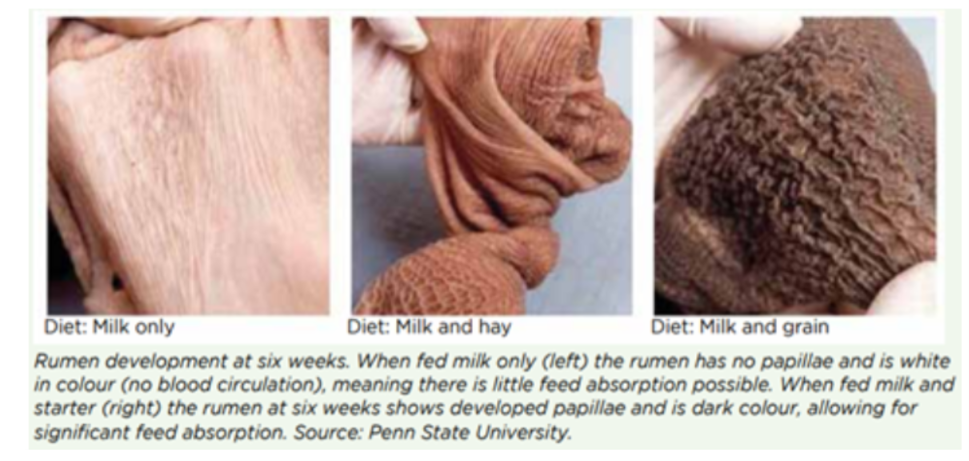
Primary stimulus for rumen development
Eating dry feed (hay, straw, concentrates)
Describe dairy calf digestion during the transition phase, and when this phase occurs.
The transition phase is when the rumen begins to take over the main digestion of feed.
This occurs between four and eight weeks of age
Describe dairy calf digestion during the ruminant phase, and when this phase occurs.
The ruminant phase is when dry feed is the sole source of feed (no more milk).
This at approximately six to eight weeks of age, and calves typically achieve full rumen development by 12 weeks of age.
Age at which a calf's rumen is fully developed
Around 12 weeks
Typical housing duration for newborn dairy calves
1 to 6 weeks
Between 1-6 weeks of age what should dairy calves be offered?
Housed indoors
Taught to drink from a milk feeder
Offered straw/hay and concentrate feed
Between 6-10 weeks of age what should dairy calves be offered?
Outside but provided shelter.
Fed milk (at this point they will be strong enough to feed unaided from a milk feeder)
Offered concentrate
After 12 weeks/weaning what should dairy calves be offered?
High quality pasture
Typical weaning age for dairy calves
Around 10 to 12 weeks
Definition of colostrum
The first milk produced after calving
Essential component of colostrum for passive immunity
IgG antibodies
Reason newborn calves strictly require colostrum
They are born with an immature immune system
Timeframe when the calves gut closes/becomes unable to absorb antibodies?
About 24 hours after birth
What are the 3 Qs of colostrum feeding
Quickly, Quantity, Quality
Quickly (provide colostrum ideally in first 6-12 hours), quantity(provide enough colostrum: 10% of their body weight in two bouts), quality (needs high IgG content, use first milking colostrum, with BRIX score 22% or higher)
Target timeframe for first colostrum feed
Within 6 to 12 hours of birth
Colostrum quantity requirement in the first 12 hours
10% of the calf's body weight
Reason first day's colostrum must be split into two feeds?
The abomasum only holds about 1.5 to 2 L
Target IgG intake weight in the first 24 hours
More than 100 g IgG
Brix refractometer reading indicating good-quality colostrum
22% or higher
What colostrum will have the highest IgG content?
Colostrum harvested from a cow's first milking
Five consequences of Failure of Passive Transfer (when the calve hasn’t received sufficient amount and quality of colostrum)
More scours, disease, mortality, poor growth, lower lifetime performance
Reason calves require milk or milk replacer early in life
Their rumen is not developed enough to digest pasture
Definition of transition milk
Milk produced during days 2 to 4 after calving
It is not high enough in IgG to be used as colostrum for calves in their first 24 hours of life, but it can be used for feeding older calves.
Reason transition milk is unsuitable for the first feed
It contains too little IgG
it is not high enough in IgG to be used as colostrum for calves in their first 24 hours of life, but it can be used for feeding older calves.
Reason antibiotic milk cannot be fed to bobby calves
It leaves illegal antibiotic residues in the meat
Most commonly used milk replacer
Whole milk powder
Cheaper milk replacer associated with higher calf losses
Whey milk powder
Two main purposes of concentrate feeding
Stimulate rumen papillae development and increase growth rate
Key characteristics of the restricted milk system
~5 L milk/day, 10-12 weeks, faster ruminant development as more pasture is consumed.
Key characteristics of the unrestricted milk system
~8 L milk/day, 6 weeks, slower rumen development (restricted as solid feed intake is minimal)
Key characteristics of the restricted milk + meal system
2-3 L milk/day for 6 weeks, access to pasture and meal from week, popular with rearers (who don’t have direct access to the mothers milk- making milk more expensive)
Purpose of an all-in/all-out housing dairy calf system
To reduce disease transmission between different age groups
What are the 3 main bedding options used in calf housing in NZ?
woodchips, river stones, and slats
these provide warm, dry bedding
Two temporary identification methods used in the paddock when calves are born
Numbered necklaces and spray paint
Once the calves in the calf shed what permanent identification method is used for dairy calves?
Ear tags (visual ID +NAIT)
Reason calves are disbudded
To prevent horn growth and reduce injury risk (to handlers and other livestock).
Criteria for weaning calves off milk
When the rumen can support a forage-only diet(occurs at 10-12 weeks)
Target weaning weight for a Jersey calf
70 kg
Target weaning weight for a Friesian-Jersey cross calf
80 kg
Target weaning weight for a Friesian calf
90 kg
What are some of the welfare and social license issues related to calves born on dairy farms?
Calves are removed from their moves with 24 hours of life meaning their is little opportunity for bonding.
The bobby Calve industry (excess calves transported at 4 days old for slaughter).
What is a staggered approach to weaning calves?
Calves are weaned when they reach a minimum target weight, but are continued to be fed concentrates until they reach a second target weight.
Do bobby calves need NAIT tags.
No, this is not a requirement (calves sent to the works less than 30 days old are exempt from the legal requirement and bobby calves are typically sent at 4 days old)
Dairy calves are commonly offered concentrate feed what range?
0.5-1.5kg
Why feed hay if it has low nutritional value for young calves?
It provides physical scratch factor to stimulate rumen development
Stomach compartment that is largest at weaning
The rumen
Which dairy calves require colostrum?
All calves (regardless of breed or eventual destination- I.e. including bobby calves)
Genetic method to reduce the need for disbudding
Use polled beef genetics
What is the primary antibody class in cow colostrum?
IgG
Why does gut closure happen at 24 hours?
The calf's intestine stops absorbing intact large antibody molecules
What occurs if a calf is fed cold colostrum?
Poor absorption of antibodies and potential digestive upset
Minimum age for legal transport of bobby calves
4 days old
State of navel required for legal transport
Must be completely dry
How does concentrate feed help develop rumen papillae?
Fermentation of grain produces butyrate, stimulating papillae growth
Why is draught-free housing critical at calf level?
Draughts cause cold stress and increase disease susceptibility
Why is wet bedding harmful to calves?
It conducts heat away, causing cold stress and harboring pathogens
At what age are dairy heifers first mated and when do they first calve/join the milking herd?
Mated at 13-15 months, and join the milking herd at 22 months.
Why must newborn calves be fed colostrum 'Quickly'?
Antibody absorption efficiency drops rapidly every hour after birth
what are the key features of shed design
- good ventilation
- no draughts at bedding level
- warm, dry bedding (wood chips, river stones, slats)
- troughs and feeders are visible and accessible to calves
Why are small undergrown heifers undesirable?
They are less likely reach puberty before the start of mating.
Have lower conception rates.
Empty heifers may be culled or carried over until mating the following year, a significant cost.
Will not produce as much milk during their lifetime as well-grown heifers, and are culled earlier.
Higher heifer replacement rates coming at a cost to the farm.
What are the 30-60-90 percentage targets in dairy heifer production
-30% of mature weight at 6 months
-60% of mature weight at 15 months (mating)
-90% of mature weight at 22 months (first calving)
What percentage of their mature body weight should heifers be at 6 months old?
30% of mature weight at 6 months
-60% of mature weight at 15 months (mating)
-90% of mature weight at 22 months (first calving)
What percentage of their mature body weight should heifers be at first calving/22 months old?
30% of mature weight at 6 months
60% of mature weight at 15 months (mating)
90% of mature weight at 22 months (first calving)
What percentage of their mature body weight should heifers be at 6 months old?
30% of mature weight at 6 months
60% of mature weight at 15 months (mating)
90% of mature weight at 22 months (first calving)
What is likely to happen if heifers do not reach their target weights before mating? and what options are there to increase their live weights before matings?
If heifers are below the target weight before mating:
They are less likely to be cycling properly, as puberty is weight-dependent
This leads to lower conception rates and delayed pregnancy
More heifers will calve late or may need to be culled if empty
Even if they get in calf, they will likely produce less milk and not last as long in the herd
Options to remedy include reallocating pasture to prioritise heifers, using supplementary feed and implementing a leader/follower grazing system (where the lighter heifers graze the paddock before the heavier ones).
Broken shoulders occur in how many dairy heifers per year
5,000
What three methods can be used for setting liveweight targets for a mob of heifers?
1. based on established breed targets
2. based on the average mature weight of the herd
3. using the BV for liveweight
How do broken shoulders occur in first-calving dairy heifers
Due to a spontaneous humeral fracture. This occurs due to from restricted growth due to poor feeding, causing growth arrest lines, a lack of collagen, and the development of osteoporosis in bones
When grazing perennial ryegrass/white clover pasture, heifers need to be fed better than dairy cows. What management practices can dairy farmers use to ensure this occurs?
1. Feeding them on similar or slightly lower pre-grazing covers compared to dairy cows.
On long pastures, they will have a high wastage rate, and if forced to continue to graze down, their growth rates will suffer.
2. Graze down to higher post-grazing residuals than dairy cows
This will allow them to selectively graze the higher quality leafy material and should result in them consuming fewer internal parasites, which are located at the base of the sward. Remembering that young stock are particularly vulnerable to internal parasites and will display reduced growth rates when suffering from a high parasite burden.
3. Use older livestock to tidy up residuals and maintain quality.
The use of old pasture, which is high in fibre, will result in low growth rates (max 0.5 kg/day).
what is a horn bud in a calf
it is a discrete area of horn-producing tissue that has not yet formed a mature horn
Why are farmers are asked to fast calves on the day of horn bud disbudding (which involves sedation)?
Sedation can diminish the gag reflex.
The gag reflex helps protect them from inhaling regurgitated acidic stomach contents.
Feeding increasing the risk of regurgitation and thus aspiration.
Which nerve needs to be blocked to abolish sensation to the horn bud during disbudding
cornual nerve (a branch of the trigeminal nerve which provides sensory information to the face)
what cranial nerve is the cornual nerve a branch of
trigeminal nerve (CN V)
What cranial nerve is the auriculopalpebral nerve a branch of
facial nerve (CN VII)
Why is it considered best practice to administer the NSAID prior to cauterisation of the horn buds?
It preemptively blocks the inflammatory pathways before tissue damage occurs. The intense tissue trauma from burning causes continuous barrage of pain impulses and can lead to a heightened state of sensitivity, making even minor post-operative touches intensely painful. Giving an NSAID beforehand reduces initial inflammation, preventing this "wind-up" from occurring.