Anatomy L5-Lower Limb: Tibia and Fibula - Bones & Joints

0.0(0)
Studied by 3 people
call kaiCall Kai
Locked
learnLearn
examPractice Test
spaced repetitionSpaced Repetition
heart puzzleMatch
flashcardsFlashcards
GameKnowt Play
Card Sorting

1/22

flashcard set

Earn XP

Description and Tags

Last updated 10:51 AM on 12/29/23
Name
Mastery
Learn
Test
Matching
Spaced
Call with Kai
Chat

No analytics yet

Send a link to your students to track their progress

23 Terms
1
New cards
<p>Which is tibia and which is fibula? Describe general structure:</p>

Which is tibia and which is fibula? Describe general structure:

A: Tibia:

  • lies medially

  • proximally more expanded

  • articulates proximally with femur

B : Fibula:

  • lies laterally

  • doesn’t articulate proximally with femur
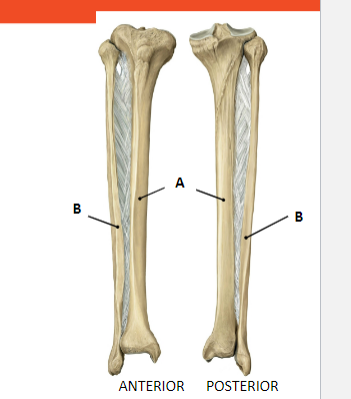
<p>A: Tibia: </p><ul><li><p> lies medially</p></li><li><p>proximally more expanded</p></li><li><p>articulates proximally with femur</p></li></ul><p>B : Fibula: </p><ul><li><p>lies laterally </p></li><li><p>doesn’t articulate proximally with femur</p></li></ul>
2
New cards
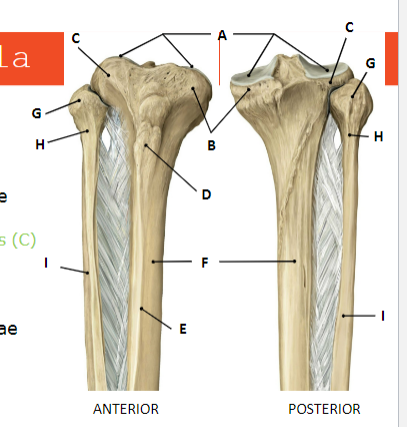
<p>Name each structure of Tibia and Fibula (proximal extremity) from A - I : </p>

Name each structure of Tibia and Fibula (proximal extremity) from A - I :

TIBIA:

A: Tibia Plateu

B: Condylus Medialis

C: Condylus Lateralis

D: Tuberositas Tibiae

E: Margo Anterior

F: Corpus Tibiae

FIBULA:

G: Caput Fibulae

H: Collum Fibulae

I: Corpus Fibulae
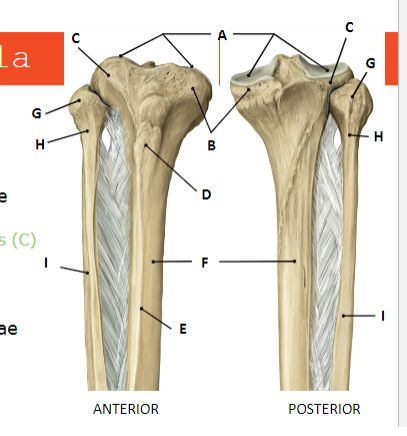
<p><strong>TIBIA:</strong></p><p>A: Tibia Plateu</p><p>B: Condylus Medialis</p><p>C: Condylus Lateralis</p><p>D: Tuberositas Tibiae</p><p>E: Margo Anterior</p><p>F: Corpus Tibiae</p><p><strong>FIBULA:</strong></p><p>G: Caput Fibulae</p><p>H: Collum Fibulae</p><p>I: Corpus Fibulae</p>
3
New cards
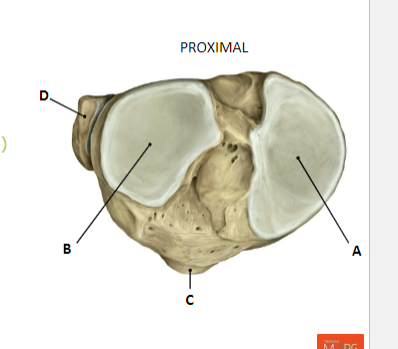
<p>What is the name of the structures? (Proximal Extremity)</p>

What is the name of the structures? (Proximal Extremity)

TIBIA:

(tibia plateau = proximal view)

A:Condylus medialis

B: Condylus Lateralis

C:Tuberositas Tibiae

FIBULA:

D: Caput Fibulae
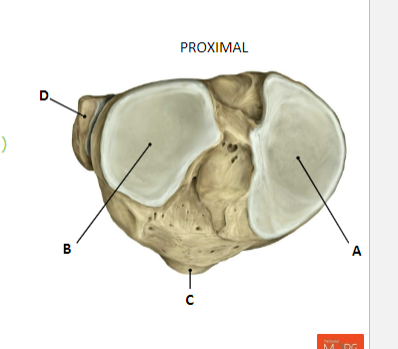
<p><strong>TIBIA:</strong></p><p><strong>(</strong>tibia plateau = proximal view<strong>)</strong></p><p>A:Condylus medialis</p><p>B: Condylus Lateralis</p><p>C:Tuberositas  Tibiae</p><p><strong>FIBULA:</strong></p><p>D: Caput Fibulae</p>
4
New cards
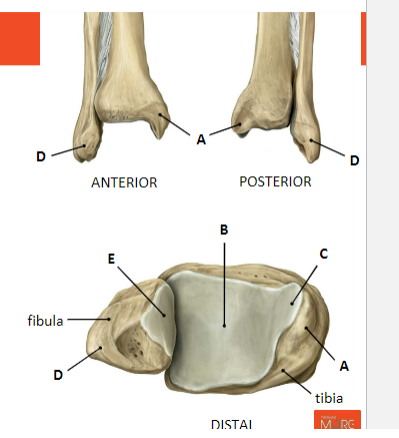
<p>What is the name of the structures? (Distal Extremity)</p>

What is the name of the structures? (Distal Extremity)

TIBIA:

A: Malleolus Medialis

B: Facies Articularis inferior

C: Facies Articularis malleoli medialis

FIBULA:

D: Malleoli Lateralis

E: Facies Articularis Malleoli lateralis
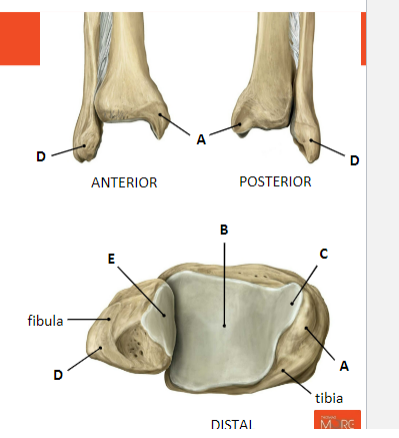
<p><strong>TIBIA: </strong></p><p>A: Malleolus Medialis </p><p>B: Facies Articularis inferior</p><p>C: Facies Articularis malleoli medialis</p><p><strong>FIBULA:</strong></p><p>D: Malleoli Lateralis</p><p>E: Facies Articularis Malleoli lateralis</p>
5
New cards
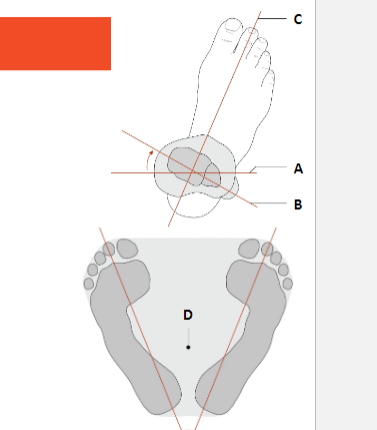
<p>What is the physiological torsion of the tibia, and how does it affect the orientation of the foot's longitudinal anatomic axis?</p>

What is the physiological torsion of the tibia, and how does it affect the orientation of the foot's longitudinal anatomic axis?

The physiological torsion of the tibia refers to the angle between the superimposed transverse axes of the upper tibia (A) and the lower tibia (B), which is approximately 23°. This angle causes the longitudinal anatomic axis of the foot (C) not to lie in the sagittal plane. As a result, when the upper tibia is directed forward, the toes point outward.
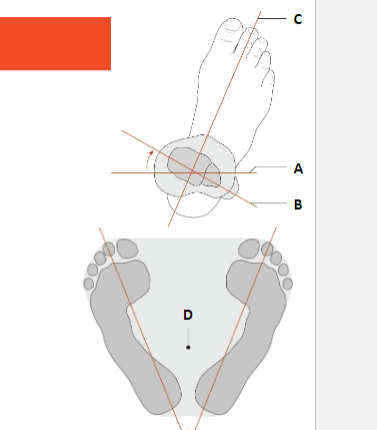
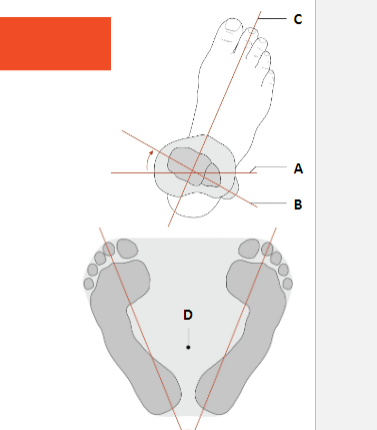
<p>The physiological torsion of the tibia refers to the angle between the superimposed transverse axes of the upper tibia (A) and the lower tibia (B), which is approximately 23°. This angle causes the longitudinal anatomic axis of the foot (C) not to lie in the sagittal plane. As a result, when the upper tibia is directed forward, the toes point outward.</p>
6
New cards
<p>Explain the angle between the superimposed transverse axes of the upper tibia (A) and the lower tibia (B) and its significance in the stability of bipedal standing.</p>

Explain the angle between the superimposed transverse axes of the upper tibia (A) and the lower tibia (B) and its significance in the stability of bipedal standing.

The angle between the superimposed transverse axes of the upper tibia and the lower tibia is approximately 23°. This angle is significant in improving the stability of bipedal standing by placing the line of gravity (D) close to the center of the area of support.
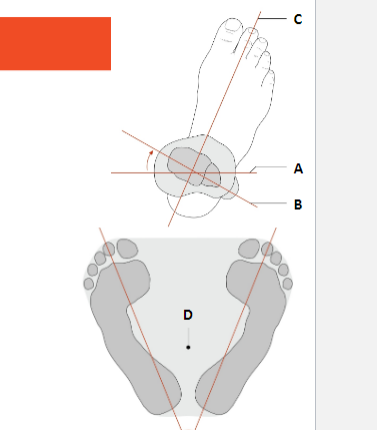
<p>The angle between the superimposed transverse axes of the upper tibia and the lower tibia is approximately 23°. This angle is significant in improving the stability of bipedal standing by placing the line of gravity (D) close to the center of the area of support.</p>
7
New cards
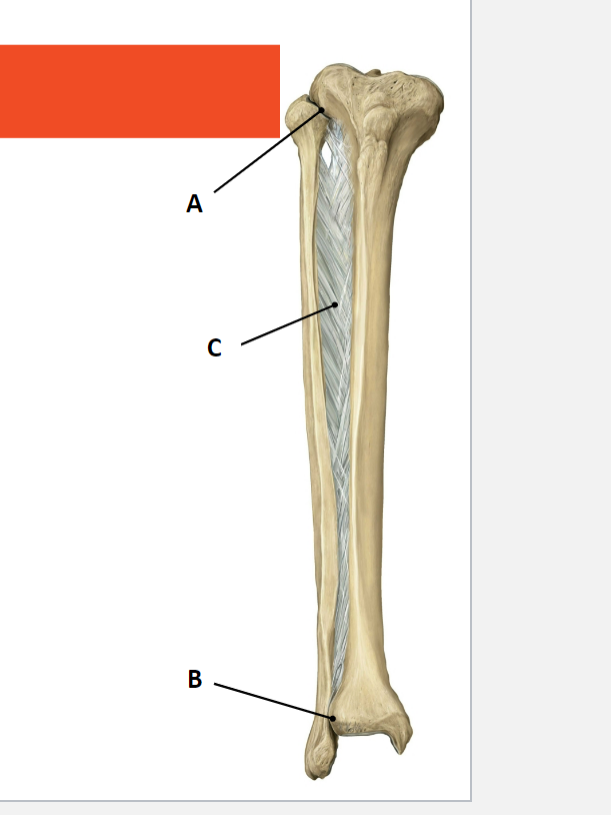
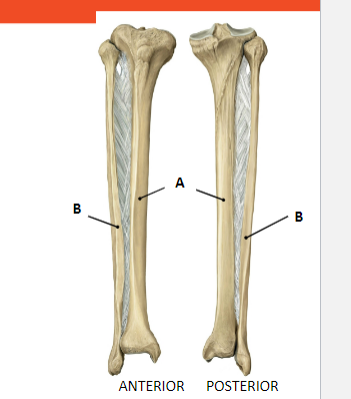
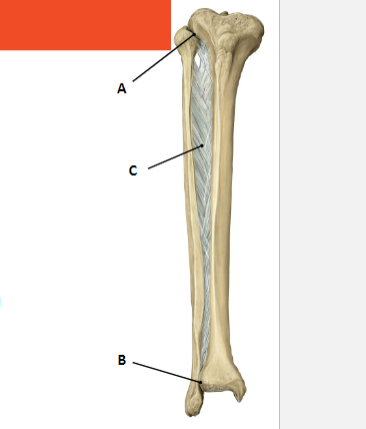
<p>Name the joint structures between the Tibia and Fibula: </p>

Name the joint structures between the Tibia and Fibula:

A: art. tibifibularis (Proximal by means of amphiarthrosis)

B: Tibiofibularis Syndesmosis (Distally by means of synarthrosis (connective tissue))

C: Membrana Interossea crusis
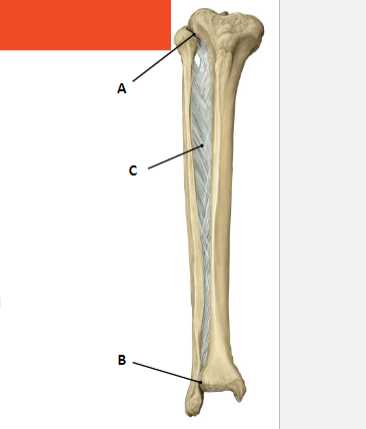
<p>A: art. tibifibularis (Proximal by means of amphiarthrosis)</p><p>B: Tibiofibularis Syndesmosis (Distally by means of synarthrosis (connective tissue))</p><p>C: Membrana Interossea crusis </p>
8
New cards
<p>Describe the structure of C: </p>

Describe the structure of C:

C is membrana interossea crusis:

  • sheet of tough connective tissue

  • serves as an origin for several muscles in the leg

  • stabilises the ankle mortise together with the tibiofibilar syndesmosis
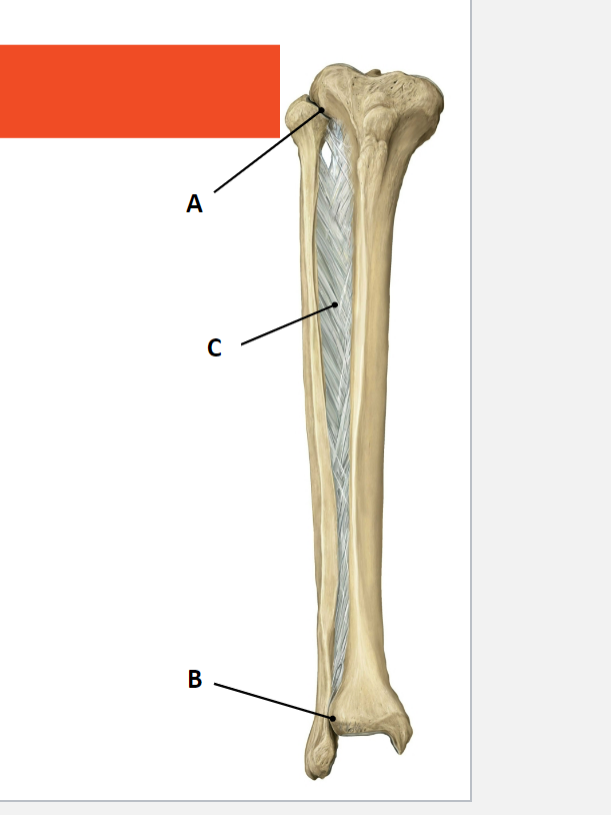
<p>C is membrana interossea crusis:</p><ul><li><p>sheet of tough connective tissue</p></li><li><p>serves as an origin for several muscles in the leg</p></li><li><p>stabilises the ankle mortise together with the tibiofibilar syndesmosis</p></li></ul>
9
New cards
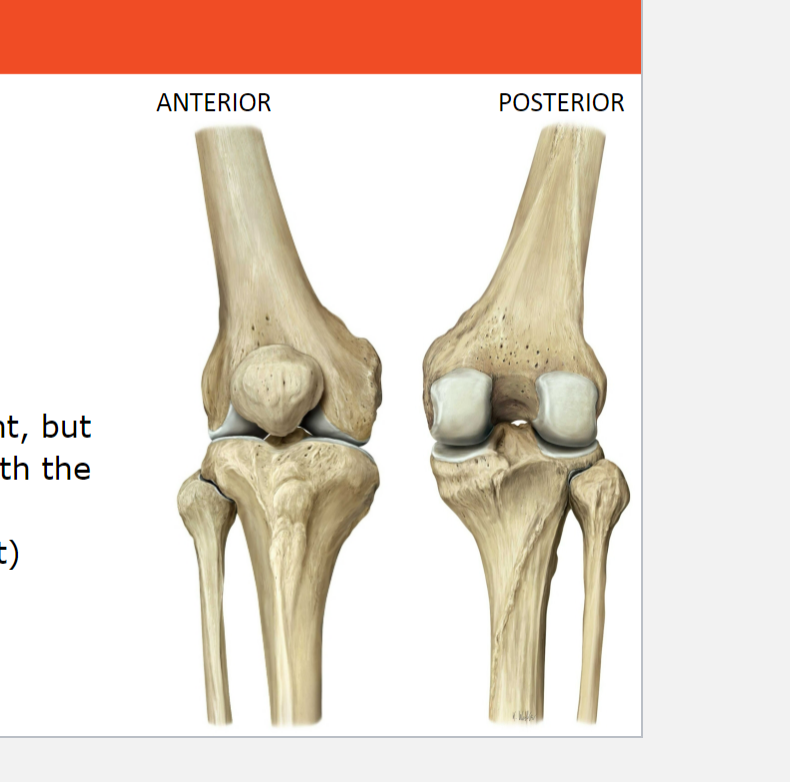
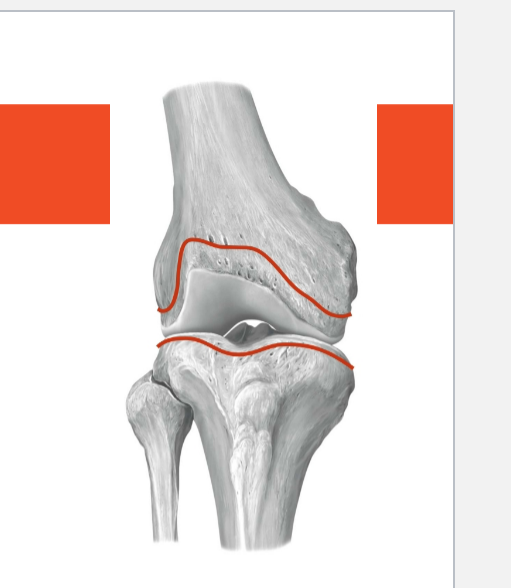
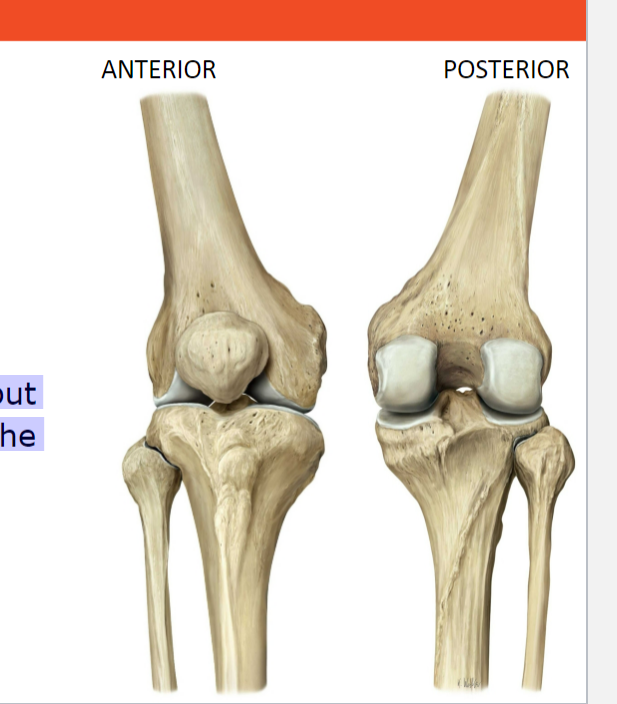
<p>What is the joint in the picture? What are the two parts of the knee joint, and what specific articulations do they involve?</p>

What is the joint in the picture? What are the two parts of the knee joint, and what specific articulations do they involve?

The joint is art. Genus or Knee joint. The two parts of the knee joint are the art. femorotibialis, which involves the articulation between the femur and tibia, and the art. femoropatellaris, which involves the articulation between the femur and patella.
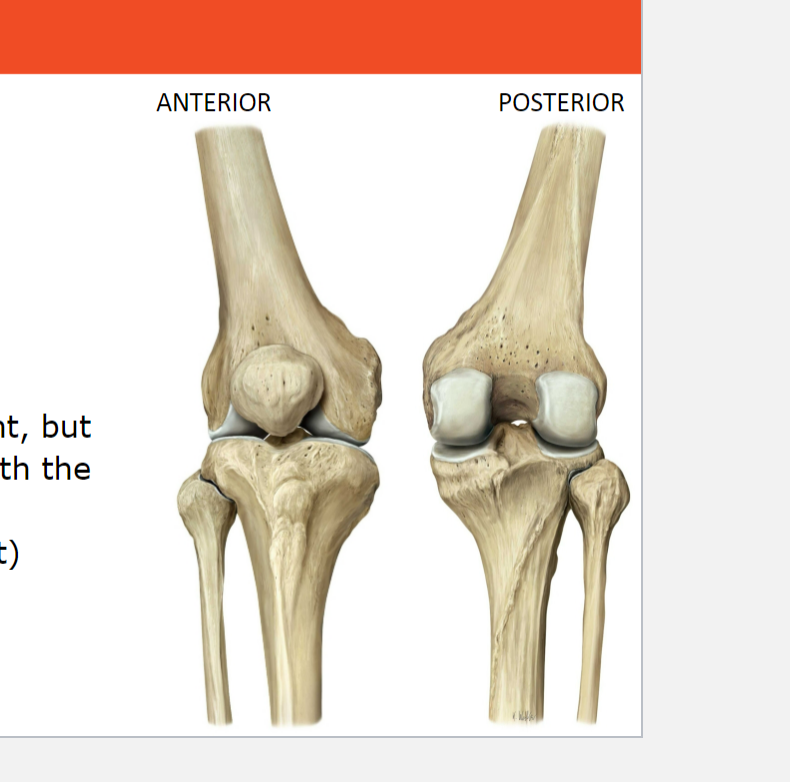
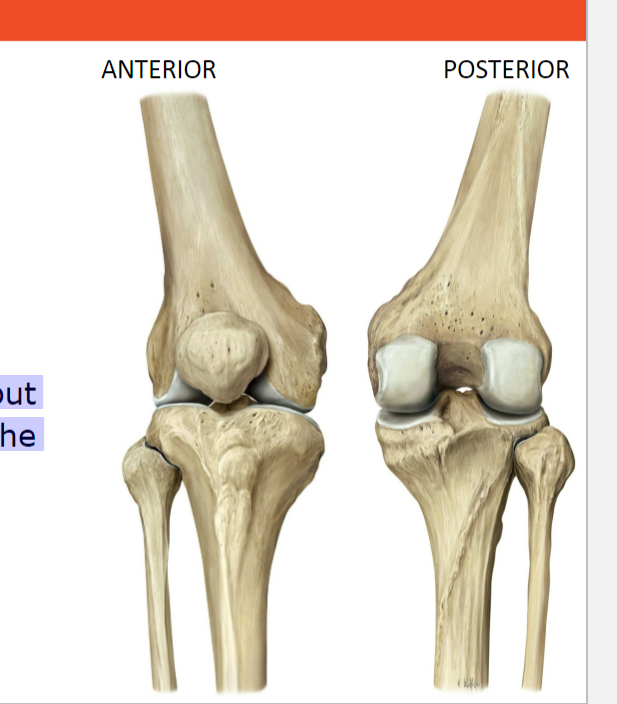
<p>The joint is art. Genus or Knee joint. The two parts of the knee joint are the art. femorotibialis, which involves the articulation between the femur and tibia, and the art. femoropatellaris, which involves the articulation between the femur and patella.</p>
10
New cards
<p>How does the knee joint differ from a typical hinge joint, and what term is used to describe its modified structure?</p>

How does the knee joint differ from a typical hinge joint, and what term is used to describe its modified structure?

The knee joint is a modified hinge joint, specifically referred to as a hinge-pivot joint. This modification allows for additional rotational movement beyond what is typical for a hinge joint.
<p>The knee joint is a modified hinge joint, specifically referred to as a hinge-pivot joint. This modification allows for additional rotational movement beyond what is typical for a hinge joint.</p>
11
New cards
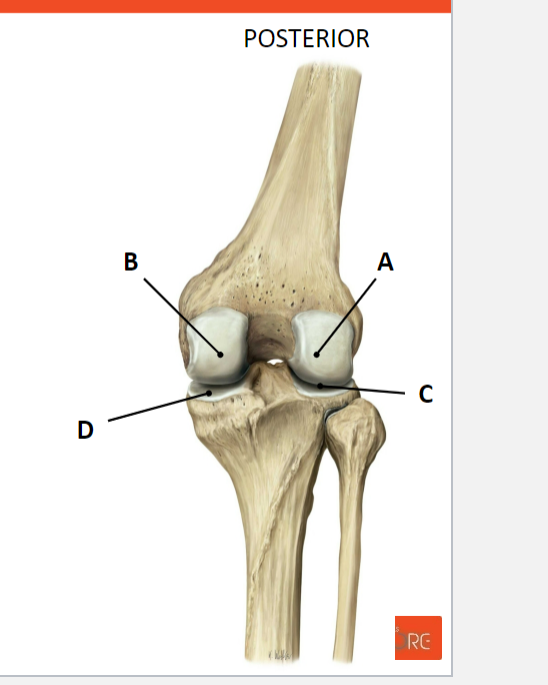
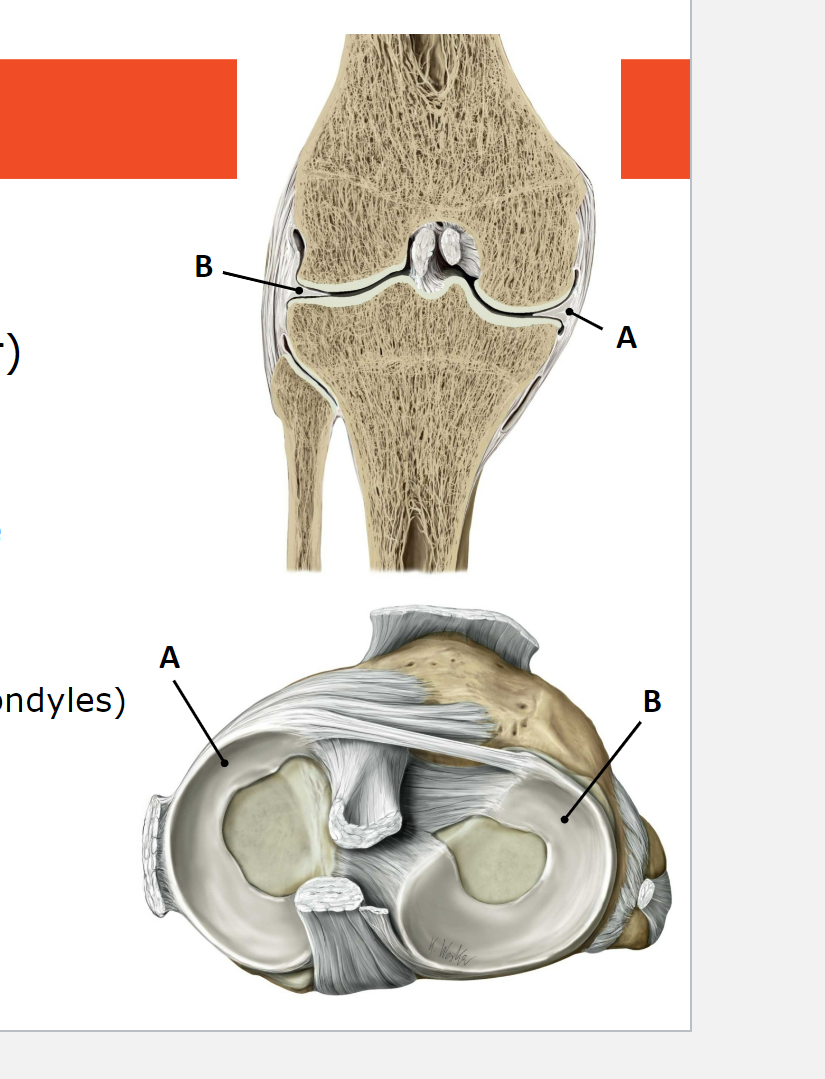
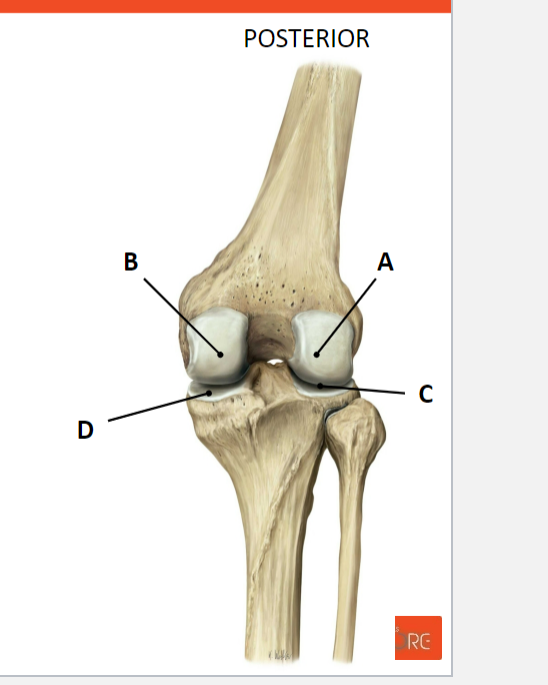
<p>Name the structures in the art. genus / knee joint (art. femorotibialis):</p>

Name the structures in the art. genus / knee joint (art. femorotibialis):

Femur:

  • A : Condylus lateralis femoris

  • B: Condylus medialis femoris

Tibia:

  • C: Condylus lateralis tibiae

  • D: Condylus medialis tibiae

<p>Femur: </p><ul><li><p>A : Condylus lateralis femoris</p></li><li><p>B: Condylus medialis femoris</p></li></ul><p>Tibia: </p><ul><li><p>C: Condylus lateralis tibiae</p></li><li><p>D: Condylus medialis tibiae</p></li></ul>
12
New cards
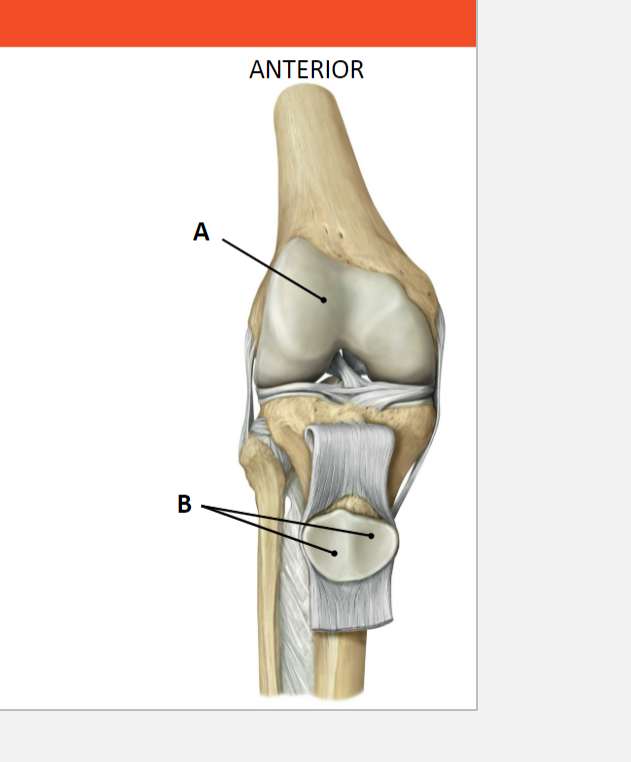
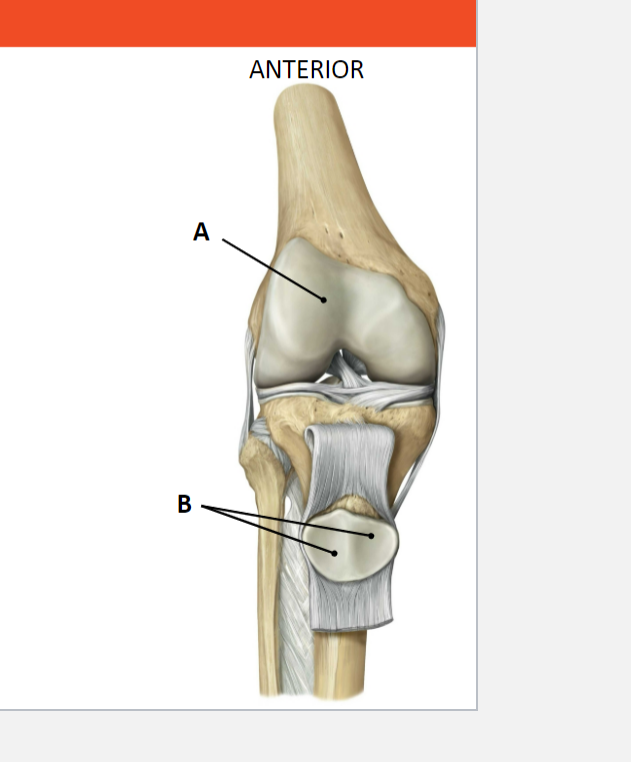
<p>Name the structures in the art. genus / knee joint (art. femeropatellaris): </p>

Name the structures in the art. genus / knee joint (art. femeropatellaris):

Femur:

A: Facies patellaris femoris

Patella:

B: Facies articularis patellae
<p>Femur:</p><p>A: Facies patellaris femoris </p><p>Patella:</p><p>B: Facies articularis patellae</p><p></p>
13
New cards
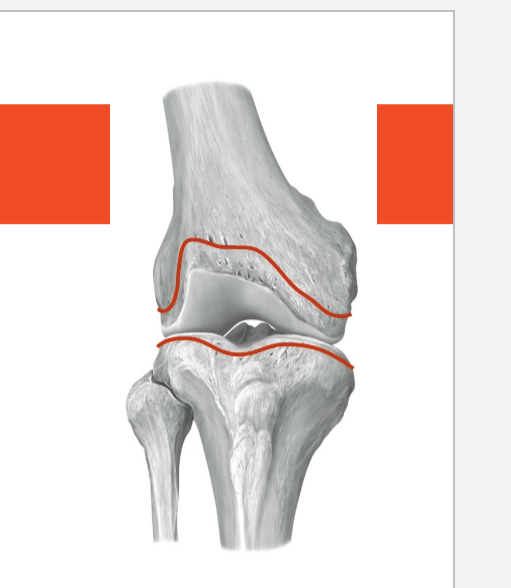
<p>Describe what the structure is, and what is its function? How would you describe its characteristic?</p>

Describe what the structure is, and what is its function? How would you describe its characteristic?

The structure is the joint capsule of the the knee joint./ art. genus. It provides support and stability to the synovial joint. The knee joint capsule is loose and weak, the capsule of the knee joint encloses both parts of the joint
<p>The structure is the joint capsule of the the knee joint./ art. genus. It provides support and stability to the synovial joint. The knee joint capsule is loose and weak, the capsule of the knee joint encloses both parts of the joint</p>
14
New cards
<p>What is the significance of the "Recessus Suprapatellaris (A)" in the knee joint?</p>

What is the significance of the "Recessus Suprapatellaris (A)" in the knee joint?

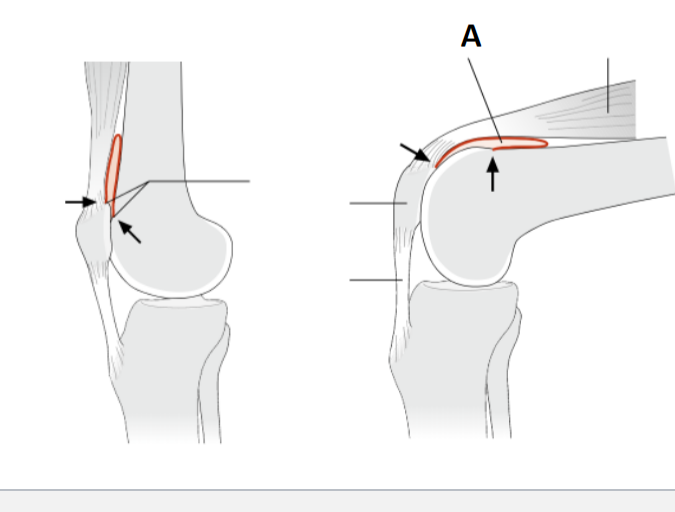
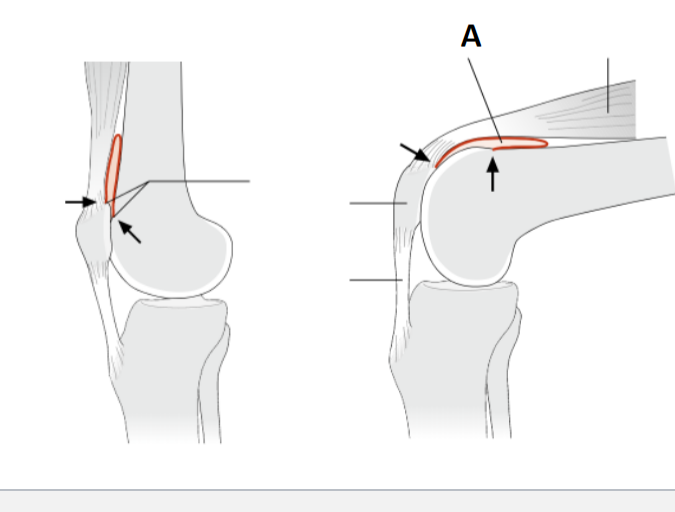
The Recessus Suprapatellaris (A) is a redundant fold above the patella that provides a reserve capacity for knee flexion.
<p><span>The Recessus Suprapatellaris (A) is a redundant fold above the patella that provides a reserve capacity for knee flexion.</span></p>
15
New cards
<p>Name the function of the extrinsic ligaments shown:</p>

Name the function of the extrinsic ligaments shown:

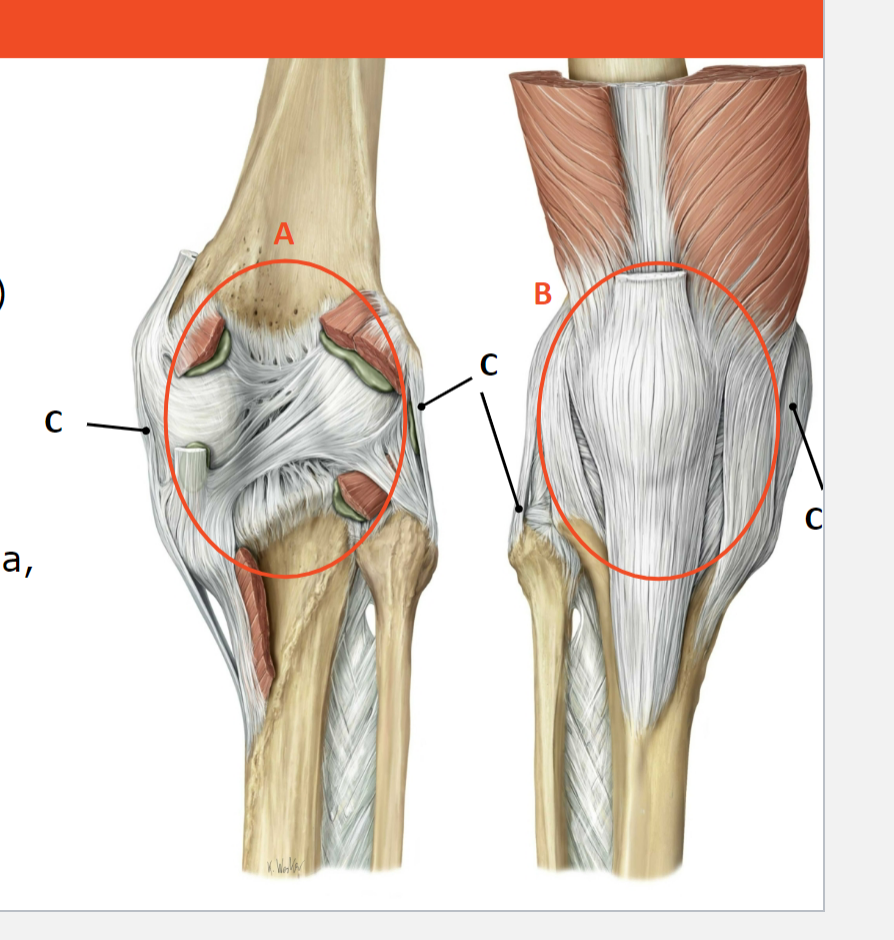
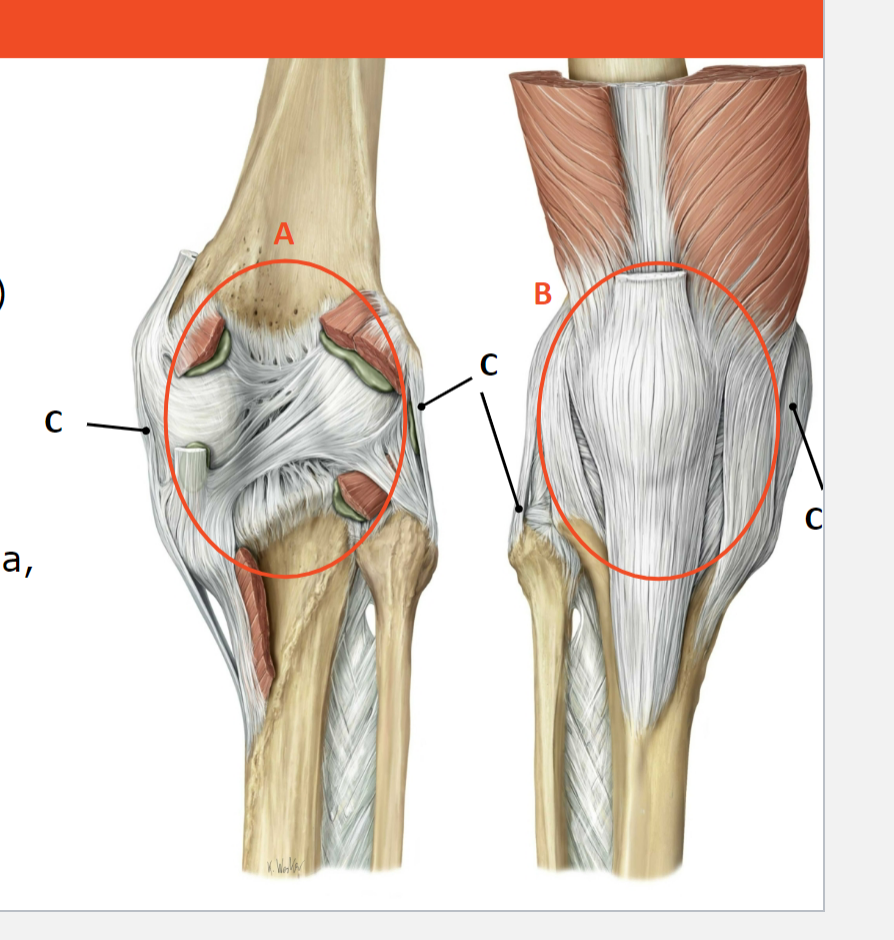
Posterior (A) : reinforce the capsule, together with the tendious attachments of the muscles in the popliteal region (hamstrings and gastrocnemius muscle)

Anterior(B) : stabilisation of the patella, together with the tendons of the quadriceps femoris muscl

Collateral ligaments (C): Stabilise the knee in the frontal plane
<p>Posterior (A) : reinforce the capsule, together with the tendious attachments of the muscles in the popliteal region (hamstrings and gastrocnemius muscle)</p><p>Anterior(B) : stabilisation of the patella, together with the tendons of the quadriceps femoris muscl</p><p>Collateral ligaments (C): Stabilise the knee in the frontal plane</p>
16
New cards
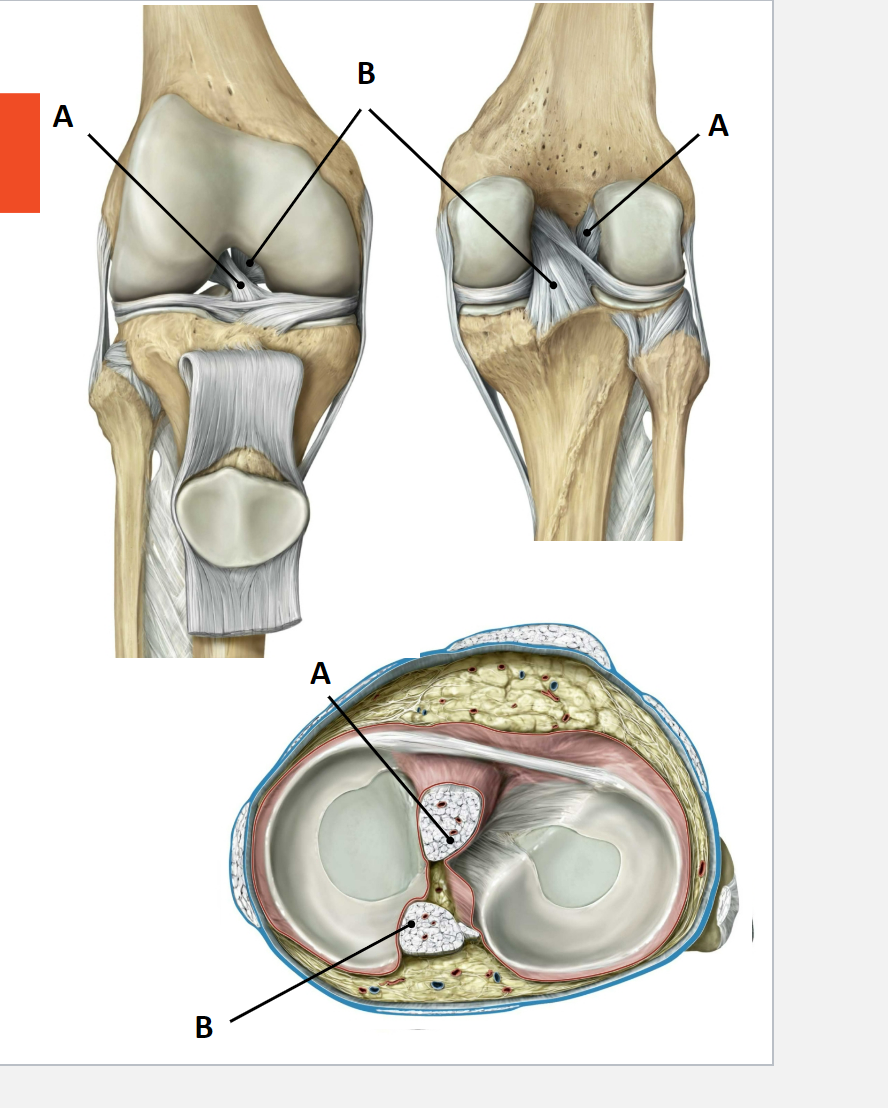
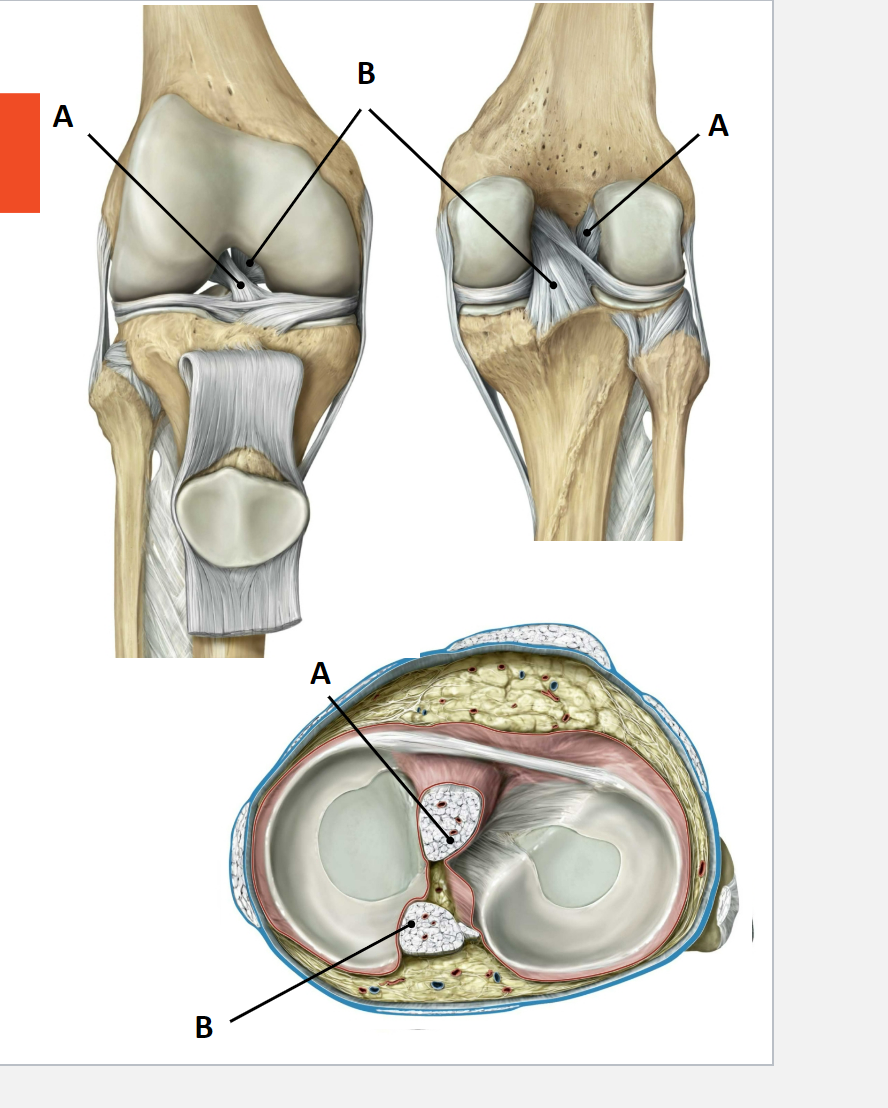
<p>Name the intrinsic ligaments shown. Explain their function. </p>

Name the intrinsic ligaments shown. Explain their function.

The intrinsic ligaments shown are:

  • anterior cruciate ligament (ACL) (lig. cruciatum anterius)

  • posterior cruciate ligament (PCL) (lig. cruciatum posterius)

They are intra-capsular, extra-articular.

They connect the femur to the tibia. They play a crucial role in keeping the articular surfaces of the femur and tibia in contact, primarily stabilizing the knee joint in the sagittal plane.
<p>The intrinsic ligaments shown are:</p><ul><li><p>anterior cruciate ligament (ACL) (lig. cruciatum anterius)</p></li><li><p>posterior cruciate ligament (PCL) (lig. cruciatum posterius)</p></li></ul><p>They are intra-capsular, extra-articular.</p><p>They connect the femur to the tibia. They play a crucial role in keeping the articular surfaces of the femur and tibia in contact, primarily stabilizing the knee joint in the sagittal plane.</p>
17
New cards
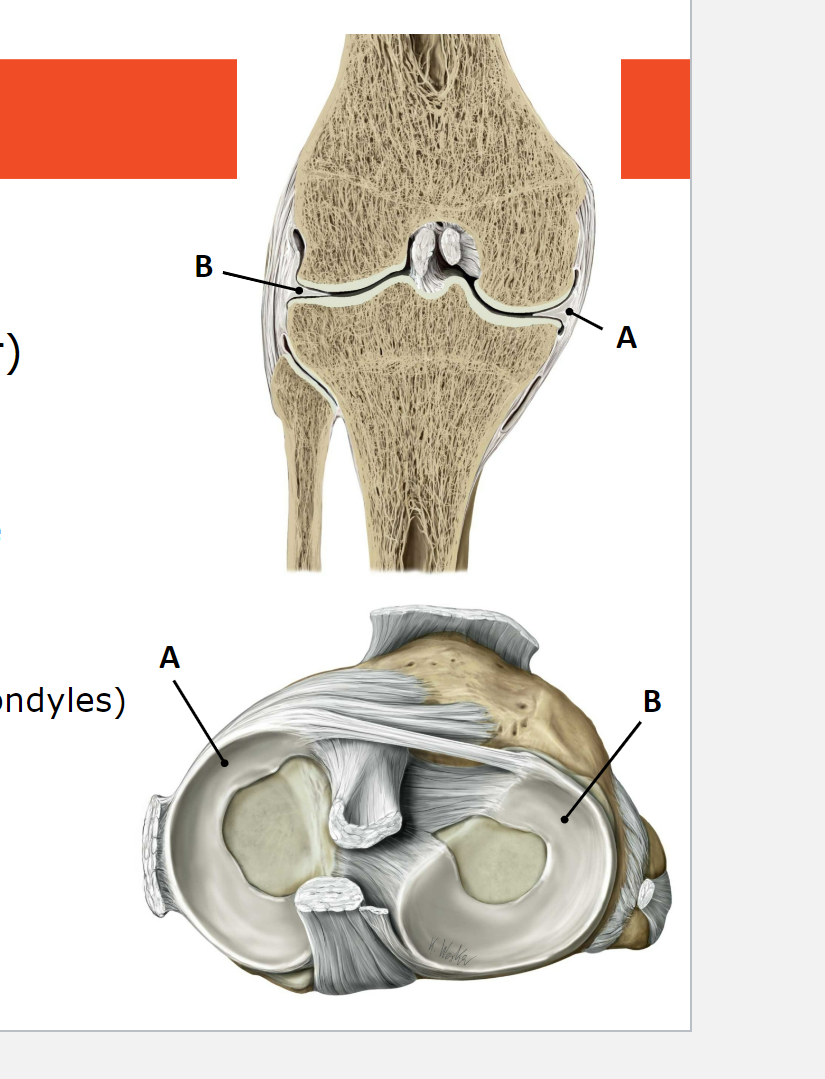
<p>What is menisci? What are the 2 menisci shown? What is their function?</p>

What is menisci? What are the 2 menisci shown? What is their function?

Menisci are auxiliary structures in the knee joint composed of pads of fibrous cartilage and tight collagenous connective tissue.

The 2 menisci shown:

  • Meniscus medialis (A): More semicircular in shape.

  • Meniscus lateralis (B): Almost forms a complete ring

Their function:

  • Compensating for the mismatch of joint surfaces (different curvatures in the femoral and tibial condyles).

  • Distributing pressures more evenly within the femorotibial joint.

  • Absorbing loads imposed on the knee.

  • Playing a role in joint lubrication.

<p><span>Menisci are auxiliary structures in the knee joint composed of pads of fibrous cartilage and tight collagenous connective tissue.</span></p><p><span>The 2 menisci shown:</span></p><ul><li><p>Meniscus medialis (A): More semicircular in shape.</p></li><li><p>Meniscus lateralis (B): Almost forms a complete ring</p></li></ul><p>Their function: </p><ul><li><p>Compensating for the mismatch of joint surfaces (different curvatures in the femoral and tibial condyles).</p></li><li><p>Distributing pressures more evenly within the femorotibial joint.</p></li><li><p>Absorbing loads imposed on the knee.</p></li><li><p>Playing a role in joint lubrication.</p></li></ul>
18
New cards
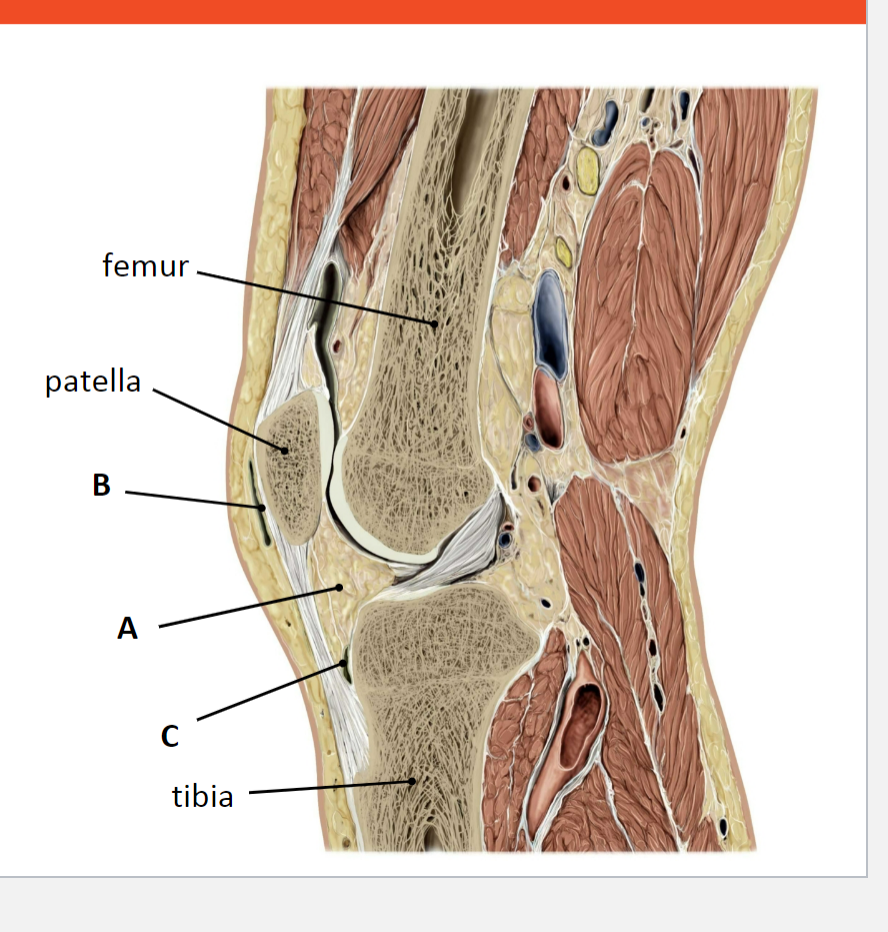
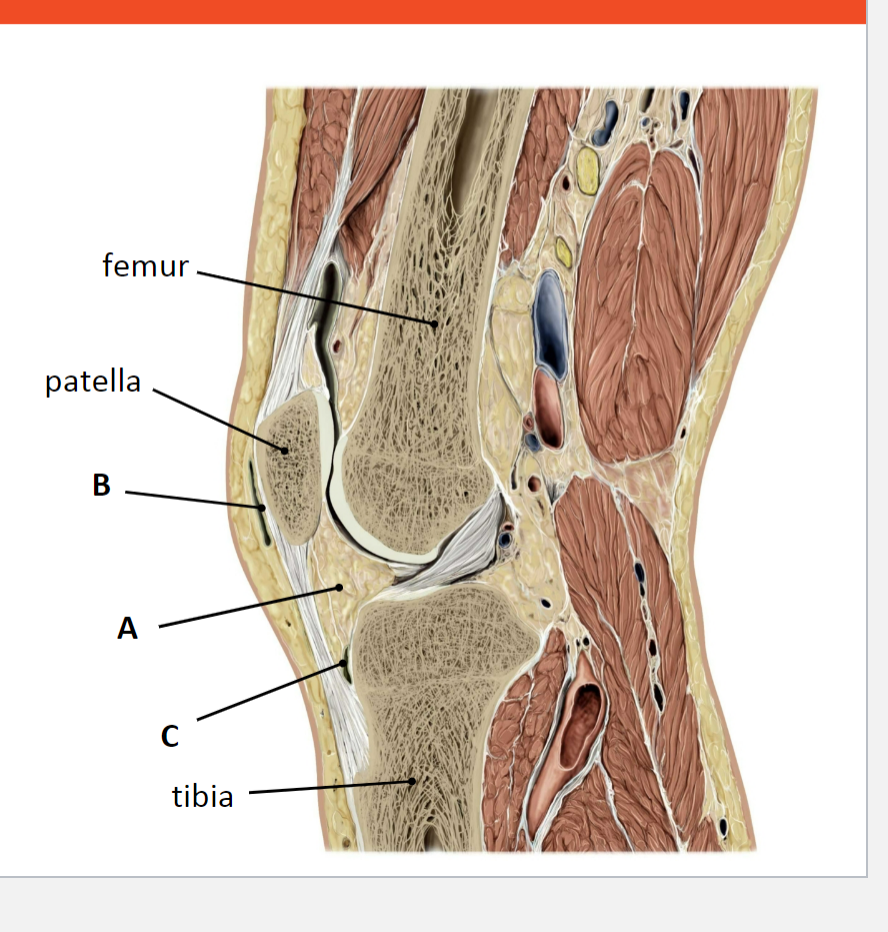
<p>Name the structures shown. What is their function?</p>

Name the structures shown. What is their function?

A: infrapatellar fat pad

B: Bursa prepatellaris

C: Bursa infrapatellaris

Function:

• shock absorbers around the edges of the

joint

• reduce friction between patella and other

surrounding tissues
<p>A: infrapatellar fat pad</p><p>B: Bursa prepatellaris</p><p>C: Bursa infrapatellaris</p><p>Function: </p><p>• shock absorbers around the edges of the</p><p>joint</p><p>• reduce friction between patella and other</p><p>surrounding tissues</p>
19
New cards
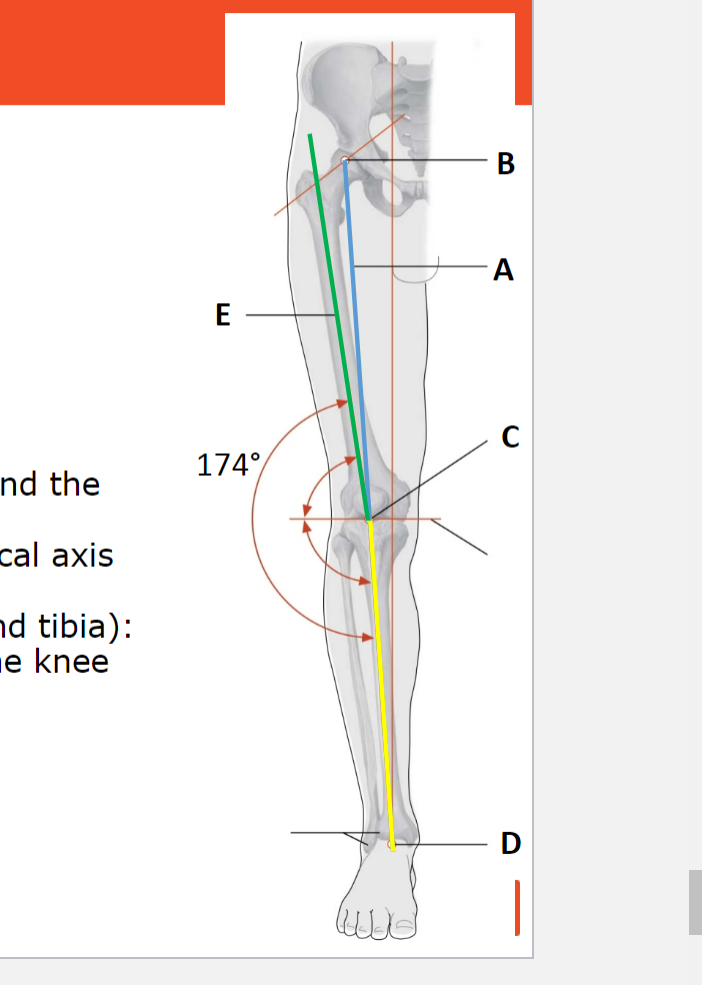
<p>Knee joint and leg axis</p>

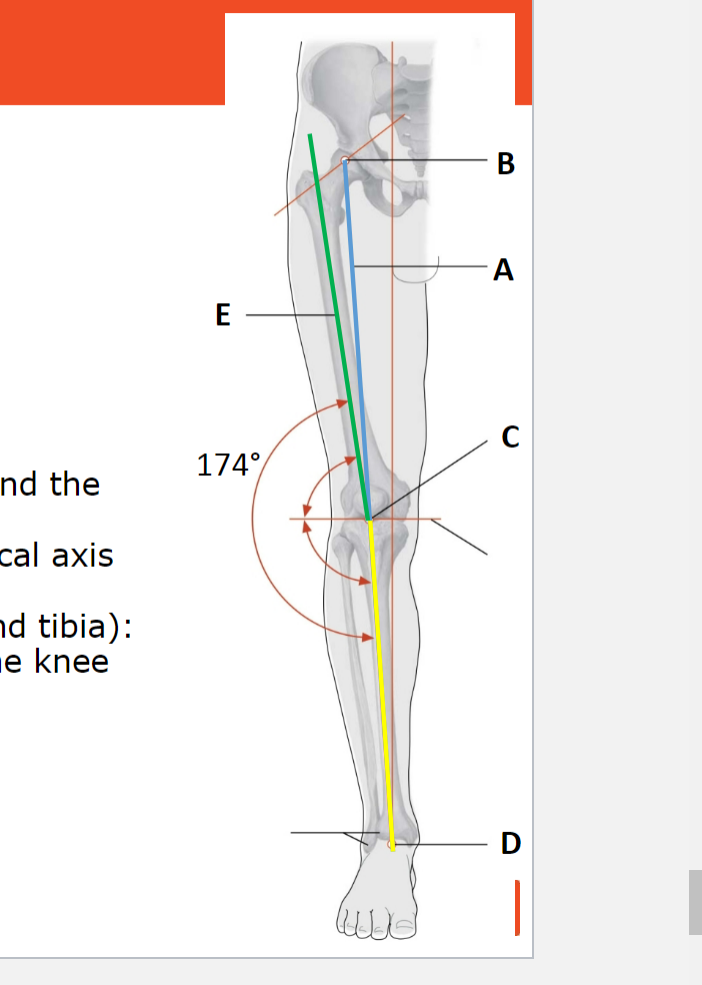
Knee joint and leg axis

The knee joint and leg axis are aligned in a normal mechanical axis (A), extending from the rotation center of the femoral head (B), through the center of the tibial plateau (C), down to the center of the ankle mortise (D). Key angles include a 6° angle between the femoral shaft's longitudinal axis (E) and the mechanical axis. The femorotibial angle, representing the angle between the longitudinal axes of the femur and tibia, is a laterally open angle of 174° at the knee joint level in the coronal plane. This alignment is observed in a normal femoral neck angle (coxa norma) and a straight knee joint (genu rectum).
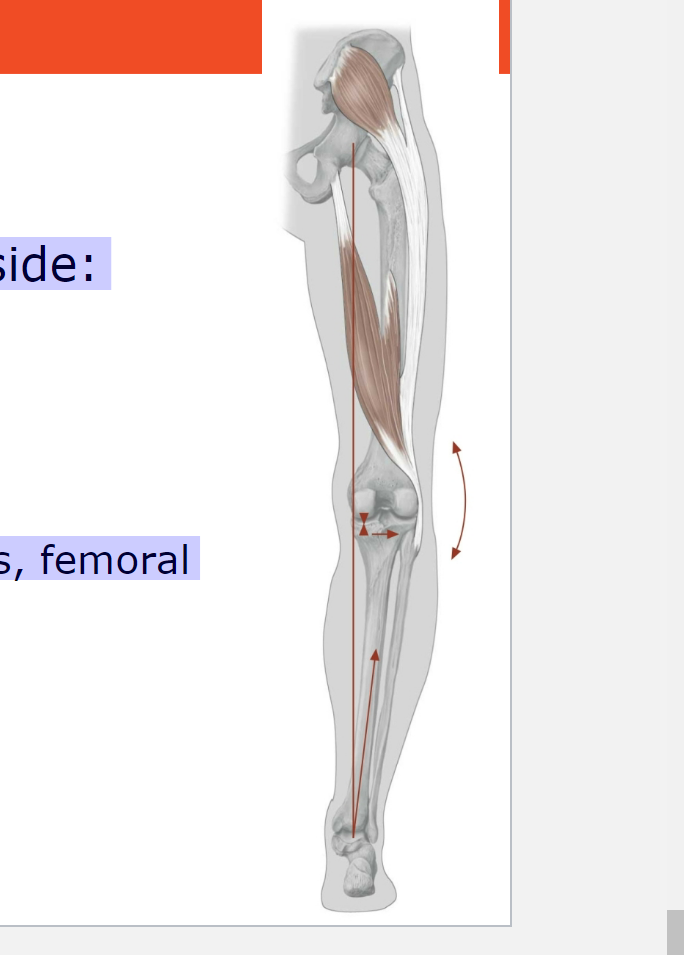
<p><span>The knee joint and leg axis are aligned in a normal mechanical axis (A), extending from the rotation center of the femoral head (B), through the center of the tibial plateau (C), down to the center of the ankle mortise (D). Key angles include a 6° angle between the femoral shaft's longitudinal axis (E) and the mechanical axis. The femorotibial angle, representing the angle between the longitudinal axes of the femur and tibia, is a laterally open angle of 174° at the knee joint level in the coronal plane. This alignment is observed in a normal femoral neck angle (coxa norma) and a straight knee joint (genu rectum).</span></p>
20
New cards
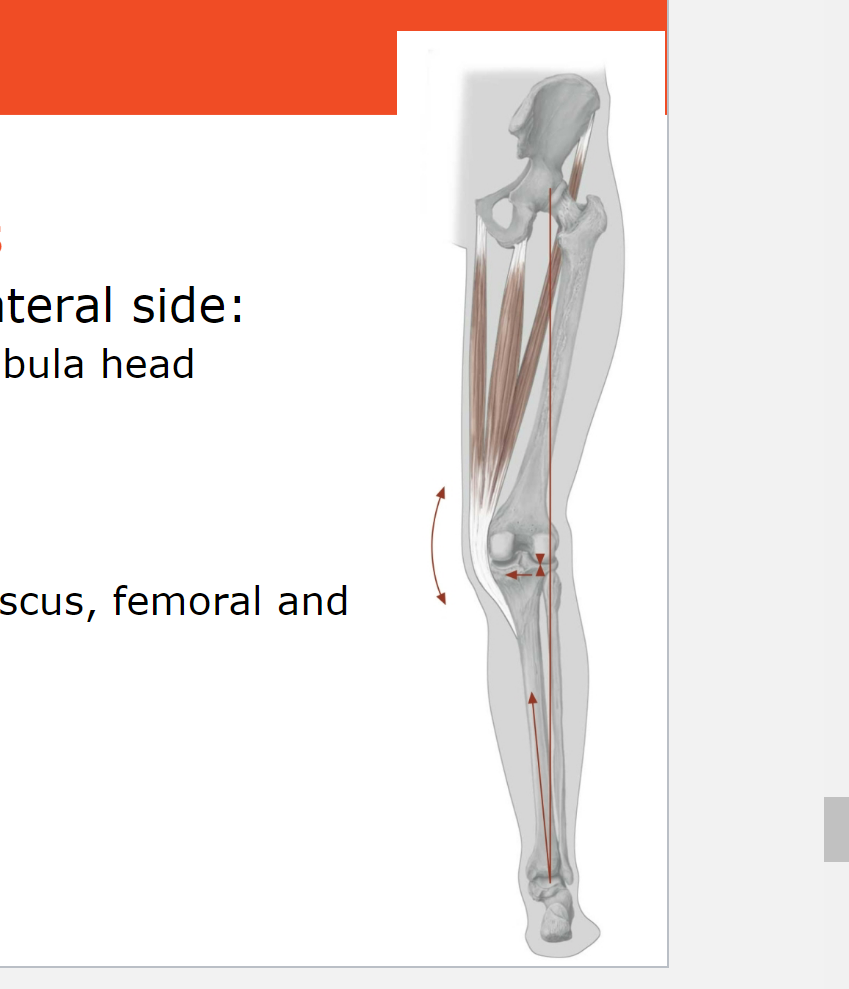
<p><span>Abnormalities in Knee Joint and Leg Axis (Genu Varum)</span></p>

Abnormalities in Knee Joint and Leg Axis (Genu Varum)

  • Details:

    • Deviation of the mechanical axis to the medial side.

    • Path: Through the medial femoral condyle or medial to it.

    • Often associated with increased femoral neck angle (coxa valga).

  • Consequence:

    • Abnormal, increased pressure on the medial meniscus, femoral and tibial condyles.

    • Stretching of the lateral collateral ligament.

    • Resulting in genu varum or bow-leggedness.
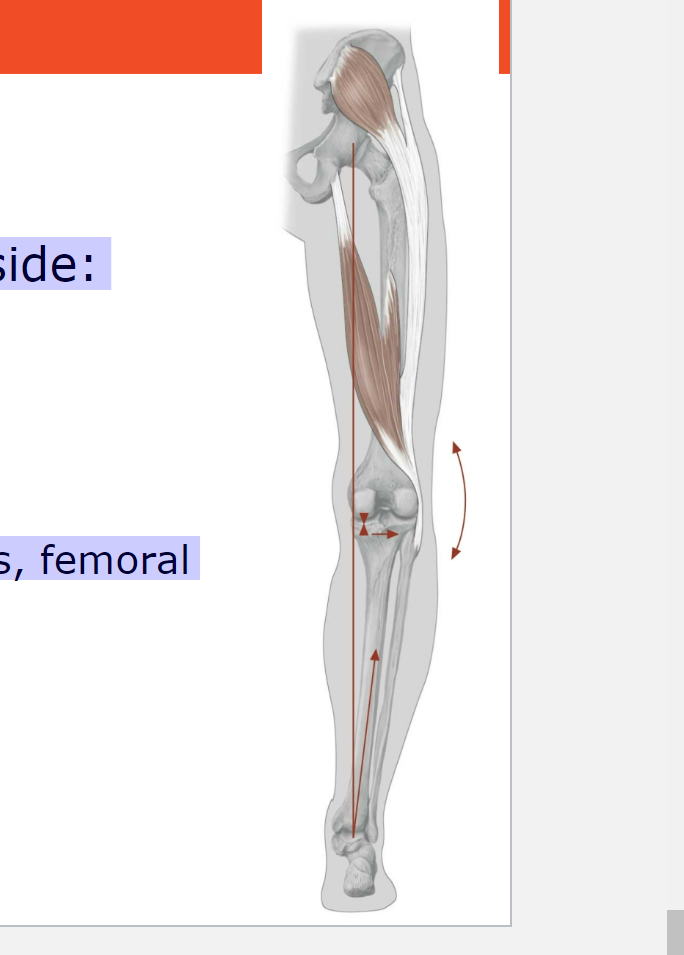
<ul><li><p>Details:</p><ul><li><p>Deviation of the mechanical axis to the medial side.</p></li><li><p>Path: Through the medial femoral condyle or medial to it.</p></li><li><p>Often associated with increased femoral neck angle (coxa valga).</p></li></ul></li><li><p>Consequence:</p><ul><li><p>Abnormal, increased pressure on the medial meniscus, femoral and tibial condyles.</p></li><li><p>Stretching of the lateral collateral ligament.</p></li><li><p>Resulting in genu varum or bow-leggedness.</p></li></ul></li></ul>
21
New cards
<p><span>Abnormalities in Knee Joint and Leg Axis (Genu Valgum)</span></p>

Abnormalities in Knee Joint and Leg Axis (Genu Valgum)

  • Details:

    • Deviation of the mechanical axis to the lateral side.

    • Path: Through the lateral femoral condyle and the fibula head.

    • Often associated with decreased femoral neck angle (coxa vara).

  • Consequence:

    • Abnormal, increased pressure on lateral meniscus, femoral and tibial condyles.

    • Stretching of the medial collateral ligament.

    • Resulting in genu valgum or knock knee.
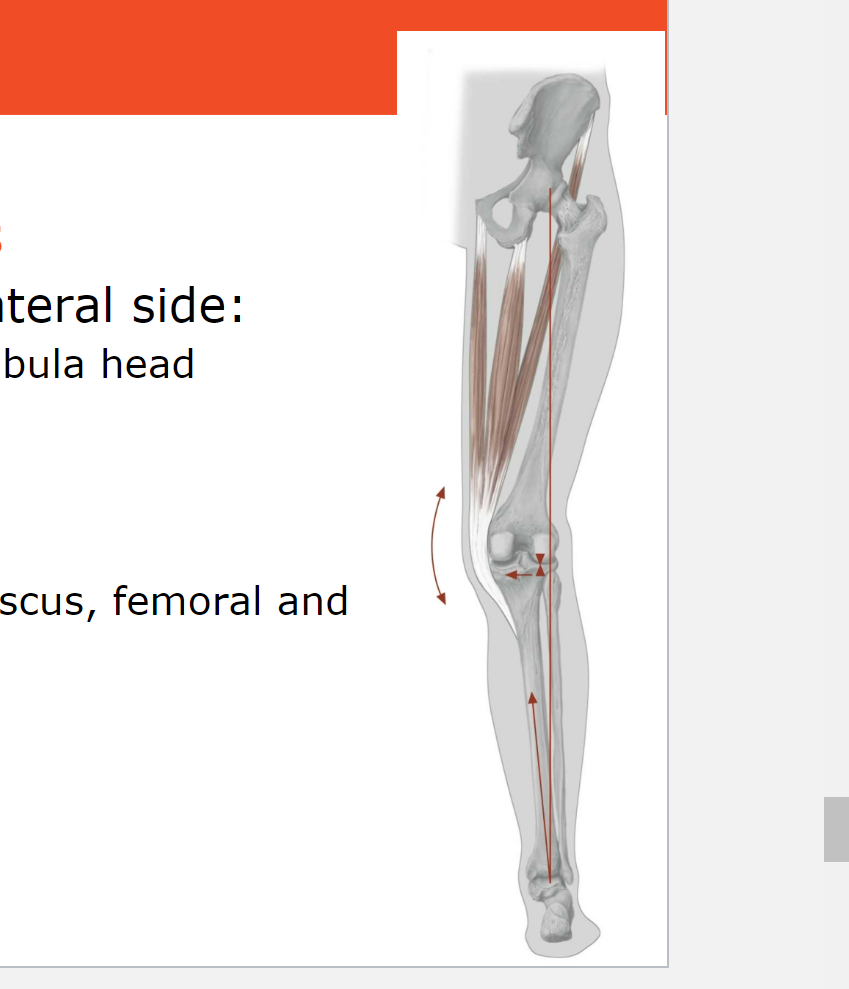
<ul><li><p>Details:</p><ul><li><p>Deviation of the mechanical axis to the lateral side.</p></li><li><p>Path: Through the lateral femoral condyle and the fibula head.</p></li><li><p>Often associated with decreased femoral neck angle (coxa vara).</p></li></ul></li><li><p>Consequence:</p><ul><li><p>Abnormal, increased pressure on lateral meniscus, femoral and tibial condyles.</p></li><li><p>Stretching of the medial collateral ligament.</p></li><li><p>Resulting in genu valgum or knock knee.</p></li></ul></li></ul>
22
New cards
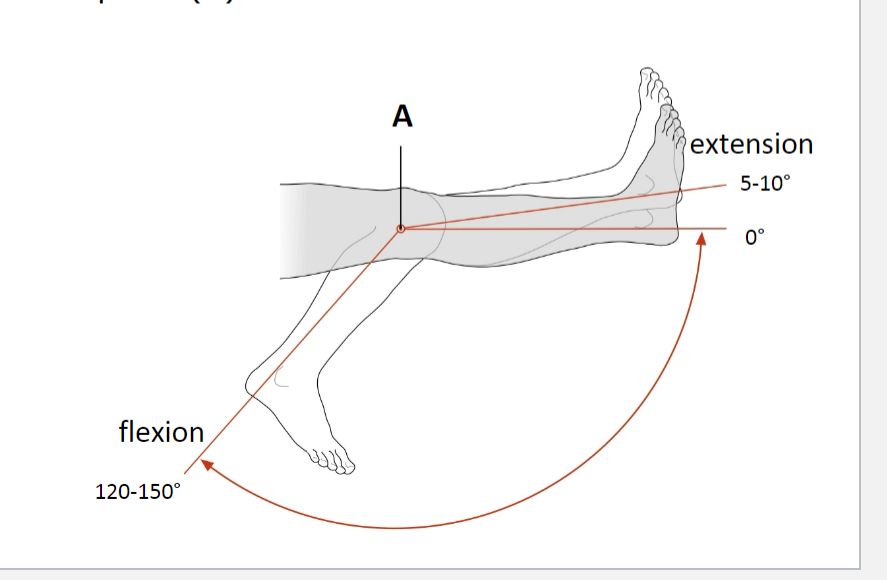
<p><span>Movements of the Knee Joint</span></p>

Movements of the Knee Joint

  • Joint Type: Hinge-pivot joint

  • Movements:

    • Flexion: 120-150°

    • Extension: 5-10°

    Around transverse axis through rotation point (A)

    • External rotation: 30-40° (only with the knee flexed 90°)

    • Internal rotation: 10° (only with the knee flexed 90°)

  • Axis of Rotation: Through the medial tibial condyle

  • Note: Internal rotation is considerably less than external rotation due to cruciate ligaments twisting around each other during internal rotation
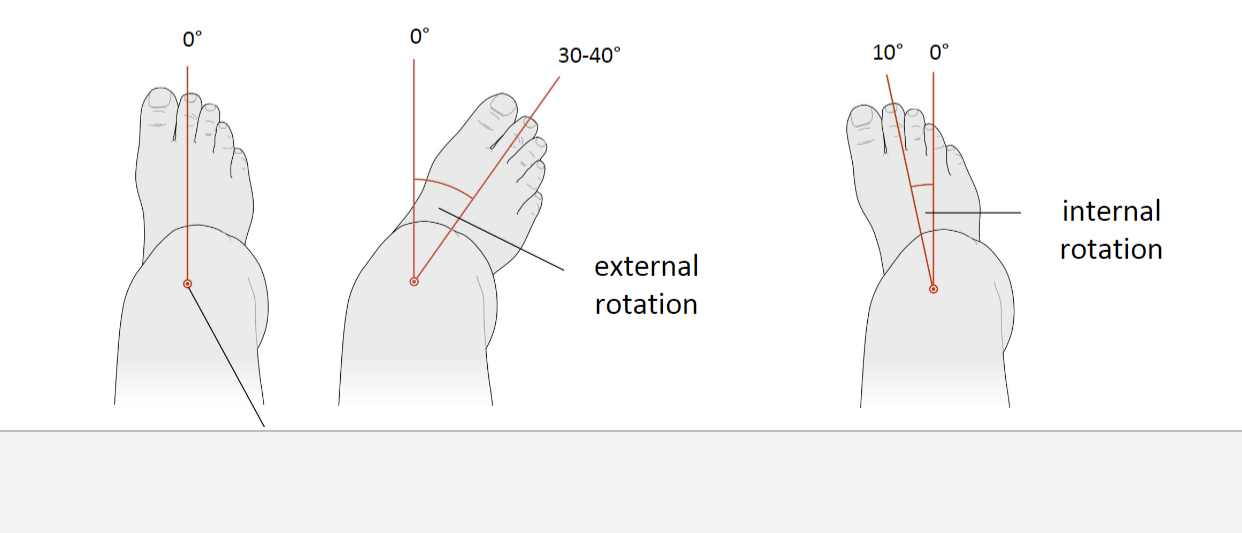
<ul><li><p>Joint Type: Hinge-pivot joint</p></li><li><p>Movements:</p><ul><li><p>Flexion: 120-150°</p></li><li><p>Extension: 5-10°</p></li></ul><p></p><p>Around transverse axis through rotation point (A)</p><ul><li><p>External rotation: 30-40° (only with the knee flexed 90°)</p></li><li><p>Internal rotation: 10° (only with the knee flexed 90°)</p></li></ul></li><li><p>Axis of Rotation: Through the medial tibial condyle</p></li><li><p>Note: Internal rotation is considerably less than external rotation due to cruciate ligaments twisting around each other during internal rotation</p></li></ul>
23
New cards
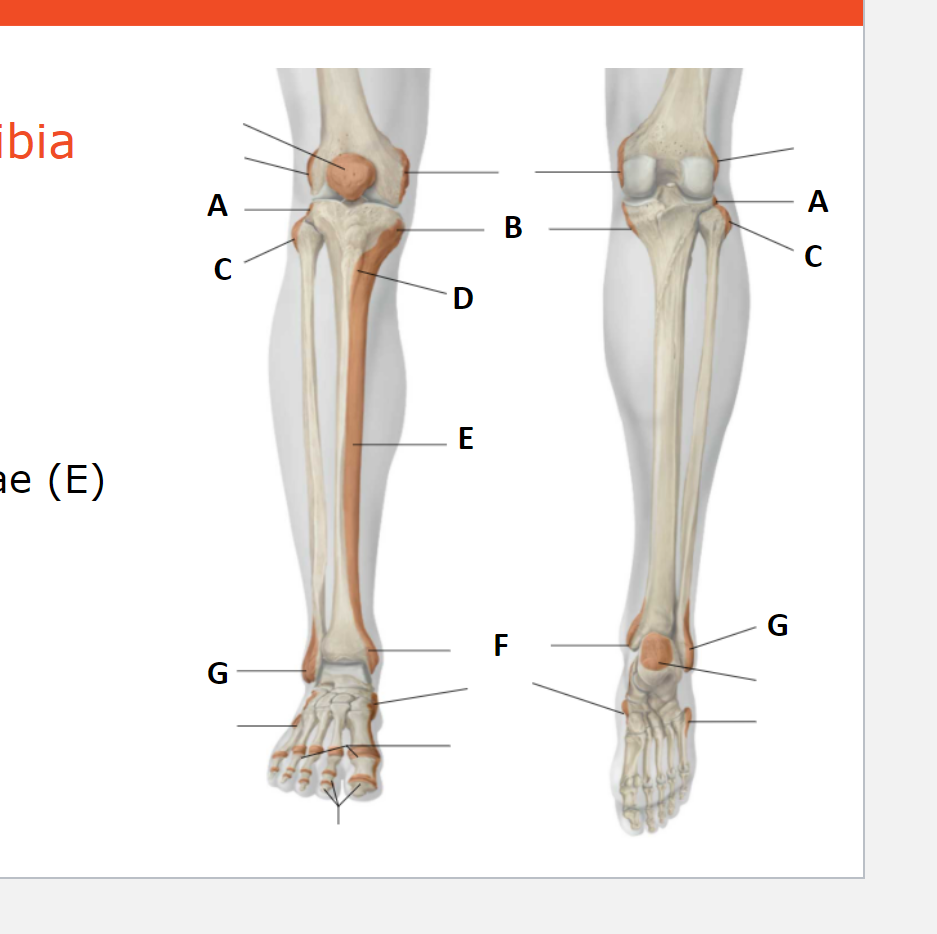
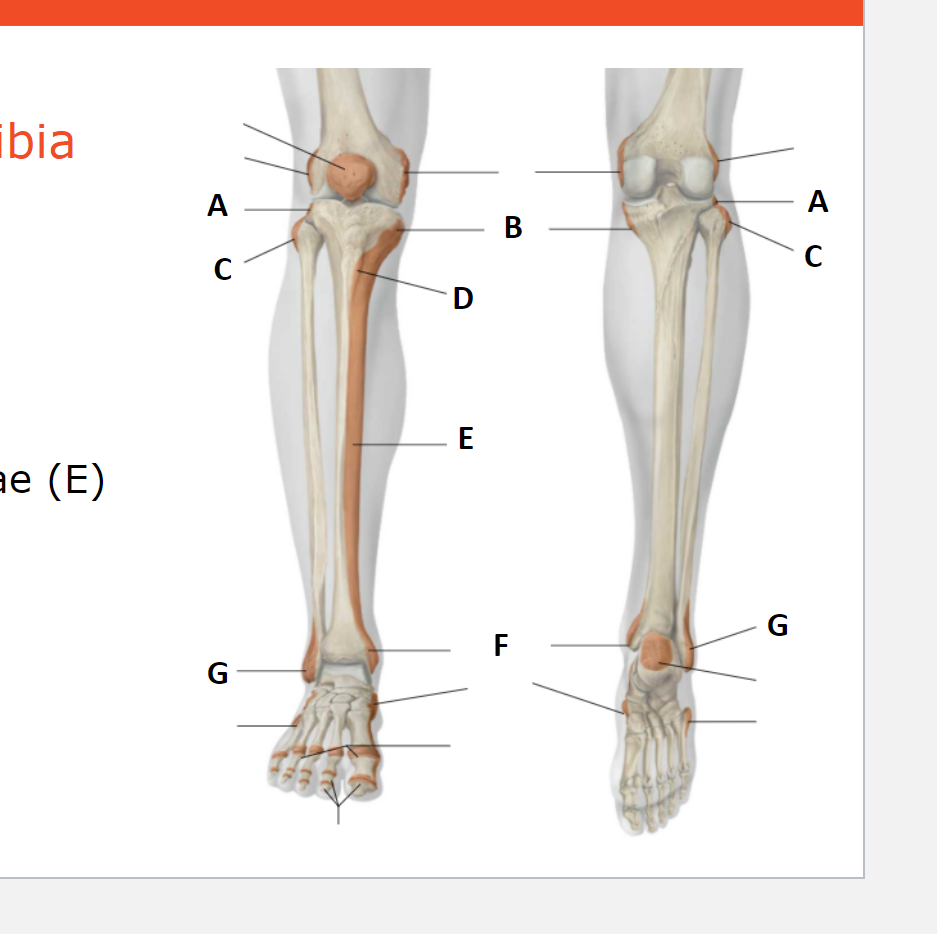
<p>Palpable bony prominences of the tibia and fibula</p>

Palpable bony prominences of the tibia and fibula

A: Condylus laterlais Tibia

B: Condylus medialis tibia

C: Caput Fibulae

D: Tuberositas Tibiae

E: Margo Anterior and facies medialis tibiae

F: Malleolus medialis (Tibiae)

G: Malleolus lateralis (Fibulae)
<p>A: Condylus laterlais Tibia</p><p>B: Condylus medialis tibia</p><p>C: Caput Fibulae</p><p>D: Tuberositas Tibiae</p><p>E: Margo Anterior and facies medialis tibiae</p><p>F: Malleolus medialis (Tibiae)</p><p>G: Malleolus lateralis (Fibulae)</p>