BISC 120 Exam 1
 Call Kai
 Learn
Learn Practice Test
 Spaced Repetition
 Match
Match Flashcards
 Knowt Play
1/113

There's no tags or description
Looks like no tags are added yet.
Name | Mastery | Learn | Test | Matching | Spaced | Call with Kai | Chat |
|---|
No analytics yet
Send a link to your students to track their progress
114 Terms
Haploid cell
Contains one set of chromosomes (egg and sperm)
23 unpaired chromosomes
Number of chromosomes in haploid cell
Diploid cell
Contains two complete sets of chromosomes
46 total chromosomes arranged in 23 pairs, 22 autosome pairs, 1 sex chromosome pair
Number of chromosomes in diploid cell
Cell genome
Consists of all the DNA in a cell, can consist of a single DNA molecule (prokaryotes) or multiple DNA molecules (eukaryotes)
DNA molecules
Series of genes, packaged into chromosomes in cells
Cell division
Reproduction of cells & continuity of life and genetic material
First part of process of cell division
Single-celled organisms give rise to new organisms through cell division
Second part of process of cell division
Muticellular eukaryotes undergo embroyonic development through cell divisionT
Third part of process of cell division
Cell division continues to function in renewal and repair in fully grown multicellular eukaryotes
What happens every time growth or development happens?
Genome is copied and put into daughter cells (any cell can be taken from the body and be the same)
G1 phase of cell cycle
Growth - cell doubles in size and performs its normal daily jobs
S phase
Synthesis - cell replicates DNA and doubles genetic information
G2 phase
Final growth stage - other structures for cell division begin to assemble, chromosomes begin to condense during Prophase
Mitosis
1st part of M phase/cell division - division of the genetic material in the nucleus, separation of duplicated chromosomes, splits the copied DNA into two new nuclei through prophase, metaphase, anaphase, and telophase
Prophase
Centromeres go to either ends of cell and spindle fibers grow, chromosomes condense to help move genetic info during cell division
Metaphase
Chromosomes condense line up down the middle of metaphase plate
Anaphase
Replicated chromosomes split and move to opposite poles of the cell
Telophase
Final stage of cell division, two nuclear envelopes form around separated sets of chromosomes
Cytokinesis
Separation of daughter cells into sister cells - the physical process of cell division, splits the cell’s main fluid (cytoplasm) and outer membrane into separate cells
G0 phase
Resting state where a cell stops dividing and just does its regular work
Interphase
Cell growth, happens 90% of the time, consists of G1, G2, S, M phase
Why does genetic material becomes visible during prophase?
Strands of chromosomes condense
As cells get ready for mitosis, what happens
They take strands of DNA and wrap them around histones to move genetic material around
Sister chromatids
Each duplicated chromosome has two of them (joined copies of the original chromosome), attached along their lengths by cohesins
Centromeres
Narrow “waist” of the duplicated chromosome, where the two chromatids are most closely attached (area of similarity in the chromosome)
What happens with the two sister chromatids of each duplicated chromosome during cell division
Separate and move into two new nuclei
After chromatids are separated…
They are called chromosomes
What does eukaryotic cell division consist of
Mitosis and cytokinesis
How does DNA replication transmit genetic information
By copying the double-stranded genome so that every new cell receives an identical set of instructions

Meiosis
Produces gametes, a variation of cell division, yields non-identical daughter cells that have half as many chromosomes as the parent cell, turns one diploid cell into 4 unique haploid sex cells
Meiosis I
Pairs of matching chromosomes line up and separate into two new cells, cutting the chromosome number in half
Meiosis II
The sister strands inside halved number of chromosomes pull apart, similar to regular cell division (mitosis), resulting in four final cells
What are the components of DNA
Polymer of monomers
Polymer = big block chain
Monomer = nucleotides (the building blocks)
nucleotides: made up of nitrogenous base, phosphate group, sugar (deoxyribose) to provide a code for constructing a protein
nucleotides become polymers made of nucleic acid (large, natural chemical molecules that store and pass on genetic information in all living cells)
composition/arrangement of nucleotides vary from one individual to the next so they act like an individual code
nitrogenous bases are adenine, thymine, cytosine, guanine

4 important classes of biological molecules (macromolecules)
Lipids, proteins, carbohydrates, nucleic acids
What is the structure and function of lipids
Structure - composed mostly of C, H, O but are hydrophobic and do not form long repeating polymer chains, so they are commonly ,ade of glycerol backbones attached to long hydrocarbon fatty acid chains via ester bonds
Function - provide long-term energy storage, cushion/protect organs, insulate body against heat lost, form the foundational lipid bilayer of all cellular membranes
What is the structure and function of proteins
Structure - built from chains of amino acid monomers linked togehter by peptide bonds, each amino acid has a central carbon, an amino group, a carboxyl group, and a unique side chain (R group) that folds into complex 3D shapes
Function - act as enzymes to speed up chemical reactions, build structural frameworks (e.g., collagen, keratin), transport nutrients, and drive immune defenses (antibodies)
What is the structure and function of carbohydrates
Structure - made of C, H, O (typically 1:2:1 ratio), monomers are simple sugars called monosaccharides (like glucose), which link together via glycosidic bonds to form complex chains or polymers (e.g., starch, glycogen, cellulose)
Function - act as primary, fast source of short-term energy for cells and provide rigid structural support
What is the structure and function of nucleic acids
Structure - composed of C, H, O, N, P, building blocks are nucleotides
Function - store, transmit, express genetic information, DNA holds master hereditary blueprint while RNA acts on those instructions to build essential proteins
What is the structural model of DNA
double helix
two outer sugar-phosphate backbones rotate around paired nitrogenous bases in the molecule’s interior
backbones are antiparallel (subunits run in opposite directions)
Who are Maurice Wilkins and Rosalind Franklin
Used x-ray crystallography to study molecular structure
Franklin produced a picture of the DNA molecule using the technique
Who are James Watson and Francis Crick
Enabled my x-ray crystallography pictures of DNA to deduce that DNA was helical
Pattern in the photo showed that DNA was made of two strands paired up and facing each other, forming a double helix
What is the function of the DNA structure
To contain, protect, and pass along genetic code
Protection keeps genetic code from being exposed to the environment since it has potential to react with other molecules
How many carbons does deoxyribose sugar have
5 (1’…5’)
What is the central dogma of biology
DNA —> RNA —> protein
Genetic information flows in one direction, from DNA to RNA to protein
What are the three processes of central dogma
Replication, transcription, translation
What is the replication stage of central dogma
DNA of a cell is copied to make more DNA
Enzymes unwind the double-stranded DNA and build new complementary strands
What is the transcription stage of central dogma
Genetic info from a DNA strand is copied to a mRNA molecule
RNA polymerase (an enzyme) reads the DNA template strand and builds a matching single-stranded RNA message
What is the translation stage of central dogma
Ribosomes read the RNA code in groups of three bases (codons) and tRNA brings the matching amino acids to build a growing protein chain
What do metabolic processes rely on
Proteins produced by gene expression
What does gene expression do
Process by which DNA directs the synthesis of proteins
Uses a gene to create a functional product, beginning with a protein
Builds enzymes and other proteins that carry out metabolic reactions
What are the functions of genetic information
Stored, copied, passed on, and used
What does it mean for genetic information to be stored
It is encoded in the nucleotide sequence of DNA and organized into genes and chromosomes
What does it mean for genetic information to be copied
Complementary base pairing (CG, AT) allows DNA to be accurately replicated
What does it mean for genetic information to be passed on
Replicated chromosomes can be distributed to new cells, maintaining the continuity of genetic information
What does it mean for genetic information to be used
Information in DNA can be ultimately expressed as proteins that influence cell structure and function
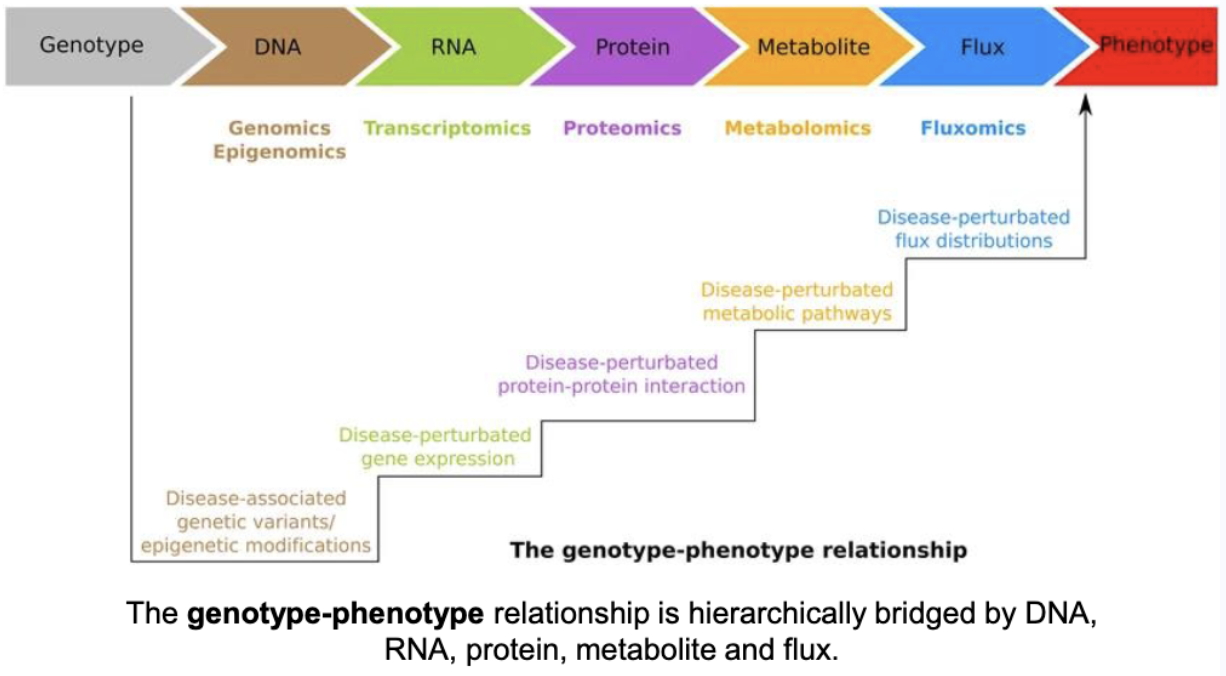
What is the structure of the genotype-phenotype relationship
Hierarchically bridged by DNA, RNA, protein, metabolite, and flux
What are the stages of transcription and translation
initiation, elongation, and termination
Template strand
Provides a template for ordering the sequence of complementary nucleotides in an RNA transcript, always the same strand for a given gene
Non-template strand
Coding strand, nucleotides are identical to mRNA sequence being produced for gene
What are the strands of DNA
Complementary; template and non-template
Antiparallel, sugar/phosphate backbone, hydrogen bonds, nucleotides
What is the initiation stage of transcription
All molecules are brought to the plane to build mRNA strand
Promoters
DNA regions that initiate the transcription of a gene
How long do promoters extend
Several dozen nucleotide pairs upstreamW of gene start point
What is the upstream of gene start point
3’ end of gene
Promoter region
What is the downstream of the gene start point
5’ end of gene (dictates how things are read in the cell)
What is the promotor for eukaryotes called
TATA box
What is the role of the TATA box
Forms the initiation complex
What are transcription factors
Proteins that have a shape/structure that help guide the binding of RNA polymerase
What is RNA polymerase
Enzyme and final piece of initiation that catalyzes the synthesis of RNA from DNA template
Pries the DNA strands apart and joins togehter the RNA nucleotieds
Enables transcriptors to bind upstream
What is the elongation stage of transcription
RNA polymerase moves along the DNA template strand and builds a complementary RNA molecule
During elongation, how is the template strand read
3’ to 5’ direction
During elongation, how is the RNA strand built
5’ to 3’ direction
Nucleotides are added to the 3’ end of the growing RNA molecule
What is the termination stage of transcription
Final step of RNA synthesis where the RNA strand is released from the RNA polymerase
Signaled by terminator regions on the template strand
What does the termination stage of transcription ensure
Proper regulation of gene expression and prevents the production of unwanted transcripts (mRNA sequences)
What is transcription in a nutshell
RNA synthesis is catalyzed by RNA polymerase
The RNA strand built is complementary to the DNA template strand (read 3’ to 5’)
RNA synthesis follows the same base-pairing rules as DNA, except that uracil substitutes for thymine
What are ribosomes
The site for translation, use the information from DNA to make proteins
Where do ribosomes build proteins
Cytasol
Outside of endoplasmic reticulum/nuclear envelope
When are ribosomes free
In the cytasol
When are ribsomes bound
Outside of the endoplasmic reticulum/nuclear envelope
What makes up ribsomes
Ribosomal proteins and ribosomal RNA
What do ribosomes specifically do in translation
Translate codons into amino acids
What is translation
Synthesis of a polypeptide from mRNA
The conversion of the nucleic acid language to the polypeptide (protein) language
What is translation based on
A triplet code
What is the triplet code in translation
Genetic instructions written as a series of three-base words
What are codons
The series of three-base words in the triplet code of translation
Genetic code
the set of rules that dictates the amino acid translations of each of the mRNA nucleotide tripletsI
In translation, how are mRNA codons used
Translated into a specific amino acid sequence of a polypeptide
In translation, what do transfer RNA molecules serve as
Interpreters
Where does translation take place
In the cytoplasm
What is the process of translation
A cell reads a messenger RNA (mRNA) blueprint to build a protein
A ribosome attaches to the mRNA and translates its message into a specific polypeptide, aided by transfer RNAs (tRNAs)
mRNA: The instructions copied from DNA that tell the cell which amino acids to assemble.
Ribosome: The cellular machine made of proteins and ribosomal RNA that locks onto the mRNA and builds the protein.
tRNA (Transfer RNA): Small molecules that carry specific amino acids and match them to the mRNA code.
Codon: A group of three mRNA nucleotides that codes for one specific amino acid or a stop signal
Anticodon
Base triplet that each tRNA bears
What is tRNA
a small RNA molecule that links genetic code to the building blocks of proteins during cell translation
What is the initiation stage of translation
Starts when the small ribosomal subunit binds to mRNA and a special initiator
Initiator tRNA carries the amino acid methionine
Small subunit moves along the mRNA until it reaches the start codon (AUG)
What is the elongation stage of translation
Translation proceeds along the mRNA in a 5’—>3’ direction
Ribosome and mRNA move relative to each other, codon by codon
During translation, what happens as mRNA moves one codon at a time relative to the ribosome
a tRNA with a complementary anticodon pairs with each codon, adding its amino acid to the growing polypeptide chain
How long does elongation continue on for
Until a stop codon reaches the ribosome’s A site
How are codons read
As nucleotides in groups of three, in the 5’ to 3’ direction
What is the start codon of translation
AUG
It codes for the amino acid methionine (MET) in eukaryotes
What can mutations affect
Protein structure and function