BISC WEEK 10
 Call Kai
 Learn
Learn Practice Test
 Spaced Repetition
 Match
Match Flashcards
 Knowt Play
1/29

There's no tags or description
Looks like no tags are added yet.
Name | Mastery | Learn | Test | Matching | Spaced | Call with Kai | Chat |
|---|
No analytics yet
Send a link to your students to track their progress
30 Terms
Root System Structures
Taproot: central, dominant root
Lateral roots: branch off the taproot
Root hairs: (site of absorption)
Fibrous roots: dense, branching root system with no dominant taproot
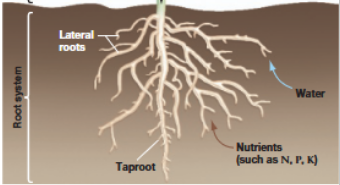
Root System Functions
Anchors the plant in soil
Absorbs water and nutrients from soil
Conducts water and selected ions up to the shoot
Obtains sugar (energy) from the shoot
Stores material produced in the shoot for later use
Root System: How structure supports function
Tube-shaped = high surface area/volume (SA/V) → faster absorption (Fick's Law: more surface area = faster diffusion)
phenotypic plasticity (grow toward resource-rich soil, shallower in waterlogged/anoxic soil) and morphological diversity (taproot vs. fibrous) that reduce competition between species
Shoot System Structures
Stems: vertical aboveground structures
Node: point where a leaf attaches
Internode: segment of stem between nodes
Axillary (lateral) bud: found at nodes; may grow into a branch
Apical bud: at the tip of stem/branch; site of growth that extends stem length
Branch: lateral extension of the shoot from an axillary bud
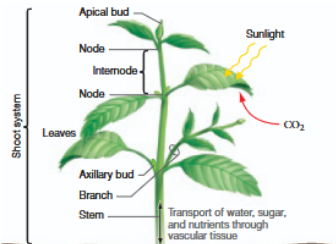
Shoot System Functions
Obtains light and CO₂ from atmosphere to produce sugars (photosynthesis)
Apical/axillary buds develop into flowers
Root System: How structure supports function
Branching pattern + phototropism maximize light capture, minimize shading
Leaf Structure
Blade: expanded, flattened portion
Petiole: stalk attaching blade to stem
Simple leaf: one blade + petiole
Compound leaf: blade divided into leaflets
Doubly compound leaf: leaflets themselves divided again
Leaf Function
Main site of photosynthesis
Leaf: How does structure support function
Flattened shape = highest SA:V of all three systems
maximizes light/CO₂ absorption (Fick's Law)
trade-off = more water loss (transpiration)
Dermal Tissue System
outer-most layer of cells and represents the interface between the organism and the external environment.
Function:
protection & gas exchange in shoots.
protection & water/nutrient absorption in roots.
Epidermal cells
Secrete waxy cuticle; protect from water loss, pathogens, herbivores
Located in outer layer of shoots and leaves
Guard Cells
Surround stomata; open/close pores to regulate gas exchange (CO₂ in, O₂ out) and water loss
located mostly in leaves (also stems)
Trichomes
Hair-like; reflect sunlight, reduce water loss, deter herbivores, trap/digest insects
located in shoot system (leaves/stems)
Root hairs
Increase surface area for absorption
located in roots (zone of maturation)
Ground Tissue System
Parenchyma → thin wall only; photosynthesis (leaves) + storage (roots); totipotent
Collenchyma → uneven thick wall, flexible; support for growing stems
Sclerenchyma → thick rigid wall + lignin; dead at maturity; support/protection
Fibres = long (rope, paper)
Sclereids = short (seed coats, gritty pear texture)
Totipotent
can regenerate whole plant — basis of cuttings/cloning
Vascular Tissue System
Xylem:
One-way transport of water & dissolved nutrients, root → shoot; also structural support.
Phloem:
Two-way transport of sugars, amino acids, hormones (roots ↔ shoots)
Primary Growth
Produced by apical meristem (tip of root/shoot)
Divides: increases length of root and shoot system
3 types of meristems derived from apical meristem
Protoderm → epidermis (dermal)
Ground meristem → parenchyma/collenchyma/sclerenchyma (ground)
Procambium → xylem/phloem (vascular)
Meristem
undifferentiated, dividing cells
Cortex
ground tissue between vascular tissue & epidermis
Cambium
a special type of meristem (also called a lateral meristem) that differs from an apical meristem in two ways.
Secondary Growth
Widens Shoots and Roots
cambium → width/girth (only in woody plants)
2 types of cambium
Vascular cambium → secondary xylem (to the inside) + secondary phloem (to outside)
Cork cambium → cork cells (out only)
Wood
Accumulated secondary xylem
bark
Everything outside vascular cambium (secondary phloem + cork cambium + cork)
Heartwood vs sapwood
Heartwood = old, no longer conducts water, darker; Sapwood = young, still conducts, lighter
Growth rings
Early wood (big, thin-walled, spring) vs late wood (small, thick-walled, dry/cold season
Rays
Parenchyma rows for lateral transport
Lenticles
Gaps in bark for gas exchange