NURS 460 Mental Exam 1
 Call Kai
 Learn
Learn Practice Test
 Spaced Repetition
 Match
Match Flashcards
 Knowt Play
1/93

There's no tags or description
Looks like no tags are added yet.
Name | Mastery | Learn | Test | Matching | Spaced | Call with Kai | Chat |
|---|
No analytics yet
Send a link to your students to track their progress
94 Terms
Mental health definition
WHO definition: State of well-being in which individuals reach their own potential, cope with the normal stresses of life, work productively, and contribute to the community
Normal: Paying for bills if you have a job, transportation, studying, relationship issues
Abnormal: If you got no job then paying bills can be abnormal, one person withdraws in the relationship, etc
Traits of Mental Health
Capacity for…
Rational thinking
Communication skills
Learning
Emotional growth important in life
Resilience (how much can you take, environmental press)
Self-esteem (how you view yourself)
Mental Illness
Psychiatric disorders with definable diagnoses (more fluid, on a spectrum)
Significant dysfunction in mental functioning related to
Developmental
Biological
Physiological disturbances
Culturally defined
Mental Health Continuum
Mental Health versus Mental Illness
Mental Health: A sense of well-being on a daily basis
Mental Illness: Individuals who may have emotional problems and experience mild to moderate discomfort and distress
A real middle ground exists: Stress and discomfort from everyday life
Conceptualized as points along a mental health continuum
Case Study: Scenario
Mrs. M comes to the clinic reporting a feeling of hopelessness. She works full time and is dealing with a troubled teenage son and her elderly parents. She confides in you that she “can’t deal with her life right now.”
Discuss attributes you might screen for to quickly assess her overall mental health.
Support system, Suicide thoughts (will she hurt herself or others), caregiver burnout, worrying of son and elderly parents, juggling with job and caring for her own family
Determinants of Mental Health pt 1
Resilience
Ability and capacity to secure resources needed to support well-being
Characterized by
Ability to secure needed resources
Capacity for regulating one’s own emotions and overcoming negative, self-defeating thoughts
Essential to recovery
Determinants of Mental Health pt 2
Social and economic circumstances
Family help set the stage in promoting confidence and coping skills or for instilling anxiety and feelings of inadequacy
Schools and peer groups
Socioeconomic status
Educational advancement
Environmental factors
Political climate & cultural considerations
Social & economic policies
Social media/entertainment
Perceptions of Mental Health and Mental Illness
Mental illness versus physical illness
Myth of mental illness are all in the head -> Leads to stigma, social shaming, disgrace, and shame
Root of most mental disorders lies in intercellular abnormalities
Both can impact each other
Nature versus nurture
Germ theory of diseases explained that specific environment caused it (theory abandoned)
Psychological theories explained the origin of mental illness as faulty psychological processes that could be corrected by increasing personal insight and understanding
The scientific community began to believe that if psychiatric problems respond to medications that alter neuro-chemistry, then a disruption of intercellular components must already be present
Diathesis-stress model: Nurture + nature argues that both impacts mental health leading to psychiatric disorders
Diathesis-Stress Model
Diathesis—biological predisposition
Stress—environmental stress or trauma
Most accepted explanation for mental illness
Combination of genetic vulnerability and negative environmental stressors
Assertion: Most psychiatric disorders result from a combination of genetic vulnerability and negative environmental stressors
Case Study: Scenario
Mrs. M has a history of major depressive disorder.
“Do we have to deal with that?” she says. “Can’t we just focus on my insomnia? If I could just get something to help me sleep at night, I think I’d cope better right away. Besides—insomnia would be covered by my health insurance. It’s an uphill battle getting compensated for any treatment for the other. Fighting with insurance people is not going to help anything!”
Need to understand that depression and insomnia are related to each other
Insurance/financial aspect
Response: I see that insomnia is affecting your life and that you want to manage it. Insomnia can be one of the signs of depression and lack of sleep can cause lost of focus and less energy during the day. How about we explore options within your insurance coverage to help manage your insomnia and depression?
National Influences on Mental Healthcare (extra info)
Consumer movement & mental health recovery
Promoted concept of recovery + consumer-focused process
National Alliance on Mental Illness (NAMI) created by people with mental illnesses and their families start to resist the traditional arrangement of mental healthcare
Decade of the Brain
President Bush Era: More awareness of advances in neuroscience and brain research
Research on the nervous system has advanced understanding of genetic brain development, neurological disorders, neurotransmitters, cytokines, and neuroimaging techniques. It has also led to computational neuroscience, which combines computer modeling with laboratory research to better understand brain function and disease.
Surgeon General’s Report On Mental Health (1999)
(1) mental health is fundamental to overall health and (2) there are effective treatments
Human Genome Project goals
identify human genes, determine the sequence of 3 billion DNA base pairs, store and analyze genetic information, and improve research tools.
It also addressed the ethical, legal, and social issues related to genetic information.
President’s New Freedom Commission on Mental Health advocated for early diagnosis and treatment, adoption of principles of recovery, and increased assistance in helping people find housing and work
Institute of Medicine
The 2005 Quality Chasm Series emphasized safe, effective, patient-centered, timely, efficient, and equitable mental health care, while addressing issues such as forced treatment and separating mental from physical health care.
The 2011 Future of Nursing report called for better-educated nurses trained in leadership, research, health policy, teamwork, and system improvement to meet the needs of a complex and diverse population.
Brain Research through Advancing Innovative Neurotechnologies (BRAIN) Initiative
goal is to uncover new ways to prevent, treat, and cure psychiatric disorders, epilepsy, and traumatic brain injury
Research Domain Criteria (RDoC) Initiative
challenges researchers to seek causes for mental disorders at the molecular level
Legislation and Mental Health Funding
Mental Health Parity Act (1996)
Parity = Equivalence
Required insurance companies to provide equal treatment coverage for psychiatric disorders
Wellstone-Domenici Parity Act (2008)
required group health plans with more than 50 employees to provide mental health coverage comparable to coverage for physical health conditions.
This included equal treatment of deductibles, copayments, out-of-pocket costs, and treatment limitations
Patient Protection and Affordable Care Act (2010)
Coverage for most uninsured Americans through expanded Medicaid eligibility (for very poor)
Created health insurance exchanges to offer more choices
“Insurance mandate” for coverage
Epidemiology of Mental Disorders
Epidemiology, as it applies to psychiatric-mental health, is the quantitative study of the distribution of mental disorders in human populations
Individuals may have more than one mental disorder or another medical disorder. The presence of two or more disorders is known as comorbidity
High risk groups: Homelessness, Healthcare workers, genetic predisposition, Older adults (loneliness), adolescence (social media), immigrants,

Clinical Epidemiology
Groups treated for specific mental disorders studied for
Natural history of illness: no treatment and left to run its course
Diagnostic screening tests
Observations and experimental studies of Interventions
Results used to describe frequency of
Mental disorders
Symptoms appearing together
Case Study: Question 1
One of Mrs. M’s complaints is about insurance. Which of the following does the Mental Health Parity Act provide?
Coverage for most uninsured Americans through expanded Medicaid eligibility
Health insurance exchanges
“Insurance mandate” for coverage
Equal coverage for mental health disorders
Equal coverage for mental health disorders
Classification of Mental Disorders
The Diagnostic and Statistical Manual of Mental Disorders, 5th Edition
Official medical guidelines of the American Psychiatric Association for diagnosing psychiatric disorders
Based on specific criteria influenced by multiprofessional clinical field trials
DSM-5 is the dominant method of categorizing and diagnosing mental illness in the United States and is the framework for clinical disorders in this textbook
DSM-5
identifies and classifies mental disorders using specific diagnostic criteria and is used across various healthcare settings.
It also helps collect epidemiological data on psychiatric disorders
classifies mental disorders, not people, so healthcare professionals should avoid stigmatizing labels. Instead, use person-first language, such as “an individual with schizophrenia” or “a patient with major depressive disorder.”
International Classification of Diseases ICD-10-CM
ICD-10-CM
International Classification of Diseases, 10e
Clinical descriptions of mental and behavior disorders
2 broad classifications
Subclassifications
Psychiatric Mental Health Nursing
Promoting mental health through assessment, diagnosis, and treatment of behavioral and mental disorders
Use nursing, psychosocial, neurobiological theories and research
Work with people throughout the life span
Employed in a variety of settings and among varied populations
Classification of Nursing Diagnoses
International Classification for Nursing Practice (ICNP)
Developed by the International Council of Nurses (ICN)
Provides standardized nursing diagnoses
Psychiatric-Mental Health Nurse Education Levels
Basic Level
Psychiatric mental health registered nurse (PMH-RN)
2 years full-time work, 2000 clinical hours, 30 hours continuing education, followed by certification exam to add “BC” to the RN title (RN-BC)
Advanced Practice
Psychiatric-mental health advanced practice registered nurse (PMH-APRN)
Master of Science (MSN) or Doctor of Nursing Practice (DNP)
Trends Impacting Psychiatric-Mental Health Nursing
Educational challenges of how long patients are being cared for versus needed more skilled nurses (plus clinical placements difficulties)
Demand for mental health professionals
Aging population grows
Cultural competence maintenance and improvements
Legal and ethical implications of Science, technology, and electronic healthcare
Advocacy & legislative involvement of HIPPA, higher-authority immediate action, being active in consumer mental health groups/awareness of current mental health legislation
PSYCHOANALYTIC THEORY (1 OF 3)
Freud’s Levels of Awareness - Iceberg
Conscious
Contains all the material a person is aware of at any one time
Preconscious
Contains material that can be retrieved rather easily through conscious effort
Unconscious
Includes all repressed memories, passions, and unacceptable urges lying deep below the surface
PSYCHOANALYTIC THEORY (2 OF 3)
Personality structure
Id (at birth) - unconscious/impulsive
Pleasure principle
Reflex action
Primary process
Ego (first few years of life) - all levels of awareness
Problem solver
Reality tester
Superego (3-5 yrs old) - all levels of awareness
Moral component
contains the internalized “shoulds” and “should nots” learned from parents and society. It can cause guilt when behavior falls short of expectations and pride when behavior meets ideals.
PSYCHOANALYTIC THEORY (3 OF 3)
Defense mechanisms and anxiety
Operate on unconscious level
Deny, falsify, or distort reality to make it less threatening
Ward off anxiety by preventing conscious awareness of threatening feelings
FREUD’S PSYCHOSEXUAL STAGES OF DEVELOPMENT
Oral (0 to 1 year)
Anal (1 to 3 years)
Phallic (oedipal) (3 to 6 years)
Latency (6 to 12 years)
Genital (12 years and beyond)
CLASSICAL PSYCHOANALYSIS
Seldom used today
Intrapsychic conflict no longer considered to be the cause of all mental illness
Free association
Dream analysis
Defense mechanism recognition
Valid tools and concepts
Transference: unconscious feelings of patient toward a healthcare worker that were originally felt in childhood for significant other
Countertransference: unconscious feelings that healthcare worker has toward the patient
PSYCHODYNAMIC THERAPY
Freud’s theory emphasizes how childhood experiences and unconscious influences shape personality and behavior.
Nurses can use this understanding to identify underlying causes of patient distress and provide support, education, and attentive listening to promote emotional well-being.
INTERPERSONAL THEORY
Purpose of all behavior is to get needs met through interpersonal interactions and to reduce or avoid anxiety
Anxiety: painful feeling or emotion that arises from social insecurity or prevents biological needs from being satisfied
Security operations: measures the individual employs to reduce anxiety and enhance security
Self-system: all of the security operations an individual uses to defend against anxiety and ensure self-esteem
Interpersonal therapy is most effective in treating:
Grief and loss
Interpersonal disputes with significant other
Role transition in life status/social role
IMPLICATIONS OF INTERPERSONAL THEORY TO NURSING
Foundations: Hildegard Peplau
Nurse as both participant & observer
Self-awareness helps keep focus on patient and make positive changes (keep nurses’ needs out of the equation)
Application of Sullivan’s theory of anxiety (differ levels) to nursing practice
Lowering patients’ anxiety improves ability to think and function
BEHAVIORAL THEORY (1 OF 2)
Pavlov’s classical conditioning theory
Pairing a behavior with a condition that reinforces/diminishes the behavior’s occurrence
Dog, bell, and food
-Watson’s behavioral theory: controlling environment could mold behavior
-Skinner’s operant conditioning theory: Learning that occurs through rewards and punishment for voluntary behavior (positive/negative reinforcement)
Extinction decreases a behavior by withholding a reward or reinforcement that previously encouraged it. For example, ignoring attention-seeking behavior can make the person less likely to repeat it.
Implications for nursing
Modifying or replacing behaviors
Behavior management
BEHAVIORAL THEORY (2 OF 2) - modeling types
Modeling for specific identified behaviors
Operant conditioning is the basis for behavior modification and uses positive reinforcement to increase desired
Exposure therapy for people who experience anxiety due to fears, phobias, or traumatic memories by exposing them to their fears
Aversion therapy is pairing a target behavior with a negative stimulus
Biofeedback is another form of behavioral therapy and help with body’s physiological response to stress and anxiety
COGNITIVE THEORY AND THERAPIES
Dynamic interplay between individuals and the environment
Thoughts come before feelings and actions
Thoughts about the world and our place in it are based on our own unique perspectives, which may or may not be based on reality.
RATIONAL-EMOTIVE THERAPY (ELLIS)
Aims to eradicate irrational beliefs
Recognize thoughts that are not accurate
ABC
A: Activating event
B: Beliefs about the event
C: Emotional consequences as a result of the event
COGNITIVE BEHAVIORAL THERAPY (BECK)
Active, directive, time-limited, structures approach
Identify and test distorted beliefs and change way of thinking; reduce symptoms
Ellis noted that, although we cannot change the past, we can change the way we are now
-Automatic thoughts are rapid, unthinking responses that can involve irrational cognitive distortions, which are common in disorders such as depression and anxiety.
-Cognitive behavioral therapy (CBT) helps patients identify, challenge, and replace distorted or negative thoughts with more realistic and positive ones.
-Homework, such as thought records, helps patients identify situations, emotions, automatic thoughts, and alternative interpretations to change unhealthy thinking patterns.
TRAUMA-FOCUSED COGNITIVE BEHAVIORAL THERAPY (TF-CBT )
Newer treatment developed to address sexual abuse trauma in children; expanded for all ages
Short-term, incorporating caregivers and family therapy
Helps children and adolescents identify feelings and how to manage them
DIALECTICAL BEHAVIORAL THERAPY (1 OF 2)
Long-term therapy (1 to 1.5 years) that uses strategies from CBT and other skills to enhance emotional regulation
Integration of opposites – dialectical strategies help the patient (and the therapist) to give up extreme positions
Developed for individuals with intractable behavioral disorders involving emotional dysregulation
Employs CBT elements
Mindfulness
Distress tolerance
Interpersonal effectiveness
Emotional regulation
IMPLICATIONS OF COGNITIVE THEORIES FOR NURSING
Recognizing the interplay between events, negative thinking, and negative responses
Helping the patient identify negative thought patterns
-Nurses can help patients identify negative thought patterns and cognitive distortions, using tools such as workbooks to support this process.
-The cognitive approach also helps nurses recognize their own distorted thoughts, such as overgeneralizing or personalizing difficult situations.
-Nurses should challenge negative thoughts that are not based on facts and replace them with more realistic and accurate perspectives.
THEORY OF HUMAN MOTIVATION
Asserts that psychology must go beyond experiences of hate, pain, misery, guilt, and conflict to include love, compassion, happiness, exhilaration, and well-being
Human beings are active participants in life, striving for self-actualization
When lower needs are met, higher needs are able to emerge
MASLOW’S HIERARCHY OF NEEDS
Human beings are active participants in life, striving for self-actualization
When lower needs are met, higher needs are able to emerge
Physiological needs
Safety (security, protection, stability, structure, order, limits)
Belonging and love needs
Esteem needs (competency, achievement, esteem from others)
Self-actualization: one's potential is fully realized
Self-transcendence: personality trait that involves the expansion or evaporation of personal boundaries
IMPLICATIONS OF MOTIVATION THEORY FOR NURSING
Emphasis on human potential and the patient’s strengths
Prioritizing: establishes what is most important in the sequencing of nursing actions
Following Maslow’s model as a way of prioritizing actions, the nurse meets the patient’s physiological need for stable vital signs and pain relief before collecting general information for a nursing database.
BIOLOGICAL MODEL
Focus on
Neurological
Chemical
Biological
Genetic
How the body and brain interact to create
Emotions
Memories
Perceptual experiences
Consider other influences that play a role in the development and treatment of mental disorders
Social, environmental, cultural, economic
Focus on
Qualities of a therapeutic relationship
Understanding patient’s perspective
Communicating to facilitate recovery
BIOLOGICAL THERAPIES
Pharmacotherapy
Use of medication to treat psychiatric illness
Neuromodulation
Electroconvulsive therapy (ECT)
Transcranial magnetic stimulation—repetitive (TMS)
Vagus nerve stimulation (VNS)
Deep brain stimulation (DBS)
Brain Stimulation therapies: focused electrical stimulation of brain to treat psychiatric and neurological disorders
IMPLICATIONS THE BIOLOGICAL MODEL FOR NURSING
Physical needs and physical care in psychiatric nursing are part of a holistic approach to healthcare.
Focusing on the qualities of a therapeutic relationship, understanding the patient’s perspective, and communicating in a way that facilitates the patient’s recovery take place alongside physical care
Psychiatric nurses administer medications and monitor patients’ sleep, activity, nutrition, hydration, elimination, and other physical needs. They also prepare patients for somatic therapies such as ECT. Overall, psychiatric nursing provides holistic care that addresses both physical and mental health needs.
DEVELOPMENTAL THEORIES
Cognitive development (Piaget)
Sensorimotor stage: basic reflexes to purposeful movement and coordination, with object permanence emerging around 9 months as infants learn that objects continue to exist even when they cannot see them
Preoperational stage: children think logically about specific objects but struggle with abstract thinking, egocentrism, and conservation, such as believing a tall, thin glass holds more liquid than a short, wide glass
Concrete operational stage: children develop logical and abstract thinking, can understand others’ perspectives, and solve problems using multiple solutions. They also develop conservation, classification, sequencing, and reversibility skills.
Formal operational stage: During adolescence, conceptual and abstract reasoning develops around puberty, allowing the child to think, problem-solve, and reason in ways similar to an adult.
Theory of psychosocial development (Erikson)
Eight stages of development: successfully completing each developmental stage leads to a positive outcome and helps individuals progress to the next stage, while failure can lead to negative outcomes.
During industry versus inferiority (ages 7–12), children develop competence and peer relationships, resulting in confidence if successful or feelings of failure and inferiority if unsuccessful
Personality continues to develop through old age
Theory of object relations (Mahler)
Past relationships influence sense of self and present relationships
The term object refers to another person, particularly a significant person
During the first 3 years, a caregiver provides a secure base that helps the child feel safe while developing independence and exploring the environment.
Consistent support, reassurance, and “good enough parenting” promote healthy separation-individuation.
STAGES OF MORAL DEVELOPMENT (KOHLBERG)
Preconventional Level
Stage 1: Obedience & punishment = following rules and obeying authority to avoid punishment
Stage 2: Individualism & exchange = Individuals recognize that people may have different perspectives and views of rules, but breaking rules can still result in punishment
Conventional Level
Stage 3: Good interpersonal relationships = Children begin to judge right and wrong based on a person’s intentions, personality, and character, while valuing harmony and shared values with others.
Stage 4: Maintaining social order = Individuals follow rules to maintain social order, rather than simply to avoid punishment. They recognize the importance of authority, laws, and societal structure.
Postconventional Level
Stage 5: Social contract & individual rights = value social order but believe that laws should be fair and protect people’s rights. If laws are unjust or corrupt, they believe they should be changed to promote justice and protect others
Stage 6: Universal ethical principles = actions should promote justice and fairness for everyone, even if that means breaking unjust laws
ETHICS OF CARE THEORY (GILLIGAN)
Worked with Kohlberg
Later criticized his work as favoring males
Suggests that a “morality of care” should replace Kohlberg’s “justice view” of morality
Emphasizes relationships, banding together
Emphasizes putting the needs of those for whom we care above the needs of strangers
Ties progress to personal development and sense of self more than cognition
CONCEPTS CENTRAL TO THE NURSE–PATIENT RELATIONSHIP
Patient-Centered Care
Dignity and respect
Information sharing
Patient and family participation
Collaboration in policy and program development
Clear and appropriate boundaries
THERAPEUTIC USE OF SELF
Safe, confidential, reliable, and consistent
Use personality consciously and in full awareness
Attempt to establish relatedness
Structure nursing interventions
IMPORTANCE OF TALK THERAPY
Advanced practice registered nurses
Based on psychotherapy
Changes brain chemistry in much the same way as medication.
Best treatment for most psychiatric problems: a combination of medication and psychotherapy
Basic-level psychiatric mental health nurses uses counseling with a supportive face-to-face process that help individuals problem solve, resolve personal conflicts, and feel supported
GOALS AND FUNCTIONS of theraputic relationship
Facilitate communication of distressing thoughts and feelings
Assist patient with problem solving
Help patient examine self-defeating behaviors and test alternatives
Promote self-care and independence
-Provide education about disorders and treatments
-Uses recovery which that begins with diagnoses and eventual management of psychiatric condition with patient being involved in their care with increasing daily and social support
Differ RELATIONSHIPS
PERSONAL RELATIONSHIPS
Initiated for the purpose of friendship, socialization, enjoyment, or accomplishment of a task
Mutual needs are met
Communication to give advice, give, or ask for help
Content of communication superficial
THERAPEUTIC RELATIONSHIPS
Needs of patient identified and explored
Clear boundaries established
Problem-solving approaches taken
New coping skills developed
Behavioral change encouraged
Clinical supervision between instructor and nursing student
Therapeutic encounter when nurse and patient have met few times only
RELATIONSHIP BOUNDARIES & ROLES
Boundary crossings: least serious form of over-involvement where something is not right and does not violate ethical standards (self-awareness and supervision can correct these types of behaviors)
-Two common circumstances in which boundaries are crossed are (1) when the relationship slips into a personal context and (2) when the nurse’s needs (for attention, affection, and emotional support) are met at the expense of the patient’s needs.
Boundary violations: reversal of roles where the needs of the nurse are being met rather than the needs of the patient

BLURRING OF ROLES
Transference
Patient unconsciously and inappropriately displaces onto nurse feelings and behaviors related to significant figures in patient’s past
Countertransference
Nurse unconsciously displaces feelings related to significant figures in the nurse’s past onto the patient
Countertransference—nurse displaces feelings related to people in nurse’s past onto patient
Patient’s transference to nurse often results in countertransference in nurse
Common sign of countertransference in nurse is overidentification with the patient
Recognizing and addressing transference and countertransference is important for professional growth and helping patients achieve their goals. Peer or team supervision can provide support in managing these issues and improving therapeutic relationships.
A FOCUS ON SELF-AWARENESS
Nurse’s values and beliefs
Values: abstract standards and represent an ideal, either positive or negative
Beliefs: An opinion that something you hold to be true, confidence, trust, or faith, and religious tenets, creed, or faith
Reflect own culture/subculture
Derived from range of choices
Chosen from a variety of influences and role models
PEPLAU’S MODEL OF NURSE–PATIENT RELATIONSHIP
Preorientation phase
Before meeting a psychiatric patient, nurses should review the patient’s information, recognize their own feelings, and follow safety guidelines to provide effective and safe care
Orientation phase
first meeting between the nurse and patient, where the nurse conducts an initial interview and helps the patient express thoughts and feelings, identify problems, and establish realistic goals
Introduction, establishing rapport, specifying a contract, and explaining confidentiality
Working phase
Nurses and patients identify problems, develop healthier coping behaviors, manage symptoms, and work toward goals.
The nurse also provides education about the disorder, medications, and treatments while evaluating the patient’s progress
Termination phase
Final stage of the nurse-patient relationship, where the nurse reviews goals, education, coping strategies, progress, and plans for follow-up care.
It also provides closure and an opportunity to address feelings about separation, while reinforcing medications, symptom management, and available support resources.
PREORIENTATION PHASE
Preparing for your assignment
Researching the patient’s history
Recognizing one’s own thoughts and feelings about meeting this patient
Anticipating and setting ground rules before the first meeting
ORIENTATION PHASE
Establishing rapport
Parameters of the relationship
Formal or informal contract
Confidentiality
Terms of termination
WORKING PHASE
Maintain relationship
Gather further data
Promote patient’s
Problem-solving skills
Self-esteem
Use of language
Facilitate behavioral change
Overcome resistant behaviors
Evaluate problems and goals
Redefine them as necessary
Promote practice and expression of alternative adaptive behaviors
TERMINATION PHASE
Summarize goals and objectives achieved
Discuss ways for patient to incorporate new coping strategies learned
Review situations of relationship
Exchange memories
FACTORS THAT PROMOTE PATIENTS GROWTH
Genuineness (open, honest, and authentic interactions)
Empathy (not sympathy): understanding the feelings of others that conveys respect, acceptance, and validation of the patient’s strengths
Positive regard: Respect a person and viewing another person as being worthy of caring about and as someone who has strengths and achievement potential
Attitudes
Actions
Attending (special kind of listening that refers to an intensity of presence or being with the patient
Suspending value judgments
-(1) recognize their presence, (2) identify how or where you learned these responses, and (3) construct alternative ways to view the patient’s thinking and behavior.
Helping patients develop resources
Theoretical Models of Communication
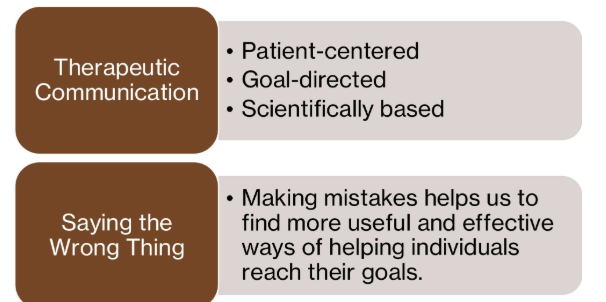
Wrong things: Personal info, playing down their feelings, false reassurance, etc
Therapeutic Communication benefits
Benefits to The Patient
Feeling safer and protected
More satisfied with the care
Increased recovery rates
Improved adherence to treatment
The Transactional Model
Communicators: Sender and receiver roles are fluid and interdependent; communication requires both parties to participate.
Message: The ideas or information being exchanged, including verbal and nonverbal cues such as tone and body language.
Channel: The method used to communicate, such as in person or telepsychiatry.
Feedback: Responses exchanged continuously between both communicators.
Encoding/Decoding: Encoding means creating a message; decoding means interpreting its meaning.
Context: Factors that influence communication: Social: Rules and norms for interaction.
Relational: Relationship history and type. Cultural: Cultural identity and background that influence communication.
Environmental Noise: Barriers that interfere with communication:
Physical: Loud noises, music, or announcements.
Physiological: Illness, pain, headache, or fatigue.
Psychological: Stress, worries, or lack of desire to communicate.

Peplau’s Interpersonal Theory
Guiding Principles in Communication
Clarity: Ensures that the meaning of the message is accurately understood by both parties (can you repeat what you said, can you rephrase what you said, etc)
Continuity: Promotes connections among ideas, feelings, events, and themes
Factors That Affect Communication
Personal factors
Depression: not thinking clearly
Cognition: learning disability
Language/cultural barriers
Environmental factors
The setting (privacy, place to talk)
Relationship factors
Level of equality within the relationship (openness to talk to equal the leveling field)
Types of Communication
Verbal Communication
All words a person speaks
Communicates
Beliefs and values
Perceptions and meaning
Can convey
Interest and understanding
Insult and judgment
Clear or conflicting messages
Honest or distorted feelings
Nonverbal Communication
Tone of voice (important, instill an understanding that you are calm, focused, engaged, etc)
Emphasis on certain words
Physical appearance
Facial expressions
Body posture
Amount of eye contact
Hand gestures
Interaction of Verbal and Nonverbal Communication
Messages can appear to be one thing when in fact they are another.
People are often less aware of their nonverbal messages and behaviors.
Verbal messages can be called the content, while the nonverbal behavior is the process.
Double-bind messages: Mutually contradictory messages, usually given by a person in power.
Therapeutic Communication Techniques vs non
Therapeutic Communication Techniques
Silence
Active listening
Clarifying techniques: Paraphrasing, restating, reflecting and exploring
Questions
Open-ended
Closed-ended
Projective (what if)
The miracle question
Nontherapeutic Communication Techniques
Excessive questioning
Giving approval or disapproval (noo noo nooo, be objective)
Giving advice
Asking “why” questions (keep them open-ended)
Cultural Considerations
Communication styles: Cultural differences can influence how emotions are expressed and interpreted, as expressive body language may be viewed as normal in some cultures but as distress or pathology in others
Use of eye contact: nurses should not assume that avoiding eye contact means disinterest, dishonesty, or disrespect. Direct eye contact may be viewed as respectful, disrespectful, aggressive, or inappropriate depending on the person’s culture and circumstances
Perception of touch: provide warmth, support, and comfort, but its meaning varies by culture, individual, gender, and personal experiences. Nurses should respect boundaries and follow facility “no-touch” policies, especially when caring for children or adolescents with a history of inappropriate touch
Cultural filters: influence how we listen and interpret information, which can introduce personal and cultural biases. Recognizing that people have different perspectives, beliefs, and behaviors helps nurses reduce bias and improve cultural understanding and communication
Information Communication Technologies
Information communication technology and telehealth improve access to psychiatric care by providing current health information and remote services, especially for people facing stigma, limited providers, or transportation barriers
Information Communication Technologies (2 of 4)
Telehealth Technologies
Video conferencing
Internet sources
Phone consultation and counseling
Image transmission
Interactive video sessions
Information Communication Technologies (3 of 4)
Mobile Applications
Monitor, diagnose, treat, and communicate with patients
Mobile phones are used at a high rate
Many quickly adoptable apps available
More research is needed
SAMHSA free apps for suicide prevention, bullying prevention, and underage drinking prevention
Information Communication Technologies (4 of 4)
Some Concerns
Privacy and confidentiality issues
Lack of data for efficacy and safety
Liability issues
Research is needed to evaluate risks versus benefits
Professional and ethical guidelines needed

The Counseling Session
Preparing for the session
-Pace: Match the patient’s pace; allow more time for slowed thinking and use shorter, more frequent sessions for mania.
-Setting: Choose a quiet, private, and safe environment that promotes comfort and security.
-Seating: Sit or stand at the same level as the patient, maintain comfortable positioning, and ensure the patient is not between the nurse and the exit for safety.
Introductions then use open ended questions with appropriately offering leads (e.g., “Go on”), making statements of acceptance (e.g., “Uh-huh”), or otherwise conveying interest
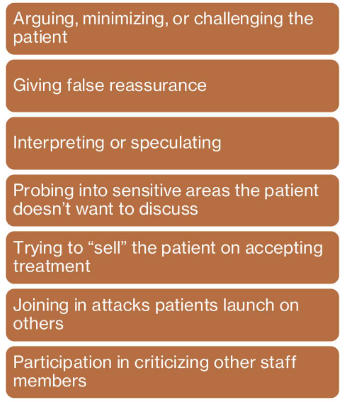
Tactics to Avoid
Behaviors that support counseling
Tactics to Avoid
Behaviors that Support Counseling: Attending Behaviors
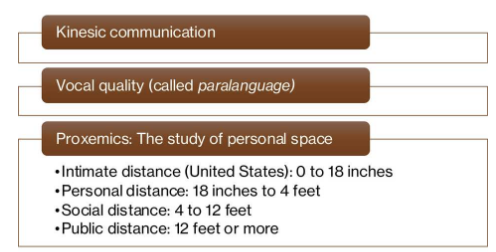
Kinesic communication is a type of nonverbal communication made by body movement. Facial expressions, body posture, and gestures are all kinesic types of communication
Paralanguage refers to nonverbal aspects of speech, such as volume, pitch, rate, and fluency, which can show empathy, build rapport, and emphasize meaning
Evaluation of Communication Skills
Debriefing is a structured conversation and reflection after an experience that promotes learning, growth, and clinical understanding by connecting knowledge with how and why it is applied

Process Recording
Reviewing clinical interactions helps nurses identify communication patterns, improve interviewing skills, and prepare for different situations that may arise during patient interactions
