3 - Adverse Drug Reactions
 Call Kai
 Learn
Learn Practice Test
 Spaced Repetition
 Match
Match Flashcards
 Knowt Play
1/125

Earn XP
Description and Tags
Proverbs 16:3
Name | Mastery | Learn | Test | Matching | Spaced | Call with Kai | Chat |
|---|
No analytics yet
Send a link to your students to track their progress
126 Terms
a. Type A (augmented)
This type of adverse drug reaction is an extension of the pharmacologic action of the drug
a. Type A (augmented)
b. Type B (bizarre)
c. Type C (continuous)
d. Type D (delayed)
e. Type E (end of use)
f. Type F (failure of therapy)
a. Type A (augmented)
Common and predictable
Dose dependent (↑ dose likely to occur)
a. Type A (augmented)
b. Type B (bizarre)
c. Type C (continuous)
d. Type D (delayed)
e. Type E (end of use)
f. Type F (failure of therapy)
b. Sulfonylureas
[Augmented ADRs]
This class of antidiabetic drugs, identified by the suffix "-ide," acts as an insulin secretagogue
a. Biguanides
b. Sulfonylureas
c. Thiazolidinediones
d. DPP-4 inhibitors
b. Insulin secretagogues
[Augmented ADRs]
Sulfonylureas act as _______, leading to hypoglycemia.
a. Insulin sensitizers
b. Insulin secretagogues
c. Alpha-glucosidase inhibitors
d. SGLT2 inhibitors
b. Hypoglycemia
[Augmented ADRs]
Sulfonylureas act as insulin secretagogues, leading to this adverse effect
a. Hyperglycemia
b. Hypoglycemia
c. Hyperkalemia
d. Hyponatremia
c. Bradycardia
[Augmented ADRs]
Beta blockers commonly cause this adverse effect on heart rate
a. Tachycardia
b. Palpitations
c. Bradycardia
d. Arrhythmia only
d. < 60 bpm
[Augmented ADRs]
Bradycardia caused by beta blockers is defined as a heart rate below this value
a. < 100 bpm
b. < 80 bpm
c. < 70 bpm
d. < 60 bpm
b. Drowsiness
[Augmented ADRs]
Antihistamines commonly cause this adverse effect
a. Insomnia
b. Drowsiness
c. Agitation
d. Tremors
b. Wakefulness signal
[Augmented ADRs]
Histamine functions as this type of signal in the body
a. Sleep signal
b. Wakefulness signal
c. Hunger signal
d. Pain signal
b. Block it
[Augmented ADRs]
Antihistamines cause drowsiness because they _____ the wakefulness signal (histamine)
a. Enhance it
b. Block it
c. Prolong it
d. Have no effect on it
b. Type B (bizarre)
This type of adverse drug reaction is described as "weird, strange, different"
a. Type A (augmented)
b. Type B (bizarre)
c. Type C (continuous)
d. Type D (delayed)
e. Type E (end of use)
f. Type F (failure of therapy)
b. Type B (bizarre)
Unpredictable
Not dose dependent
a. Type A (augmented)
b. Type B (bizarre)
c. Type C (continuous)
d. Type D (delayed)
e. Type E (end of use)
f. Type F (failure of therapy)
c. Idiosyncratic reaction
[Bizarre ADRs - Idiosyncratic Reactions]
This term describes an abnormal, genetically predetermined response to a drug
a. Hypersensitivity reaction
b. Anaphylactic reaction
c. Idiosyncratic reaction
d. Cytotoxic reaction
Red man syndrome
Stevens-Johnson Syndrome (SJS)
[Bizarre ADRs - Idiosyncratic Reactions]
Examples of idiosyncratic reactions under Type B (Bizarre) ADRs include:
a. Red man syndrome and Stevens-Johnson Syndrome (SJS)
b. Hypoglycemia and bleeding
c. Cushing's syndrome and osteoporosis
d. Rebound hypertension and withdrawal symptoms
c. Vancomycin
[Bizarre ADRs - Idiosyncratic Reactions]
This drug commonly causes red man syndrome
a. Carbamazepine
b. Allopurinol
c. Vancomycin
d. Chloramphenicol
b. Slowing down the infusion
[Bizarre ADRs - Idiosyncratic Reactions]
Red man syndrome is managed by doing this to the infusion
a. Speeding up the infusion
b. Slowing down the infusion
c. Stopping the infusion permanently
d. Doubling the infusion dose
b. Carbamazepine
[Bizarre ADRs - Idiosyncratic Reactions]
This anticonvulsant is associated with Stevens-Johnson Syndrome (SJS)
a. Allopurinol
b. Carbamazepine
c. Vancomycin
d. Procainamide
b. Allopurinol
[Bizarre ADRs - Idiosyncratic Reactions]
This drug lowers uric acid levels or treats hyperuricemia by inhibiting xanthine oxidase.
a. Probenecid
b. Allopurinol
c. Febuxostat
d. Sulfinpyrazone
b. Xanthine oxidase
[Bizarre ADRs - Idiosyncratic Reactions]
Allopurinol lowers uric acid levels or treat HYPERuricemia by inhibiting this enzyme.
a. Monoamine oxidase
b. Xanthine oxidase
c. Cytochrome P450
d. Acetylcholinesterase
b. NSAIDs
[Bizarre ADRs - Idiosyncratic Reactions]
Drugs with the suffix "-oxicam" belong to which drug class?
a. Penicillins
b. NSAIDs
c. Opioids
d. Cephalosporins
a. NSAIDs (-oxicam)
[Bizarre ADRs - Idiosyncratic Reactions]
Drug class associated with Stevens-Johnson Syndrome (SJS) and contains the suffix "-oxicam."
a. NSAIDs
b. Penicillins
c. Cephalosporins
d. Macrolides
c. Hypersensitivity reaction
[Bizarre ADRs]
This term describes an exaggerated immune response
a. Idiosyncratic reaction
b. Anaphylaxis
c. Hypersensitivity reaction
d. Drug-induced lupus
a. Type I
[Bizarre ADRs - Hypersensitivity]
This type of hypersensitivity reaction is:
IgE mediated hypersensitivity reaction.
Immediate hypersensitivity reaction.
a. Type I
b. Type II
c. Type III
d. Type IV
a. Histamine release
[Bizarre ADRs - Hypersensitivity]
In Type I hypersensitivity, antigen/allergen binds to mast cells triggering ______
a. Histamine release
b. Cytokine release
c. Antibody production
d. Complement activation
c. Allergy and Anaphylaxis
[Bizarre ADRs - Hypersensitivity]
Histamine release in Type I hypersensitivity causes _________
a. Contact dermatitis and organ rejection
b. Hemolytic anemia and thrombocytopenia
c. Allergy and Anaphylaxis
d. Drug-induced lupus and rash
b. Type II
[Bizarre ADRs - Hypersensitivity]
Antibody mediated hypersensitivity reaction.
Cytotoxic hypersensitivity reaction.
a. Type I
b. Type II
c. Type III
d. Type IV
c. IgM and IgG
[Bizarre ADRs - Hypersensitivity]
In Type II hypersensitivity, these antibodies destroy cells
a. IgA and IgD
b. IgE only
c. IgM and IgG
d. IgG4 only
b. Blood cells
[Bizarre ADRs - Hypersensitivity]
In Type II hypersensitivity, this component of blood is most commonly targeted
a. Platelets only
b. Blood cells
c. Plasma proteins
d. Endothelial cells
c. IgM
[Bizarre ADRs - Hypersensitivity]
This antibody comes first in Type II hypersensitivity
This immunoglobulin is a pentamer.
a. IgG
b. IgA
c. IgM
d. IgE
b. IgG
[Bizarre ADRs - Hypersensitivity]
This antibody is for chronic/long term immunity
a. IgM
b. IgG
c. IgE
d. IgA
c. Hemolytic anemia
[Bizarre ADRs - Hypersensitivity]
Methyldopa, an a2 agonist, causes _______ anemia by targeting RBCs for lysis
a. Aplastic anemia
b. Megaloblastic anemia
c. Hemolytic anemia
d. Iron deficiency anemia
c. Aplastic anemia
[Bizarre ADRs - Hypersensitivity]
Chloramphenicol causes______ characterized by decreased RBC, WBC, and platelets
a. Hemolytic anemia
b. Gray baby syndrome
c. Aplastic anemia
d. HIT
b. Metabolism
[Bizarre ADRs - Hypersensitivity]
Gray baby syndrome caused by chloramphenicol is due to _________ , not Type II hypersensitivity
a. Immune complex formation
b. Metabolism
c. T cell activation
d. IgE release
Gray baby syndrome
Hemolytic anemia
[Bizarre ADRs - Hypersensitivity]
Chloramphenicol can cause ______ [2]
b. Heparin-Induced Thrombocytopenia (HIT)
[Bizarre ADRs - Hypersensitivity]
Heparin causes this condition _______
a. Hemolytic anemia (HA)
b. Heparin-Induced Thrombocytopenia (HIT)
c. Hepatic Immune Toxicity (HIT)
d. Hyperimmune Thrombosis (HT)
c. Decreased platelets
[Bizarre ADRs - Hypersensitivity]
HIT (Heparin Induced Thrombocytopenia) results in_______ platelets
a. Increased platelets
b. No change in platelets
c. Decreased platelets
d. Platelet aggregation only
c. Type III
[Bizarre ADRs - Hypersensitivity]
Immune complex mediated hypersensitivity reaction.
a. Type I
b. Type II
c. Type III
d. Type IV
c. Formation of Ab-Ag complex
[Bizarre ADRs - Hypersensitivity]
In Type III hypersensitivity, instead of the antibody destroying the antigen, this occurs
a. Direct cell lysis
b. T cell activation
c. Formation of Ab-Ag complex
d. Mast cell degranulation
b. Skin, joints, kidneys
[Bizarre ADRs - Hypersensitivity]
Type III hypersensitivity most commonly affects these organs/tissues
a. Heart, lungs, brain
b. Skin, joints, kidneys
c. Liver, spleen, pancreas
d. Bone marrow only
Hydralazine
Isoniazid
Procainamide
Sulfonamide
📌Mnemonic: “HIPS”
[Bizarre ADRs - Hypersensitivity]
Drugs that causes lupus include _____ [4]
a. True
[Bizarre ADRs - Hypersensitivity]
Procainamide is an antiarrhythmic drug (class IA)
a. True
b. False
d. Type IV
[Bizarre ADRs - Hypersensitivity]
Delayed mediated hypersensitivity reaction.
Cell mediated hypersensitivity reaction.
a. Type I
b. Type II
c. Type III
d. Type IV
c. T cells
[Bizarre ADRs - Hypersensitivity]
In Type IV hypersensitivity, _______ cell type kills normal cells
a. B cells
b. Mast cells
c. T cells
d. Neutrophils
Poison Ivy
Fake jewelry (nickel)
Latex (gloves, condom)
[Bizarre ADRs - Hypersensitivity]
Common causes of contact dermatitis (local Type IV hypersensitivity) include _____ [3]
c. Poison Ivy
[Bizarre ADRs - Hypersensitivity]
This plant is a common cause of contact dermatitis (local Type IV hypersensitivity)
a. Nickel
b. Latex
c. Poison Ivy
d. Rubber
b. Nickel
[Bizarre ADRs - Hypersensitivity]
This metal, found in fake jewelry, is a common cause of contact dermatitis
a. Gold
b. Nickel
c. Silver
d. Copper
c. Latex
[Bizarre ADRs - Hypersensitivity]
This material, found in gloves and condoms, is a common cause of contact dermatitis, prompting use of nitrile gloves instead
a. Nickel
b. Silicone
c. Latex
d. Polyester
a. Nitrile
[Bizarre ADRs - Hypersensitivity]
Latex material, found in gloves and condoms, is a common cause of contact dermatitis, prompting the use of _____ gloves instead.
a. Nitrile
b. Vinyl
c. Neoprene
d. Polyethylene
b. Organ rejection
[Bizarre ADRs - Hypersensitivity]
T cells attacking a newly transplanted organ is an example of this Type IV hypersensitivity reaction
a. Contact dermatitis
b. Organ rejection
c. Drug induced lupus
d. Anaphylaxis
a. Type I
[Bizarre ADRs - Hypersensitivity]
Allergies
a. Type I
b. Type II
c. Type III
d. Type IV
b. Type II
[Bizarre ADRs - Hypersensitivity]
Cytotoxic mediated hypersensitivity reaction.
a. Type I
b. Type II
c. Type III
d. Type IV
c. Type III
[Bizarre ADRs - Hypersensitivity]
Immune Complex mediated hypersensitivity reaction.
a. Type I
b. Type II
c. Type III
d. Type IV
d. Type IV
[Bizarre ADRs - Hypersensitivity]
Delayed mediated hypersensitivity reaction.
a. Type I
b. Type II
c. Type III
d. Type IV
a. Type I
[Bizarre ADRs - Hypersensitivity]
IgE mediated hypersensitivity reaction
a. Type I
b. Type II
c. Type III
d. Type IV
b. Type II
[Bizarre ADRs - Hypersensitivity]
IgM and IgG mediated hypersensitivity reaction
a. Type I
b. Type II
c. Type III
d. Type IV
c. Type III
[Bizarre ADRs - Hypersensitivity]
Involves Ab-Ag complexes
a. Type I
b. Type II
c. Type III
d. Type IV
d. Type IV
[Bizarre ADRs - Hypersensitivity]
T cell mediated hypersensitivity reaction
a. Type I
b. Type II
c. Type III
d. Type IV
c. Type C (continuous)
Occurs after chronic use
Duration dependent
a. Type A (augmented)
b. Type B (bizarre)
c. Type C (continuous)
d. Type D (delayed)
e. Type E (end of use)
f. Type F (failure of therapy)
c. Cushing's syndrome
[Continuous ADRs]
Chronic steroid use leads to _____ syndrome
a. Stevens-Johnson Syndrome
b. Red man syndrome
c. Cushing's syndrome
d. Gray baby syndrome
Moon face
Buffalo hump
Central obesity
Violet striae
[Continuous ADRs]
Characteristics of Cushing syndrome [4]
b. Cisplatin
[Continuous ADRs]
This chemotherapy drug causes:
Ototoxicity (ears)
Nephrotoxicity (kidneys)
a. Doxorubicin
b. Cisplatin
c. Bleomycin
d. Cyclophosphamide
d. Amifostine
[Continuous ADRs]
This rescue drug is used for cisplatin-induced toxicity
a. Dexrazoxane
b. Leucovorin
c. MESNA
d. Amifostine
b. Doxorubicin
[Continuous ADRs]
This chemotherapy drug causes cardiomyopathy/cardiotoxicity
a. Cisplatin
b. Doxorubicin
c. Vincristine
d. Bleomycin
c. Dexrazoxane
[Continuous ADRs]
This rescue drug is used for doxorubicin-induced cardiotoxicity
a. Amifostine
b. MESNA
c. Dexrazoxane
d. Leucovorin
Bleomycin
Busulfan
[Continuous ADRs]
These two chemotherapy drugs cause pulmonary fibrosis (thickening of lung tissue leading to difficulty in breathing)
a. Cisplatin and Doxorubicin
b. Bleomycin and Busulfan
c. Vincristine and Cyclophosphamide
d. Methotrexate and 6-mercaptopurine
c. Cyclophosphamide
[Continuous ADRs]
This chemotherapy drug causes hemorrhagic cystitis (bleeding and inflammation of the bladder)
a. Bleomycin
b. Cisplatin
c. Cyclophosphamide
d. Vincristine
b. MESNA
[Continuous ADRs]
This rescue drug is used for cyclophosphamide-induced hemorrhagic cystitis
a. Dexrazoxane
b. MESNA
c. Amifostine
d. Leucovorin
b. Mercaptoethane sulfonate sodium
[Continuous ADRs]
MESNA is the acronym for this chemical name
a. Methylethyl sodium naphthalene acid
b. Mercaptoethane sulfonate sodium
c. Metabolic enzyme sodium neutralizing agent
d. Methionine ester sodium amide
c. Cyclophosphamide
[Continuous ADRs]
Among chemotherapy drugs, this is the only drug that causes hemorrhagic cystitis
a. Bleomycin
b. Doxorubicin
c. Cyclophosphamide
d. Vincristine
a. Vincristine
[Continuous ADRs]
This chemotherapy drug causes peripheral neuropathy (numbing, pain, and needles sensation)
a. Vincristine
b. Cisplatin
c. Bleomycin
d. Doxorubicin
5-fluorouracil
6-mercaptopurine
Methotrexate
[Continuous ADRs]
These three chemotherapy drugs cause myelosuppression (bone marrow suppression), resulting in aplastic anemia
a. Cisplatin, Doxorubicin, and Bleomycin
b. Vincristine, Busulfan, and Cyclophosphamide
c. 5-fluorouracil, 6-mercaptopurine, and Methotrexate
d. Amifostine, Dexrazoxane, and MESNA
c. Aplastic anemia
[Continuous ADRs]
5-fluorouracil, 6-mercaptopurine, and Methotrexate cause myelosuppression (bone marrow suppression), resulting in ______ anemia.
a. Hemolytic anemia
b. Iron deficiency anemia
c. Aplastic anemia
d. Megaloblastic anemia
d. Leucovorin (Folinic Acid)
[Continuous ADRs]
This rescue drug is used for methotrexate-induced myelosuppression
a. MESNA
b. Amifostine
c. Dexrazoxane
d. Leucovorin (Folinic Acid)
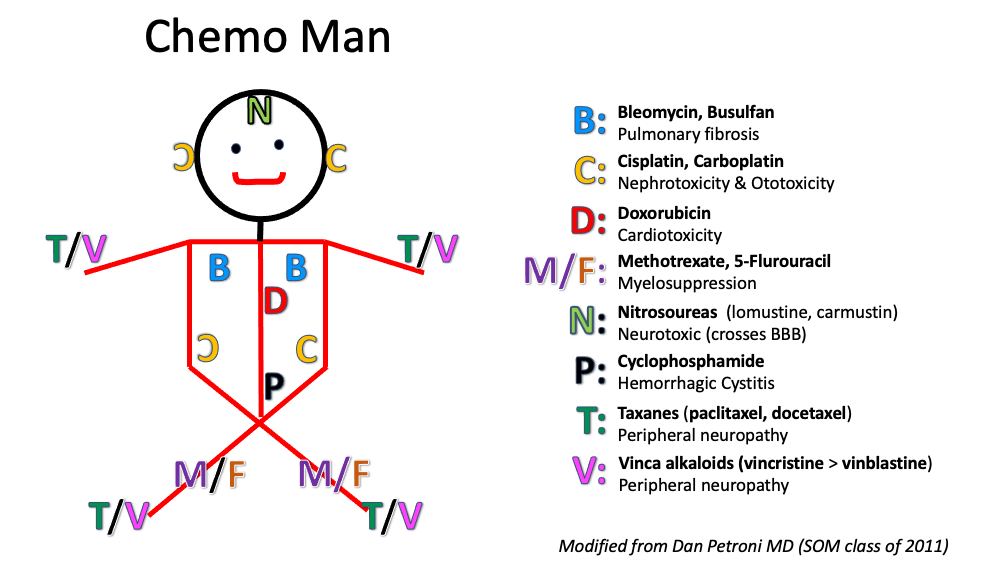
CHEMO MAN Technique:
d. Type D (delayed)
Occurs long after exposure
a. Type A (augmented)
b. Type B (bizarre)
c. Type C (continuous)
d. Type D (delayed)
e. Type E (end of use)
f. Type F (failure of therapy)
Carcinogens
Teratogens
[Delayed ADRs]
Type D (Delayed) adverse drug reactions include these two categories of harmful agents
a. Idiosyncratic and immune-mediated
b. Carcinogens and teratogens
c. Dose dependent and predictable
d. Cytotoxic and cell mediated
b. Methimazole
[Delayed ADRs]
This drug causes aplasia cutis as a teratogenic effect
a. Propylthiouracil (PTU)
b. Methimazole
c. Lithium
d. Phenytoin
c. Propylthiouracil (PTU)
[Delayed ADRs]
This drug is used as an alternative to Methimazole during the 1st trimester to avoid aplasia cutis
a. Carbamazepine
b. Valproic acid
c. Propylthiouracil (PTU)
d. Phenytoin
b. ACEIs and ARBs
[Delayed ADRs]
These drug classes cause renal dysgenesis, resulting in one kidney, a smaller kidney, or two kidneys combined
a. Sulfonylureas and Beta blockers
b. ACEIs and ARBs
c. Methimazole and PTU
d. Valproic acid and Carbamazepine
b. Lithium
[Delayed ADRs]
This drug causes Ebstein's anomaly, characterized by heart enlargement leading to heart failure at a very young age
a. Phenytoin
b. Lithium
c. Methimazole
d. Valproic acid
Valproic acid
Carbamazepine
[Delayed ADRs]
These two drugs cause neural tube defects, such as spina bifida
a. Methimazole and PTU
b. ACEIs and ARBs
c. Valproic acid and Carbamazepine
d. Lithium and Phenytoin
d. Phenytoin
[Delayed ADRs]
This drug causes fetal hydantoin syndrome, characterized by: - -
Microcephaly (small head)
Cleft lip
Cleft palate
a. Valproic acid
b. Carbamazepine
c. Lithium
d. Phenytoin
e. Type E (end of use)
Due to sudden discontinuation of medication
Withdrawal syndrome
a. Type A (augmented)
b. Type B (bizarre)
c. Type C (continuous)
d. Type D (delayed)
e. Type E (end of use)
f. Type F (failure of therapy)
Opioids
BZD (Benzodiazepines)
Barbiturates
Alcohol
Nicotine
Caffeine
Clonidine
Steroids
[End of Use ADRs]
Drugs that causes Withdrawal Syndrome (Type E ADR) include ______ [8]
Irritability
Dizziness
Headache
Cold sweats
[End of Use ADRs]
Sudden discontinuation of caffeine causes________ symptoms including:
a. Irritability, dizziness, headache, and cold sweats
b. Nausea, vomiting, and abdominal pain
c. Tachycardia and palpitations
d. Fatigue and difficulty concentrating
b. Rebound hypertension
[End of Use ADRs]
Sudden discontinuation of clonidine causes__________
b. Rebound hypertension
c. Bradycardia
d. Tachycardia only
c. Adrenal crisis
[End of Use ADRs]
Sudden discontinuation of steroids causes ________, since the adrenal cortex has not been producing steroids
a. Addison's disease
b. Cushing's syndrome
c. Adrenal crisis
d. Red man syndrome
b. Addison's disease
[End of Use ADRs]
This condition, caused by a genetic inability of the adrenal cortex to produce steroids
This is NOT considered a Type E ADR
a. Adrenal crisis
b. Addison's disease
c. Cushing's syndrome
d. Withdrawal syndrome
c. Dose tapering
[End of Use ADRs]
Withdrawal syndrome (Type E ADR) is managed using this approach
a. Abrupt discontinuation
b. Increased dose
c. Dose tapering
d. Switching drug class
f. Type F (failure of therapy)
Failure of use
a. Type A (augmented)
b. Type B (bizarre)
c. Type C (continuous)
d. Type D (delayed)
e. Type E (end of use)
f. Type F (failure of therapy)
Interactions
Poor adherence
[Failure of Therapy ADRs]
Type F (Failure of Use) adverse drug reactions can result from these drug-related events
a. Idiosyncratic reactions and teratogens
b. Interactions and poor adherence
c. Withdrawal syndrome and dose tapering
d. Carcinogens and hypersensitivity
b. Colistin
[Failure of Therapy ADRs]
This antibiotic is used for Linezolid-Resistant Staphylococcus aureus (LRSA) as an example of antimicrobial resistance under Type F ADR
a. Vancomycin
b. Colistin
c. Chloramphenicol
d. Methicillin
c. 2050
[Failure of Therapy ADRs]
This year is cited as the deadline concern for antibiotic resistance
a. 2030
b. 2040
c. 2050
d. 2100
a. Type A (augmented)
[Classify]
Sulfonylureas causing hypoglycemia
a. Type A (augmented)
b. Type B (bizarre)
c. Type C (continuous)
d. Type D (delayed)
e. Type E (end of use)
f. Type F (failure of therapy)
a. Type A (augmented)
[Classify]
Beta blockers causing bradycardia
a. Type A (augmented)
b. Type B (bizarre)
c. Type C (continuous)
d. Type D (delayed)
e. Type E (end of use)
f. Type F (failure of therapy)
a. Type A (augmented)
[Classify]
Antihistamines causing drowsiness
a. Type A (augmented)
b. Type B (bizarre)
c. Type C (continuous)
d. Type D (delayed)
e. Type E (end of use)
f. Type F (failure of therapy)
b. Type B (bizarre)
[Classify]
Vancomycin causing red man syndrome
a. Type A (augmented)
b. Type B (bizarre)
c. Type C (continuous)
d. Type D (delayed)
e. Type E (end of use)
f. Type F (failure of therapy)
b. Type B (bizarre)
[Classify]
Carbamazepine causing Stevens-Johnson Syndrome
a. Type A (augmented)
b. Type B (bizarre)
c. Type C (continuous)
d. Type D (delayed)
e. Type E (end of use)
f. Type F (failure of therapy)
b. Type B (bizarre)
[Classify]
Allopurinol causing hyperurecemia
a. Type A (augmented)
b. Type B (bizarre)
c. Type C (continuous)
d. Type D (delayed)
e. Type E (end of use)
f. Type F (failure of therapy)
b. Type B (bizarre)
[Classify]
NSAIDS (-oxicams) causing Stevens-Johnson Syndrome
a. Type A (augmented)
b. Type B (bizarre)
c. Type C (continuous)
d. Type D (delayed)
e. Type E (end of use)
f. Type F (failure of therapy)