Lecture 3.6: Electron Transport
 Call Kai
 Learn
Learn Practice Test
 Spaced Repetition
 Match
Match Flashcards
 Knowt Play
1/52

There's no tags or description
Looks like no tags are added yet.
Name | Mastery | Learn | Test | Matching | Spaced | Call with Kai | Chat |
|---|
No analytics yet
Send a link to your students to track their progress
53 Terms
Match each metabolic process to the location where it occurs in the eukaryotic cell.
Glycolysis —
Pyruvate decarboxylation —
Citrate cycle —
Electron transport chain —
Glycolysis — cytoplasm
Pyruvate decarboxylation — mitochondrial matrix
Citrate cycle — mitochondrial matrix
Electron transport chain — mitochondrial inner membrane
Match each descriptor to the correct number of electrons it contains.
Proton —
Hydrogen atom —
Hydride ion —
Proton — 0 electrons (a proton is H⁺, a bare nucleus with no electrons)
Hydrogen atom — 1 electron
Hydride ion — 2 electrons (H⁻, a hydrogen atom plus an extra electron)
(T/F) FMN is a prosthetic group of complex I whereas NAD+ is a coenzyme of complex I
True
FMN (flavin mononucleotide) is tightly, permanently bound to Complex I (NADH dehydrogenase) — this makes it a prosthetic group. It stays attached to the enzyme and gets regenerated (reoxidized) in place after each catalytic cycle.
NADH (which delivers electrons to Complex I) binds only transiently, donates its electrons to FMN, and then dissociates as NAD⁺ to be reused elsewhere in the cell. Because it binds loosely and reversibly, it's classified as a coenzyme (specifically a co-substrate) rather than a prosthetic group.
Which of the following is TRUE about cytochrome c in the electron transport chain? Select all that apply.
Multiple answers:Multiple answers are accepted for this question
a) It is highly water soluble.
b) It contains iron-sulfur cluster.
c) It is located in the mitochondrial matrix.
d) It can diffuse in the membrane.
e) It is a prosthetic group.
f) It is a protein.
a) It is highly water soluble
f) It is a protein
Which of the following is TRUE about ubiquinone in the electron transport chain?
Select an answer and submit. For keyboard navigation, use the up/down arrow keys to select an answer.
a) It is highly water soluble.
b) It contains Cu cofactors.
c) It is located in the mitochondrial matrix.
d) It can diffuse in the membrane.
e) It is a prosthetic group.
f) It is a membrane protein.
d) It can diffuse in the membrane.
Which of the following is NOT true?
a) NADH transfer can transfer 2 e- as a hydride ion.
b) FMN and FAD can transfer up to 2 e-, one at a time.
c) Fe-S cluster can transfer 1 e-.
d) Cytochrome can transfer up to 2 e-, one at a time.
e) Ubiquinone can transfer up to 2 e-, one at a time.
d) Cytochrome can transfer up to 2 e-, one at a time.
In a redox reaction, the oxidant (oxidizing agent) is the electron _______; it _______ electrons.
a) donor; loses
b) acceptor; gains
c) acceptor; loses
d) donor; gains
b) acceptor; gains
In a redox reaction, the reductant (reducing agent) is the electron _______; it _______ electrons.
a) donor; loses
b) acceptor; gains
c) acceptor; loses
d) donor; gains
a) donor; loses
A higher E°' indicates a _______ (higher, lower) affinity for electrons. A higher E°' indicates a greater tendency to be _______ (reduced, oxidized). A molecule with a higher E°' indicates a stronger _______ (oxidant, reductant). Electrons flow from molecules with _______ (lower, higher) reduction potentials to those with ________ (lower, higher) reduction potentials.
Higher; reduced, lower, higher
or a coupled redox reaction, ΔE°' can be calculated using the equation: _____. Select all that apply.
Multiple answers:Multiple answers are accepted for this question
a) ΔE°'= E°'e- acceptor - ΔE°'e- donor
b) ΔE°'= E°'e- donor - ΔE°'e- acceptor
c) ΔE°'= E°'reductant - ΔE°'oxidant
d) ΔE°'= E°'oxidant - ΔE°'reductant
a) ΔE°'= E°'e- acceptor - ΔE°'e- donor
d) ΔE°'= E°'oxidant - ΔE°'reductant
Fill in the blanks with (positive/negative)
if ΔE°' is ______, then ΔG°' is ______ and the reaction is unfavorable.
if ΔE°' is ______, then ΔG°' is ______ and the reaction is favorable.
negative; positive
positive; negative
Which of the following describes how the components of the respiratory chain are ordered?
a) From large to small
b) From low to high reduction potential
c) From high to low ability to pump protons across the inner membrane
d) From high to low electronegativity
e) From low to high free energy
b) From low to high reduction potential
What is reduction potential (ΔE°')
The measure of how readily the oxidized form of a molecule accepts electrons
What is the formate for ΔE°'
Acceptor + H + e- —→ Donor
A more positive ΔE°' = better ________
electron acceptor
Electrons pass _______ from carriers of _____ ΔE°' to _____ ΔE°'
spontaneously; lower; higher
What does n represent
n = number of electrons transferred
What does F represent
Faraday’s constant = 96.5 kJ/V mol
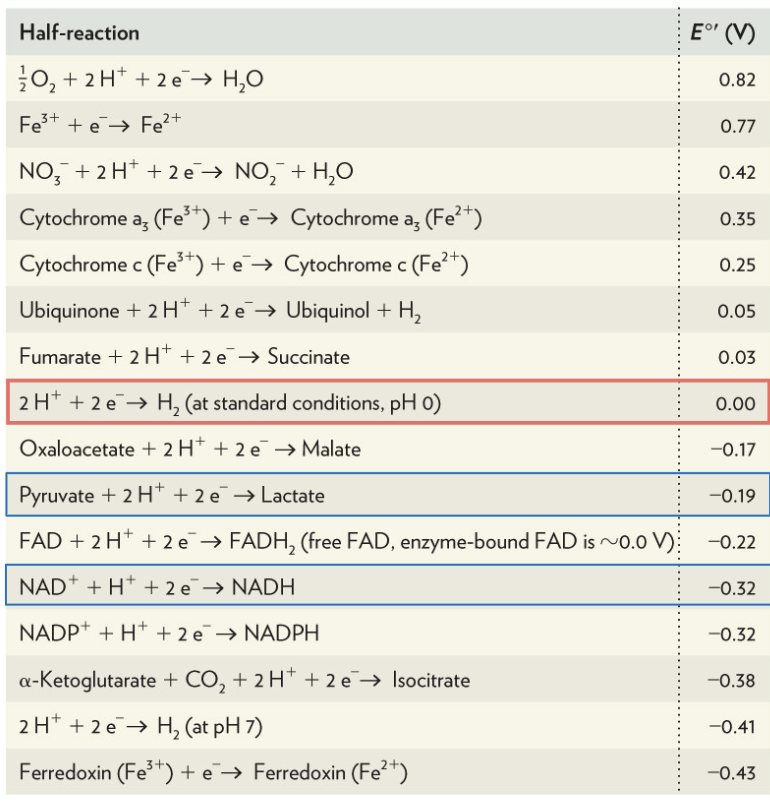
What is the ΔG°' for this example of pyruvate to lactate
ΔG°' = - (2) (96.5kJ/V mol) (+0.13V)
ΔG°' = -25.09 kJ/mol
The overall oxidation of NADH & FADH2 by O2 is strongly ________
exergonic
Explain why the ETC moves from lower energy potential to higher energy potential
Since electrons flow from a good reductant (low affinity, wants to donate) to a good oxidant (high affinity, wants to accept), and since that direction is exactly what makes ΔE°' positive and ΔG°' negative, the chain is built so that each carrier has a slightly higher E°' than the one before it. Each step is a small, energetically favorable "downhill" electron transfer, releasing free energy along the way — free energy the cell captures to pump protons and eventually make ATP.
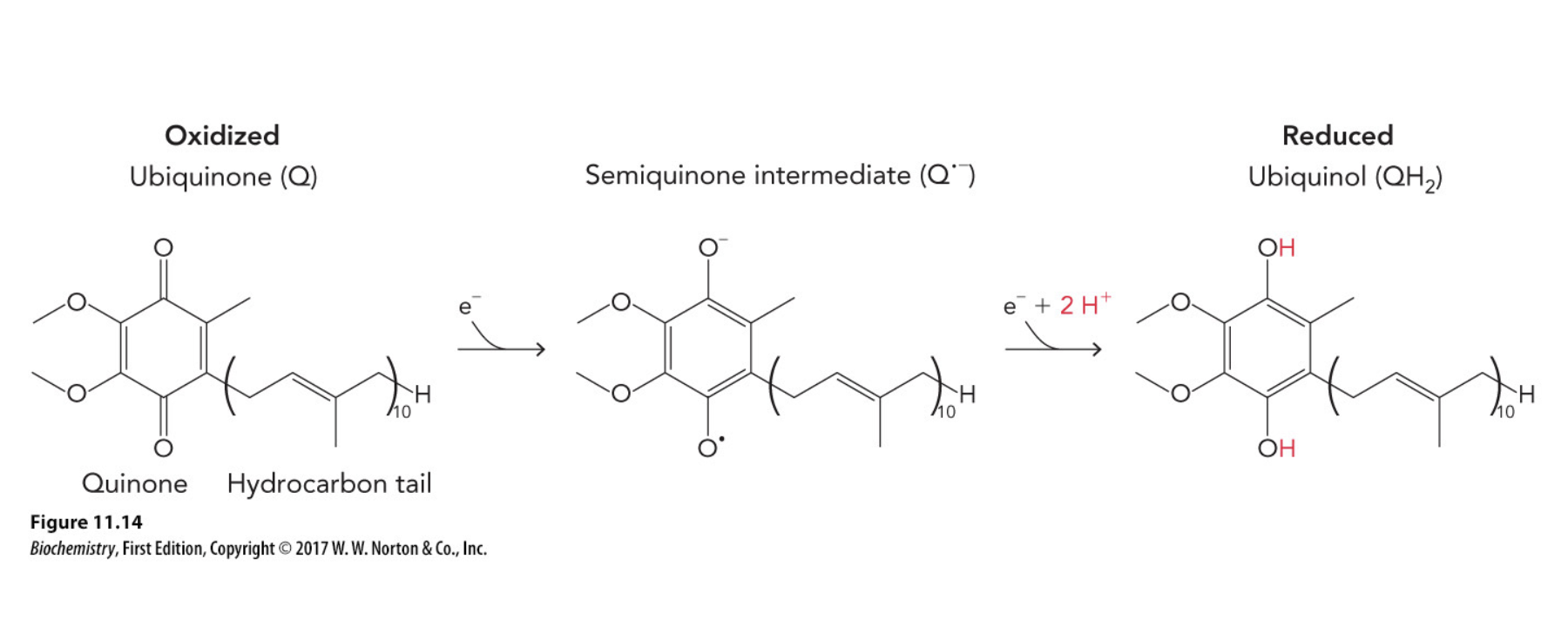
Explain the steps for Ubiquinone reduction
Ubiquinone (Q) accepts one e- to become semiquinone intermediate. Then another e- is accepted to become the reduced from, ubiquinol (Q2)
For a coupled redox reaction, ΔE°' can be calculated using the equation: _____. Select all that apply.
Multiple answers:Multiple answers are accepted for this question
a) ΔE°'= E°'e- acceptor - ΔE°'e- donor
b) ΔE°'= E°'e- donor - ΔE°'e- acceptor
c) ΔE°'= E°'reductant - ΔE°'oxidant
d) ΔE°'= E°'oxidant - ΔE°'reductant
a) ΔE°'= E°'e- acceptor - ΔE°'e- donor
d) ΔE°'= E°'oxidant - ΔE°'reductant
The relationship between the reduction potential difference (ΔE°') and the change in free energy (ΔG°'):
If ΔE°' is ___, then ΔG°' is ___, and the reaction is unfavorable.
If ΔE°' is ___, then ΔG°' is ___, and the reaction is favorable
If ΔE°' is negative, then ΔG°' is positive, and the reaction is unfavorable.
If ΔE°' is positive, then ΔG°' is negative, and the reaction is favorable.
Which of the following describes how the components of the respiratory chain are ordered?
Select an answer and submit. For keyboard navigation, use the up/down arrow keys to select an answer.
a) From large to small.
b) From low to high reduction potential.
c) From high to low ability to pump protons across the inner membrane.
d) From high to low electronegativity.
e) From low to high free energy.
b) From low to high reduction potential.
Match each electron transfer step in the ETC to the appropriate mobile electron carrier (or "not applicable" if there's no direct transfer):
Complex I --> Complex II
Complex I --> Complex III
Complex II --> Complex III
Complex III --> Complex II
Complex II --> Complex IV
Complex III --> Complex IV
Complex I --> Complex II = not applicable
Complex I --> Complex III = ubiquinone
Complex II --> Complex III = ubiquinone
Complex III --> Complex II = not applicable
Complex II --> Complex IV = not applicable
Complex III --> Complex IV = cytochrome c
Which of the following are true of Complex I?
a) it's not a proton pump.
b) it pumps 4H+ into the mitochondrial matrix for every pair of electrons donated by NADH.
c) electrons from NADH are accepted by an FMN prosthetic group within Complex I.
d) electrons from NADH are passed through Complex I prosthetic groups to Complex II.
e) it accepts electrons from either NADH or FADH2.
c) electrons from NADH are accepted by an FMN prosthetic group within Complex I.
Which of the following are true of Complex II?
Select an answer and submit. For keyboard navigation, use the up/down arrow keys to select an answer.
a) it's a proton pump.
b) it transfers electrons through Q cycle.
c) FAD in Complex II accepts electrons from succinate in the citrate cycle.
d) electrons from FADH2 are passed through Complex II prosthetic groups to complex III.
e) it accepts electrons from either NADH or FADH2.
c) FAD in Complex II accepts electrons from succinate in the citrate cycle.
Which prosthetic groups are found in Complex II? Select all that apply.
Multiple answers:Multiple answers are accepted for this question
a) Q
b) Fe-S
c) heme
d) FMN
e) NAD+
f) FAD
b) Fe-S
c) heme
f) FAD
How many molecules of Cytochrome c are reduced by each QH2?
2
During the first half of the Q cycle, when the first QH2 is oxidized, where do the electrons go?
Select an answer and submit. For keyboard navigation, use the up/down arrow keys to select an answer.
a) both are passed to cytochrome c.
b) both are passed to complex IV.
c) one is passed to cytochrome c and the other is passed to complex IV.
d) one is passed to cytochrome c and the other is passed back to Q.
e) one is passed to O2 and the other is passed back to Q.
d) one is passed to cytochrome c and the other is passed back to Q.
What is the reaction catalyzed by the cytochrome c oxidase complex of the mitochondrial respiratory chain? Select all that apply.
Multiple answers:Multiple answers are accepted for this question
a) oxidation of cytochrome c
b) reduction of cytochrome c
c) oxidation of molecular oxygen to water
d) reduction of molecular oxygen to water
e) oxidation of coenzyme QH2
f) reduction of coenzyme Q
a) oxidation of cytochrome c
d) reduction of molecular oxygen to water
Match each electron carrier to its type of electron transfer
Transfer options:
Direct transfer of an e⁻
Transfer of a hydride ion OR transfer of 1e⁻ and 1H⁺ followed by a second transfer of 1e⁻ and 1H⁺
Transfer of a hydride ion
Transfer of 1e⁻ followed by transfer of 1e⁻ and 2H⁺
Direct transfer of an e⁻
Electron carriers:
Heme, NADH, Fe-S cluster, Flavin nucleotides, Ubiquinone
Heme = direct transfer of an e-
NADH = transfer of a hydride ion
Fe-S cluster = direct transfer of an e-
Flavin nucleotides = Transfer of a hydride ion OR transfer of 1e⁻ and 1H⁺ followed by a second transfer of 1e⁻ and 1H⁺
Ubiquinone = Transfer of 1e⁻ followed by transfer of 1e⁻ and 2H⁺
What active site cofactor is found in cytochrome proteins?
a) heme
b) quinone
c) Fe-S cluster
d) Flavin
e) NAD+
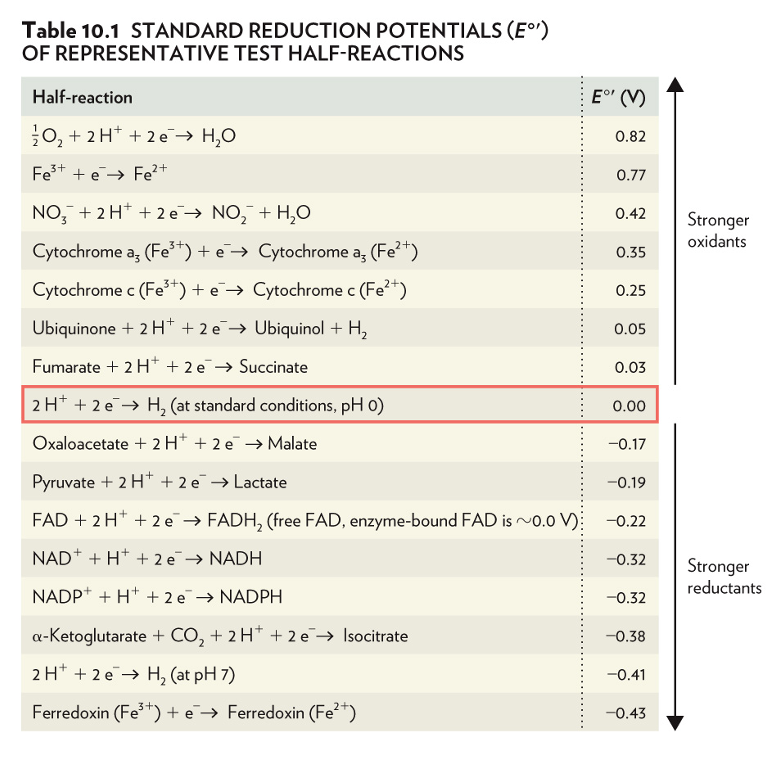
Place these in order of increasing tendency to accept electrons:
α-ketoglutarate
O2
NADP+
oxaloacetate
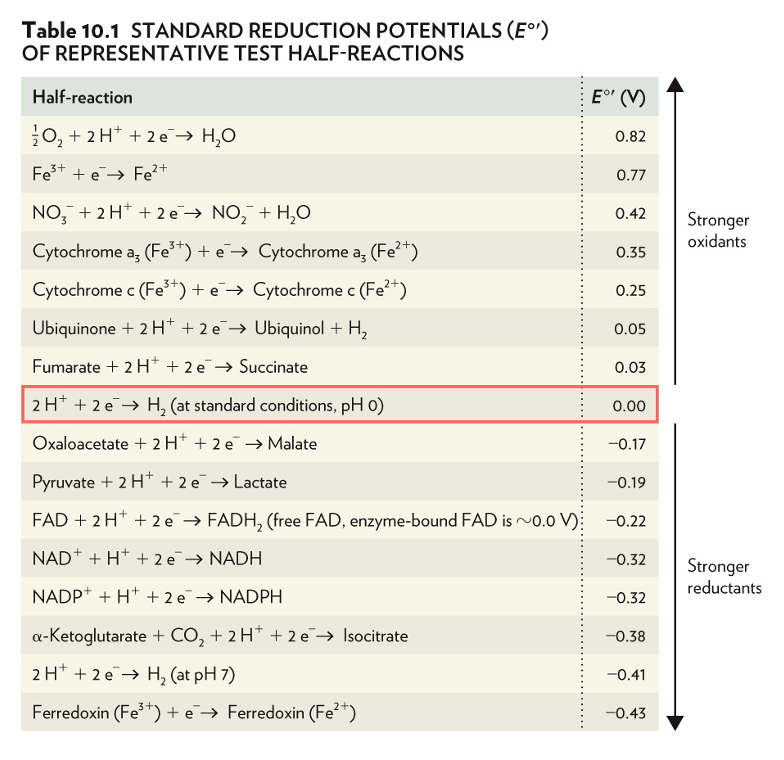
Using Table 10.1, calculate ΔE°' for isocitrate oxidized by NAD+ to form α-ketoglutarate + CO2
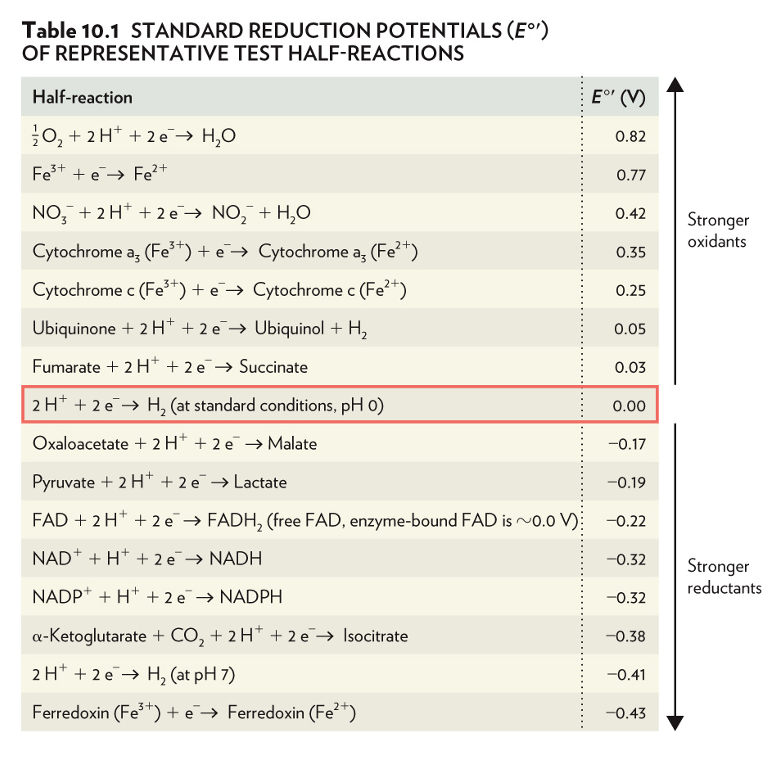
Calculate the standard free energy change (ΔG°') for isocitrate oxidized by NAD+ to form α-ketoglutarate + CO2
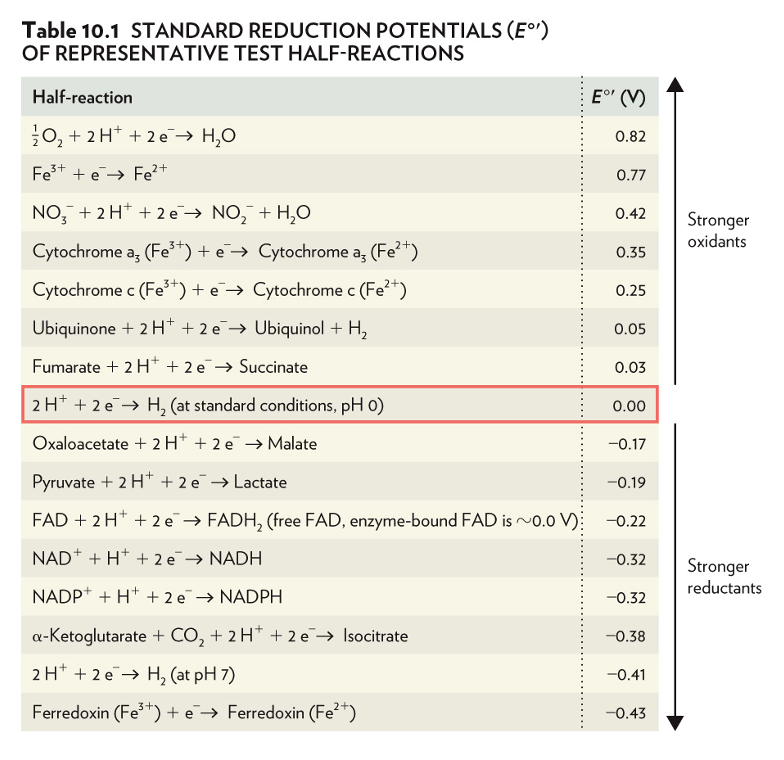
All the dehydrogenases of glycolysis and the citrate cycle use NAD+ (E′° for NAD+/NADH is −0.32 V) as an electron acceptor except succinate dehydrogenase, which uses covalently bound FAD (E′° for FAD/FADH2 bound to this enzyme is 0.050 V). Suggest why FAD is a more appropriate electron acceptor than NAD+ in the dehydrogenation of succinate, based on the E′° values of fumarate/succinate (E′° = 0.031 V), NAD+/NADH, and the succinate dehydrogenase FAD/FADH2.
It is required to use FAD because ΔE°' = E°'(FAD/FADH₂) − E°' (fumarate/succinate) = 0.050 − 0.031 = +0.019 V — a positive E°′ makes a favorable, negative ΔG°'. If NAD+ were used then, ΔE°' = E°'(NAD⁺/NADH) − E°'(fumarate/succinate) = −0.32 − 0.031 = −0.351 V. The E°′ would be negative, making ΔG°' positive which is an unfavorable reaction
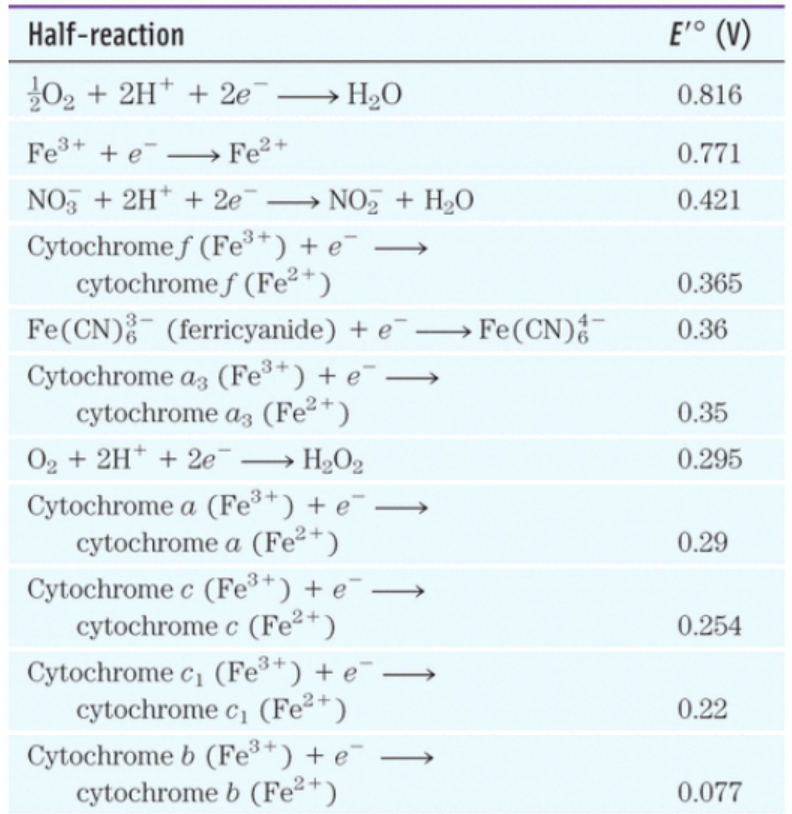
Is reduced cytochrome c more likely to give up electrons to cytochrome a or cytochrome b?
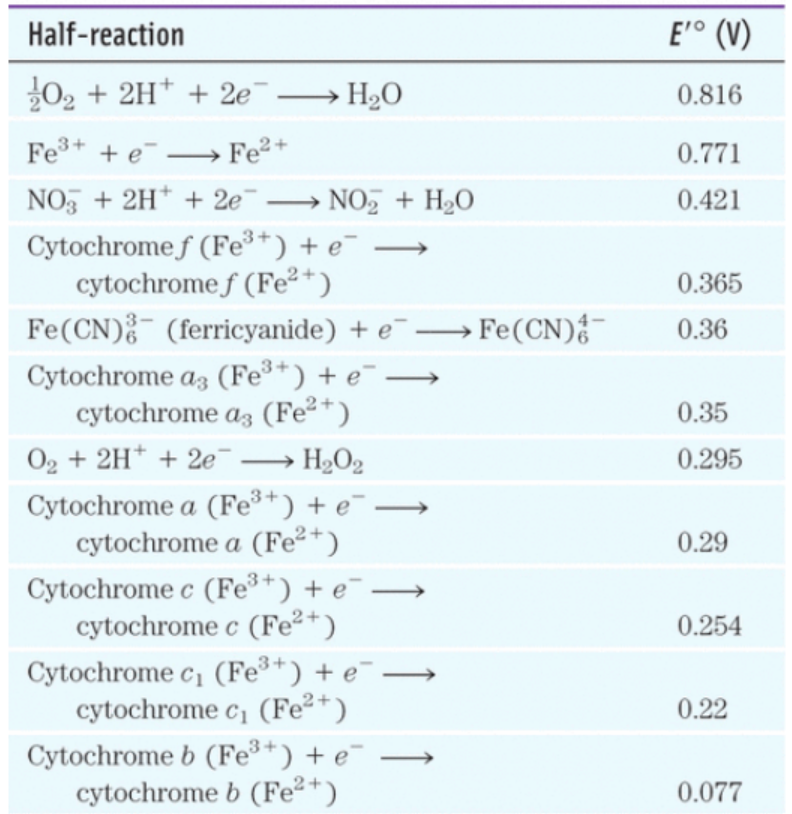
Under standard conditions, will cytochrome a(Fe2+) + cytochrome b(Fe3+) → cytochrome a(Fe3+) + cytochrome b(Fe2+) proceed spontaneously?
No, because the reduction potential difference is a negative number and the standard free energy change is a positive number
Place these electron transport system components in proper order
Ubiquinone, NADH-Q oxidoreductase, Q-cytochrome c oxidoreductase, cytochrome c oxidase, cytochrome c
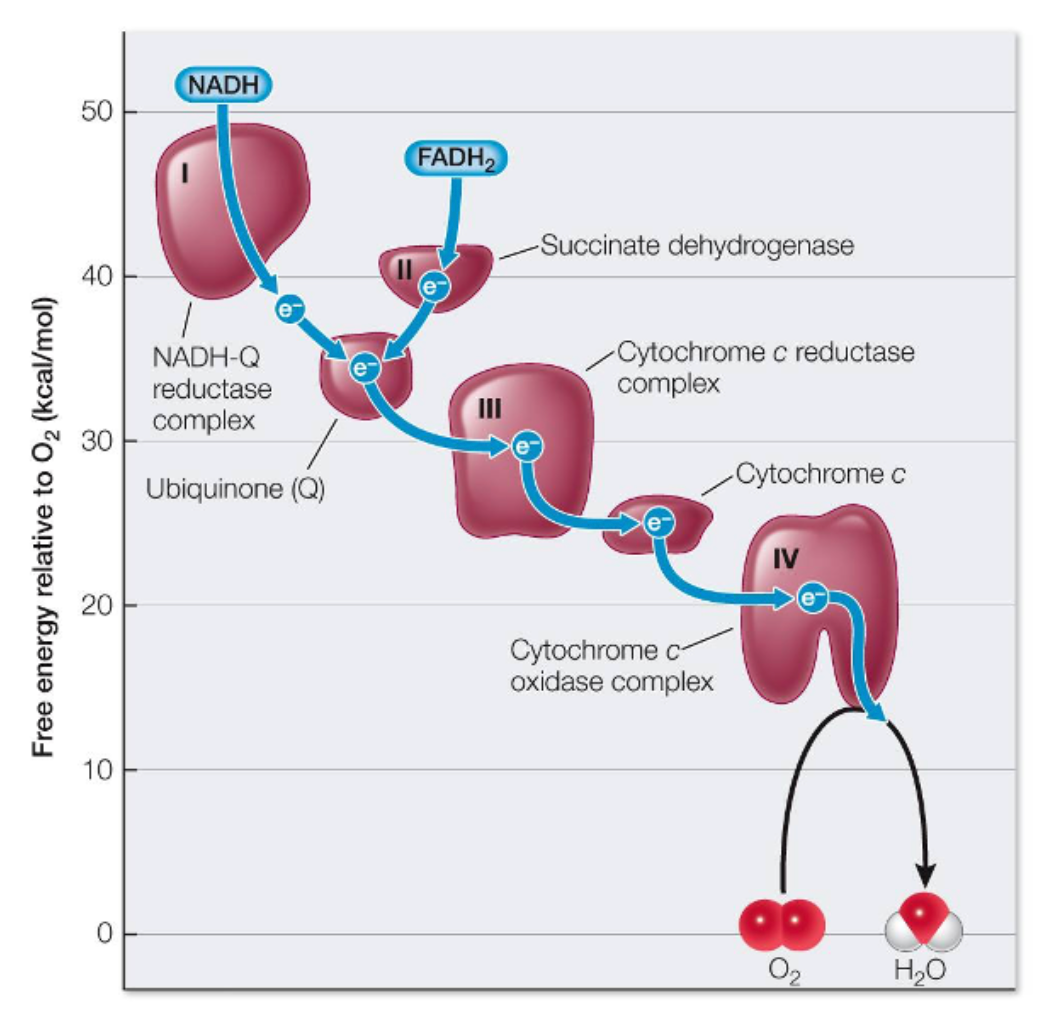
Which statement about the electron transport chain explains the biological importance of the information portrayed in the graph?
Select an answer and submit. For keyboard navigation, use the up/down arrow keys to select an answer.
a) The extensive folding of the inner mitochondrial membrane provides the space needed to accommodate the large number of proteins making up the electron transport chain.
b) Oxygen serves as the final electron acceptor in the electron transport chain, forming water as a result of its acceptance of electrons that have passed down the chain.
c) Each oxidation–reduction step in the electron transport chain releases free energy.
d) NADH and FADH2 pass their electrons to different carriers in the electron transport chain.
e) The components of the electron transport chain are physically arranged within the mitochondrial membrane in the order of transfer of electrons down the chain.
Why does NADH generate more ATP via the ETC than FADH2?
a) more NADH per glucose
b) NADH gives 2e-, FADH2 gives 1e-
c) different final acceptors
d) more protons pumped with NADH as donor vs FADH2
e) more H2O made with NADH vs FADH2
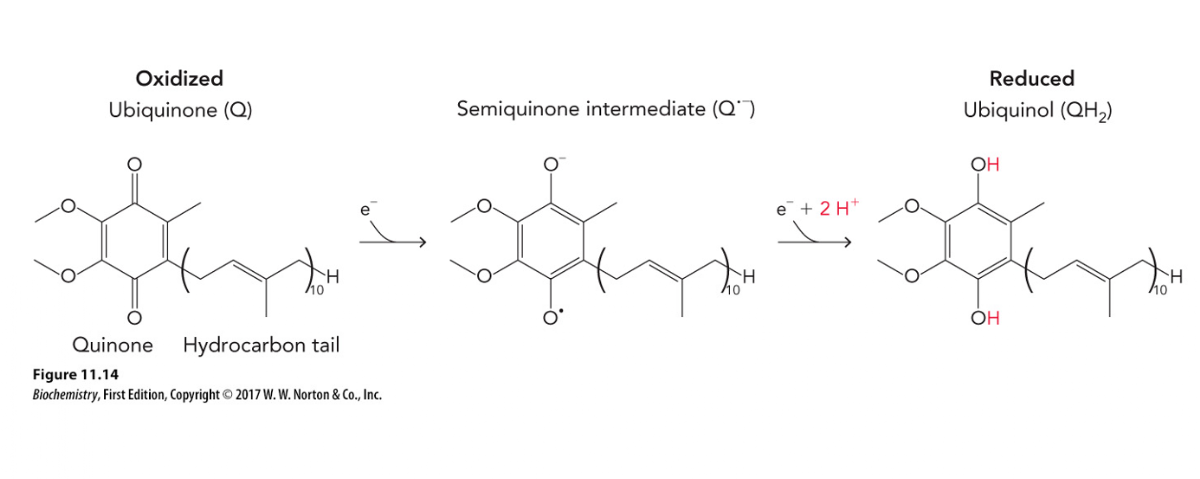
Which statements about ubiquinone are correct (select all)?
a) mobile carrier between Complex III and IV
b) integral membrane protein
c) reduction = simultaneous 2e- transfer from Complex I Fe-S center
d) reduced to ubiquinol via semiquinone intermediate
e) small lipid-soluble molecule
d) reduced to ubiquinol by way of a semiquinone intermediate;
e) small lipid soluble molecule
In electron transfer, only the quinone portion of ubiquinone undergoes oxidation-reduction; the isoprenoid side chain remains unchanged. What do you think is the function of this chain?
The isoprenoid side chain anchors ubiquinone to the mitochondrial membrane and allows it to remain lipid soluble and diffuse across the complexes
Which of the following statements about cytochrome c are correct? Select all that apply.
Multiple answers:Multiple answers are accepted for this question
a) It is an integral membrane protein.
b) It donates electrons to Complex IV.
c) It donates electrons directly to O2 .
d) It is soluble in water.
e) It is the mobile electron carrier that shuttles electrons between Complex II and Complex III.
b) It donates electrons to Complex IV.
d) It is soluble in water.
What is the reaction catalyzed by the cytochrome c oxidase complex of the mitochondrial respiratory chain? Consider that 2 electrons are transferred to cytochrome c oxidase.
a) translocation of no H+ ; O2 reduction
b) translocation of no H+; O2 oxidation
c) translocation of 2 H+ from the N-side to the P-side; 1/2 O2 reduction
d) translocation of 2 H+ from the P-side to the N-side; 1/2 O2 oxidation
e) translocation of 4 H+ from the P-side to the N-side; 1/2 O2 oxidation
f) translocation of 4 H+ from the N-side to the P-side; 1/2 O2 reduction
c) translocation of 2 H+ from the N-side to the P-side; 1/2 O2 reduction
In the reoxidation of QH2 by purified ubiquinone-cytochrome c reductase (Complex III) from heart muscle, the overall stoichiometry of the reaction requires 2 mol of cytochrome c per mole of QH2 because:
a) two molecules of cytochrome c must first combine physically before they are catalytically active
b) heart muscle has a high rate of oxidative metabolism, and therefore requires twice as much cytochrome c as QH2 for electron transfer to proceed normally.
c) cytochrome c is water soluble and operates between the inner and outer mitochondrial membranes
d) cytochrome c is a two-electron acceptor, whereas QH2 is a one-electron donor.
e) cytochrome c is a one-electron acceptor, whereas QH2 is a two-electron donor.
e) cytochrome c is a one-electron acceptor, whereas QH2 is a two-electron donor.
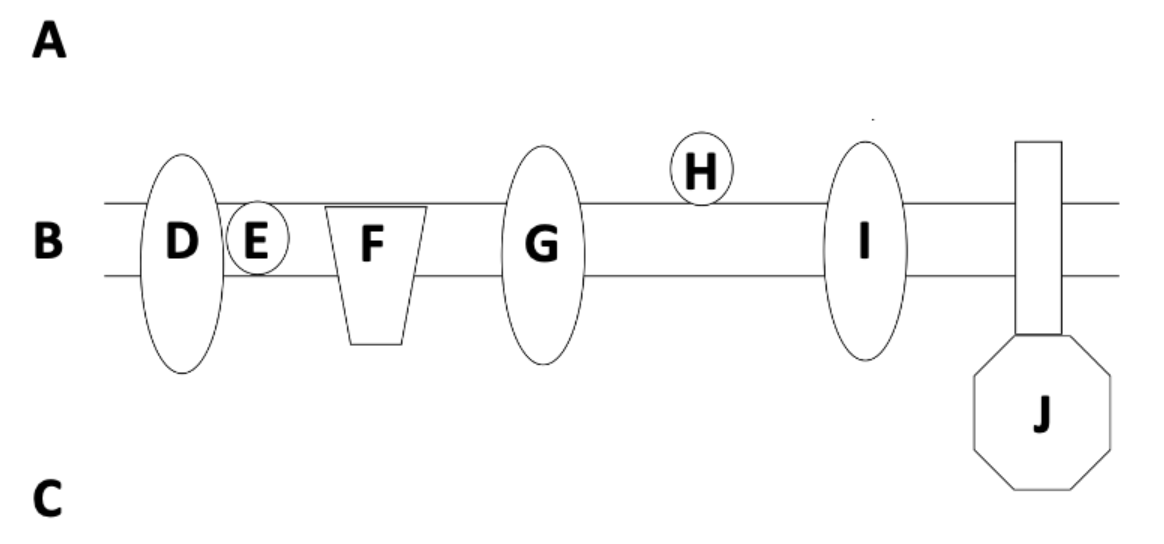
Where does the oxidation of NADH occur?
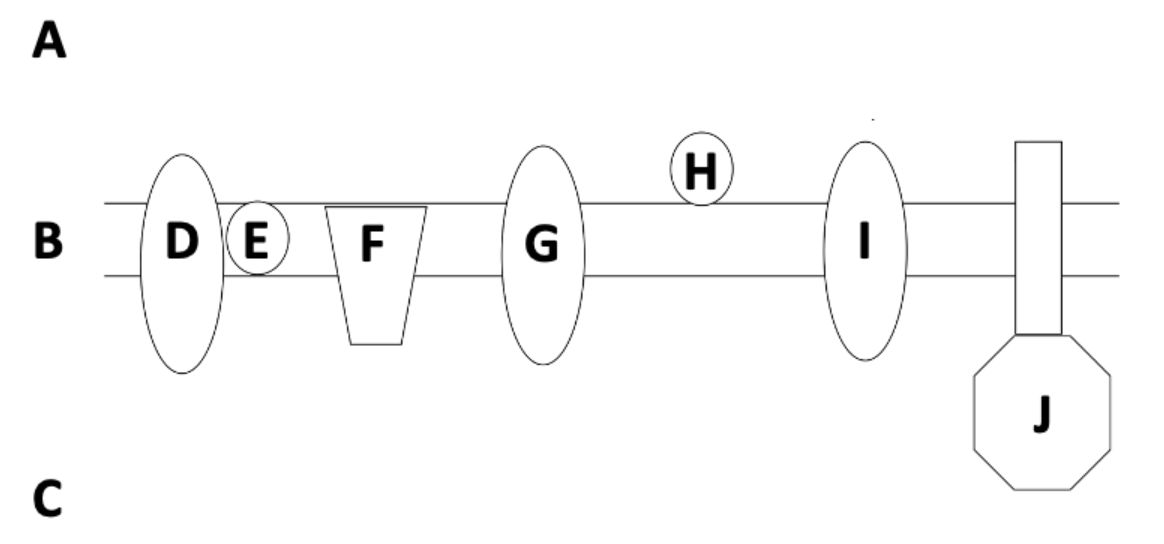
Which is the correct electron path from NADH to O2?
a) NADH → D→E→F→G→H→I→J→O2
b) NADH → D→E→G→H→I→J→O2
c) NADH → D→E→G→H→I→O2
d) NADH → F→E→G→H→I→J→O2
e) NADH → F→E→G→H→I→O2
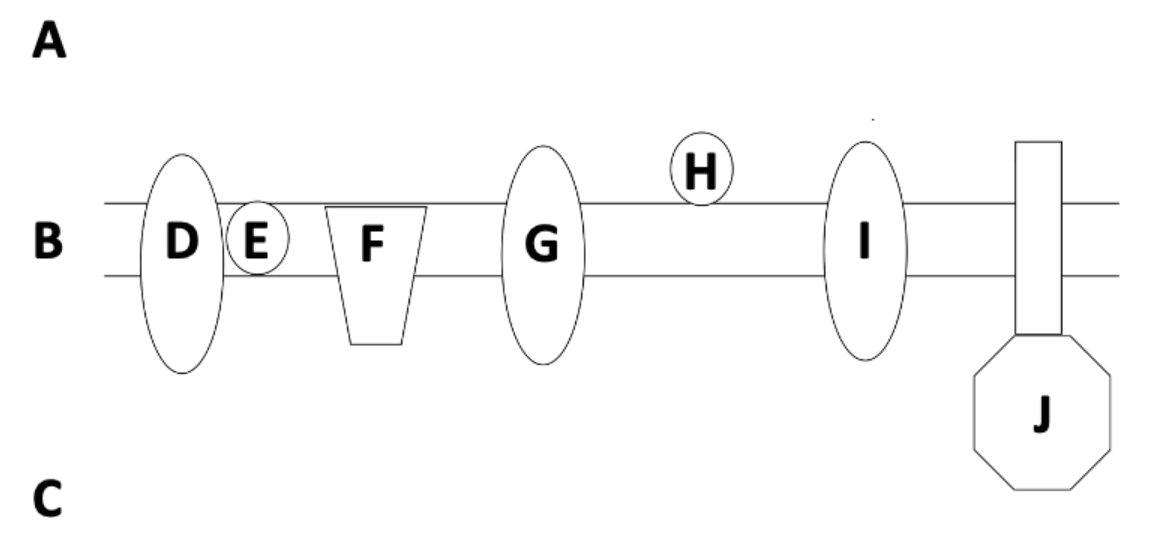
Where does the oxidation of FADH2 occur?
a) D
b) E
c) F
d) G
e) H
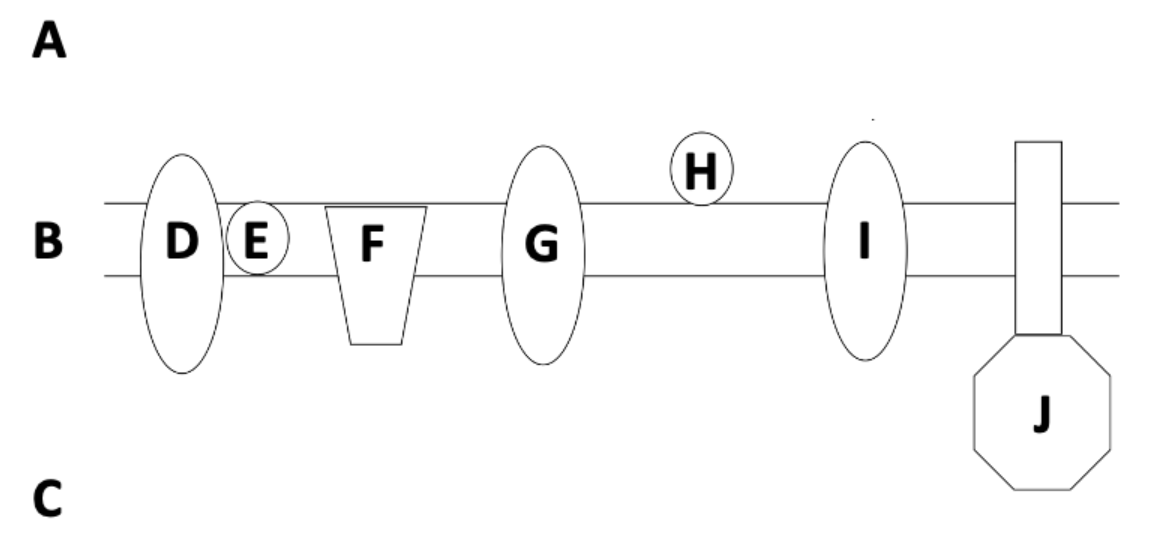
Which of the following is the correct path that a pair of electrons would take from FADH2 through the electron transport chain to O2?
a) FADH2→D → E → F → G → H → I → J → O2
b) FADH2→D → E → G → H → I → J → O2
c) FADH2→D → E → G → H → I →O2
d) FADH2→F → E → G → H → I → J → O2
e) FADH2 →F → E → G → H → I → O2
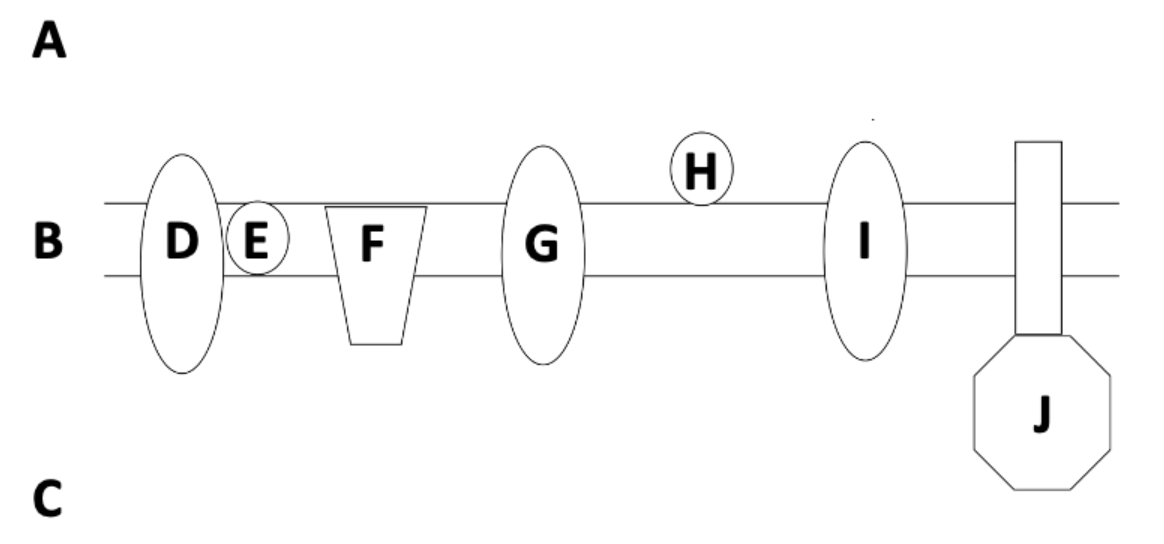
Oxygen consumption occurs at the structure labeled ______ and ATP synthesis occurs at the structure labeled ______.
a) G;I
b) I;J
c) J;J
d) I;I
e) D;F
f) F;D
b) I;J