2 - System of Measurement
 Call Kai
 Learn
Learn Practice Test
 Spaced Repetition
 Match
Match Flashcards
 Knowt Play
1/43

There's no tags or description
Looks like no tags are added yet.
Name | Mastery | Learn | Test | Matching | Spaced | Call with Kai | Chat |
|---|
No analytics yet
Send a link to your students to track their progress
44 Terms
a. International System of Units (SI)
The metric system is also known as
a. International System of Units (SI)
b. Apothecary System
c. Household System
d. Avoirdupois System
a. Decimal system
[Metric System]
The metric system is based on the
a. Decimal system
b. Binary system
c. Octal system
d. Hexadecimal system
a. 10
[Metric System]
Each unit in the metric system differs from the next smaller or larger unit by a factor of ______
a. 10
b. 100
c. 1000
d. 2
For weight - Gram (g)
For volume - Liter (L)
For length - Meter (m)
[Metric System]
Primary units for metric system include _____ [3]
a. Gram (g)
[Metric System]
The primary unit for weight in the metric system
a. Gram (g)
b. Liter (L)
c. Meter (m)
d. Kilogram (kg)
b. Liter (L)
[Metric System]
The primary unit for volume in the metric system
a. Gram (g)
b. Liter (L)
c. Meter (m)
d. Kilogram (kg)
c. Meter (m)
[Metric System]
The primary unit for length in the metric system
a. Gram (g)
b. Liter (L)
c. Meter (m)
d. Kilogram (kg)
a. l × w × h = m³
[Metric System]
Volume is calculated as
a. l × w × h = m³
b. l × w = m²
c. l × h = m²
d. w × h = m²
a. 7
[Metric System]
The number of base units in the SI system
a. 7
b. 6
c. 8
d. 10
b. Kilogram (kg)
[Metric System]
The SI base unit for weight
a. Gram (g)
b. Kilogram (kg)
c. Liter (L)
d. Meter (m)
c. Meter (m)
[Metric System]
The SI base unit for length
a. Gram (g)
b. Kilogram (kg)
c. Meter (m)
d. Liter (L)
a. Second (s)
[Metric System]
The SI base unit for time
a. Second (s)
b. Minute (min)
c. Hour (hr)
d. Day (d)
a. Ampere (A)
[Metric System]
The SI base unit for electric current
a. Ampere (A)
b. Volt (V)
c. Ohm (Ω)
d. Watt (W)
a. Kelvin (K)
[Metric System]
The SI base unit for temperature
a. Kelvin (K)
b. Celsius (°C)
c. Fahrenheit (°F)
d. Rankine (°R)
a. Mole (mol)
[Metric System]
The SI base unit for the amount of substance
a. Mole (mol)
b. Gram (g)
c. Kilogram (kg)
d. Liter (L)
a. Candela (cd)
[Metric System]
The SI base unit for luminous intensity
a. Candela (cd)
b. Lumen (lm)
c. Lux (lx)
d. Watt (W)
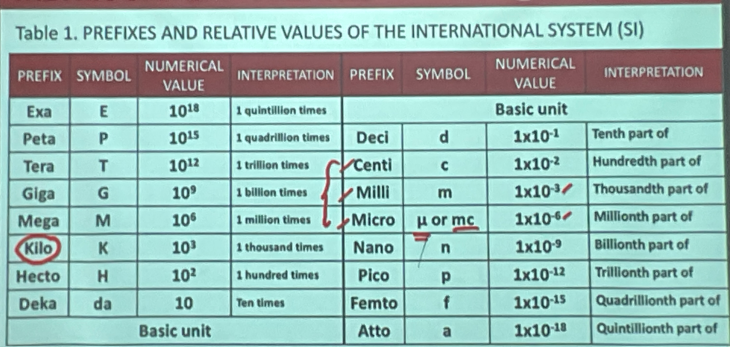
[Metric System - Prefixes]
Table 1. Prefixes and Relative Values of the International System (SI)
Arabic numerals are used to express quantities in this system.
2. Parts of a unit or a fraction of a unit are expressed as decimals.
3. The quantity whether in whole numbers or decimals is always written before the abbreviation or symbol for a unit of measure.
4. Zeros should always be placed in front of the decimal when the quantity is not a whole number.
5. Fractions are not used. Ex: % gram is incorrect. It must be expressed as a decimal. 0.75 gram is the correct way to express this quantity.
[Metric System]
Rules of the metric system [5]
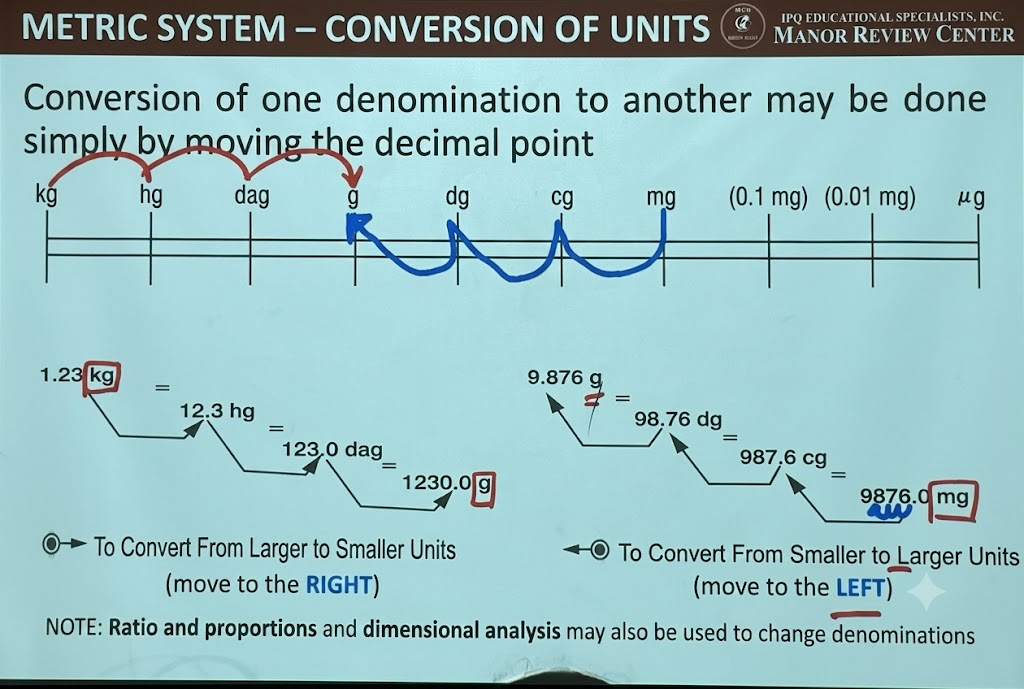
Metric System - Conversion of Units:
a. Ratio and proportions and dimensional analysis
[Metric System - Conversion of Units]
The methods that may also be used to change denominations in the metric system
a. Ratio and proportions and dimensional analysis
b. Ratio and proportions only
c. Dimensional analysis only
d. Addition and subtraction
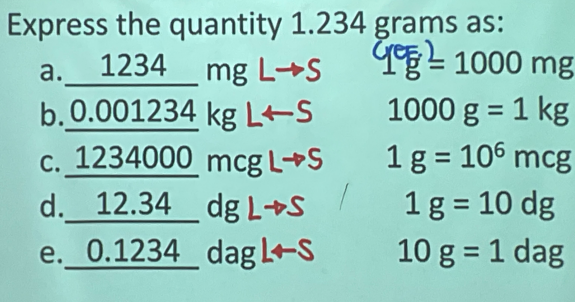
Practice Test for Metric System - Conversion of Units
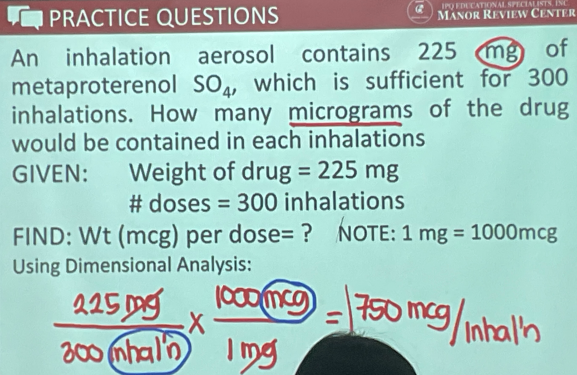
Practice Test for Metric System - Conversion of Units
British system
Imperial system
The common (English) systems are also known as
a. British, Imperial system
b. American, Imperial, Syst.
c. British, American, Syst.
d. British, Imperial, Metric
a. English systems
[Common / English System]
The common systems also known as British and Imperial
a. English systems
b. Metric systems
c. Apothecary systems
d. Avoirdupois systems
a. Apothecary
[Common / English System]
The system used by pharmacists in weighing ingredients for compounding prescriptions
a. Apothecary
b. Avoirdupois
c. Imperial
d. Metric
b. Avoirdupois
[Common / English System]
The system used by wholesalers and manufacturers in providing pharmacists powdered drugs or chemicals in bulk or stock packages
a. Apothecary
b. Avoirdupois
c. Imperial
d. Metric
a. Small quantities
[Common / English System]
The apothecary system is used for
a. Small quantities
b. Large quantities
c. Bulk quantities
d. Stock packages
b. Large quantities
[Common / English System]
The avoirdupois system is used for
a. Small quantities
b. Large quantities
c. Compounding prescriptions
d. Weighing ingredients
Morphine sulfate
Atropine sulfate
Codeine
Sodium Phenobarbital
Aspirin
[Common / English System]
The medications customarily written using the apothecary and avoirdupois systems
a. Morphine sulfate, Atropine sulfate, Codeine, Sodium Phenobarbital, Aspirin
b. Morphine sulfate, Atropine sulfate, Codeine, Sodium Phenobarbital, Paracetamol
c. Morphine sulfate, Atropine sulfate, Codeine, Sodium Phenobarbital, Ibuprofen
d. Morphine sulfate, Atropine sulfate, Codeine, Sodium Phenobarbital, Amoxicillin
a. Apothecary
[Common / English System]
The system used by pharmacists in weighing ingredients for compounding prescriptions
a. Apothecary
b. Avoirdupois
c. British
d. Imperial
b. Avoirdupois
[Common / English System]
The system used by wholesalers and manufacturers bin providing pharmacist powdered drugs or chemicals in bulk or stock packages
a. Apothecary
b. Avoirdupois
c. British
d. Imperial
[Common / English System]
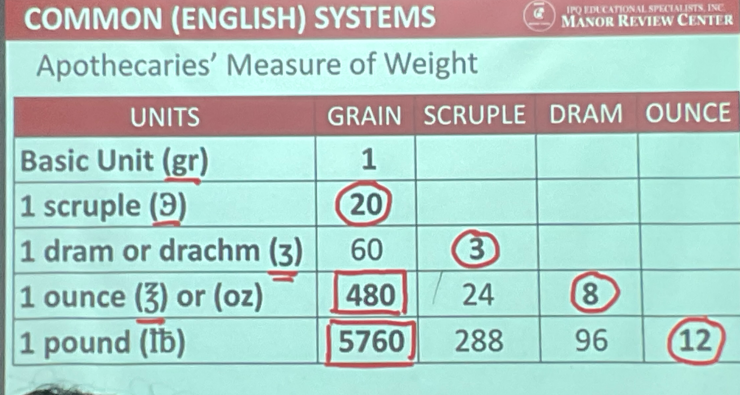
Apothecaries’ Measure of Weight:
[Common / English System]
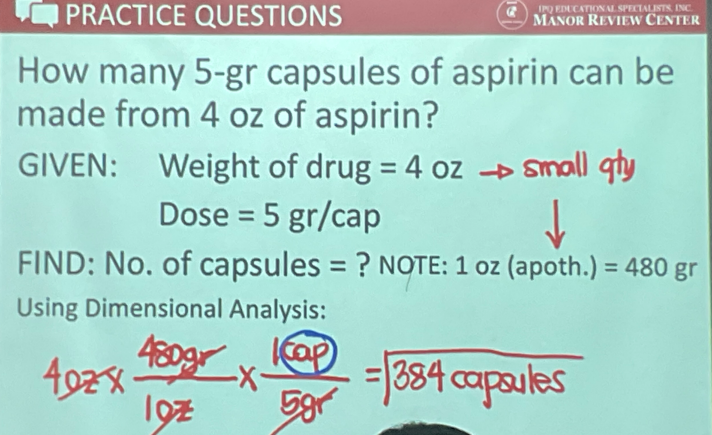
Practice Test for Common / English System:
[Common / English System]
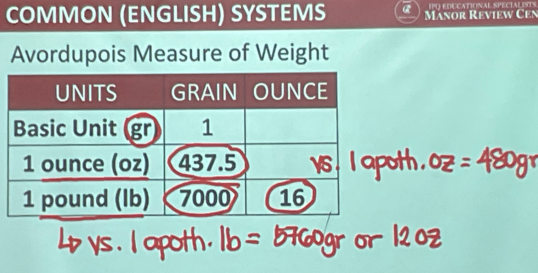
Avordupois Measure of Weight:
[Common / English System]
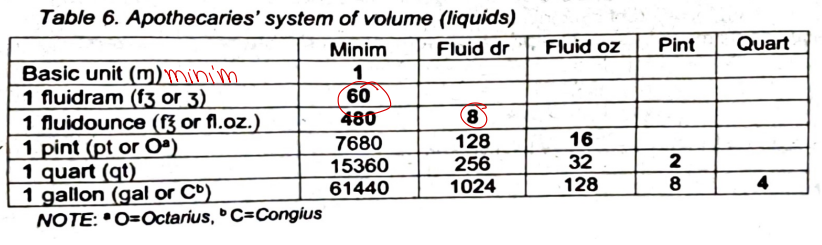
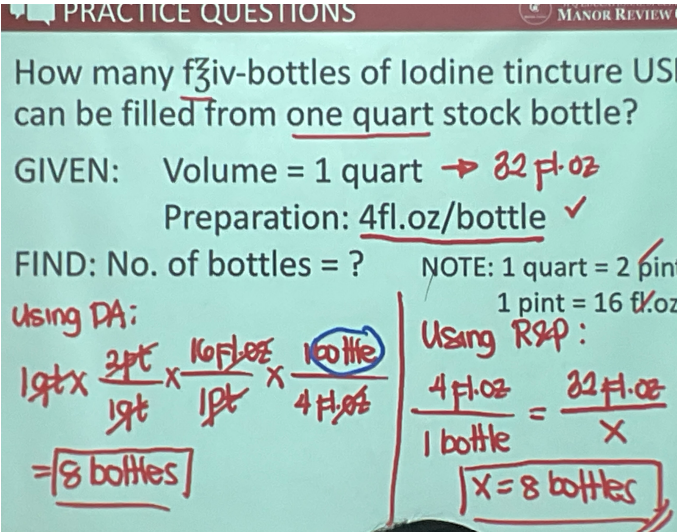
Apothecaries’ system of volume (liquids)
[Common / English System]
Practice Test for Common / English System
a. True
[Household System]
The household system is the least accurate but easily understood by patients
a. True
b. False
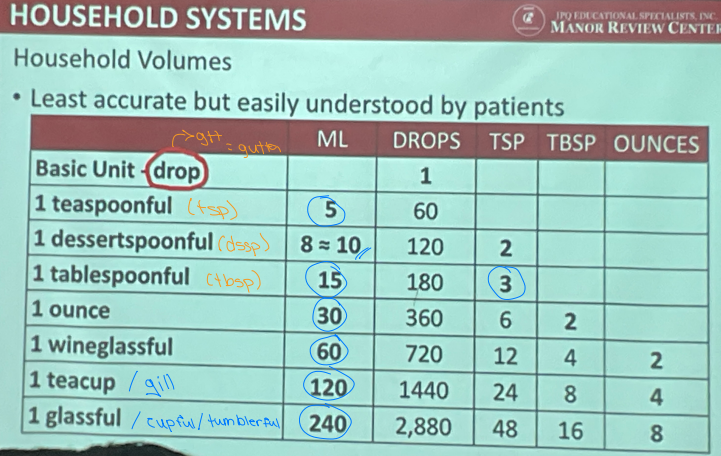
Household System:
a. 20 drops/mL
[Household System]
The official dropper is calibrated to deliver how many drops of water per mL?
a. 20 drops/mL
b. 15 drops/mL
c. 10 drops/mL
d. 25 drops/mL
a. 45-55 mg (ave: 50mg)
[Household System]
The USP standard for 1 drop of water is approximately
a. 45-55 mg (ave: 50mg)
b. 40-50 mg (ave: 45mg)
c. 50-60 mg (ave: 55mg)
d. 30-40 mg (ave: 35mg)
a. 50 mg
[Household System]
The average weight of 1 drop of water according to USP
a. 50 mg
b. 45 mg
c. 55 mg
d. 60 mg
a. 1 g/mL
[Household System]
The density of water used in the calculation
a. 1 g/mL
b. 0.5 g/mL
c. 2 g/mL
d. 1.5 g/mL
a. 50 mg
[Household System]
The average weight of 1 drop of water according to USP
a. 50 mg
b. 45 mg
c. 55 mg
d. 60 mg
[Household System]
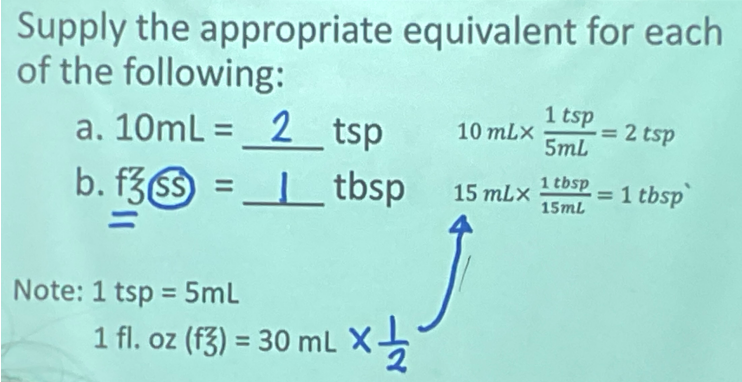
Practice Test for Household system: