CHEM 1120 EXAM 2
 Call Kai
 Learn
Learn Practice Test
 Spaced Repetition
 Match
Match Flashcards
 Knowt Play
1/50

Earn XP
Description and Tags
Chapters 14 & 15
Name | Mastery | Learn | Test | Matching | Spaced | Call with Kai | Chat |
|---|
No analytics yet
Send a link to your students to track their progress
51 Terms
Reaction rate
The speed of a chemical reaction (how fast the reaction makes products or uses reactants)
Fast rate = large fraction of molecules reacting in a given period of time
Slow rate = small fraction of molecules reacting in a given period of time
Reactant concentrations affect on reaction rate
The greater the concentration of reactant molecules, the faster the reaction (increased frequency of reactant molecule contact)
Concentration of gases depends on the partial pressure of the gas (higher pressure = higher concentration)
Concentration depends on molarity (M) = moles solute / L solution
Temperatures affect on reaction rate
Increasing temperature increases the reaction rate
In general, for every 10 C rise in temp, the speed of the reaction doubles
Breaking bonds requires energy (endo) while forming bonds gives off energy (exo)
Higher temp = higher kinetic energy of gas molecules (many collisons occur with enough energy to break bonds in reactants, faster rate of reaction)
Activation energy
The energy required to get the reaction started (comes from forming bonds and from temperature (kinetic energy))
Nature of the reactants affect on reaction rate
Refers to what kind of reactant molecules there are and their physical condition
Smaller molecules tend to react faster than large molecules (quicker collisons bc faster molecules)
Powdered solids are more reactive than blocks (more surface area)
Certain types of chemicals are more reactive than others
Ions react faster than molecules
Structure and orientations affect on reaction rate
Rate depends on the structure and relative orientation of colliding reactant particles
The orientation of the collisions between reactant molecules
Rate equation
To be consistent, the change in concentration of each substance is multiplied by 1/coefficient

Average rate
The change in measured concentrations in any particluar time period
Linear approximation of a curve
The larger the time interval, the more the average rate deviated from the instantaneous rate since reaction slows with time
The instantaneous rate
The change in concentration at any one particular time (ex: rate at 20 seconds)
Slope at one point of a curve
Determined by taking the slope of a line tangent to the curve at that point
Rate law
The rate law shows how the rate of a reaction depends on the concentration of one or more of the reactants
Rate law must be determined experimentally
The rate of a reaction is directly proportional to the concentration of each reactant raised to a power
Rate = k [A]n [B]m
n & m are the orders with respect to each reactant
k is the rate constant
the reaction is (m+n)th order overall
Reaction order
The power tells you how much that reactant is contributing to the overall rate
Zero order
Rate = k [A]0 = k
The rate of the reaction does not depend on initial concentration
Doubling [A]0 will have no effect on reaction rate
Rate = M/s, k = M/s
First order
Rate = k[A]1
The rate is directly proportional to the reactant concentration
Doubling [A] will double the rate of the reaction
Rate = M/s, k = s-1
Second Order
Rate = k[A]2
The rate is directly proportional to the square of the reactant concentration
Doubling [A]2 will quadruple the rate of the reaction
Rate = M/s, k = 1 / Ms
Integrated rate laws
Integrating the rate law shows the relationship between the concentration of A and the time of the reaction

First order integrated rate law
Rate law: rate = k[A]1
Integrated rate law: ln[A]t = -kt +ln[A]0 (y = mx+b)
A graph of first order: ln[A] vs time is a straight line where slope = -k and the y intercept = ln[A]0
Half life: t1/2 = ln2 / k
![<p>Rate law: rate = k[A]<sup>1</sup></p><p>Integrated rate law: ln[A]<sub>t</sub> = -kt +ln[A]<sub>0 </sub>(y = mx+b)</p><p>A graph of first order: ln[A] vs time is a straight line where slope = -k and the y intercept = ln[A]<sub>0</sub></p><p>Half life: t<sub>1/2</sub> = ln2 / k </p><p></p>](https://assets.knowt.com/user-attachments/d4d043c1-7f03-4959-b981-5da02cdede57.png)
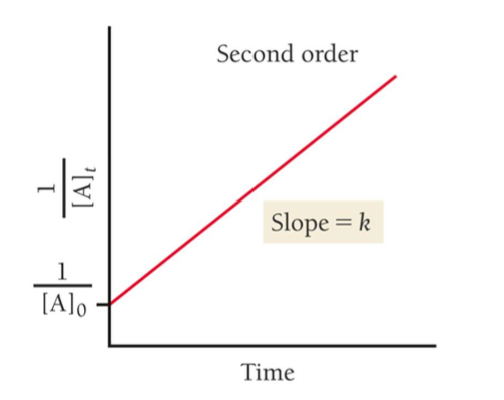
Second order integrated rate law
Rate law: rate = k[A]2
Integrated rate law: 1 / [A]t = kt + 1 / [A]0
A graph of second order: 1 / [A] vs time results in a straight line where slope = k and the y intercept = 1 / [A]0
Half life: t1/2 = 1 / (k[A]0)
![<p>Rate law: rate = k[A]<sup>2</sup></p><p>Integrated rate law: 1 / [A]<sub>t</sub> = kt + 1 / [A]<sub>0</sub></p><p>A graph of second order: 1 / [A] vs time results in a straight line where slope = k and the y intercept = 1 / [A]<sub>0 </sub></p><p>Half life: t<sub>1/2</sub> = 1 / (k[A]<sub>0</sub>)</p>](https://assets.knowt.com/user-attachments/78541f8f-8d38-4e0e-96a5-d34e37be4ab7.png)

Zero order reactions
Rate law: rate = k[A]0 = k
Integrated rate law: [A]t = -kt + [A]0
A graph of zero order: [A] vs time results in a straight line where slope = -k and the y intercept = [A]0
Half life: t1/2 = [A]0 / 2k
![<p>Rate law: rate = k[A]<sup>0</sup> = k</p><p>Integrated rate law: [A]<sub>t</sub> = -kt + [A]<sub>0</sub></p><p>A graph of zero order: [A] vs time results in a straight line where slope = -k and the y intercept = [A]<sub>0</sub></p><p>Half life: t<sub>1/2 </sub>= [A]<sub>0</sub> / 2k</p>](https://assets.knowt.com/user-attachments/9eacbe89-3469-4719-9d36-fda88a53725d.png)
Half life (t1/2)
The half life of any reaction is the time it takes for the concentration of the reactant to fall to half its initial value
The half life depends on the order of the reaction
The half life of a first order reaction is constant
Relationship between order and half life
Zero order: the lower the intial concentration of the reactants, the shorter the half life
t1/2 = [A]0 / 2k
First order: half life is independent of the concentration
t1/2 = ln(2) / k
Second order: half life is inversely proportional to the initial concentration. Increasing the initial concentration shortens the half-life
t1/2 = 1 / (k[A]0)
The effect of temperature on rate
Changing the temperature changes the rate constant of the rate law
k = A (-Ea / eRT )
T = temp in Kelvin
R = gas constant in energy units (8.314 J / (K x mol)
Ea = activation energy
A = frequency factor constant = the rate the reactant energy approaches the activation energy
Activation energy
The amount of energy needed to convert reactants into the activated complex or transition state.
The difference in energy between the reactants and the activated complex.
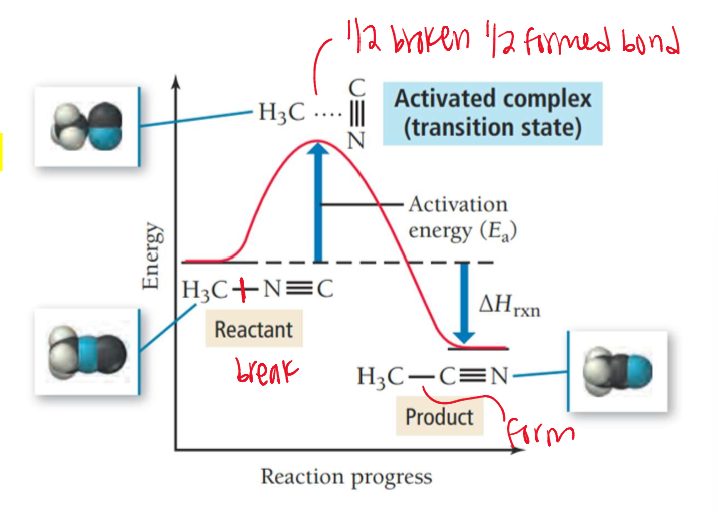
Activated complex
A chemical species with partially broken and partially formed bonds (always high in energy because of its partial bonds)
Frequency factor
The number of molecules that begin to form the activated complex in a given period of time (you want a lot for a lot of product)
The arrhenius equation: the exponential factor
The exponential factor in the Arrhenius equation is a number between 0 and 1, representing the fraction of reactant molecules with sufficient energy so they can make it over the energy barrier.
The energy comes from converting the kinetic energy of motion to potential energy in the molecules when the molecules collide.
Increasing temperature will increase the number of molecules with sufficient energy to overcome the energy barrier and the reaction rate.

Arrhenius Plots
The equation is in the form y = mx + b
y = ln (k)
x = ( 1 / T )
y - intercept = ln A (A has the same units as k)
A graph of ln(k) vs. (1 / T) is a straight line

Arrhenius Equation: Two-point form
Can be used if you only have two data points (T, k)

Reaction Mechanism & Elementary step
The series of individual chemical steps or reactions that occur to produce the overall observed reaction.
Each step in a mechanism is an elementary step, which cannot be broken down into simpler steps
Intermediates
Materials that are products in an early mechanism step and reactants in a later step
Molecularity
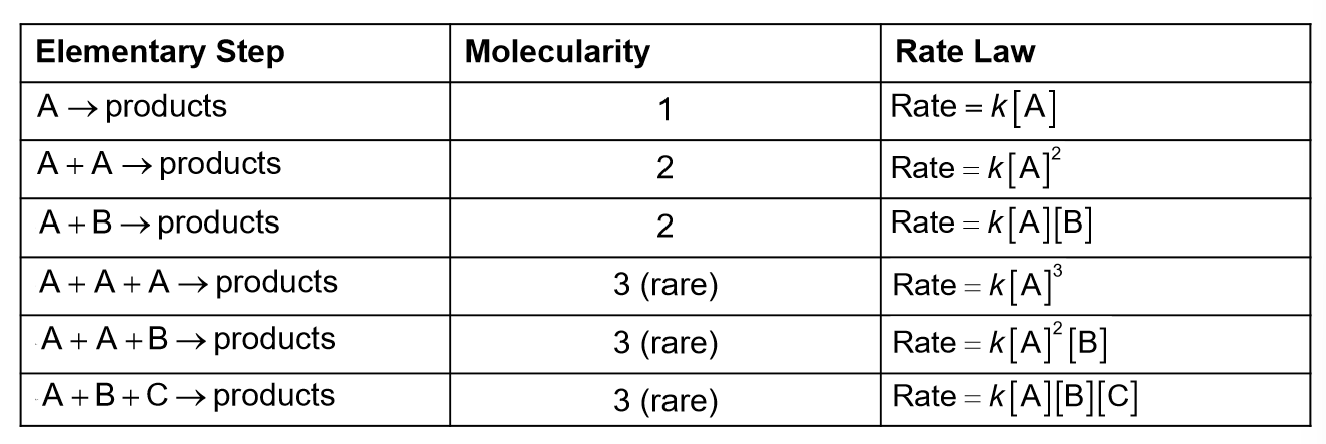
The number of reactant particles in an elementary step
Unimolecular- 1 particle
Bimolecular- 2 particles (could be the same or different)
Termolecular- 3 particles (very rare)
Rate laws for elementary steps
The rate law of an ELEMENTARY step can be deduced from the molecularity of the step
Rate-determining step
The slow step of the reaction mechanism. Product production cannot occur any faster than the slowest step, the step determines the rate of the overall reaction.
The slowest step has the largest activation energy.
The rate law of the rate-determining step determines the rate law of the overall reaction.
Criteria to validate a mechanism
The elementary steps must sum to the overall balanced reaction
The rate law predicted by the rate-determining step of the mechanism must be consistent with the experiementally observed rate law.
Catalysts
Catalysts are consumed in an early mechanism step and then made in a later step.
They affect the rate of a reaction without being consumed
They work by providing an alternative mechanism for the reation with a lower activation energy
Speed up = positive catalysts
Slow down = negative catalysts
Heterogeneous catalysts
Species present in different phases
Heterogeneous catalysts hold one reactant molecule in proper orientation for reaction to occur when the collision takes place
Sometimes they also help to start breaking bonds
Ex: solid catalytic converter in a cars exhast system
Homogeneous catalyst
All species present in the same phase
Homogeneous catalysts react with one of the reactant molecules to from a more stable activated complex with a lower activation energy
Ex: Cl (g) in the destruction of O3 (g)
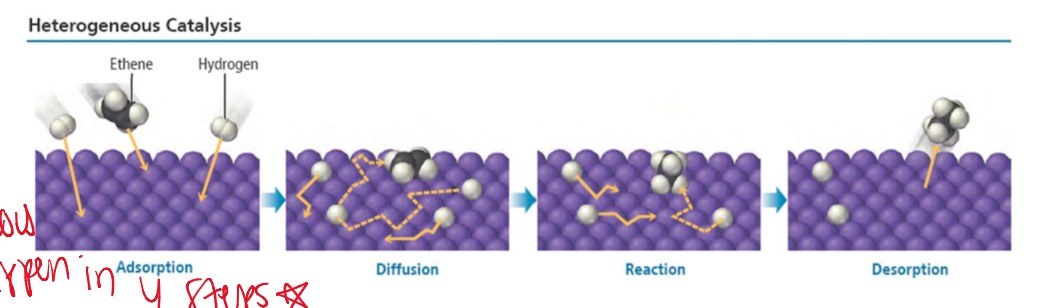
4 steps of a heterogeneous catalysts reaction
Adsorption: the reactants are absorbed onto metal surfaces
Diffusion: the reactants diffuse on the surface until they approach each other
Reaction: the reactants react to from the products
Desorption: the products desorb from the surface into the gas phase
Enzymes: Biological catalysts
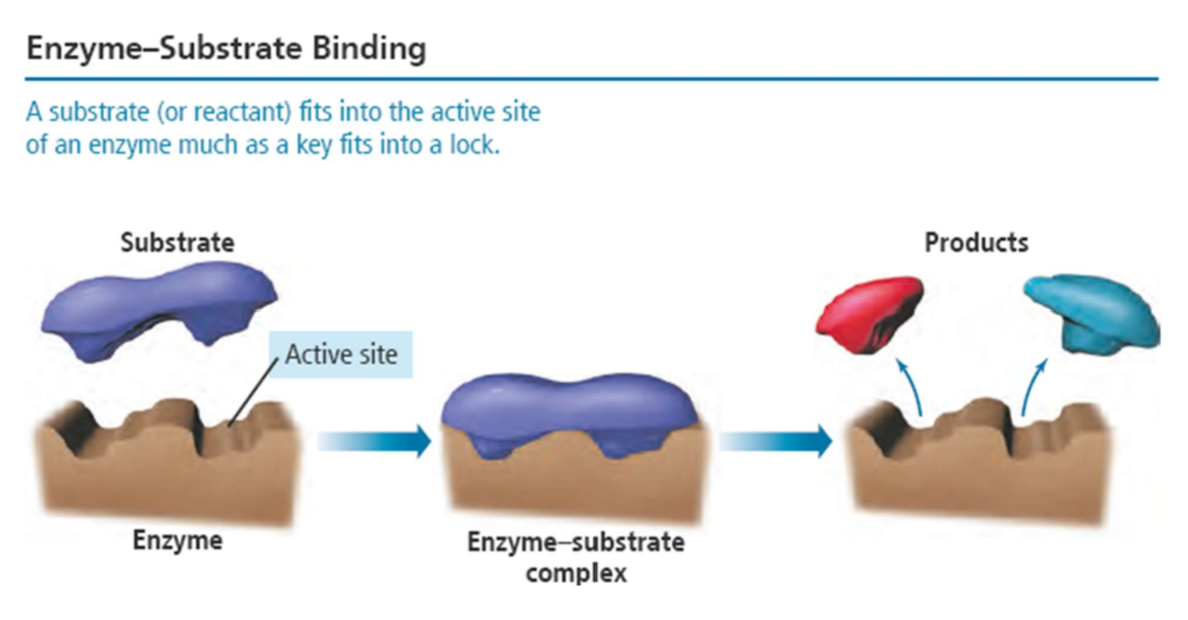
Enzymes are protein molecules that catalyze biological reactions
They are required for many biological reactions to proceed at a reasonable rate as the molecules are large and complex
Enzymes absorb the substrate reactant onto an active site that orients the substrate for reaction
Hemoglobin
Hemoglobin (Hb) is a protein found in red blood cells that reacts with O2
It enhances the amount of O2 that can be carried through the bloodstream
Hb + O2 ⇋ HbO2
Dynamic equilibrium
When the rates of the forward and reverse reactions are equal
The concentrations of reactants and products are constant (NOT EQUAL)
Denoted by ⇋
There is always a tendency to restore equilibrium
Equilibrium Constant (K)
The relationship between the chemical equation and the concentrations of reactants and products is called the law of mass action
aA + bB ⇋ cC + dD
the lowercase letters represent the coefficients of the balanced chemical equations
always products over reactants
K has no units

Reversible processes
Processes that proceed in both the forward and reverse directions
O2 Transport
Hb + O2 ⇋ HbO2
In the lungs:
Concentration of O2 is high, the equilibrium shifts to the right, Hb and O2 combine to make more HbO2
In the muscles:
Concentration of O2 is low, the equlibrium shifts to the left, HbO2 breaks down increasing the amount of free O2.
Significance of K
K « 1, reverse reaction is favored, forward reaction doesnt proceed very far
K » 1, forward reaction is favored, reverse reaction does not proceed very far
K = 1 neither direction is favored, forward reaction proceeds about halfway
Relationship between K and chemical equations
Kforward = 1/Kreverse
K2 = K1n
K3 = K1 x K2
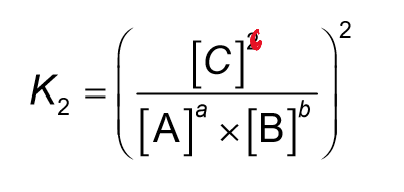
Equilibrium constants for reactions involving gases
The concentration of a gas in a mixture is proportional to its partial pressure.
Partial pressures always in atm
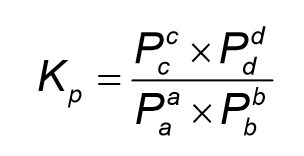
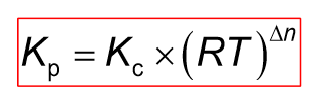
Kc & Kp Connection
Kc = Kp when △n = 0
△n is the difference between the number of moles of gaseous reactants and the number of moles of gaseous products
Heterogeneous Equilibria
The concentrations of pure solids and pure liquids do not change during the course of a reaction, so they are NOT included in the equilibrium constant expression. You include (aq) and (g).
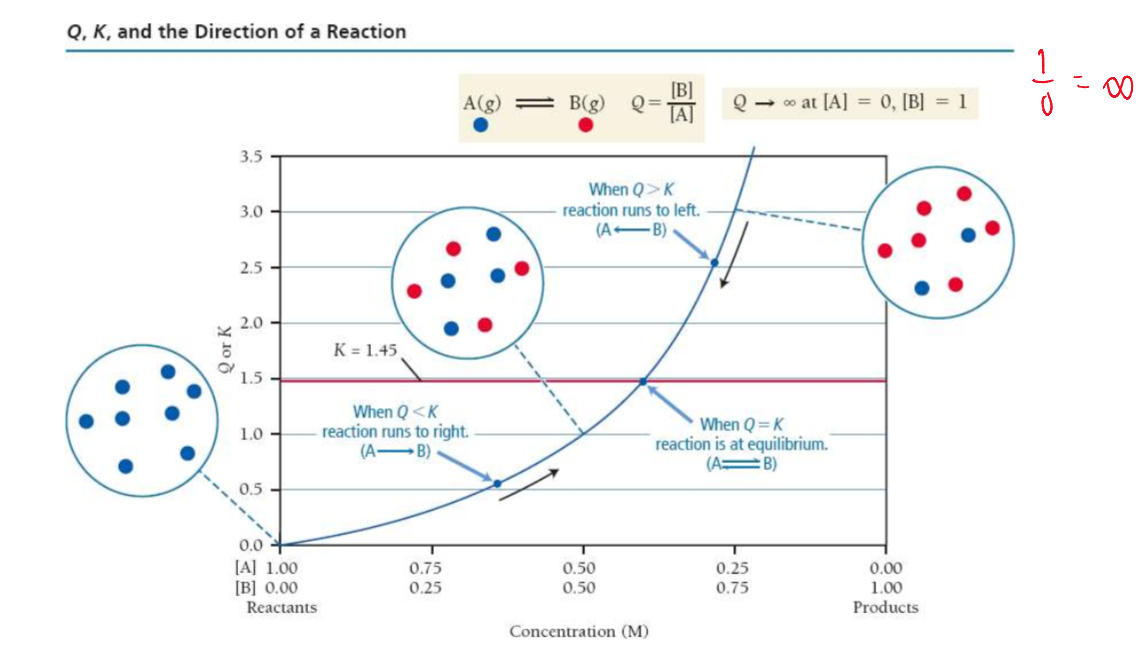
The Reaction Quotient (Q)
The concentration ratio of the products (rasied to the power of their coefficients) to the reactants (rasied to the power of their coefficients) is called the reaction quotient, Q.
Used when a reaction mixture with both reactants and products is not at equilibrium.
You compare the current concentration ratios to the equilibrium constant.

Predicting the direction of change with Q
Q > K, the reaction proceeds faster in the reverse direction (reactants will increase)
Q < K, the reaction proceeds faster in the forward direction (products will increase)
Q = K, the reaction is at equilibrium (products and reactions will not change)
If a reaction mixture contains just reactants, then Q =0 and the reaction proceeds in the forward direction
If a reaction mixture contains just products, then Q = ∞, and the reaction proceeds in the reverse direction