Microbio - Chapters 3&4
 Call Kai
 Learn
Learn Practice Test
 Spaced Repetition
 Match
Match Flashcards
 Knowt Play
1/38

There's no tags or description
Looks like no tags are added yet.
Name | Mastery | Learn | Test | Matching | Spaced | Call with Kai | Chat |
|---|
No analytics yet
Send a link to your students to track their progress
39 Terms
The Cell Envelope
-The cell envelope refers to the layers
surrounding a cells
Bacteria:
-Plasma membrane
-Cell wall composed of peptidoglycan
-A capsule or slime layer composed of carbohydrates
Archaea:
-Plasma membrane
-May or may not have a cell wall composed of pseudomurin
-Commonly have a protein S-layer
Plasma Membranes
selectively permeable barrier composed of phospholipids
-Basic structure of phospholipids
-It's fluid!
-Polar and charged molecules require transport proteins
-Important for energy (proton motive
force)
-Passive and facilitated diffusion
-Active Transport
-Osmosis and tonicity (hyper-, iso-, hypo-)

Plasma Membranes of bacteria and archaea
Bacterial phospholipids: fatty acids are attached to glycerol by ester linkages
-Generally unbranched
Archaeal phospholipids: fatty acids are attached to glycerol by ether linkages
-Often branched
Differences in saturation allow bacteria and archaea to thrive in "harsh" temperatures.
- More unsaturated = doesn't solidify in cold environments.

Plasma Membranes: for transporting nutrients
-Cells require particular molecules to synthesize their necessary macromolecules and to aid in enzyme catalysis.
-Polar, charged, and large molecules requires transport.
-Further, the concentration of these molecules often must be much higher in the cytoplasm than in the environment.

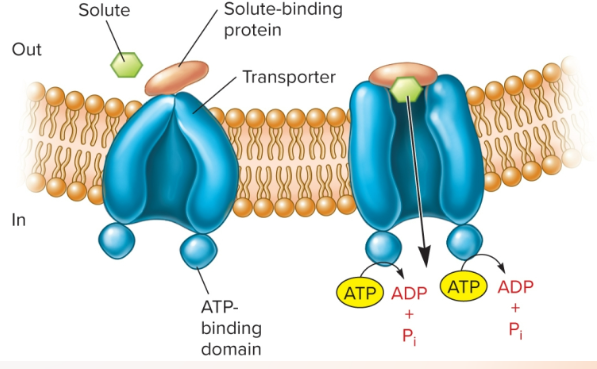
ABC Transporters
-ATP binding cassette transporters
-Very common in bacteria.
-200+ different systems have been discovered.
-Composed of three components: binding protein, transmembrane transporter, and ATP-hydrolyzing
protein
-Uniport: move a specific molecule against the concentration gradient
Siderophores
-Iron Acquisition System Working with an ABC Transporter
-Iron is required as a co-factor for many enzymes, like the cytochromes involved in the electron transport chain.
-Tightly binding iron to keep from pathogens is an example of nutritional immunity.
-secreted from bacteria and bind iron.
-Following binding to a receptor protein, iron-siderophore complexes are often move into cells via ABC transporters.

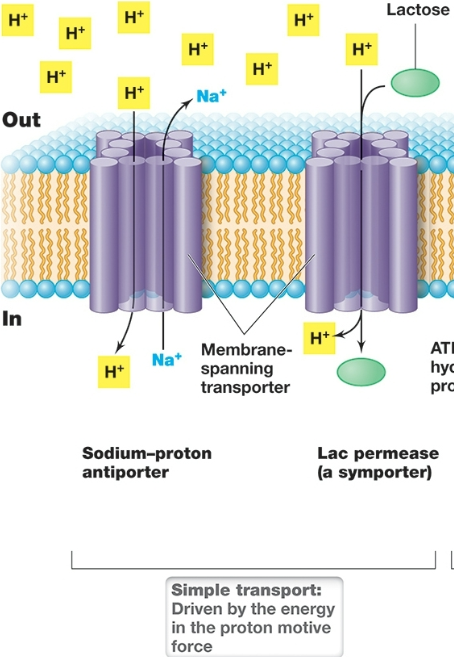
Symport
Driven by proton motive force, the release of energy as protons move with their concentration across a membrane
-the molecule and H+ move in the same direction
-In E. coli lactose is transported by Lac permease via

Antiport
Driven by proton motive force, the release of energy as protons move with their concentration across a membrane
-the molecule and H+ move in opposite directions
Group Translocation
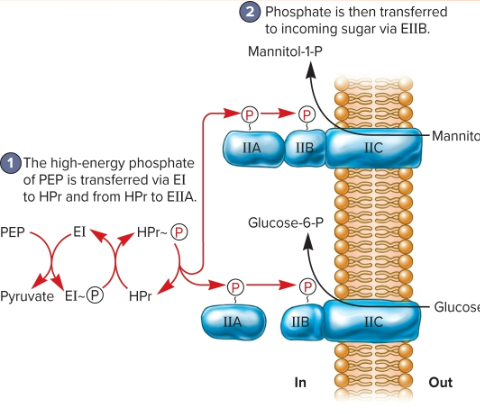
-modification of a molecule as it passes through the membrane
Example:
-Phosphoenolpyruvate sugar phosphotransferase system (PTS): glucose is phosphorylated as it moves into cell
-Important because glucose is permeable to the membrane and adding P prevents diffusion
-Fueled by the transfer of phosphate from PEP eventually to the sugar
Bacterial Cell Wall
-composed of peptidoglycan
Cell wall function
-maintain shape, protect from lysis and toxic materials, contributes to pathogenicity
Peptidoglycan
-rigid structure composed of carbohydrates and peptides
-Surrounds the plasma membrane
-Carbohydrate: alternating N-acetylglucosamine (NAG) and N-acetylmuramic acid (NAM)
-Peptide: link adjacent carbohydrate chains via D- and L- amino acids
-Forms a lattice structure
-Only bacteria have in cell wall

Bacterial Cell Wall Shapes
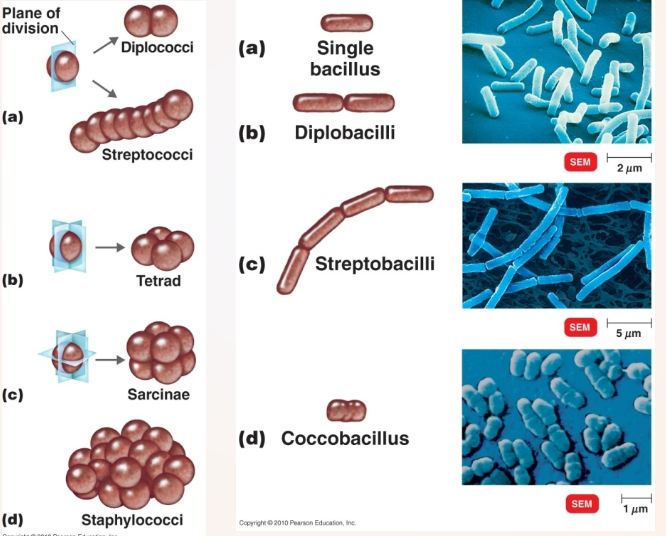
-Monomorphic: maintain a single shape
-Pleomorphic: have many shapes
-Coccus: spherical
-Bacillus: rod-shaped
-Spirilla: rigid
-Spirochete: flexible helical filament
-Vibrio: comma
-Coccobacillus: oval shaped

Bacterial Cell Wall Arrangements
-incomplete separation during division leads to arrangements
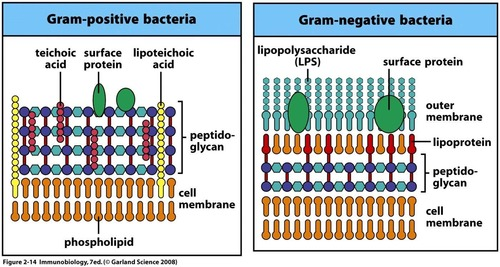
Gram-positive Cell Envelope
-Thick peptidoglycan cell wall (20-35 nm thick)
-15 or more layers
-Teichoic acids: protect from lysis, regulate ion movement, vary from one gram-positive to the next
-Lipoteichoic acids: teichoic acids bound to plasma membrane lipids, are antigenic

Antigenic
elicit an immune response
Gram-negative Cell Envelope
-More complex
-1-2 layers of peptidoglycan
-No teichoic or lipoteichoic acids
-Have an asymmetrical outer membrane
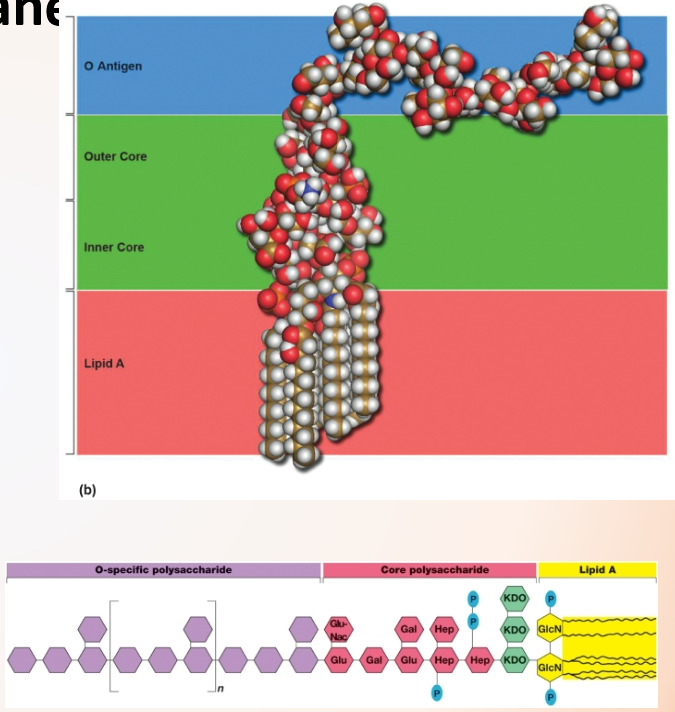
-Contain lipopolysaccharides (LPS)
-Porins: proteins for transport
-Periplasm: space between inner and outer membrane (20-40% cell volume)

Gram-negative Outer Membrane
-Outer membrane: extra permeability barrier, contributes to intrinsic antibiotic resistance
-Lipopolysaccharides (LPS): contribute to negative surface charge, stabilize outer membrane, protects from attack by immune response, toxic (endotoxin)
-Lipid A (endotoxin): in the outer membrane
-Stimulates inflammation leading to fever, vomiting, diarrhea, shock
-Core polysaccharide
-O side chain (o antigen)
Gram-positive and Gram-negative bacteria microscopically via gram staining
-Addition of iodine causes crystals to form.
-Alcohol dehydrates gram-positive cells making them impermeable to the iodine-crystal violet complex---crystal violet retained
-Alcohol dissolves the outermembrane of gram-negative cells allowing the iodine-crystal violet complex to diffuse—crystal violet lost

Bacterial Cell Wall Targeted
-Peptidoglycan can be weakened by lysozyme a protein produced by the animal innate immune system which cleaves the glycosidic bond between NAM and NAG.
-Penicillin binds to an enzyme (called penicillin binding proteins) that links the peptide side chains.
-The resulting weakened cell wall lysis by osmotic lysis

Bacterial Cell Envelope Diversity
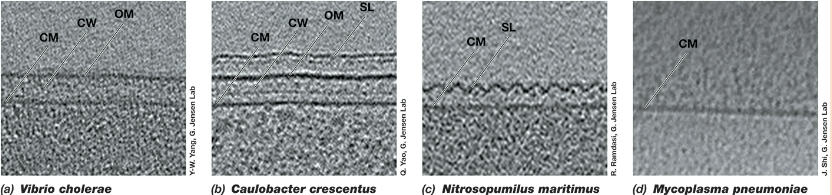
-Some bacteria lack obvious peptidoglycan, like Chlamydia trachomatis and Mycoplasma
Acid-fast bacteria cell envelopes
-(those belonging to genera Mycobacterium and Nocardia) have a Gram-positive cell wall, but have an additional layer of mycolic acid
-Mycolic acid: a waxy lipid that resists staining and makes the bacteria hardy in desiccation, clump together, and difficult to destroy by antibiotics, immune response, and disinfectants.
-Acid-fast staining can distinguish acid fast and non- acid fast bacteria.

Archaeal Cell Wall
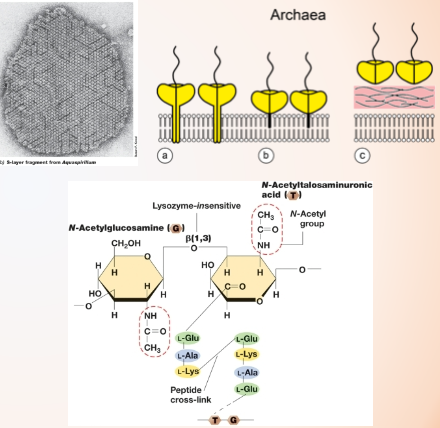
-S-layer: protein coat that surroundsmost archaea (some bacteria do have in addition to peptidoglycan)
-Pseudomurein: alternating N-acetylglucosamine (also in peptidoglycan) and N-acetyltalosaminuronic acid (different, replaces N-acetylmuramic acid)
-β-1,3 glycosidic bonds instead of β-1,4
-Amino acids all l-stereoisomer
-Cannot be destroyed by lysozyme and penicillin
Bacterial Cell Wall: Capsules and Slime layers
-Glycocalyx: viscous polysaccharide and/or polypeptide secreted outside cell wall and membrane
-Capsules: organized, tightly packed glycocalyx
-Functions: cell-to-cell attachment, resistance to desiccation, evading immune response
-Pathogenicity factor: protects bacteria from phagocytosis by certain white blood cells
-Resistant to staining, seen as halo
-Slime layers: loosely associated glycocalyx, associated with biofilms and aggregates

Pili/Fimbriae
-often used interchangeably to refer to short, thin,
hairlike protein appendages.
-Involved in cell-to-cell attachment, initiating biofilm development, twitching motility, DNA uptake
-Pathogenicity factor: involved in attachment to host cells/tissues
-Sex pili: involved in conjugation (a type of horizontal gene transfer that results in exchange of plasmids)

Twitch via Pili
-one of the types of surface associated motilities
-Type IV pili are required for this movement.
-Subunits of pili proteins are added where the pilus attaches to the cell envelope to extend the pilus.
-The pilus attaches to the surface and then the pilus filament is disassembled where it is attached to the cell envelope by removing pili filament proteins. The shortening is called retraction.
-Retraction pulls the cell forward.

Flagella Functions
-Threadlike, protein, extends out from membrane and cell wall.
-Functions: motility, attachment, recognized by the innate immune response.
-Pathogenicity factor: movement and attachment is important for colonization.
-Staining can detect differences in flagella number and arrangement

Flagella Structure
-Filament: extends from the cell, and is composed of the protein flagella arranged in a helix.
-Basal Body (motor): embedded in the cell envelope, includes the rotor and stator, complex multiprotein structure.
-Harnesses proton motive force to turn the filament.
-Because of differences in cell envelope structure the basal body of gram-positive and gram-negative bacteria differ.
-Hook: short curved segment, attaches filament to basal body.
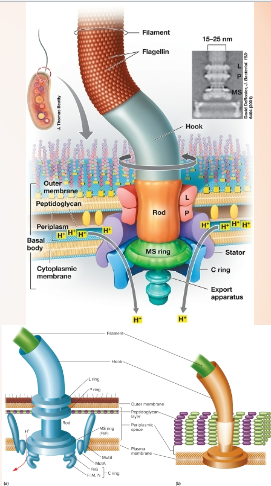
Flagella Synthesis
-Composed of many proteins which are encoded by genes regulated in a hierarchy.
-Filament: helical filament is hollow, flagellin subunits move through the filament to the growing cap at the tip.
-Constant synthesis because of how delicate the filament is. Cap keeps breaking off and getting replaced constantly.

Flagella swimming and swarming
-Swimming: occurs in aqueous environments
-Is random in the absence of an attractant/repellent
-Taxis: directed movement to a chemical or physical stimuli
-Chemotaxis: response to chemicals
-Phototaxis: response to light
-Receptors stimulate signals that inhibit changes in flagella rotation, inhibiting frequent tumbles/reorientation allowing directional movement.

Measurement of chemotaxis
-Chemotaxis assay: capillary tubes containing either attractants, repellents, or water are placed in a culture of bacteria.
-Capillaries are removed and the contents are plated to determine bacterial concentration.
-Capillaries that have more bacteria than the capillaries containing the negative control (water) are likely attractants.
-Capillaries that have less bacteria than the capillaries containing the negative control (water) are likely repellents.
-Also measured microscopically.

Bacteria “tax” to or away from
-Phototaxis: bacteria called cyanobacteria are photosynthetic and even non-photosynthetic bacteria have been shown to sense and respond to light.
-Photoreceptors: proteins that detect light and regulate flagellar rotation proteins.
-Osmotaxis: response to ionic strength
-Hydrotaxis: response to water
-Aerotaxis: response to oxygen
-Magnetotaxis: some bacteria have magnetosomes which allow them to align with the earths magnetic field and swim to or away from oxygen.

Flagella swarming
-Swarming motility: unlike swimming, swarming is often a coordinated group movement, and it occurs on a surface.
-Swarmers are often peritrichous.
-Flagella of the group form a flagella bundle that overcomes the surface tension and friction.
-Biosurfactants: are secreted by many swarmers to reduce friction/lubricate the surface.
-Swarming can be directional (taxis).

Spirochetes
-weird flagella in some gram-negatives
-Flagella filament does not extend from cell, instead it remains in the periplasmic space and wraps around the cell.
-When the flagella motor turns, the whole cell flexes and spins.
-Corkskrew shape of the spirochetes allow them to move much like a screw.
-Ex: Treponema pallidum (causes syphilis) and Borrelia burgdorferi (causes lyme disease)

Gliding motility
-unlike swimming and swarming, gliding does not require a flagella
-Biosurfactants have been shown to be important
-A helical intracellular protein track and gliding motors and adhesion proteins work like the tracks on a skid loader to drag the bacteria across a surface (like a skid loader)

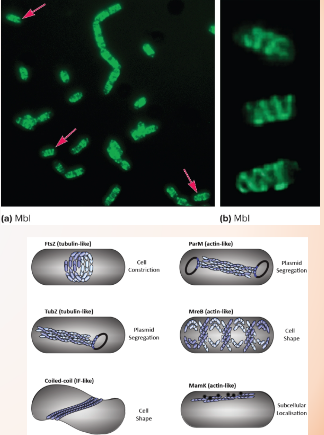
Bacterial cytoskeleton
-Somewhat “new”
-Involved in cell division and positioning peptidoglycan.
-Can be detected by tagging the proteins with fluorescent proteins (Drs. Weis and Ellermeier at UIowa study the divisisome in C. diff).
-FtsZ: forms a ring at midcell to constrict the cytoplasm during cell division.
-MreB: Maintains shape and positions peptidoglycan machinery.
-CreS: maintains curve shape.
Ribosomes
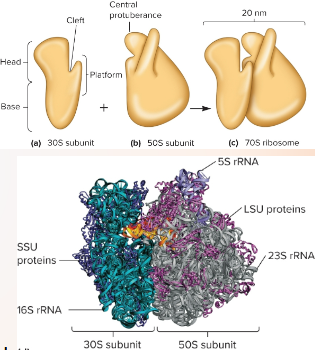
-Protein/RNA complexes involved in protein synthesis.
-Bacteria and archaea both have 70S ribosomes but are distinct (archaea were discovered by Woese due to vastly different 16S rRNA).
-Bacteria: 16S rRNA is part of the 30S subunit and 23S and 5S rRNA are part of the 50S subunit.
-Eukaryotes have 80S ribosomes.
-Structural difference between bacterial and eukaryotic ribosomes allow 70S ribosome to be an antibiotic target (streptomycin, neomycin, tetracycline, erythromycin).
Nucleoid and Plasmids
-Nucleoid: there is no nuclear envelope, but the bacterial chromosome is localized.
-Supercoiling allows the very long genome to be packaged inside the cell.
-Plasmids: extrachromosomal DNA that is small, circular.
-Replicate independent of the chromosome.
-Carry genes that are not essential for survival but do carry a selective advantage (like antibiotic resistance).
-Can integrate into chromosome via recombination.

Endospores
-Highly differentiated, dormant cells produced by some gram-positive bacilli.
-Resistant to heat, radiation, harmful chemicals, drying, nutrient depletion.
-Are NOT reproductive structures, produced by a cell, which releases the spore and doesn’t persist.
-Endospores are the dormant cell. Vegetative cells are the cell of the same organism that replicates.
-Spore location varies when inside the producing cell.
-Composed of: core, inner membrane, cortex, outermembrane, endospore coat, exosporium.
-Core contains: small acid-soluble spore proteins (SASPs) and diplicolinic acid (both bind to and protect DNA).
-Production is mediated by 200+ genes.
-Sporulation/Sporogenesis: production of spores from vegetative cells.
-Spore release kills the cell.
-Water is eliminated from the cytoplasm.
-Germination: return to vegetative cell.
-HUGE problem for health and food safety.
