ECONOMICS UNIT4 - AOS 1A- BUDGETARY POLICY
 Call Kai
 Learn
Learn Practice Test
 Spaced Repetition
 Match
Match Flashcards
 Knowt Play
1/51

There's no tags or description
Looks like no tags are added yet.
Name | Mastery | Learn | Test | Matching | Spaced | Call with Kai | Chat |
|---|
No analytics yet
Send a link to your students to track their progress
52 Terms
KK1: the need for aggregate demand policies, including monetary policy and budgetary policy in terms of stabilising the business cycle
The need for aggregate demand policies:
To stabilise fluctuations in the business cycle.
To increase aggregate demand during periods of weak economic growth or recession.
To decrease aggregate demand during periods of excessive economic growth and inflation.
To help achieve the government's domestic macroeconomic goals, particularly strong and sustainable economic growth, low inflation, and full employment.
KK2: sources of government revenue, including direct and indirect taxation; progressive, regressive and proportional taxes; and revenue from government businesses and the sale of government assets
3 largest sources of gov revenue
Income tax receipts: $492.3B (70%) — money the government collects directly from people and businesses based on their income, such as personal income tax and company tax.
Indirect tax receipts: $150.3B (22%) — taxes collected on goods and services, rather than directly on income. Examples include GST and excise taxes.
Non-tax receipts: $55.9B (8%) — government revenue that doesn't come from taxes, such as government fees, fines, dividends from government-owned businesses and interest income.
nature of aus taxes
Progressive taxes – those taxes whereby higher income earners pay a higher proportion of their wage then lower income earners e.g. income tax in Australia
Proportional taxes – those taxes whereby the ‘rate of tax’ stays the same. For example, company tax is set at 30% for those companies with a turnover of more than $50 million.
Regressive taxes – results in the portion of income paid in tax rising as income falls. The GST is levied on most G+S (with many necessities exemptions) and has regressive effects as low income earners pay a higher portion of their wage in GST than higher income earners.
KK3: types of government expenses, including government current and capital expenditure and transfer payments
2 largest expenses
social security and welfare: 36%
other purposes - primarily gst distributions to state gov 19%
-this can be categorised as g1 - current, or g2 - capital, and transfer payments
gov expenditure
g1: spending on g/s consumed within the budget period that have no future ongoing benefits e.g. wages fro public servants
g2: purchase of assets that have benefits beyond current budget period e.g. infrastructure
transfer payments: involves transfer of money to the private sector in the form of welfare e.g. pensions
KK4: the budget outcome: balanced, deficit or surplus
NOTE: OUTCOME IS DEFICIT OR SURPLUS, STANCE: IS EXPANSIONARY OR CONTRACTIONARY
what are the three possible outcomes of the budget?
balanced budget- gov revenue = expenditure
budget surplus - gov revenue is bigger then expenditure
budget deficit - gov revenue is lower then expenditure
reporting budget outcome
The headline cash outcome is the simply the total cash received minus the total cash outlaid. As it includes all cash flows it can provide a misleading picture of the budget outcome and stance.
The underlying cash outcome excludes cash flows that do not directly impact the economy (called ‘Net cash flows from investments in financial assets for policy purposes’ (IFAPP)) . It removes such items as Future Fund earnings and the proceeds from the sale of GBE's (e.g. MediBank Private). This provides a more accurate reflection of the actual budget outcome and stance.
KK5: the underlying cash balance (budget outcome), including as a proportion of Gross Domestic Product (GDP)
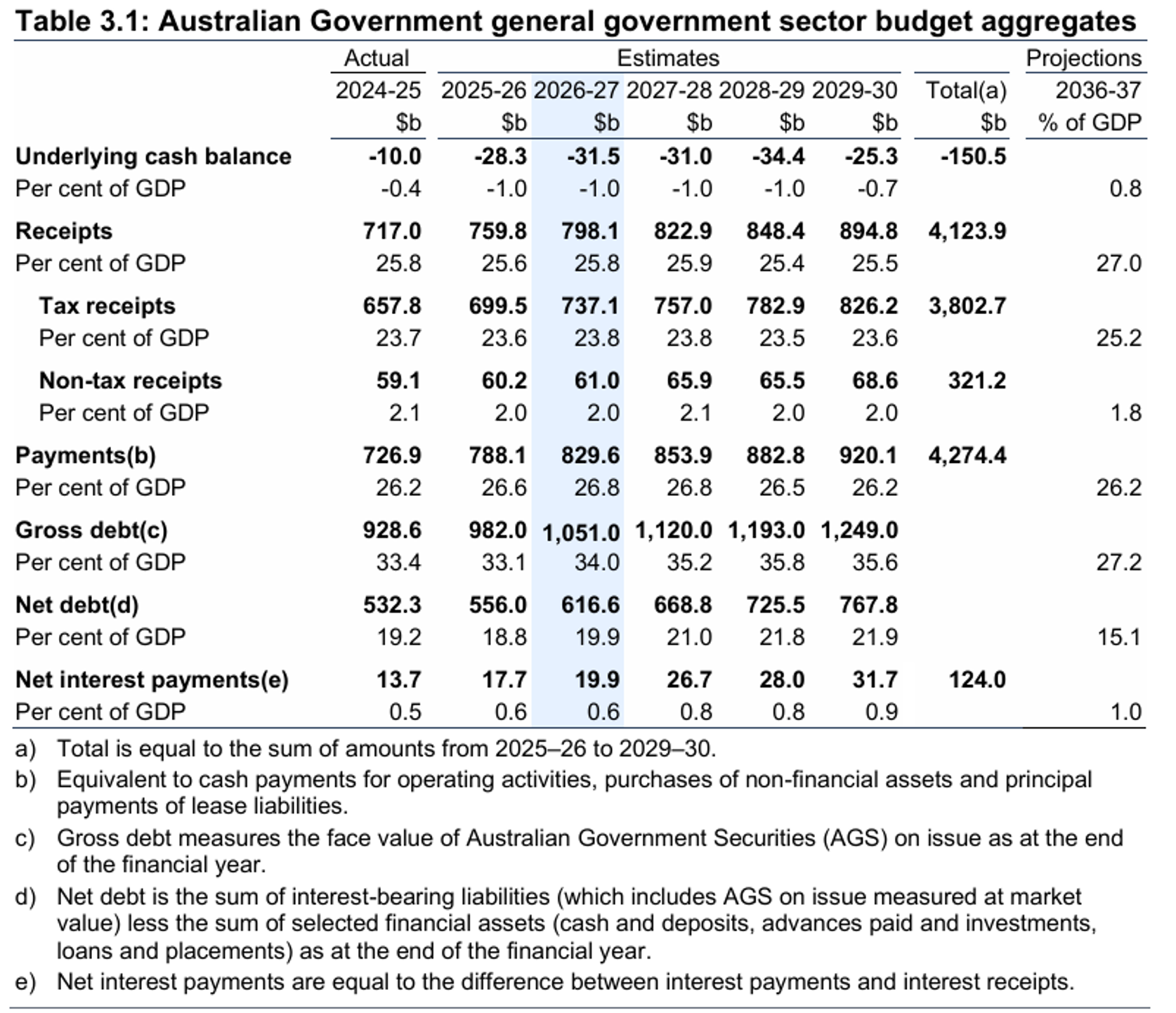
reporting underlying cash balance
The underlying cash balance is the primary measure used by the Australian government and media to assess the budget outcome. It represents the gap between total cash receipts (primarily tax revenue) and total cash payments (government spending and investment).
For the 2026/27 budget the estimated underlying cash deficit was $31.5 billion. This indicates that the government expenditure exceeded revenue by $31.5 billion once ‘Net cash flows from investments in financial assets for policy purposes (IFAPP)’ are excluded. These IFAPP transactions are excluded as they don’t directly impact the economy.
To put things into perspective (and make comparisons between nations and time periods) the underlying budget outcome is reported as a % of GDP. The $31.5 billion underlying budget deficit only represents 1% of GDP.
KK6: methods of financing a deficit or utilising a surplus
financing a debt
when the budget is in a deficit it means that the gov needs to raise funds to cover the difference. the gov will issue bonds (or notes) in order to raise funds
the purchasers will become lenders to the gov and recieve interest
in australia: aus gov securities (ags)
Selling bonds to Australian investors – this has been the most common approach of financing a deficit over recent years. This is the least expansionary approach of the three. In selling bonds domestically, the government places upward pressure on interest rates which makes it more expensive for the private sector to borrow funds. This is called crowding out of the private sector.
Selling bonds to overseas investors - this approach involves selling bonds to foreign investors. As the government is borrowing from overseas (resulting in capital inflow) this causes the AUD to appreciate having a negative impact on exports and again somewhat negating the effects of an expansionary budget. This is called crowding out of the external sector.
Selling bonds to the RBA – this is the most expansionary and most inflationary way of financing a budget deficit as it involves the release of new money into circulation. This approach has fallen out of favour since the late 1980's. The RBA desires a clear separation between budgetary and monetary policy.
options when utilising surplus
If the government runs a budget surplus it can either invest the money in financial markets (e.g account with RBA), repay existing government debt or establish funds for specific purposes (e.g. Future Fund)
While budget deficits tend to contribute to 'crowding out', budget surpluses tend to contribute to 'crowding in'. A surplus means that the government becomes a net lender rather than a borrower for the year meaning less pressure for funds in the market and therefore lowering the cost of borrowing for the private sector.
KK7: the relationship between the budget outcome and the level of government (public) debt
running a deficit
Remember that deficit and debt are not the same thing, however, they are connected.
Deficits refer to a financial shortfall over a period of time whereas debt is the total sum of money owed.
Budget deficits will increase the size of Australia's public debt
Debt requires regular repayments of both principal and interest meaning that public debt is an ongoing cost. The larger the debt the larger the repayments.
Australia currently has AAA credit ratings (the highest rating) meaning our costs of borrowing are lower than many other nations. If our credit rating was to be downgraded the costs of borrowing and servicing our debt would grow. For example, this may happen if we were to accumulate too much debt.
High levels of debt can result in a country having raise taxes and/or cut spending.
When it comes to public debt (and budget deficits) what matters is whether the amount borrowed is sustainable (can be repaid comfortably) and does it provide future economic benefit.
running a surplus
If the government runs a budget surplus it can either invest the money in financial markets (e.g account with RBA), repay existing government debt or establish funds for specific purposes (e.g. Future Fund)
While budget deficits tend to contribute to 'crowding out', budget surpluses tend to contribute to 'crowding in'. A surplus means that the government becomes a net lender rather than a borrower for the year meaning less pressure for funds in the market and therefore lowering the cost of borrowing for the private sector.
Fiscal consolidation refers governments reducing expenditure and raising revenue in order toreturn the budget to surplus.
Some specific reasons for returning the budget to surplus include:
Helps buffer the economy against future economic shocks
Generates greater investor confidence (maintaining a AAA credit rating)
Allows the cyclical component of the budget to do its job and reduce the deficit as the economy recovers
Allows monetary policy to better manage the economy (especially the rate of inflation)
KK8: the role of automatic stabilisers (cyclical component of the budget) in influencing aggregate demand and stabilising the business cycle
automatic stabilisers
Automatic stabilisers (or cyclical components of the budget) impact the level of economic activity without any new changes to the budget. For example, if the economy was to enter a trough more people would be eligible for unemployment benefits. This helps to stabilise economic activity in a counter cyclical fashion without the need for new government policy. The marginal income tax system of Australia is also an automatic stabiliser.
Smooths fluctuations in the business cycle.
automatic stabilisers during a downturn
Tax revenue decreases.
Welfare payments increase.
Household disposable income increases relative to otherwise.
Consumption and aggregate demand (AD) are supported.
Helps reduce the severity of the downturn.
automatic stabilisers during an expansion
Tax revenue increases.
Welfare payments decrease.
Household disposable income decreases relative to otherwise.
Consumption and AD decrease.
Helps reduce inflationary pressures.
KK9: the role of discretionary stabilisers (structural component of the budget) in influencing aggregate demand and stabilising the business cycle
discretionary stabilisers
Discretionary stabilisers (or structural components of the budget) involve the government altering the budget in order to impact the level of economic activity. For example, in order to stimulate the economy the Australian gov. may cut income taxes or they may provide stimulus payments.
Helps stabilise the business cycle through deliberate government action.
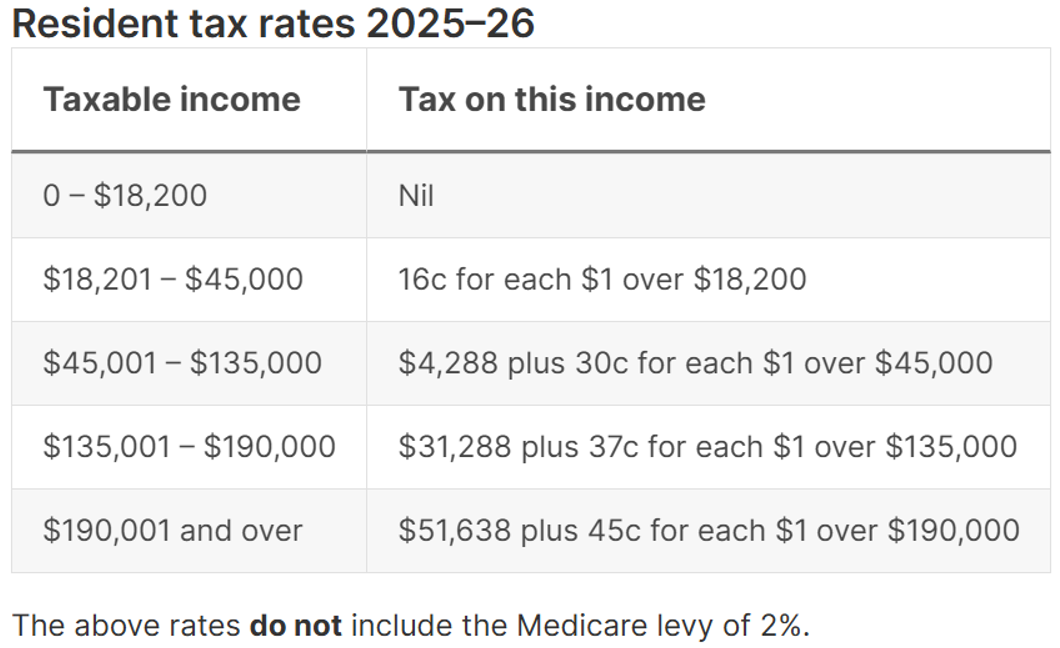
bracket creep or fiscal drag **
Australia's tax brackets are not linked to inflation therefore meaning that as nominal wages rise workers incomes will push them into higher tax brackets increasing the effective rate of tax they pay.
The Federal Government has long been happy to accept the effects of bracket creep as it is a way of increasing revenue without raising taxes in nominal terms.
*For example, over the past few years inflation has been running at around 3%, this means workers need to achieve a pay rise of about 3% over the year in order for their real wage to remain the same. Even if they do achieve a 3% pay rise they will find themselves paying a slightly higher rate of tax.
discretionary policys in expansionary policy (during a slowdown)
Expansionary policy (during a slowdown):
Increase government spending.
Decrease taxation.
Increase disposable income, consumption and investment.
Increase AD.
Increase economic growth and employment.
Contractionary policy (during strong growth/inflation):
Decrease government spending.
Increase taxation.
Reduce disposable income, consumption and investment.
Decrease AD.
Reduce inflationary pressures.
KK10: the effect of automatic and discretionary changes in the budget on the budget outcome and government (public) debt
automatic stabilisers during a downturn
Tax revenue falls.
Welfare spending rises.
Budget moves towards a deficit (or larger deficit).
Government borrowing increases.
Government (public) debt increases.
automatic stabilisers in an expansion
Tax revenue rises.
Welfare spending falls.
Budget moves towards a surplus (or smaller deficit).
Less borrowing or debt repayment.
Government (public) debt decreases.
discretionary stabilisers in expansionary budgetary policy
Increase spending and/or decrease taxation.
Budget moves towards a deficit (or larger deficit).
Government borrowing and public debt increase.
discretionary stabilisers during contractionary budgetary policy
Decrease spending and/or increase taxation.
Budget moves towards a surplus (or smaller deficit).
Less borrowing or debt repayment.
Public debt decreases.
KK11: the stance of budgetary policy: expansionary or contractionary
what is estimated vs eventuated
There can be high differences between what is estimated and what eventuated. this difference generally depends heavily on cyclical factors such as the actual economic growth and unemployment figures e.g. high or low growth rate and then expected can have a big impact on cash balance
expansionary vs contractionary budget - stance
A balanced budget means that expenditure matches revenue i.e. injections equal leakages. This generally has a neutral impact upon the economy.
A budget surplus means that the revenue collected by the government is greater than the expenditure. This generally has a contractionary impact upon the economy as the government is taking more money out of the economy than it is injecting in.
A budget deficit means that the revenue collected is less than that expenditure undertaken by the government. This generally has an expansionary impact on the economy as the government is injecting more money into the economy than it is taking out.
changes to size of deficit or surplus
A bigger deficit than the year before can be considered more expansionary. While a smaller deficit can be considered less expansionary. A similar approach can be used for the contractionary impacts of a budget surplus.
When categorising a budget in comparison to the previous year as expansionary or contractionary we need to focus upon the discretionary (or structural) changes to the budget and ignore the cyclical (or automatic) components.
KK12: the effect of the budgetary policy stance and budgetary initiatives over the past two years and their likely effect on the achievement of the domestic macroeconomic goals and living standards
how budgetary policy assists with achievment of economic goals
All budgetary policy is designed to improve the way our nation's resources are allocated so that welfare and living standards are improved.
Budgetary policy plays a key role in achieving stability in the level of domestic economic activity (aka internal or domestic stability). This occurs when the following goals are simultaneously achieved: strong and sustainable economic growth, low inflation and full employment.
budgetary policy and low inflation
The problem of high inflation is primarily tackled by the RBA
However, budgetary policy can assist. For example, the government could run a surplus in order to minimise inflationary pressure. The government’s use of subsidies for energy (directly paid through electricity bills) have also had a disinflationary effect during the time they were applied (and an immediate inflationary effect when removed).
If high inflation is largely demand driven the government could raise taxes or if it is largely supply driven they could cut the fuel excise and increase investment in infrastructure.
budgetary policy and strong and sustaianable economic growth
Budget deficits (expansionary) assist with the achievement of economic growth as the government is injecting net funds into the economy. This stimulates AD leading to higher levels of production and employment as firms increase production to meet the higher AD.
Some recent initiatives that help with eco growth include: increased transfer payments, stimulus payments, income tax cuts, business tax cuts, emergency business subsidies.
budgetary policy and full employmenet
Budgetary policy is the primary policy weapon used to target the problem of high unemployment. This is due to the ability for budgetary policy to focus on both the macro economy and specific sectors.
Policies that increase AD will also lead to a higher derived demand for labour as firms increase output, however, specific polices can be introduced such as: welfare to work initiatives, increased spending on training and education and subsidies to firms to take on particular types of job seekers.
list of general policy options - stabilising
Trough
Automatic stabilisers expand the economy as required by injecting more into welfare payments for unemployed and taking less tax from less income earners.
Expansionary policy increase government spending and/or structurally decrease tax. Reduce a surplus/increase a deficit.
Peak
Automatic stabilisers contract the economy as required by injecting less into welfare payments for unemployed and taking more tax from more income earners.
Contractionary policy decreases government spending and/or structurally increases tax. Increase a surplus/reduce a deficit.
list of general policy options - inflation
High Inflation (General)
Increase structural surplus or decrease a structural deficit.
Demand Inflation
Structurally increase taxes or remove tax concessions.
Supply Inflation
Cost of living relief (energy subsidies).
Increase skilled migration.
Reduce fuel excise.
Increase productive capacity through infrastructure and capital works.
Investment incentives (accelerated depreciation or R&D tax concessions)
list of general policy options - growth
Stimulate AD
Increase transfer payments (pensions, unemployment, family) (C)
‘One-off’ Stimulus payment to taxpayers or welfare recipients (C)
Personal tax cuts (C)
Business tax cuts (I)
Cost of living relief – household rebates (C)
Increases to G1 or G2 spending
Accelerated depreciation – Investment in capital (I)
Industry grants to access export market (X)
Subsidy for natural disasters
list of policy options - living standards
Non-material
Funding for public goods (defence, prisons)
Funding for underprovided services (age care, disability, house construction)
Provision of services with positive externalities (education and health)
Provision of goods with positive externalities (R&D, renewables)
Taxes on goods with negative externalities in consumption (tobacco, alcohol)
Taxes on goods with negative externalities in production (carbon tax)
Public sector monopoly (Aus Post)
Funding for government bodies (ACCC and ASIC)
list of general policy options unemployment
Microeconomic incentives
Mutual obligation programs
Funding for job placement
Funding for small business specifically for unemployed persons
Increased expenditure on education and training
Wage subsidy to retain employees during downturn (Jobkeeper)
Subsidies to employ specific groups of structurally unemployed persons
Welfare to work initiatives
KK13: the strengths and weaknesses of using budgetary policy to affect aggregate demand and influence the achievement of the domestic macroeconomic goals and living standards
strengths of budgetary policy
Able to target specific sectors of the economy e.g. Increased Medicare bulk-billing incentives, energy rebates.
Able to target a range of economic goals e.g. equitable distribution of income
Short impact lag – the time taken for budgetary policy to influence the economy is minimal
Is effective at stimulating AD during a downturn due to direct increases in AD
Contains automatic stabilisers e.g. welfare and marginal tax rates
Many parliamentary checks and balances
weaknesses of budgetary policy
Political hurdles can be problem – parts of the budget bill may be blocked by the Senate
Prone to political bias – decisions are often made for political rather than economic reasons
Implementation lag – new discretionary policy can take a significant amount of time to pass parliament and be actually implemented
Can be inflexible – most budgetary policy initiatives are announced in the annual May budget
Less effective at containing AD during a boom as the gov. is less able to restrict income.
Crowding out problem.
Expectations of future budget repair.
extra about fiscal strategy + to just note****
The fiscal strategy is simply a statement in the budget that outlines the medium and long-term financial goals of the government.
It helps the ensure that the budget is approached in a financially responsible and sustainable fashion. Unsustainable budgets can cause long term suffering and harm future generations.
In the 2024-25 budget the Federal Government noted: “Inflation is the primary focus of the Budget in the near term. As inflation moderates, fiscal policy will shift emphasis towards promoting sustainable economic growth and public finances over time. This is achieved through a balanced approach that manages near-term risks to inflation and growth, puts in place reforms to build a stronger and more resilient economy, and safeguards fiscal sustainability.”
Federal budget = the annual financial plan of the Australian Government. It outlines expected government revenue and government spending for the financial year.
Budgetary policy (fiscal policy) = the government's use of the federal budget (changes to government spending and taxation) to influence economic activity and achieve its objectives.
— Simple way to remember:
Federal budget = the document/plan.
Budgetary policy = the actions taken through that plan.
ITS ALL LIKE A FLOW ON EFFECT.