GELOG30007 Test #1
 Call Kai
 Learn
Learn Practice Test
 Spaced Repetition
 Match
Match Flashcards
 Knowt Play
1/62

There's no tags or description
Looks like no tags are added yet.
Name | Mastery | Learn | Test | Matching | Spaced | Call with Kai | Chat |
|---|
No analytics yet
Send a link to your students to track their progress
63 Terms
Why Study Fossils?
Fossils are the remains or traces of a once-living organism
Paleontology which is the study of fossils. The importance of paleontology is:
Biostratigraphy (age of rocks)
Evolution
Paleoecology/paleoenvironmental interpretation
Paleogeography/paleobiogeography
Simple Fascination
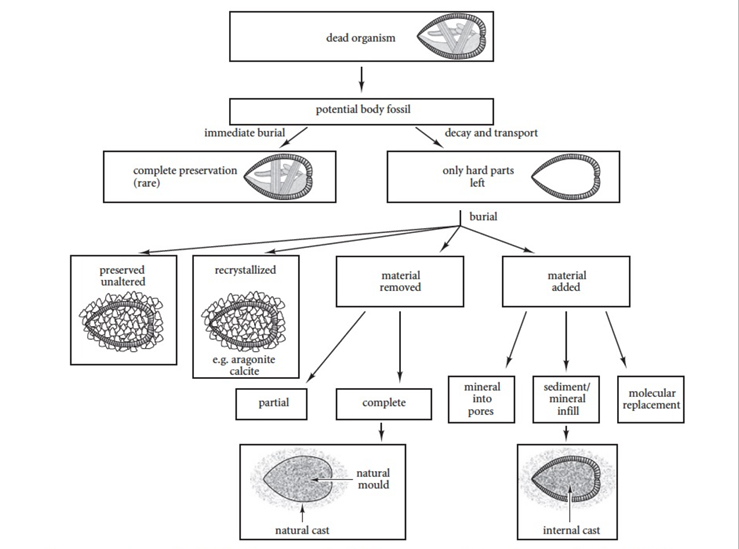
What are the modes of preservation?
Unaltered remains (frozen mammoths; insects in amber; unaltered shells & bones) anoxide conditions
Permineralization (infilling of void spaces)
Replacement (molecule by molecule substitution)
Impressions
Carbonization
Molds/Casts
What is taphonomy?
The science of fossilization — the study of the transition of the remains of an organism from the biosphere into the lithosphere (i.e., from a living organism to a fossil), including every process and source of bias along the way.
What is a "life assemblage" (biocenosis)?
The community of organisms actually living together in an environment while alive
What is a "death assemblage" (thanatocenosis)?
The assemblage of remains produced after death — after necrolysis (scavenging/decay) has acted on the life assemblage, but before burial/further alteration.
What is necrolysis?
The process by which a life assemblage (biocenosis) becomes a death assemblage (thanatocenosis) through scavenging and decay.
Aka Death
What is biostratinomy?
The set of processes acting on remains between death and final burial — break-up, scattering, transport, and shallow burial of remains.
What is diagenesis (in a taphonomic context)?
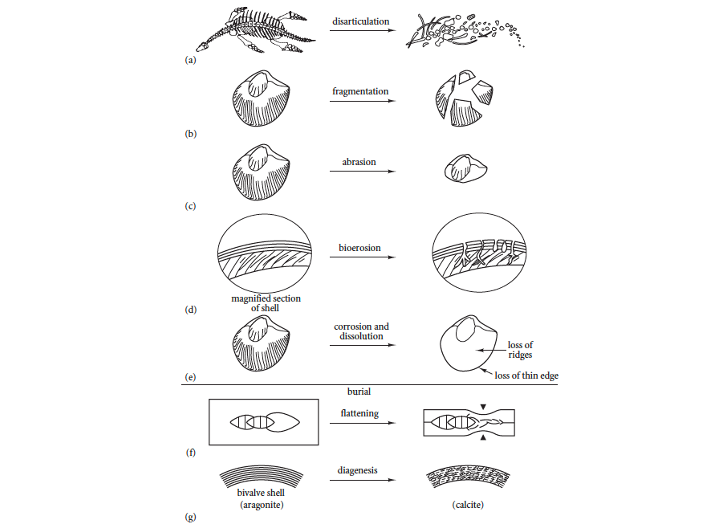
The processes acting on remains after burial — deep burial, recrystallization, dissolution, metamorphism, etc. — that convert an "initial fossil assemblage" into the "final fossil assemblage."
the change of sediments into solid rock through compaction, cementation, and mineral changes at low temperatures and pressures
Put the four taphonomic stages in order.
Life assemblage (biocenosis) → [necrolysis] → Death assemblage (thanatocenosis) → [biostratinomy] → Initial fossil assemblage → [diagenesis] → Final fossil assemblage
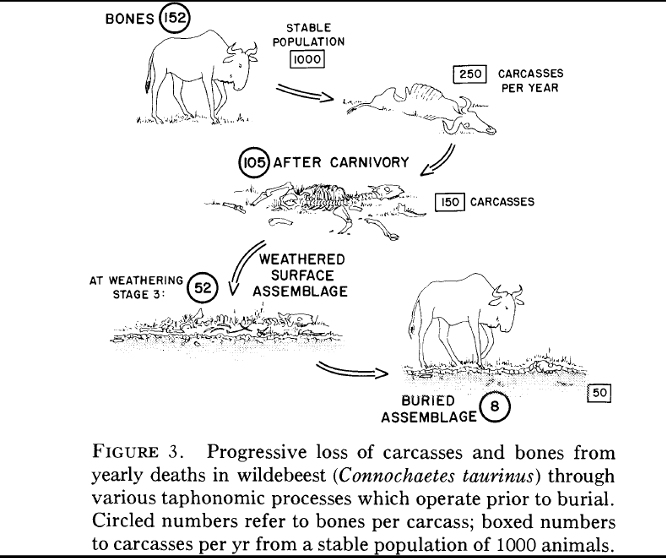
At every step in the taphonomic pathway, what generally happens to the number of individuals/specimens preserved?
There is significant removal of specimens at every step (destruction of soft tissue, then hard tissue, then fossils themselves) — so the number of fossils actually discovered is always far smaller than the original living population.
What is a Lagerstätte (plural Lagerstätten)?
A sedimentary deposit that shows exceptional fossil richness or completeness of preservation (often including soft tissues). German for "storage place" (Lager = storage, Stätte = place).
What is bioturbation?
The reworking/mixing of sediment and buried remains by the biological activity of organisms (burrowing, feeding, moving through sediment) — a major cause of physical and biological destruction/mixing of the taphonomic and fossil record before final burial.
What is biostratinomy vs bioturbation — how do they differ?
Biostratinomy = physical reworking/destruction of remains via sedimentary processes (currents, transport, burial).
Bioturbation = biological reworking/destruction via the activity of living organisms (burrowing, feeding).
Define "in situ" as used for fossil deposits
Preserved/formed in its original place of growth or deposition, without significant transport — e.g., "in situ Peat" meaning peat that formed and stayed where the plants grew, giving very high time resolution (near real-time/short time averaging).
Define "necroplanktonic" organisms.
Organisms that were planktonic (floated/drifted) only after death, not during life — e.g., a dead nekton/benthos organism whose remains drift with currents. This causes transport out of the original life habitat and reduces spatial fidelity.
What is pollen, in the context of taphonomic time-averaging charts?
Microscopic plant reproductive grains; because pollen is small, durable (sporopollenin walls), and easily wind/water transported, pollen assemblages typically show low spatial fidelity but can span a wide range of temporal resolution depending on the depositional setting
Define "fidelity" in a taphonomic sense
How accurately a fossil assemblage reflects the original living community — assessed along several axes
Define diastem
A very short, often subtle break/gap in sedimentation (a minor, brief non-depositional interval) — as opposed to an unconformity/disconformity (a major, longer time gap).
Diastems still represent "missing time" in a stratigraphic section even though they may leave little obvious physical trace.
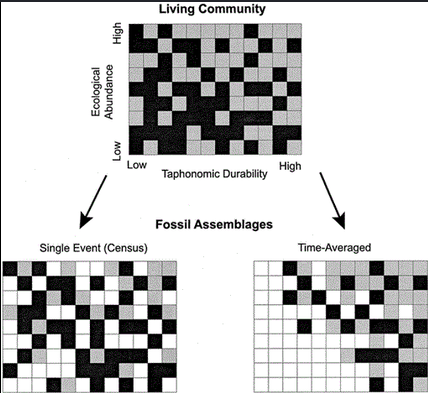
Define "temporal and spatial mixing" as related to taphonomic durability and ecological abundance
Temporal and spatial mixing refers to the averaging of biological remains over long time periods (temporal) and wide geographic areas (spatial). This mixing distorts fossil records, making ecologically rare species with high skeletal durability appear artificially abundant, while fragile, short-lived species go unrepresented despite past ecological presence.
In the chart above, in a single event, the High taphonomic durable (such as robust shell) are persevere easily so after a single event, they’re able to withstand it better.
In a time-averaged continuous eroded/diagensis created bias towards shell individuals
What are the three main axes used to classify a fossil assemblage's quality?
Compositional fidelity
Spatial fidelity
Temporal resolution
together these largely determine "fossil accumulation" quality.
Define Temporal resolution (Time Resolution) and its main source of bias
Mixing of non contemporaneous remains within single sedimentary units via physical or biological processes (taphonomic time-averaging)
Simple terms: It relates closely to how slowly the fossils accumulated and how much time got mixed together before they were finally buried.
EX: Mass Death was Instant as it was represents a single, near-instant moment in time. Therefore it is High Time Resoultion.
High resolution = short time span (census)
Bias source: mixing of noncontemporaneous remains within a single sedimentary unit through physical or biological processes
Define Spatial fidelity and its main source of bias.
Transport out of life position, rearrangement within life habitat, transport out of life habitat or biogeograpahic province (e.g. necroplanktonic organisms, pollen)
Simple terms: How well assemblage’s location reflects the organisms’ original life position aka is its at its original spot when it died or made an imprint
High Spatial Fidelity = Did not move out of its original habitat (the fossil/assemblage)
Bias source: transport out of position
Define Compositional fidelity and its main source of bias
How well the taxonomic/species composition of an assemblage matches the original living community.
Simple terms: how much original material is preserve
High Compositional fidelity = Mostly original material
Low Compositional fidelity = Susbsets of biominerals, or creatures at the k-pg impact
Bias source: selective destruction or preservation of species, morphs, or body parts; introduction of exotic or noncontemporaneous remains.
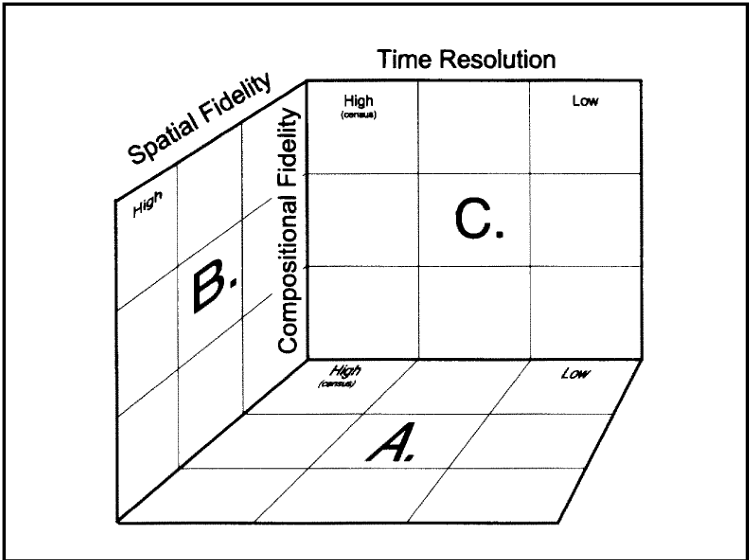
Explain the relationship + why is it important to assess all three fidelity/resolution axes together rather than relying on just one?
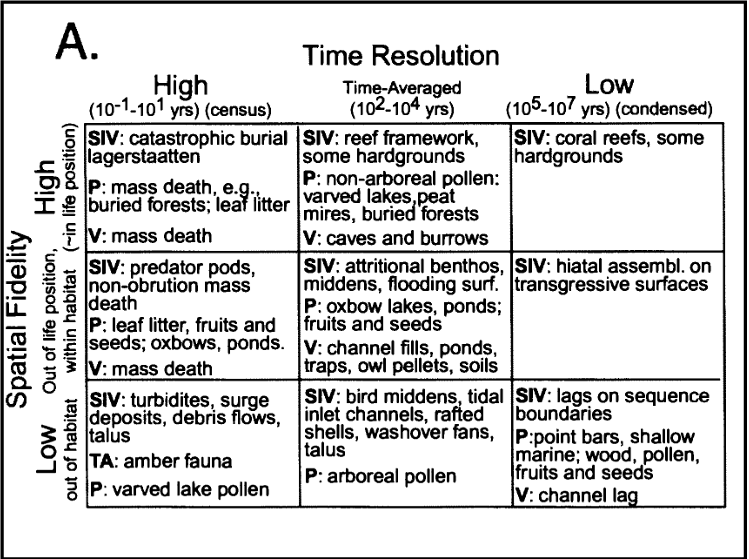
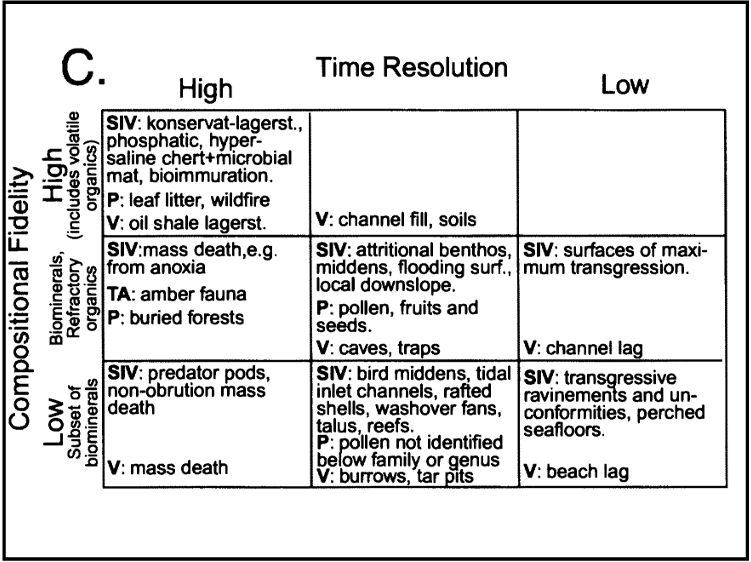
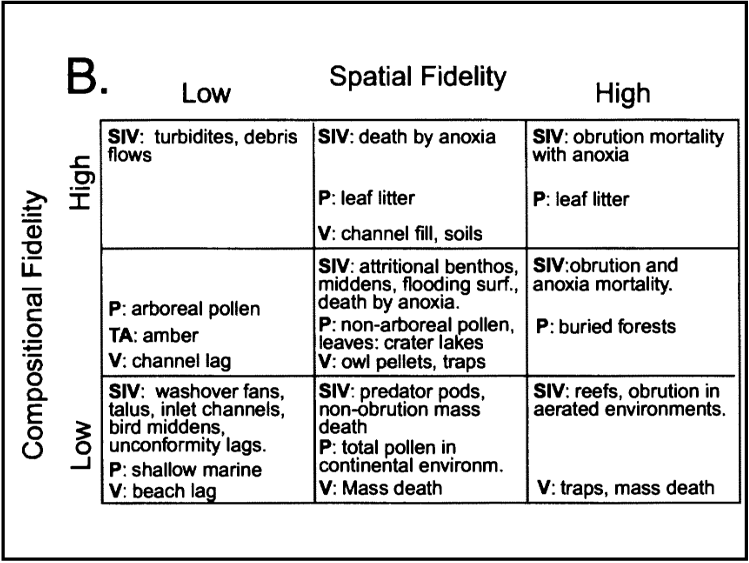
No single 2-axis table fully describes assemblage quality — a deposit can be time-averaged but spatially faithful, or spatially jumbled but compositionally faithful, etc. The cube shows that Tables A, B, and C (Practical 2 Tables 3, 5, 4) are three 2D "faces" of one 3D quality space, and a real assemblage must be evaluated on all three axes simultaneously.
Because a deposit can score well on one axis and poorly on another (e.g., a hardground can have high compositional fidelity but very low time resolution/high condensation), so a single axis alone would give a misleadingly simple picture of preservation quality
List the six basic modes of preservation given in lecture
Unaltered remains (e.g., frozen mammoths, insects in amber, unaltered shells/bones)
Permineralization (infilling of void spaces)
Replacement (molecule-by-molecule substitution)
Impressions
Carbonization
Molds/casts.
What is replacement (as a mode of preservation)?
Molecule-by-molecule (or larger-scale) substitution of the original hard-part material by a new mineral, often preserving fine original structure (e.g., silicified or pyritized fossils)
What is permineralization?
Infilling of void/pore spaces within a hard part (e.g., bone, wood) with minerals precipitated from groundwater, without replacing the original material itself.
What is carbonization?
Preservation in which volatile components (H, O, N) are driven off from organic tissue, leaving behind a thin carbon-rich film outlining the organism — common in leaves and soft-bodied organisms in fine-grained sediments (e.g., carbonized Jurassic leaf, Ediacaran/Burgess-type films)
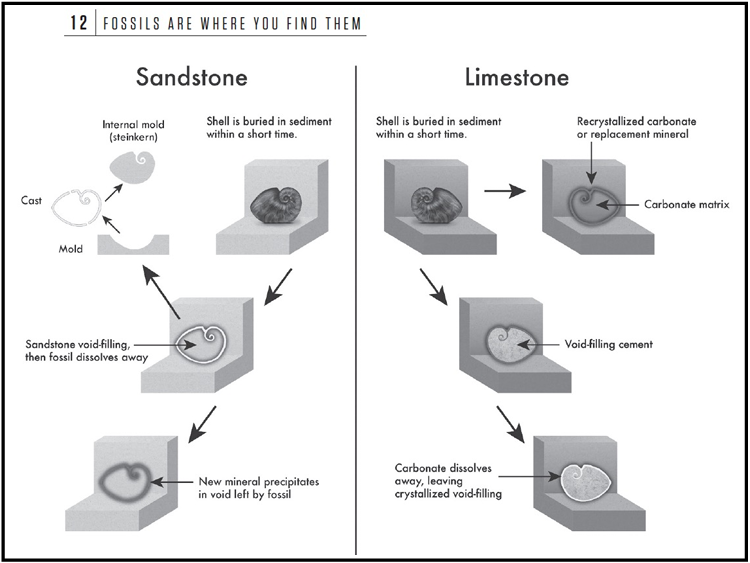
What are the two general processes governing "modes of preservation" for shell material buried in sandstone vs limestone?
In sandstone, the shell dissolves leaving a mold, which can be void-filled with new minerals (internal mold → cast); in limestone, the shell can recrystallize or be replaced within the carbonate matrix, or dissolve leaving a crystallized void-fill.
What environmental/chemical conditions generally favor exceptional (soft-tissue) fossil preservation?
Rapid burial (reducing time exposed to decay/scavenging)
anoxia (low oxygen, which slows microbial decay and deters scavengers)
fine-grained sediment (limits mechanical damage and allows fine detail)
early diagenetic mineralization (e.g., phosphatization or authigenic mineral precipitation) that "locks in" soft tissue before it decays away
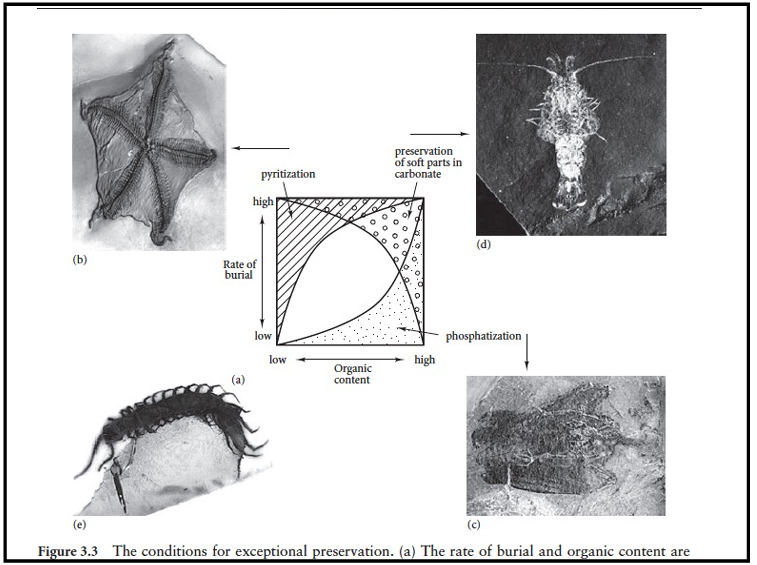
According to the "rate of burial vs organic content" figure (Figure 3.3), what two variables jointly control whether soft parts are preserved in carbonate vs by phosphatization? (phosphatization is a geological fossilization mode where organic tissues are replaced or replicated by calcium phosphate)
Rate of burial (high vs low)
Organic content of the sediment (low vs high)
high burial rate + appropriate organic content favors preservation of soft parts in carbonate, while phosphatization is favored under different combinations, generally tied to high organic content promoting rapid authigenic mineral growth.
What is anoxia, and why does it favor fossilization?
The absence/near-absence of dissolved oxygen in water or sediment. It favors fossilization because it excludes most scavengers and slows aerobic microbial decay, allowing soft tissues and delicate structures to survive long enough to be buried and preserved
How does rapid ("obrution") burial protect a carcass from destruction?
It physically isolates the organism from scavengers, weathering, oxygen (oxidation, and physical/biological breakdown, dramatically increasing the odds that soft tissue and full articulation survive to be preserved.
What preservational advantage does a fine-grained, low-energy sediment (e.g., shale/lime mud) give over a coarse, high-energy sediment (e.g., sandstone with strong currents)?
Fine-grained, quiet-water sediment causes less mechanical abrasion/fragmentation and can mold/preserve very fine anatomical detail, whereas coarse or high-energy sediments tend to disarticulate, abrade, and destroy delicate structures.
What is the difference between a mold and a cast?
Mold is the negative impression left in the surrounding rock/sediment after the original organism/shell dissolves or decays away
Cast is the positive replica formed when new material (mineral, sediment) fills that mold.
What is the difference between an external mold and an internal mold (steinkern)?
An external mold is the impression of the outer surface of a shell (concave impression of the exterior); an internal mold (steinkern) is formed when sediment fills the interior of a shell before the shell itself dissolves, preserving the shape of the shell's inner surface once the shell is gone.
How does amber preserve organisms, and what type of preservation category is that?
Amber is fossilized tree resin; insects/other small organisms are trapped in sticky resin, which then hardens and preserves them essentially unaltered (soft parts, fine detail like wing venation)
What is a trace fossil?
A fossil that records the activity of an organism (tracks, trails, burrows, borings, coprolites) rather than the organism's actual body/hard parts
What is Cruziana?
A trace fossil produced by a trilobite "plowing" along the sediment surface, typically preserved as a broad furrow with paired scratch marks.
What is Diplichnites?
A trace fossil produced by a trilobite (or similar arthropod) walking over the sediment surface, preserved as paired rows of small footprint-like marks.
What is a body fossil?
A fossil formed from the actual physical remains of an organism (shell, bone, exoskeleton, soft tissue, wood) — as opposed to a trace of its activity.
Are unaltered remains (e.g., insects in amber, frozen mammoths) considered fossils?
Yes — "unaltered remains" is explicitly listed as one of the modes of preservation, even though the original material is essentially unchanged rather than mineralized
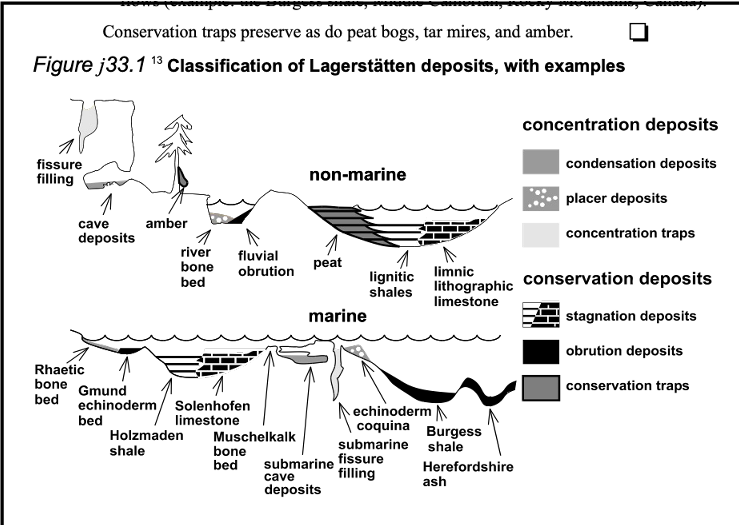
What are concentration deposits vs conservation deposits?
Conservation deposits preserve exceptional quality (i.e. Burgress Shale, Amber, Solenfoen limestone)
Concentration deposits preserve exceptional quantity/density of typically hard parts without necessarily preserving soft tissue (i.e. bone beds, placer deposits)
What is the approximate age range of Cambrian Period?
~485.4-541 Ma
What is the age range of the Ordovician Period?
~443.8-485.4 Ma
What is the age range of the Silurian Period?
~419.2-443.8 Ma
What is the age range of the Devonian Period?
~358.9-419.2 Ma
What are the two subdivisions of the Carboniferous Period given in the lecture table, and their ages?
Lower Carboniferous - Mississippian ~323.2-358.9 Ma
Upper Carboniferous - Pennsylvanian ~298.9-323.2 Ma
What is the age of the Permian Period, and what major event ends it?
~251.9-298.9 Ma
Ending with the end-Permian Mass extinction (The Great Dying), the largest mass extinction in Earth’s History
What is the age of the Triassic Period?
~201.3-251.9 Ma
What is the age of the Jurassic Period?
~145.0-201.3 Ma
What is the age of the Cretaceous Period?
~66-145 Ma
What is a "living fossil," and what are three examples given in lecture?
A living species that closely resembles its ancient fossil relatives and/or has persisted with little morphological change over a very long geological time span. Examples given: Ginkgo biloba, the lake sturgeon, and Limulus (horseshoe crab).
What organisms use iron oxides for biomineralization?
Magnetotactic bacteria
What minerals do invertebrate shells and vertebrate skeletons typically use for biomineralization?
Calcium carbonates (aragonite, calcite) for invertebrate shells; calcium phosphates (apatite) for vertebrate skeletons.
Define Biologic Destruction
Predation
Scavenging
Boring (Drilling, Core)
Bacterial Decay
What is molting, and why is it relevant to the fossil record of arthropods (e.g., trilobites)?
Molting (ecdysis) is the periodic shedding of an arthropod's exoskeleton to allow growth. It is relevant because a single individual can leave behind multiple exoskeleton "fossils" (molts) during its lifetime, meaning arthropod fossil counts can overestimate the true number of individuals that ever lived.