1 - Lab Animal Science Laws
 Call Kai
 Learn
Learn Practice Test
 Spaced Repetition
 Match
Match Flashcards
 Knowt Play
1/80

There's no tags or description
Looks like no tags are added yet.
Name | Mastery | Learn | Test | Matching | Spaced | Call with Kai | Chat |
|---|
No analytics yet
Send a link to your students to track their progress
81 Terms
Body of scientific and technical information,
knowledge, and skills related to laboratory
animal care and laboratory animal medicine
LABORATORY ANIMAL SCIENCE
•Any animals that are specifically bred for
biomedical research.
LABORATORY ANIMALS
Features of lab animals
• Clear source
• Bred artificially
• Defined genetic background
USES OF LABORATORY ANIMALS
Drug Development
Vaccine Development
Safety Testing
Surgical Techniques
Basic Research
Disease Modelling
Instruction/Extension Services/Training
AAALAC International
(Association for Assessment and Accreditation
of Laboratory Animal Care)
AALAS
(American Association for Laboratory Animal Science)
ACLAM
(American College of Laboratory Animal Medicine)
ASLAP
(American Society of Laboratory Animal Practitioners)
ILAR
(Institute for Laboratory Animal Research)
ICLAS
(International Council for Laboratory Animal Science)
NABR
(National Association for Biomedical Research)
FELASA
(Federation of European Laboratory Animal Science
Associations)
AFLAS
(Asian Federation of Laboratory Animal Associations)
(PALAS)
Philippine Association for Laboratory
Animal Science
PCLAM
Philippine College of
Laboratory Animal Medicine
difference of PALAS and PCLAM
PALAS: joining can be for anyone who’ll use lab animals for use/promotion (e.g., NGO)
PCLAM: joining is ONLY for licensed vets
organization guided by the 3 global R’s
PALAS
Global 3R’s framework
Replacement
Reduction
Refinement
PALAS is a member of what organization
AFLAS - Asian Federation of Laboratory Animal Science Associations
PALAS work closely with stakeholders like
PVMA - Philippine Veterinary Medicine`
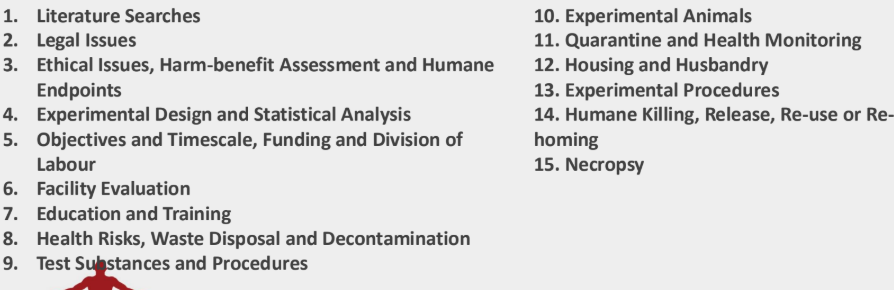
These guidelines are named what
PLANNING RESEARCH AND EXPERIMENTAL PROCEDURES ON
ANIMALS: RECOMMENDATION FOR EXCELLENCE (PREPARE)
GUIDELINES
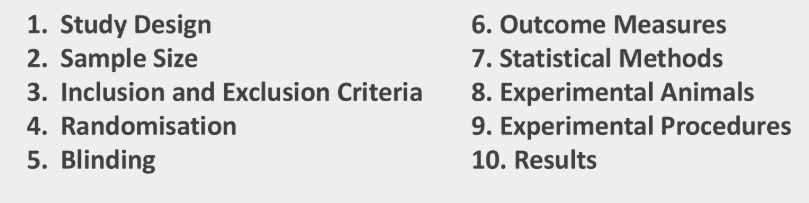
these guidelines are named what
ANIMAL RESEARCH: REPORTING OF IN VIVO EXPERIMENTS
(ARRIVE) GUIDELINES
the PRINCIPLE OF HUMANE EXPERIMENTAL TECHNIQUE (3RS) are proposed by
Rex Burch and William Russell
An animal experiment is only approved if no suitable alternative method exists, such as computer simulations or cell culture experiments
Replace
Only the smallest number of animals necessary for an experiment may be used. a clever study design provides a statistically significant result with a minimum number of animals
Reduce
Housing and experimental conditions are being constantly optimized in order to subject laboratory animals to as little stress as possible. This includes always choosing the most animal-friendly experimental method, promoting non-invasive procedures, and treating any pain the animal may be in.
Refine
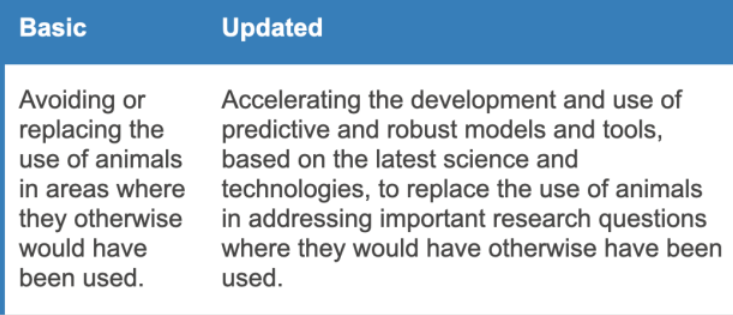
Replacement
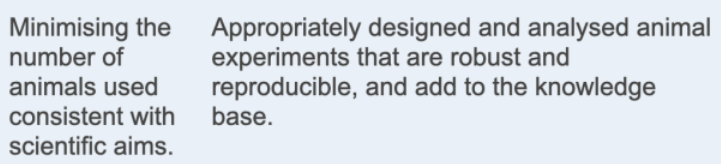
Reduction
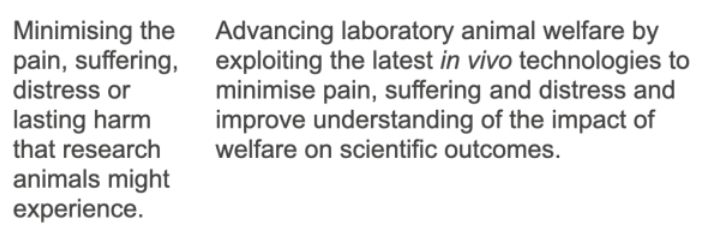
Refinement
organization that updated the 3Rs framework
NATIONAL CENTRE FOR THE REPLACEMENT REFINEMENT &
REDUCTION OF ANIMALS IN RESEARCH
atlernatives of animal models for biomedical research
In vitro
In vertebrate
In silico
High-throughput screening (HTS) and cell based assays
Organoids and organs-on chips
In vitro model
Chick embryo chorioallantoic membrane (CAM) model
In vertebrate
Copepods
In vertebrate
Zebra fish (Danio rerio)
In vertebrate
Xenopus laevis (African clawed frog)
In vertebrate
Mollusca
In vertebrate
Brine shrimp (Artemia)
In vertebrate
Caenorhabditis elegans
In vertebrate
scientific name of zebrafish
Danio rerio
scientific name of African clawed frog
Xenopus laevis
scientific name of brine shrimp
Artemia
type of roundworm used for lab research
Caenorhabditis elegans
fruit fly used for lab research
Drosophila melanogaster
scientific name for mouse
Mus musculus
lab research animal that is cheap, genome size of ~10 mb, 65% human disease gene conservative rates, low neuron (302), 4 day generation time
Caenorhabditis elegans
75% conservative rate; 10 day generation time; 140 mb; ~100,00 neuron
Fruit fly
82% conservative rate; 3-4 month genration time, ~1400 mb; ~1M neurons
Zebra fish
99% conservative rate; 9-11 wk gen time; 2600 mb; 70M neurons
Mouse
Animal model of choice for biomedical research
95-98% shared genomes to humans
small size, short pregnancy and nursing, high
# of offspring, short life cycle, abundant genetic resources for diabetes
cost-effective
Mouse
sci name of rat
(Rattus norvegicus)
2ND most common laboratory animal for
biomedical research
Large size, can replicate complexity of human
diseases, abundant genetic resources
Rat
sci name of SYRIAN HAMSTER
(Mesocricetus auratus)
Stocky and with abundant loose skin
Aggressive and fierce territorial; dominant female
Radioresistant
SYRIAN HAMSTER
sci name of GUINEA PIG
(Cavia porcellus)
Herbivores, hystricomorph (porcupine-like)
Stocky body, no tail or vestigial
Tonic immobility, 11 vocal sounds
GUINEA PIG
RABBIT sci name
(Oryctolagus cuniculus)
Nocturnal and social animals
Obligate nose breathers
Tonic immobility, caecotrophy
rabbit
NON-HUMAN PRIMATES sci name
(Macaca fascicularis)
Diurnal, arboreal, omnivores
Excellent swimmers, less cold tolerant
Females with beard
NHP
2nd most commonly used NHP
Cynomolgus
Macaques
DOGS SCI NAME
(Canis familiaris)
Dichromatic vision, better night vision
Cannot sweat, panting
Polyphasic sleepers, exceptional sense of smell
Emotional sensitivity
dog
dog breed usually used in lab research :((
beagle
PIGS sci name
(Sus scrofa)
Excellent sense of smell, insensitive to noise,
less developed vision
Omnivores, gregarious animals
Similar cardiovascular, immune, skin
Naturally hygienic, highly intelligent
pigs
pigs usually used for lab research
Gottingen Mini Pig
Miniature pig
Share over 70% similarity with humans
Found in diverse habitats, omnivores
Capable of regenerating tissues, lateral line system
Zebra fish
Share more than 75% similarity with humans
“Dew lover”, requires moist environment
Development is temperature dependent
Short life cycle
fruit fly
Capable of hermaphroditic reproduction (through self-fertilization)
Feed by means of rhythmic contraction of the pharynx
Consumes microorganisms and flourishes in nutrient-rich setting
Lack blood and circulatory system
round worms
SELECTION CRITERIA FOR ANIMAL MODELS
• Appropriateness as an analog
• Transferability of information
• Genetic uniformity of organisms
• Background knowledge of biological properties
• Cost and Availability
• Ease and adaptability to experimental manipulation
Used to understand how diet influences disease development and
biological functions such as expression of genes i.e. feeding high-
calorie, high-fat diet to mimic human obesity and metabolic
syndrome.
Diet-induced Models
A cost-effective and reproducible way to mimic human diseases by
exposure to specific chemicals i.e. toxins, carcinogens.
Chemical- induced Models
Used to induce the development of disease i.e. CLP-induced sepsis or
to examine the therapeutic outcomes or regenerative potential
Surgical Models
Application of genetic modification tools like CRISPR/Cas9, ZFN, Cre-
Lox, electroporation, etc. to elucidate the precise role of gene/s in
disease development
Genetic Models
EXPERIMENTAL MODELLING APPROACHES
Diet-induced Models
Chemical- induced Models
Surgical Models
Genetic Models
CLASSIFICATION OF DISEASE MODELS
(1) Spontaneous: diseases or conditions occur naturally in animals
(2) Chemically induced
(3) Genetically modified
(4) Negative models: resistant to a particular condition or disease
(5) Orphan models: nonhuman species with disorders or diseases unknown
to human
PHILIPPINE LAWS RELATING TO THE CARE AND USE
OF LABORATORY ANIMALS
1. Republic Act 8485 (RA 8485) – The Animal Welfare Act of 1998
2. Department of Agriculture Administrative Order No. 40 (DA
AO 40) Series of 1999 – Rules and Regulations on the Conduct
of Scientific Procedures Using Animals
RA 8485 is amended by
Amended by RA 10631
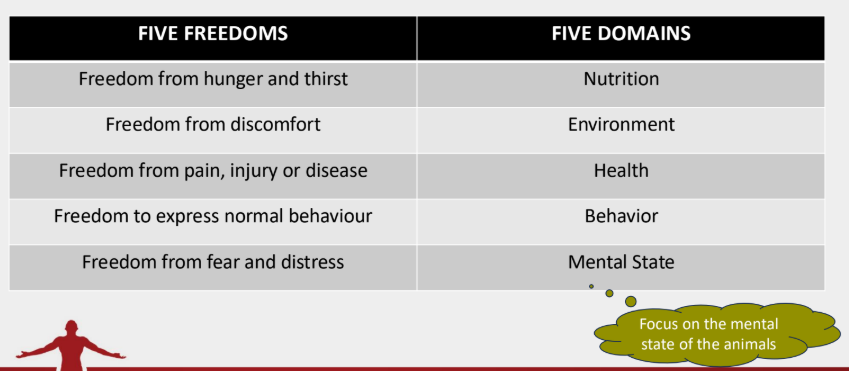
FIVE FREEDOMS VS FIVE DOMAINS
RULES AND REGULATIONS ON THE CONDUCT OF SCIENTIFIC
PROCEDURES USING ANIMALS
1. Acceptability of the Animal Care and Use Program (ACUP)
➢Grants authorization to conduct scientific procedures using animals to any
concerned entity based on:
2. Existence of an Institutional Animal Care and Use Committee (IACUC)
DA ADMINISTRATIVE ORDER NO. 40