Physics: Energy, Circular Motion, Gravitational Field
 Call Kai
 Learn
Learn Practice Test
 Spaced Repetition
 Match
Match Flashcards
 Knowt Play
1/37

There's no tags or description
Looks like no tags are added yet.
Name | Mastery | Learn | Test | Matching | Spaced | Call with Kai | Chat |
|---|
No analytics yet
Send a link to your students to track their progress
38 Terms
EPE
1/2kx^2 or 1/2Fx, where F is spring (applied) force
work is done when
WD by a constant force on a body is defined as the product of the force and the displacement in the direction of the force. WD = Fscos𝚹
gravitational force
F = GMm/r^2. r is the distance bw the two cg of the masses
circular motion formulae
Fc = m*ac = m x (v2/r = rω^2 = vω)
for POCOE qsn
loss in energy a = gain in energy b
KE
1/2mv^2
POCOE formula
KEi + PEi + WD by ncnsf - wd against ncnsf = KEf + PEf
uniform circular motion
An object undergoing uniform circular motion must have constant magnitude of velocity and its acceleration should always point to the centre of the circle
circular motion qsn
centripetal force is provided by: usually Mg, N, T, f etc.
for a drifting car, usually Fc is frictional force
for rollercoaster, Fc top: N+W, where N = 0 for min velocity
for spinning water bucket, its T instead of N
eqn connecting power and force
P = Fv
banked track qsn
∑Fy = 0
Ncos𝚹 = mg
∑Fx = m*ac
Nsin𝚹 = mv^2/r
tan𝚹 = v^2/rg
roller coaster qsn
∑Fy top = mg = mv(top)^2/r
∑Fy bottom = N - W = mv(bottom)^2/r
thus, v top,min = (rg)^1/2
TEi = TEf (where i is bottom, f is top)
KEi = KEf + GPEf
0.5mv(bottom)^2 = 0.5mv(top)^2 + mg(2r)
thus, v bottom = (5rg)^1/2
KE in gfield
GMm/2r. derive from GMm/r^2 = mv^2/r, then manipulate mv^2/r into 1/2mv^2
angular speed formula
ω = 2π/T = ∆𝚹/∆t
period of geostationary satellite
24 hours
is there work done when obj is underfoing uniform circular motion?
no. force is towards the centre and the displacement it perpendicular to the force, thus WD = Fcos90 = 0 joules
how to find WD from F-x graph
WD = area under F-x graph
work energy theorem
∑WD = ∆KE
Power
work done / time
when a spring is gently lowered until from its unstretched length to equilibrium, the loss is gpe is more than the gain in epe. why?
theres upward work done by your hand. since WD = F cos theta, where theta = 180 degrees (since the displacement is downwards), WD is -ve.
by POCOE, loss in gpe + WD = gain in EPE. since WD is -ve, loss in gpe - wd = gain in epe, thus gain in epe < loss in gpe
WD by gas
WD = pressure x ∆Volume
when gas expands, work is done by gas
when gas contracts, work is done on gas
efficiency
eff = useful output/ total input
formula for g in g-field
F = GMm/r^2 = mg
thus, g = GM/r^2
formula for U in g-field
U = mϕ = GMm/r
why does the moon orbit with a specific radius from the earth?
the G-force of the earth acting on the moon is sufficient to prove centripetal force
kepler's third law
T^2 is proportional to r^3. T is the orbital period, r is the orbital radius.
equate GMm/r^2 = mr(2pi/T)^2
angular velocity
rate of change of angular displacement with respect to time
gravitational field strength
gravitational force per unit mass acting on a small test mass placed at that point. g = GM/r^2
how to find escape velocity
By POCOE, Et at earth's surface = Et at infinity
Ep + Ek at earth = Ep + Ek at infinity
-GM(e)m/r^2 + 1/2mv^2 = 0 + 0
then u manipulate to find v. m = obj's mass. M = earth's mass
why are small planets devoid of an atmosphere
usually ur to prove escape velocity
when speed of gas particles > v(esc), particles will have sufficient KE to overcome the gravitational pull of the planet and escape to infinitys
escape velocity formula
(2GM/r)^1/2
if eqn is a differentiation of given values / graph
find the two closest coordinates to find most accurate gradient at that point. refer to gfield DQ 8b
when is there weighlessness?
when N = 0.
when is N = 0? when the surface supposed to provide contact has the same acceleration as the person. thus, the surface does not push against the person.
gravitational potential
The gravitational potential at a point in a field is defined as the work done per unit mass by an external agent in bringing a small test mass from infinity to that point.
why does gravitational potential have a negative value?
gravitational potential at infinity is taken to be zero.
since G-force is attractive, external force will be acting radially away from the source mass
F ext is opposite in direction to displacement of the mass
Thus WD by Ext mass to bring a unit mass from infinity to a point in the field will be -ve.
[WD = Fcos(180)x = -Fx]
how are g-force and g-potential related?
F = mg = m(-dϕ/dr). gravitational field strength = gradient of ϕ against radius graph.
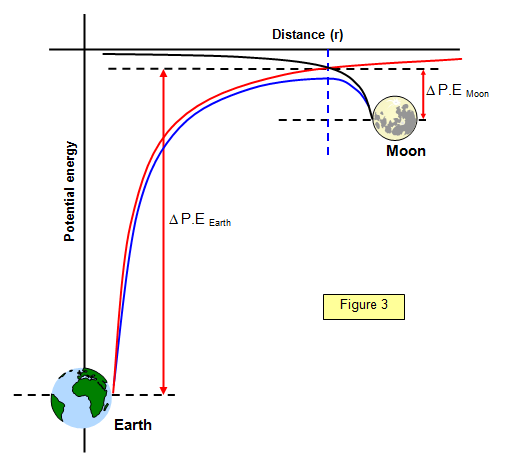
variation of potential energy with distance due to earth and moon
its negative, key in 1/x graph in gc. for moon, mirror it. DQ12
how to find GPE when theres a spring compression involved. aka, lets say a ball falls down into a spring.
loss in GPE = h+x. x is the spring compression.