Intro to Neuro - Brain and Spinal Cord Anatomy
 Call Kai
 Learn
Learn Practice Test
 Spaced Repetition
 Match
Match Flashcards
 Knowt Play
1/26

Earn XP
Description and Tags
Lecture 2
Name | Mastery | Learn | Test | Matching | Spaced | Call with Kai | Chat |
|---|
No analytics yet
Send a link to your students to track their progress
27 Terms
White Matter
myelinated axons
gray matter
mostly cell bodies and dendrites
Spinal cord
Located within the vertebral column
• Transfers information between CNS and PNS
• Pairs of spinal nerves are attached to the cord at 31 different
levels. Spinal nerves are either sensory or motor.
• Sensory information enters the dorsal (back) portion, and
motor commands exit on the ventral (stomach) side.
• Ganglion – collection of somas
• Root – axons entering and exiting the spinal cord
Medulla
Includes neurons that maintain normal, rhythmic breathing
Pons Region
Includes axons that allow the cerebellum to communicate with the brainstem and the cerebral cortex. The fourth ventricle is on the dorsal side
Midbrain
Superior and inferior colliculi: localization of visual and auditory stimuli
Cerebellum
Motor planning:
• Aids the motor cortices in planning
complex movements
Motor learning:
• Error correction when learning
movements: compares intended
movement with actual movement and
corrects errors that might occur
• Synapses change with experience

Diencephalon
Thalamus:
• Located rostral to the midbrain
• “Relay” for information going to and
coming from the neocortex
Hypothalamus:
• Located below the thalamus
• Regulates the autonomic nervous system
• Regulates hormone release

Cerebral cortex (a.k.a. neocortex) - structure
Gross structures:
• Sulci (singular: sulcus): grooves
• Fissures: deep sulci
• Gyri (singular: gyrus): rounded regions
between sulci

Cerebral cortex (a.k.a. neocortex) - function
Functions:
• Processing of sensory input
• Initiation/planning of movements
• “Higher-order” functions including
memory, cognition, language
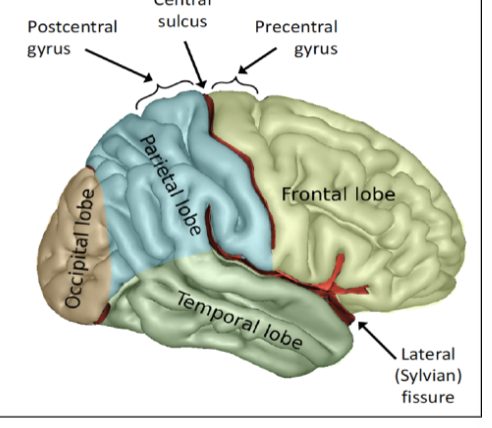
Lobes of the cerebral cortex
• Occipital lobe
• Parietal lobe
• Temporal lobe
• Frontal lobe

Central sulcus:
separates parietal and frontal lobes
Lateral Fissure
Separates the temporal lobe from those surrounding it
Longitudinal Fissure
Separates the two hemispheres of the brain
Postcentral gyrus
• Directly caudal to the central
sulcus
• Contains the primary
somatosensory cortex, which
processes touch and pain
information

Precentral gyrus
• Directly rostral to the central sulcus
• Contains the primary motor cortex,
which helps plan movements and
sends motor (movement) signals to
the spinal cord
Occipital lobe
Early stages of vision
Parietal lobe
touch and pain, late-stage vision
temporal lobe
memory, hearing, language comprehension
Frontal Lobe
• Planning and signaling movements
• Working memory
• Inhibition of inappropriate behaviors
• Planning
Limbic System
A group of interconnected
structures that are related to
emotional behavior and emotional
interpretation of the world.
• Sexual behavior
• Involved in the formation of
memory, contains primary reward
and punishment centers.
• Site of action of drugs which
produce euphoria (direct and
indirect)
Hypothalamus - limbic system
Regulates many
motivated functions (e.g.,
eating and drinking),
sleep/wake cycle
• Controls activity of the
pituitary gland (master
gland that interacts with
the hypothalamus to
regulate many functions
via the release of
hormones)
Hippocampus - limbic system
Memory consolidation and providing organism’s context
Amygdala - limbic system
Coordinates autonomic responses in with emotional states
Cerebral cortex - limbic system
Interacts with subcortical structures to guide behavior
Basal Ganglia
Group of interconnected structures
that control voluntary, smooth movement
Structures include:
striatum (caudate/putamen)
globus pallidus
substantia nigra
Actions of stimulants in the
basal ganglia increases motor
activity
Corpus callosum
Long range of neurons that connect the two different halves of the brain