Mammalian Kidneys and Osmoregulation
 Call Kai
 Learn
Learn Practice Test
 Spaced Repetition
 Match
Match Flashcards
 Knowt Play
1/38

There's no tags or description
Looks like no tags are added yet.
Name | Mastery | Learn | Test | Matching | Spaced | Call with Kai | Chat |
|---|
No analytics yet
Send a link to your students to track their progress
39 Terms
What do mammals rely on for osmoregulation?
kidneys
What nitrogen product do mammals excrete?
urea
What U:P ratio do mammals have?
greater than 1, humans 4
How can mammals make water?
metabolic water, have a high metabolis
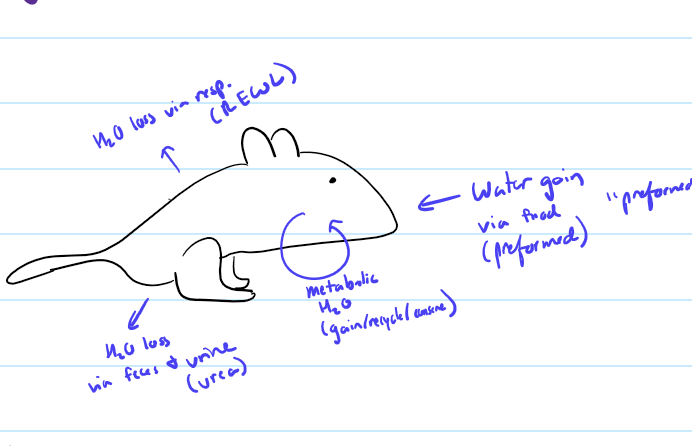
Describe kangaroo rats and their osmoregulatory adaptations, icnlduing
H20 loss/gain
adaptations
heat exchange
gain water via food and metabolic H20
lose water via respiration, feces and urine (urea)
produce highly concentrated urine (U:P = 12)
use nasal passage heat exchange to reduce water loss

Describe kangaroo rats nasal passage heat exchange
heat exchange in nasal passages to reduce respiratory water loss
inhale= hot, dry air picks up heat and water from nasal lining, which cools lining
exhale = the now warm, humid air passes over the cool nasal lining, the exhaled air cools, causing water vapor to condense back into liquid on the nasal surfaces
retains more water
Describe camel osmoregulatory adaptations
use heat exchange in nasal passages to retain some water
At night, cool nasal passages cool the warm, humid air exhaled from the lungs.
Water vapor in that exhaled air condenses onto the nasal lining and can be absorbed.
so they exhale desaturated air (75% relative humidity)
What do marine mammals salt intake depend on and what is common prey’s osmolarity?
salt intake varies with prey
bony fish = 300mOsm, low salt, high protein/Nh3 excretion
invertebrates = 1000mOsm, high salta
plants = 1000mOsm, high salt

Describe marine mammal water and salt gain/loss
gain water via food/drink, metabolic H20
lose water via REWL, cutaneously when surfacing, via urine/feces, via lactation
gain salt via food/drink
lose salt via urine/feces and lactation

What unique osmoregulatory adaptation to marine mammals have?
reniculate kidneys that can produce concentrated urine and eliminate excess salts

What are the main excretory organs and what are their functions?
liver - processes hydrophobic waste (large waste, carbs, fats)
colon - processes waste, excretes/reabsorbs H20
kidney - processes hydrophilic waste, primary organ for osmoregulation, blood pressure, and blood pH regulation via blood filtration
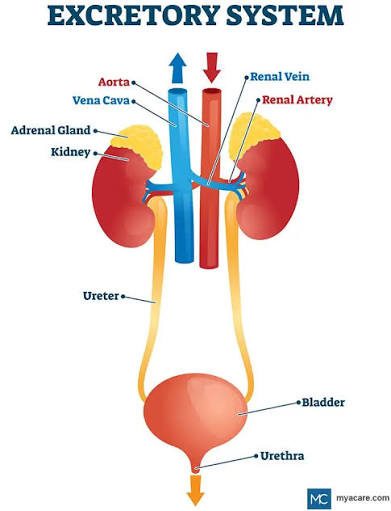
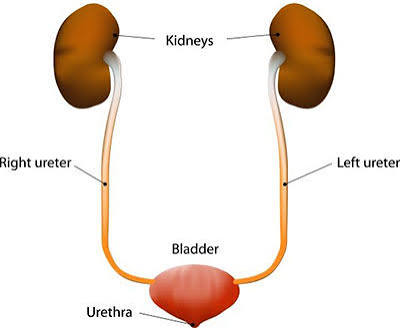
What are the parts of the urinary system?
kidneys drain into ureters
ureters travel to bladder
urine exits bladder into urethra via internal smooth muscle sphincter
urine exits urertha via external skeletal muscle sphincter


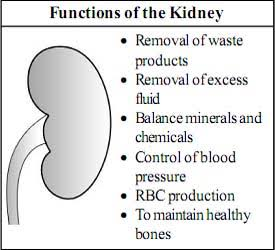
What are the 6 functions of the kidney?
ion balance (esp. Na+ and K+)
osmotic balance - by determining volume and conc of urine/blood
blood pressure - by controlling blood/ECF volume (influenced by hormones)
blood pH - by retaining/excreting H+ or HCO3-
Excretion - nitrogenous and hydrophilic waste
Endocrine - produces renin that starts blood pressure regulation cascade and erythropoietin to refulate RBC synthesis

What is renin and what organ produces it?
hormone produced by kidney that begins blood pressure regulation cascade

What is erythropoietin and what organ produces it
hormone produced by kidney that regulates red blood cell synthesis

How does osmolarity change across the kidney?
increasing osmolarity as you go deeper from cortex to medulla

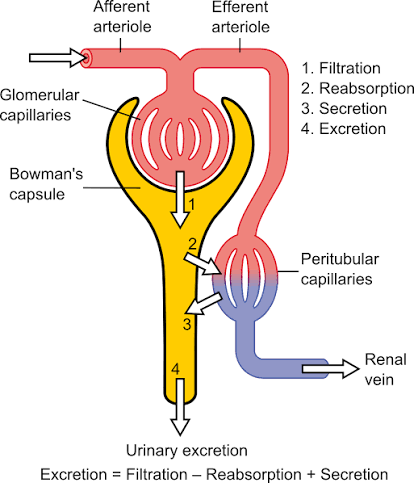
What three key steps occur in the nephron?
filtration
reabsorption
secretion

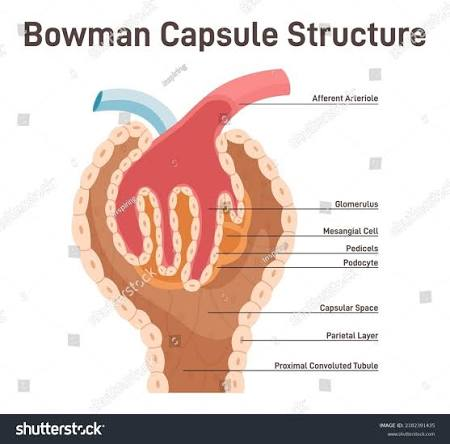
What is the Bowman’s Capsule and glomerulus ?
structure at the start of nephron that surrounds the glomerulus, a bundle of capillaries
blood enters the glomerulus via afferent arteriole and exits via efferent arteriole to the vasa recta
diameter of arterioles regulate glomerular blood pressure and amount of fluid filtered into Bowman’s Capsule
The afferent arteriole is usually wider than the efferent arteriole, helping maintain high pressure in the glomerulus for filtration.
If blood pressure is low, what happens to the afferent and efferent arterioles?
dilate to allow more blood enter glomerulus to maintain glomerular pressure
Describe filtration in the kidney
movement of plasma across capillary membranes using blood pressure in Bowman’s capsule
creates filtrate of water, ions, glucose, amino acids, and small waste inside nephron
blood exits Bowman’s capsule via efferent arteriole and forms vasa recta
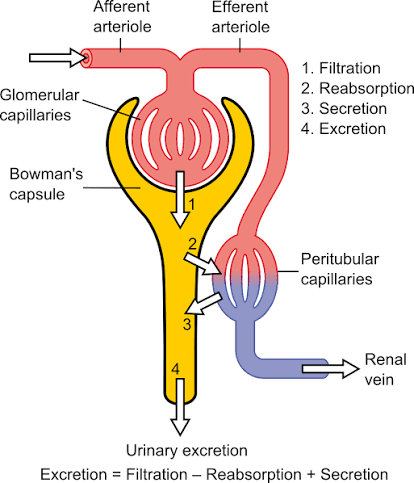
Describe kidney reabsorption, including what is reabsorbed
body takes back stuff it wants from filtrate to blood, mainly through vasa recta
lots of H20 from plasma ends up in filtrtae, but 99% of filtered water is reabsorbed/restored
always reabsorbed: glucose, amino acids, H20
sometimes reabsorbed: ions, additional H20
occurs mostly in proximal tubule, but also in Loop of Henle, Distal tubule, and collecting duct
Describe kidney secretion, including what is secreted
adding something from blood to filtrate
always secreted: creatinine (measure of kidney function)
sometimes secreted: ions
occurs in proximal tubule, distal tubule, and collecting duct
How does filtrate move through the nephron?
bowman’s capsule/glomerulus
proximal convoluted tubule
Loop of Henle
distal convoluted tubule
collecting duct
Describe the Proximal convoluted tubule
most reabsorption and secretion occurs here; reabsorbs as much as pssible
reabsorbs ALL glucose via active cotransporters with Na+
reaborbs all amino acids
reaborbs lots of H20, some sodium
Water follows the reabsorbed solutes by osmosis into the surrounding vasa recta
How does the vasa recta create a strong osmotic gradient for water?
Low hydrostatic pressure: blood has passed through the high-resistance efferent arteriole, so there is less pressure pushing water out of the capillary.
High osmotic pressure: some water was filtered out at the glomerulus, but proteins stayed in the blood. This makes the blood protein concentration higher, which pulls water into the capillaries.
Describe the loop of henle, including the descending vs ascending limb
estabolishes and maintains conc gradient in medulla for later via facilitated diffusion
descending limb - permeable to H20 (aquaporins), not permeable to ions
ascending limb - not permeable to H20, permeable to ions (channels)
How does the countercurrent multiplier in the loop of Henle concentrate the fluid surrounding the medulla?
The descending limb lets water leave but retains salt, so filtrate becomes concentrated.
the ascending limb does not let water leave but moves NaCl into the medulla.
this builds a high salt concentration in the medulla, allowing water reabsorption into medulla and concentrated filtrate
the vasa recta have blood flowing in the opposite direction and act as a countercurrent exchanger
Describe the distal convoluted tube
site of specialized secretion and absorption based on body’s needs
reabsorbs Na+ in response to aldosterone
secretes excess K+ in response to aldosterone
What does aldosterone cause to happen in the kidneys?
reabsorption of sodium and secretion of potassium in distal convoluted tubule
Descibe the collecting duct
site of regulated H20 reabsorption in response to ADH
if ADH is present → permeable to H20 (aquaporins present), water reabsorb passively, more conc urine
if ADH not present → impermeable to H20 (no aquaporings), less conc urine
what does the strenght of the medullary osmotic gradient depend on?
loop of henle length
What stays in the blood during filtration in Bowman’s Capsule?
blood cells and large proteins; too large to pas through filtration barrier
What happens in the ascending limb of the loop of Henle?
NaCl leaves the filtrate, but water cannot, making the filtrate more dilute and the medulla saltier.
Why are long loops of Henle useful in desert mammals?
They create a stronger medullary osmotic gradient, allowing more water reabsorption and reducing water loss in urine.
What is the external urethral sphincter made of?
Skeletal muscle, so it is under voluntary control.
What causes water to move out of the collecting duct when ADH is present?
The high solute concentration of the medulla pulls water out by osmosis once aquaporins are inserted.
What stimulates renin release from the kidney?
Low blood pressure, low blood volume, or low NaCl delivery to the kidney.
How do kidneys help regulate blood pH?
They secrete H⁺ into urine and reabsorb or produce HCO₃⁻, helping prevent the blood from becoming too acidic.
What are major routes of water loss in marine mammals?
Respiration, urine, feces, skin loss while at the surface, and lactation.