12.6 Figures/Equation Cards
 Call Kai
 Learn
Learn Practice Test
 Spaced Repetition
 Match
Match Flashcards
 Knowt Play
1/8

Earn XP
Description and Tags
Note: The negative variable dictates the direction the figure opens with the exception of a Hyperbolic Paraboloid
Name | Mastery | Learn | Test | Matching | Spaced | Call with Kai | Chat |
|---|
No analytics yet
Send a link to your students to track their progress
9 Terms
Hyperboloid of One Sheet
Equation: (x²/a²) - (y²/b²) + (z²/c²) = 1
Note: For this figure, y is negative. This results in the figure rotated sideways as seen in the image
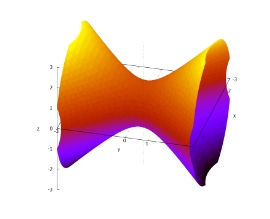
Hyperboloid of One Sheet
Equation: (x²/a²) +(y²/b²) - (z²/c²) = 1
Note: In this figure, z is negative. This results in the hyperboloid opening in the z direction

Elliptic Cone
Equation: (x²/a²) + (y²/b²) - (z²/c²) = 0
Note: When y = 0, the cross section of the figure is an X

Hyperboloid of Two Sheets
Equation: (x²/a²) + (y²/b²) - (z²/c²) = -1
Note: The difference between two sheets and one sheet is in what the equation is equal to. When equal to -1, the resulting figure is of two sheets.

Elliptic Paraboloid
Equation: (x²/a²) + (y²/b²) - (z/c) = 0
Note: For c > 0, the figure opens in the positive. For c < 0, the figure opens in the negative

Hyperbolic Paraboloid
Equation: (x²/a²) - (y²/b²) - (z/c) = 0
Note: In other instances, you would multiple the equation by -1 to get one negative and two positives, but since only two of the three variables are quadratic and set equal to 0, you need not multiply by -1.

Plain old Cylinder
Equation: x² + y² = 1
Note: Cylinders only have two variables, as they are 2D curves with lines going through them all around to create a 3D shape

Parabola
Equation: y = x²

Ellipse
Equation: x² + 4z² = 4
Note: The two variables included in the equation dictate the plane in which the ellipse lies
