SUMMER CHEM 51B FINAL
 Call Kai
 Learn
Learn Practice Test
 Spaced Repetition
 Match
Match Flashcards
 Knowt Play
1/87

There's no tags or description
Looks like no tags are added yet.
Name | Mastery | Learn | Test | Matching | Spaced | Call with Kai | Chat |
|---|
No analytics yet
Send a link to your students to track their progress
88 Terms
Ether + Strong Acid
ether cleavage
strong acid:
H-I
H-Cl

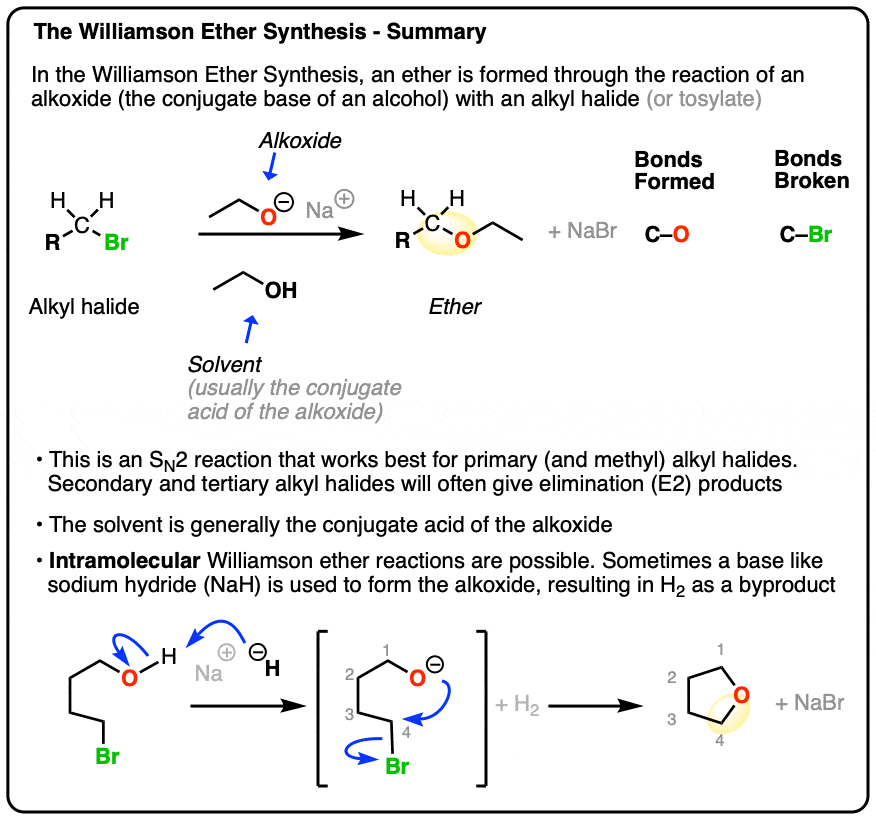
Alkyl Halide R-Br + Alkoxide + Alkoxide Conj Acid (Solvent)
Williamson Ether Synthesis
-Ether + NaBr
SN1
- tertiary carbons; polar protic nucleophile
-two steps
-Uses weak nucleophile/base (generally neutral)
-Higher degrees the better (tertiary > secondary > primary>methyl)
- carbocation formation
- rate = k[RX]
- need good leaving group
-Favors Protic Solvents
![<p>- tertiary carbons; polar protic nucleophile</p><p><span>-two steps</span></p><p><span>-Uses weak nucleophile/base (generally neutral)</span></p><p>-Higher degrees the better (tertiary > secondary > primary>methyl)</p><p>- carbocation formation</p><p>- rate = k[RX]</p><p>- need good leaving group</p><p>-Favors Protic Solvents</p>](https://assets.knowt.com/user-attachments/4bf2e5dd-1906-4208-808c-d0bd86f18693.png)
SN2
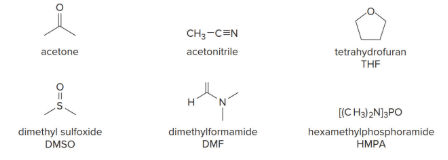
- polar apriotic
- 1 step (concerted) “attack of nucleophile on backside.”
- rate = k[RX][Nuc]
-Lower degrees the better (methyl>primary > secondary > tertiary)
-Strong nucleophile (OH-) or strong nuc/weak base (I-, CH3CO2-) required for methyl, primary, and secondary
-Uses strong nucleophiles (generally negative charge)
-check for steric hindrance and inversion/retention
-Stereochemistry: Inversion only
![<p>- polar apriotic</p><p>- 1 step (concerted) “attack of nucleophile on backside.”</p><p>- rate = k[RX][Nuc]</p><p>-Lower degrees the better (methyl>primary > secondary > tertiary)</p><p>-Strong nucleophile (OH-) or strong nuc/weak base (I-, CH3CO2-) required for methyl, primary, and secondary</p><p>-Uses strong nucleophiles (generally negative charge)</p><p>-check for steric hindrance and inversion/retention</p><p>-Stereochemistry: Inversion only</p>](https://assets.knowt.com/user-attachments/0f7b600b-b0ea-43eb-bd2a-7c2d578374c0.png)
Polar Priotic
-Hydrogen Bonding
-Can act as H-bond donor to nucleophiles
-H-bonds shield nucleophiles and reduce nucleophilicity
-Solvents: HO, ROH, RCOOH
E1
-2 steps
-Higher degrees the better (tertiary > secondary > primary>methyl)
-needs a more stable carbocation to be fast
- Polar Priotic
- rate = k[RX]
-Weak nuc/weak base (typically solvolysis) for secondary and tertiary carbons; competes with SN1 (without heat)
-Follows Zaitsev’s rule: removes hydrogen from carbon attached to fewest hydrogens
![<p>-2 steps</p><p>-Higher degrees the better (tertiary > secondary > primary>methyl)</p><p>-needs a more stable carbocation to be fast</p><p>- Polar Priotic</p><p>- rate = k[RX]</p><p>-Weak nuc/weak base (typically solvolysis) for secondary and tertiary carbons; competes with SN1 (without heat)</p><p>-Follows Zaitsev’s rule: removes hydrogen from carbon attached to fewest hydrogens</p>](https://assets.knowt.com/user-attachments/4fe02d9f-1982-4509-815d-ec70f6f86d2c.png)
Polar Apriotic
-No hydrogen bonding
-No H-bonds to Nu-, so they are more “naked” and more nucleophilic
Epoxide + EtOH, H2SO4
Epoxide Opening:
1. Epoxide Protonation
2. Backside attack of Nuc
-Acidic Conditions (ACID: H2SO4) attack the MORE substituted side
-Basic Conditions (BASIC: NaOEt) attack the LESS substituted side
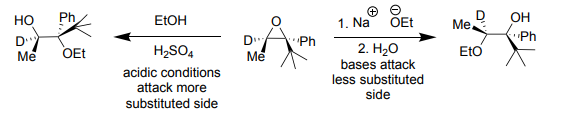
Epoxide + NaOEt, H2O
Epoxide Cleavage via SN2
Result: Cleavage of one C-O bond, Addition of OH
-Basic Conditions (BASIC: NaOEt) attack the LESS substituted side

Alkene + H-Br, ROOR
-Radical Hydrobromination
-makes Alkyl Halide
-Br added anti-Markovnikov

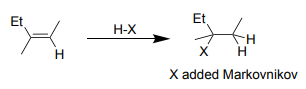
Alkene + H-X
-makes Alkane: alkyl halide
-X added Markovnikov
Alkene + H2O and H2SO4
-Hydration
-Alcohol alkane
-OH added Markovnikov

Alkene + X2 + H2O
-Halohydrin: Adds an X and an OH breaks alkene to alkane
-Anti Addition Reaction: Additions add on opposite sides
-OH on more substituted side while halide is on less substituted
-makes Enantiomer

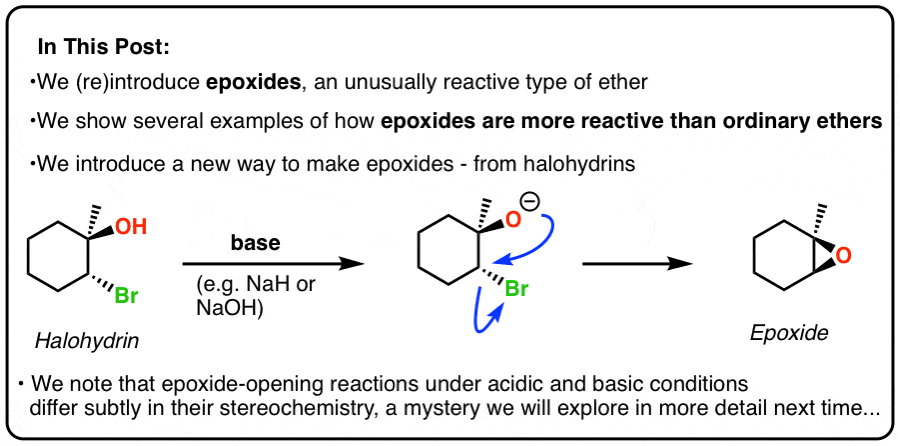
Halohydrin: Alkane with X and OH + (Base like :OH, NaH, NaOH)
Epoxide formation
:OH attacks H-o
O: attacks C-Br
Br leaves
Racemization
-50:50 mixture of enantiomers
-SN1 + E1

alkene + BH3 and H2O2
-Hydroboration
-Adds BH2 and H where alkene was then turns it to OH and makes it an alkane
-Syn Addition: H and B same side/stereochem
-BH2 and OH added anti-Markovnikov

Alkene + 9BBN + H2O2/HO-
Hydroboration-Oxidation
B attaches to alkene, R group included (weird kite > ((=B
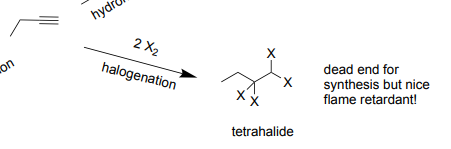
Alkyne + 2 X2
-Halogenation
-makes alkane and adds 4 X
-(dead end for synthesis)
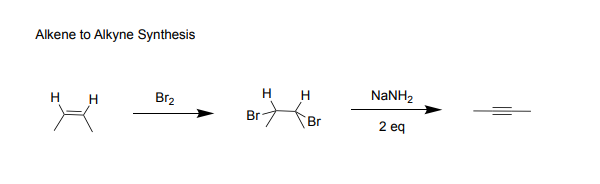
1) Alkene + Br2 2) Alkane + NaNH2 (excess)
-alkene to alkyne synthesis
-makes TERMINAL ALKYNE
-go from alkene to alkyne in two steps (need two hydrogens
Vicinal Dihalide Alkane (diff carbs but same side/cis) + NaNH2 x2
R---R Alkyne
INTERNAL ALKYNE

Alkyne + HX
-Hydrohalogenation
-makes a geminal dihalide (2 X and 2 H)
-X adds Markovnikov

1) Alkyne + BH3 2) H2O2, NaOH
-Hydroboration Oxidation
-makes an aldehyde
-adds alcohol anti-Markovnikov (enol) then becomes a aldehyde

keto-enol tautomerism
Enol form is the one with the alcohol.
Keto form is the one with the ketone.
Keto form is more stable, it is the predominant form.
Ketone
R-C=O,-R
Alkyne + H+, Hg 2+
K/E taut: Hydration
Alkyne + H20, H2SO4,HgSO4
-Hydration
-breaks alkyne and makes ketone and two H
-converts enol to keto tautomer

Addition
Increases numb of bonds, trip to double to single
Oxidation
form C-O, break C-H
Alkane to Alcohol to Aldehyde to Alkane
Reduction
form C-H, break C-O
Carboxylic Acid to Aldehyde to Alcohol to Alkane
Reduces nmb of bonds, single to double to triple
Alkyne + Lindlar's Catalyst + H2
-syn addition
-does not reduces the alkene
-makes a cis alkene

Alkyne + Na/NH3
-anti addition
-does not reduces the alkene
-makes a trans alkene

Alcohol + H2SO4
-E1 reaction
-makes alkene from alcohol
-makes minor and major product

Alcohol + POCL3, Pyridine
-E2 reaction
-makes alcohol to alkene

Alcohol + PBr3 OR SOCl2, Pyridine
-Replaces -OH with X
-1', 2' Alcohol only = alkyl bromide
-sn2 reaction
-X = Br when using PBr3
-X = Cl when using SOCl2

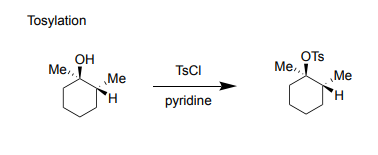
alcohol + TsCl, pyridine
-Tosylation
-replaces alcohol with OTs
-does not invert stereochemistry
1,2-alkyl shift
a carbocation rearrangement wherein an alkyl group migrates to an adjacent atom
1,2-hydride shift
the movement of a hydride ion from one carbon to an adjacent carbon
Alcohol + H2SO4 and heat
-turns alcohol into an alkene

Alkene + X2
-halogenation
-turns alkene to alkane with 2 Xs
-makes an enantiomer

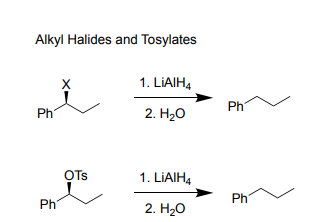
LiAlH4
reduces alkyl halides to alkanes, epoxides to alcohols
E2 Reaction
-needs strong bulky base
-Leaving group must be anti-periplanar to hydrogen to be removed
-FAVORS FORMATION OF STABLE ALKENES (MORE SUBSTITUTED)
-Fav base: KOtBu, DBU, NaNH2 for alkynes, likes bulky bases
-Higher degrees the better (tertiary > secondary > primary)
-rate = k[RX][BASE]
-Follows Zaitsev’s rule: removes hydrogen from carbon attached to fewest hydrogens
-favored by polar aprotic
1) Alcohol + NaH 2) -O product + Br-R
Williamson Ether Synthesis from Alcohol
-Ether + NaBr

Alkene + NBS +hv (ultraviolet light) or ROOR
-keeps alkene and adds Br right next to alkene
-mostly used when alkene cannot react with anything else
Alkyl halide + DBU
-E2 Reaction
-alkyl halide to alkene on the most substituted alkene
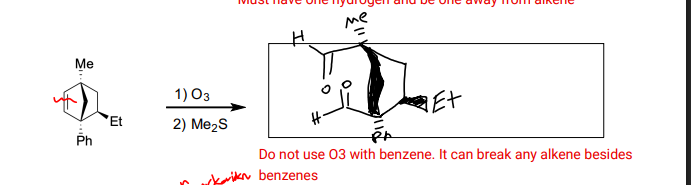
1) Alkene + O3 2) Me2S
-Oxidative cleavage
-makes an aldehyde and ketone at cleavage
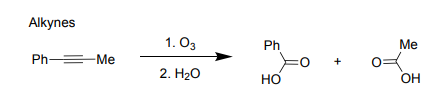
1) Alkyne with Me + O3 2) H2O
-Oxidative cleavage makes ketone
1) Alkyne with H + O3 2) H2O
-oxidative cleavage
-makes a ketone and 2 O double bonded to a carbon

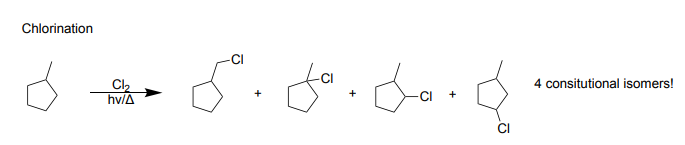
Alkane + Cl2, hv/heat
-radical reactions
-adds Cl using radicals
Alkane + Br2, hv/heat
-radical reaction
-Adds Br using radical
-Selective to Br being added to most substituted carbon

Alkene +HBr, hv/ROOR
-makes alkane and adds and H and a Br
-Br added anti-Markovnikov

Diene + Dienophile
-creates a six membered ring
-diene and dienophile must be cis to each other

Double Alkene + HBr
-breaks one alkene and adds a H and a Br
-makes a 1,2-addition and a 1,4-addition

1) Alkene + O3 2) Zn, H2O
-oxidative cleavage
-makes aldehyde and ketone

Alkene + mCPBA
-removes alkene makes an Epoxide

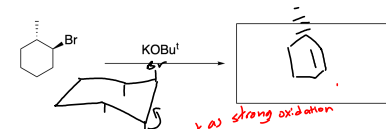
Alkane + KotBu
-E2 reaction
-needs leaving group
-need antipreiplanar H
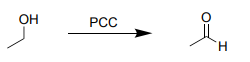
Alcohol + PCC
-Oxidation reaction (not as strong)
-turns alcohol into aldehyde OR ketone
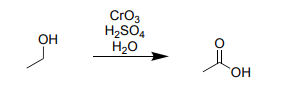
Alcohol + CrO3, H2SO4, H2O
-Oxidation Reaction (Stronger)
-Turns alcohol into carboxylic acid
Alkyl Halide + H2O, NaOH
-turns alkyl halide into Alcohol

Alkene + KMnO4, Lindlar Catalyst
-turns alkene into 2 Alcohols

Alcohol + NaH
-Williamson Ether synthesis
-Sn2 reaction
-turns alcohol to oxygen (ether)
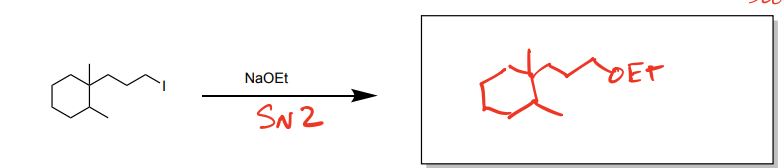
Alkyl Halide + NaOEt
-Sn2 Reaction
-replaces Alkyl Halide with OEt
Alkyl Halide + NaOtBu
-E2 reaction
-Antiperiplanar H makes alkene

Alkyl Halide + CH3OH
-Sn1 + E1 reaction

Akyl Halide + CH3SNa, DMSO
-Sn2 reaction
-inversion of stereochemistry

Alkyl Halide + DBU
-E2 Reaction
-Needs antiperiplanar H
-Makes Diastereomers

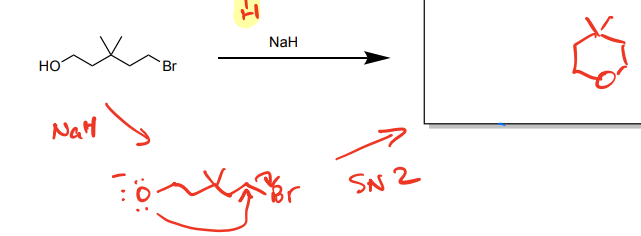
Alcohol and Alkyl Halide + NaH
-Six membered ring ether formation
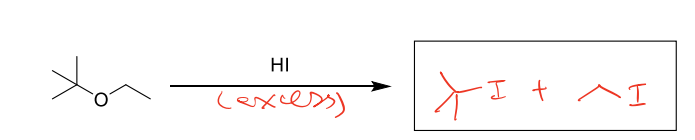
Ether + HI (excess)
-cleaves the ether and replaces it with I
Epoxide + Alcohol, H2SO4
-epoxide break
-Breaks epoxide adds Alcohol to the more substituted side because acidic conditions

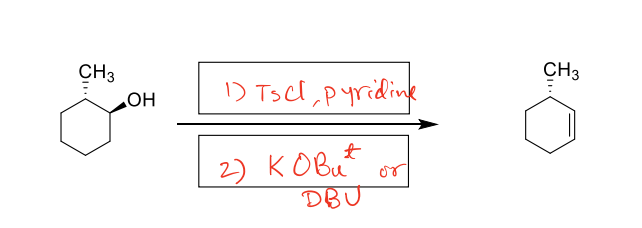
1) Alcohol + TsCl, pyridine 2) KOtBu or DBU
-Tosylation of alcohol then E2 Reaction
-get rids of OH for alkene
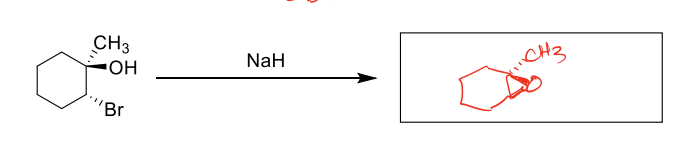
Alcohol and Br + NaH
-Makes Epoxide by removing Br and the H from OH
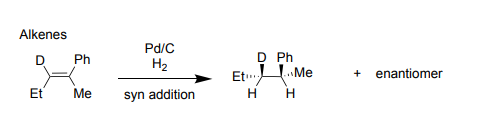
Alkene + Pd/C, H2
-Reduction reaction
-reduces alkene to alkane
-syn addition
-makes an enantiomer
Aldehyde + Pd/C, H2
-Reduction reaction
-reduces double bond of O and replaces it with an OH by having the H bond to the O

Ketone + Pd/C, H2
-Reduction reaction
-reduces double bond of O to OH
-Makes diastereomer

Alkyne + Pd/C, H2
-Reduction reaction
-reduces alkyne to alkane

Alkyne + Lindlar’s Catalyst, H2
-reduces Alkane to Alkene
-syn addition in Z (conformer): cis

Alkyne + Na, NH3
-reduces Alkane to Alkene
-anti addition in E (conformer): trans

1) Epoxide + LiAlH4 2) H2O
-breaks epoxide
-replaces O to OH
-is an epoxide opening under basic conditions (on the less substituted side)

1) Alkyl Halide/OTs (Tosylates) + LiAlH4 2) H2O
-gets rid of leaving group and keeps it as an Alkane (and does not change stereochemistry)
1) Alkene + OsO4 2) NaHSO3, H2O
-dihydroxylation reaction
-breaks alkene and adds two OH (2 alcohol bonds)
-in syn-diol addition

1) Alkene + mCPBA 2) Epoxide + KOH
-dihydroxylation reaction
-Makes alkene to epoxide then breaks epoxide to add two alcohols (2 OH bonds)

Aromatic Conditions
1) Is the molecule cyclic?
each p orbital must overlap with p orbitals on adjacent atoms
2) Are all the atoms sp2 hybridized/is the molecule planar?
all adjacent p orbitals must be aligned so that the electromn density can be delocalized
3) A molecule must be completely conjugated
aromatic compounds must have a p orbital on every atom
if No to the first two then the compound is NON
4) Number of pi electrons must satisfy Huckel’s Rule
Aromatic: 4n+2 pi electrons
Anti-Aromatic: 4n pi electrons
-Important Note: when counting the pi electrons the electrons must be within the cyclic molecule
2 X Alkyl halide + NaNH2 (excess), DMSO
-E2 reaction
-double E2

Alkyl Halide + KOCH3
-SN2 and E2 reaction
Alkyl Halide + NaN3, DMSO
-SN2 reaction
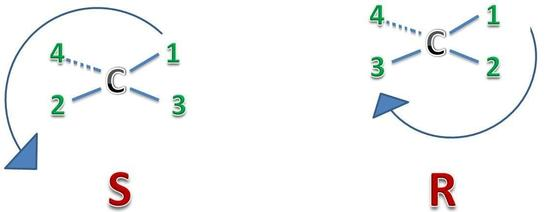
R and S configuration
-R configuration: clockwises
-S configuration: counterclockwise
-Wedge H will switch the configuration
Degrees of Unsaturation
-Formula: 2C + 2 + N - H - X/ 2
-O does not add any degrees of unsaturation
Newman Projection
-if wedge faced up newman projection first carbon faced down
-if wedge faced down neman projection first carbon faced up

1) Epoxide + NaOCH3 2) H2O
-breaks epoxide and adds an OH (alcohol bond)