reward and addiction (Andrew Young)
 Studied by 0 people
 Call Kai
 Learn
Learn Practice Test
 Spaced Repetition
 Match
Match Flashcards
 Knowt Play
1/27

There's no tags or description
Looks like no tags are added yet.
Name | Mastery | Learn | Test | Matching | Spaced |
|---|
No study sessions yet.
28 Terms
What is motivation
the reason for acting in a certain way
the driving force for performing a behaviour
In animal studies, what is increased when a reward is received
dopamine
Direct measurement of what in where shows that dopamine release is increased during naturally rewarding behaviours
dopamine in nucleus accumbent using micro dialysis
What are the main pathways
mesolimbic: from ventral tegmental area (VTA) to nucleus accumbens
mesocortical: from ventral tegmental area (VTA) to cortex (mainly frontal)
nigrostriatal: from substantial nigra to dorsal striatum
Animals will work to
receive natural rewards including food, water, sex
e.g. pressing a lever
Work rates are affected by drugs which affect the
dopamine system, given either systemically or locally into nucleus accumbens
e.g. effect of pimozide (dopamine antagonist) on lever pressing for food reward
Describe the study and findings by Olds and Milner, 1954
carrying out experiments on effect of electrical stimulation of the reticular formation on attention in rats
observed that a single animal appears to ‘enjoy’ brain stimulation
“by the time the third electrical stimulus had been applied the animal seemed indubitably to be coming back for more”
found that the electrode was in VTA (ventral tegmental area), rather than reticular formation
showed that animals would press a lever repeatedly in order to receive electrical stimulation of specific brain areas
mesolimbic pathway
effect in very region specific
What pathway doe animal models show is important in controlling reward
mesolimbic pathway
What increases in the nucleus accumbens during natural reward (e.g. food, water)
dopamine release
How can we be sure that dopamine is what gets released after receiving a reward
A dopamine antagonist is a drug that blocks dopamine receptors.
When animals are given a dopamine antagonist:
they stop pressing the lever as much
they lose motivation to work for the reward
the reward no longer feels as rewarding
This shows that dopamine is necessary for motivation and reward-seeking behaviour.
What is a reward
a pleasurable experience (Hedonia)
“Hedonia refers to the pursuit of pleasure and positive emotions as a source of wellbeing.”
“While hedonia focuses on pleasure and comfort, eudaimonia emphasises meaning and personal growth.”
may increase the likelihood of repeating the behaviour
How can the reward/reinforcement system create a problem for empirical study
what is pleasurable for one person/animal, may not be pleasurable for another (subjective)
Animals will work (e.g. press a lever) in order to receive electrical stimulation of certain brain areas such as:
ventral tegmental area
median forebrain bundle
nucleus accumbens
What affects electrical self-stimulation
effects of stimulation current/frequency on press rate
not supported below a certain current
as the current or/and frequency increases, so does the press rate
press rate is increased by drugs which increase dopamine
amphetamine, nicotine, morphine, heroine
pressing abolished by lesions of median forebrain bundle
List and describe what drugs that self-administered by animals
amphetamine - increases dopamine release, blocks reuptake and inhibits enzymatic breakdown
cocaine - blocks dopamine reuptake
morphine - agonist at opiate receptors
nicotine - agonist at acetylcholine receptors
ethanol - mechanisms of action uncertain
What happens to self-administration of amphetamine or cocaine when a dopamine antagonist is given?
Self-administration is potentiated (increased)
The animal presses the lever more frequently to receive additional drug in an attempt to overcome the blocking effects of the dopamine antagonist
What happens to systemic self-administration of amphetamine or cocaine when high doses of dopamine antagonists are given?
Self-administration is abolished.
At high antagonist doses, the drug’s effects cannot be overcome by taking more, so animals stop pressing the lever, similar to the effect seen in self-stimulation experiments.
Give evidence that dopamine release in nucleus accumbens signals reward
self-administration and effects of dopaminergic drugs
drug self-administration
dopamine release in nucleus accumbens during rewarded behaviour
drugs which enhance these behaviours, all evoke dopamine release in nucleus accumbens when given alone
What is substance abuse
frequent and/or excessive use of a substance for non-medical reasons, bringing damage to relationships, and/or daily functioning
What is substance dependence or addiction
compulsive substance taking
lives centred around a substance
tolerance and/or withdrawal symptoms
State the data found from DiChiara & Imperato (1988)
brain micro dialysis studies showed that a number of drugs increase dopamine release in nucleus accumbens
larger responses in nucleus accumbens than striatum
these are the drugs which
animals will self-administer
enhance self-stimulation
enhance reinforced behaviours
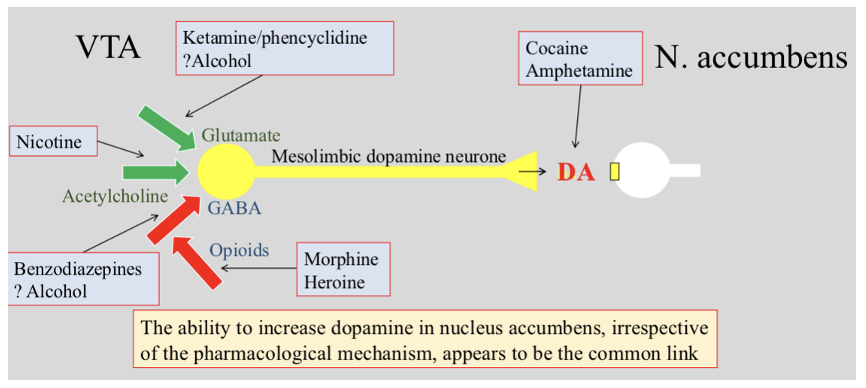
List the pharmacology of addictive drugs
amphetamine - dopamine reuptake inhibitor, also causes efflux from terminal
cocaine - dopamine reuptake inhibitor
nicotine - actelycholine agonist
alcohol - has effects on opioid, GABA and glutamate systems
morphine - opiate agonist
heroine - opiate agonist
benzodiazepines - allosteric enhancer of GABA function
Mechanisms of action of addictive drugs
Motivation and addiction loops
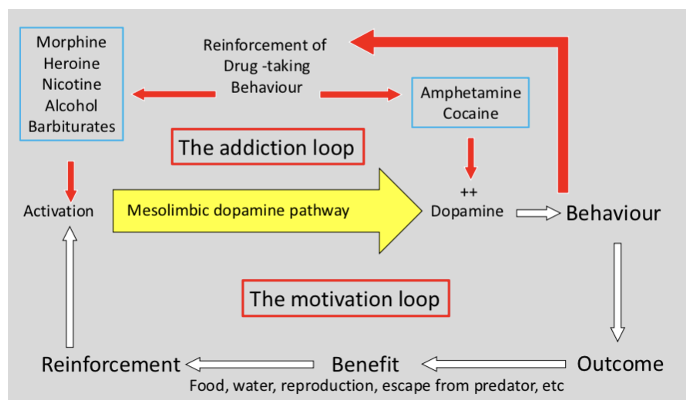
Many behaviours and/or stimuli associated with drug taking become reinforced such as
promote drug taking
induce cravings for drugs
induce physical symptoms similar to withdrawal symptoms
Behaviour associated with reward may also become addictive such as
gambling (addiction of impulse-control disorder)
exercise
eating disorders
What system appears to be critically involved in addiction
dopamine systems
Why do drugs reinforce drug taking behaviour
because drugs activate the natural motivation system
this reinforcement drives further drug-taking, often at the expense of other important behaviours, such as eating and drinking