Physics 2
 Studied by 0 people
 Call Kai
 Learn
Learn Practice Test
 Spaced Repetition
 Match
Match Flashcards
 Knowt Play
1/12

There's no tags or description
Looks like no tags are added yet.
Name | Mastery | Learn | Test | Matching | Spaced | Call with Kai |
|---|
No study sessions yet.
13 Terms
“Two charges are placed at different positions — what is the direction of the electric field at a point?”
Draw a dot where the field is asked.
For each charge:
Positive → field points away
Negative → field points toward
Draw arrows from the point, one for each contribution.
Break each arrow into x and y components.
Add components:
Ex=∑ExE_x = \sum E_xEx=∑Ex
Ey=∑EyE_y = \sum E_yEy=∑Ey
Combine into a final direction:
Quadrant tells you the answer
“Find the electric potential at a point from multiple charges.”
Use the scalar formula — no directions:
V=∑kQrV = \sum k\frac{Q}{r}V=∑krQ
Compute distance from the point to each charge.
Add all contributions with signs:
charge → + potential
– charge → – potential
Compare to answer choices.
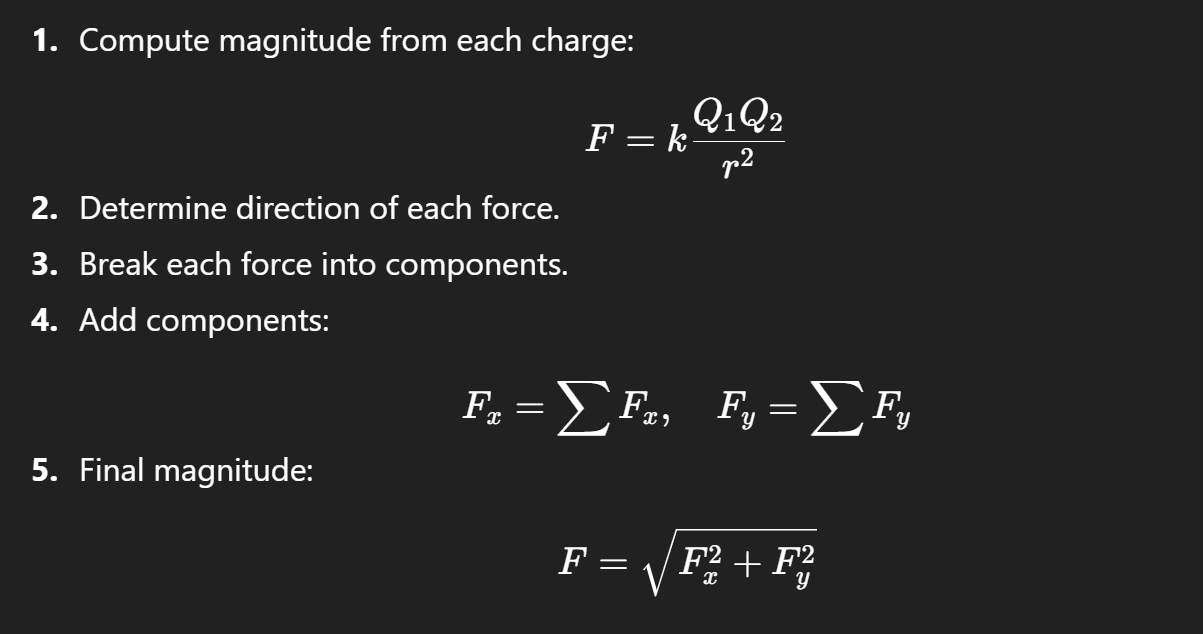
“Find net electric force on a point charge from other charges.”
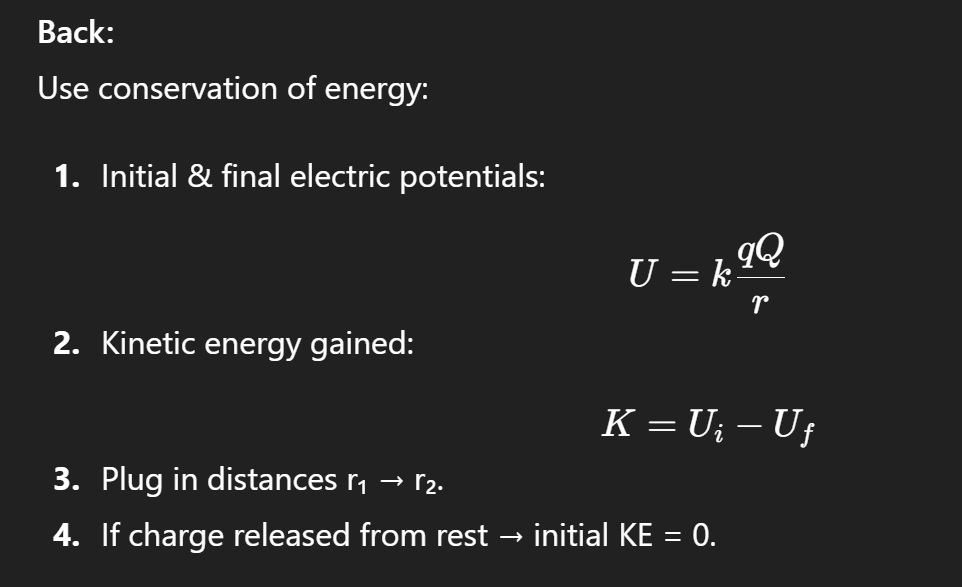
“Energy change when a charge moves from r₁ to r₂.”
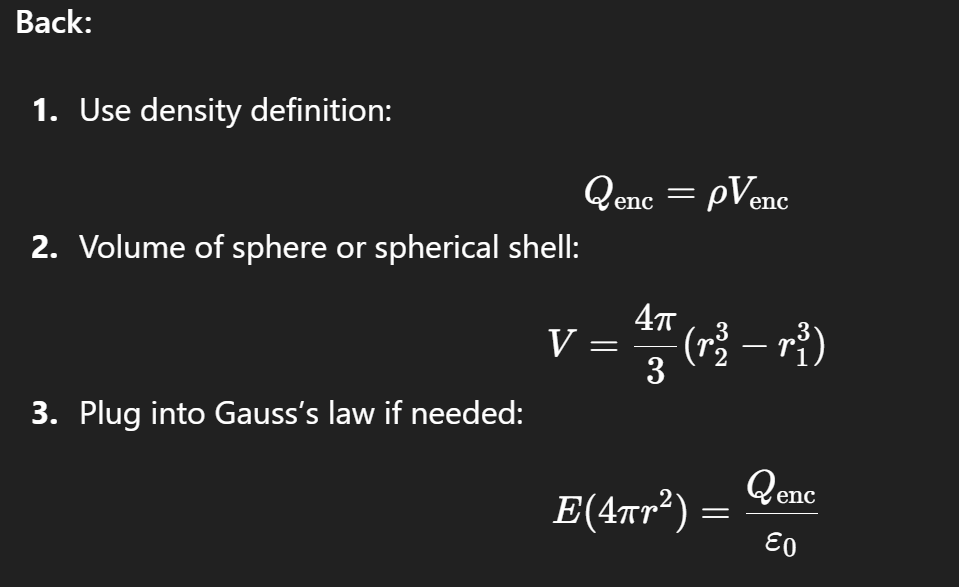
“Gauss’s Law — find charge enclosed inside a spherical Gaussian surface.”
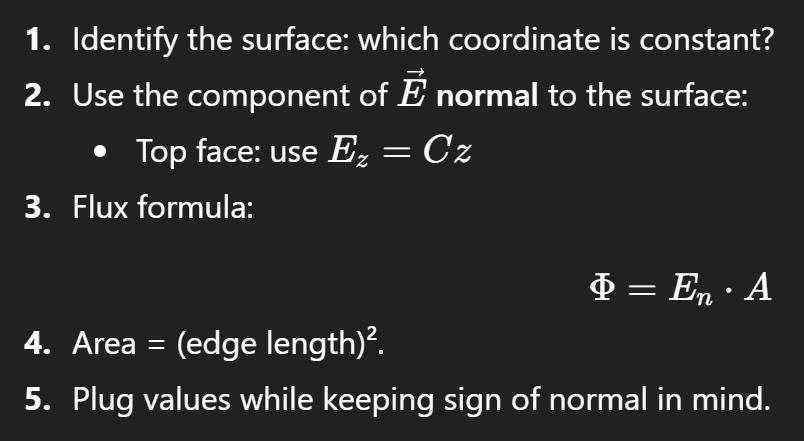
“Electric flux through a surface when E = Ax + By + Cz.”
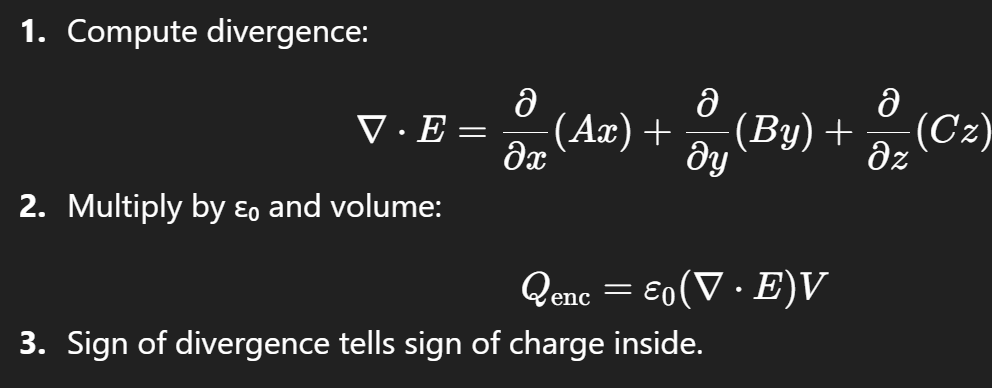
“Find charge enclosed using divergence of E.”
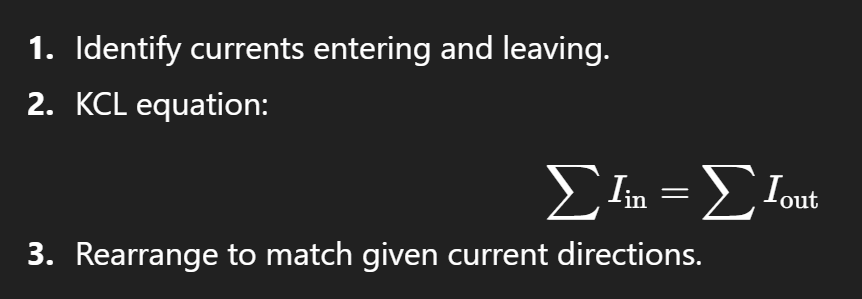
“Circuit current relationship at a junction (KCL).”
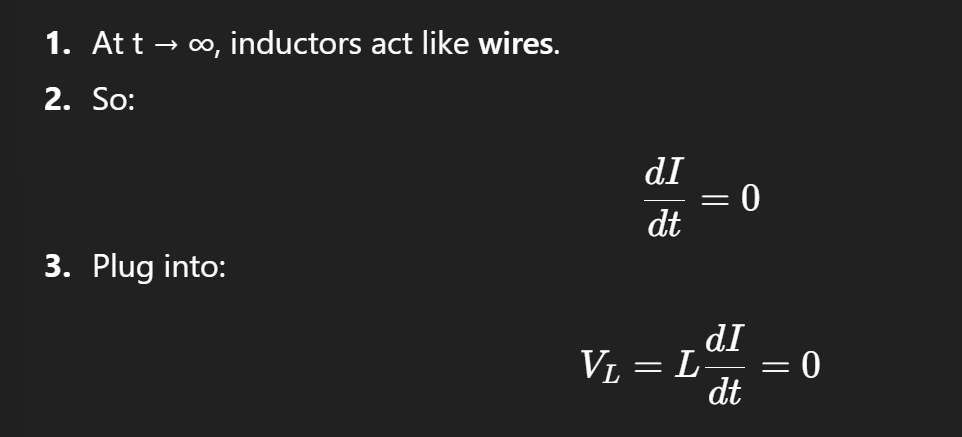
“Inductor voltage long after switch closes.”
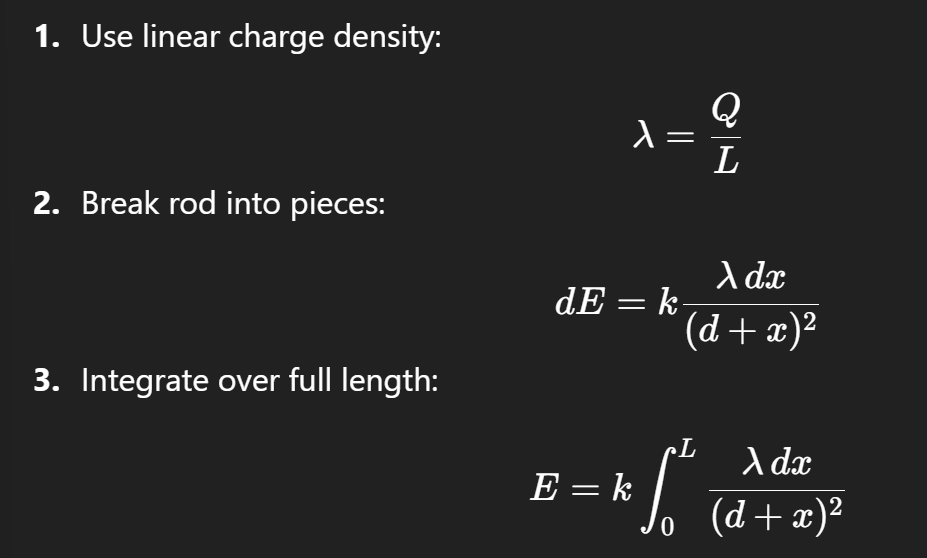
“Electric field from a uniformly charged rod at a point along its axis.”
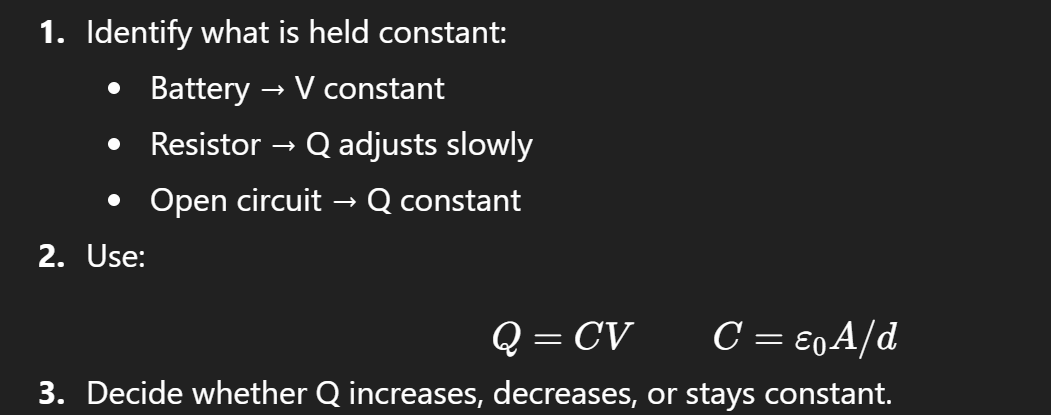
“Capacitor attached to a resistor or battery — how does Q change when geometry changes?”
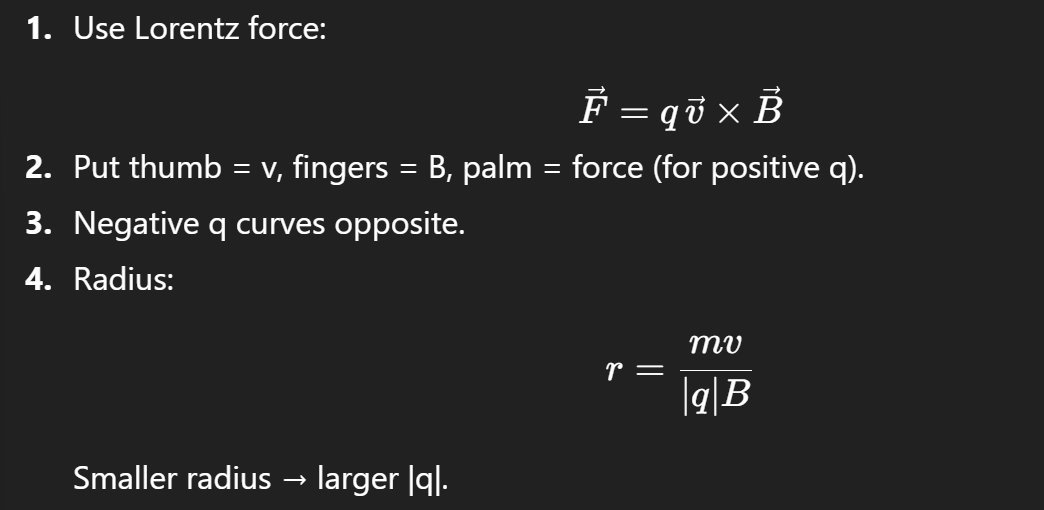
“Determine charge sign and magnitude from particle curvature in magnetic field.”
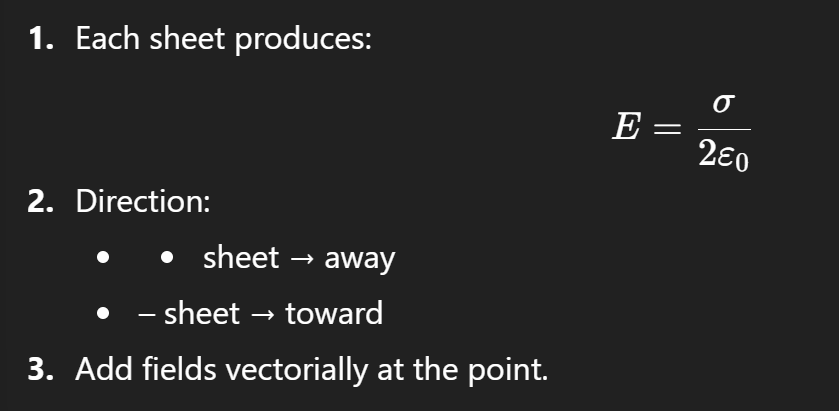
“Field from infinite sheet(s) of charge.”