Serum protein electrophoresis
 Call Kai
 Learn
Learn Practice Test
 Spaced Repetition
 Match
Match Flashcards
 Knowt Play
1/35

There's no tags or description
Looks like no tags are added yet.
Name | Mastery | Learn | Test | Matching | Spaced | Call with Kai | Chat |
|---|
No analytics yet
Send a link to your students to track their progress
36 Terms
Electrophoresis
is the migration of charged
solutes or particles in an electric field. It separates proteins on the basis of their electric charge
densities. Protein, when placed in an electric current, will move
according to their charge density, which is determined by the pH
of a surrounding buffer.
(Electrophoresis) (net charge) (size) (shape) (strength of the electric field) (chemical) (physical) (directly) (inversely )
(____________) - “migration with electricity”
The rate of migration is controlled by the (_______) of the particle, the (_____) and
(________) of the particle, the (_________________), (_________) and (________)
properties of the supporting medium, and the electrophoretic medium.
The rate of migration is (______) proportional to the net charge of the particle and (_______) proportional to its size and the viscosity of the buffer.
(Iontophoresis) (zone electrophoresis)
• (___________) refers to the migration of small ions, whereas
(_____________) is the migration of charged
macromolecules in a porous support medium such as paper,
cellulose acetate, or agarose gel film.
(electrophoretogram)
• A (________________) is the result of zone electrophoresis and
consists of sharply separated zones of a macromolecule.
(smaller) (big) (Globular proteins) (fibrous proteins.) (agarose
gel, cellulose acetate, or polyacrylamide gel.) (agarose gel) (polyacrylamide gel) () () () () () () () ()
SIZE AND SHAPE
• Between a small and a large molecule, (_____) molecules
will migrate faster than (_____) molecules.
• (_________) will migrate faster than (__________)
SUPPORT MEDIUM
• There are different kinds of support medium. It can be (_____________, ______________, ____________________)
• If (__________) is used as a support medium, then the basis of the
separation and migration is electrical charge.
• If (_____________) is used, then the basis of the separation is
molecular weight or the size of the molecules.
(ionic concentration) (heat production) (buffer) (cathode) (anode)
IONIC STRENGTH
• During electrophoresis, ions cluster around a migrating particle. The higher the
(_______________), the higher the size of the ionic cloud, and the lower the
mobility of the particle.
• Greater ionic strength produces sharper protein-band separation but leads to
increased (__________). This may cause denaturation of heat-labile proteins.
BUFFER PH / NET CHARGE OF MOLECULE
• If the (______) is more acidic than the isoelectric point (pI) of the
ampholyte, it binds H+, becomes positively charged, and migrates
towards the (__________).
• If the buffer is more basic than the pI, the ampholyte loses H+, becomes
negatively charged, and migrates towards the (_______).
(5) (electrophoresis chamber) (Sufficient buffer) (constant voltage or constant current) (fixative) (rapidly dried) (dye) (clearing agent)
PROCEDURE
• The sample is soaked in hydrated support for approximately (__) minutes.
• The support is put into the (_______________), which was previously filled with the
buffer.
• (____________) must be added to the chamber to maintain contact with the support.
• Electrophoresis is carried out by applying a (____________/__________) for a specific time.
• The support is then removed and placed in a (_______) or (_________) to prevent diffusion of the sample.
• This is followed by staining the zones with an appropriate (_____).
• The uptake of dye by the sample is proportional to sample concentration.
• After excess dye is washed away, the supporting medium may need to be placed in a (_____________). Otherwise, it will be dried completely.
driving force (electrical power), the support medium, the buffer, the sample, and the detecting system.
Electrophoresis consists of five components: the (_____________, ______________, ____________, ________, ______________)
(pH) (ionic strength) (electric current) (constant pH) (ampholyte)
• Two buffer properties that affect the charge of ampholytes are (_____) and (_________).
The ions carry the applied (___________) and allow the buffer to maintain (_______) during electrophoresis.
• An (_________) is a molecule, such as protein, whose net charge can be either positive or negative.
(cellulose acetate or agarose gel) (cellulose acetate) (acetic anhydride) (80% air space) (pliable) (densitometer quantitation) (dried transparent film) (isoelectric) () () () ()
SUPPORT MATERIALS
CELLULOSE ACETATE
• Paper electrophoresis use has been replaced by (_______/______) in clinical laboratories.
• Cellulose is acetylated to form (________) by treating it with (_________).
Cellulose acetate, a dry, brittle film composed of about (___________), is produced commercially.
• When the film is soaked in buffer, the air spaces fill with electrolyte and the film becomes (_______).
• After electrophoresis and staining, cellulose acetate can be made transparent for (__________).
• The (____________) can be stored for long periods.
• Cellulose acetate is prepared to reduce electroendosmosis. Cellulose acetate is also used in (__________) focusing.
(AGAROSE GEL) (Agarose gel) (urified fraction of agar) (neutral) (detained (cleared)) (dried) (densitometer) (Agarose gel electrophoresis) () () () () () () () () ()
SUPPORT MATERIALS
(__________)
• (_______) is another widely used supporting medium. Used as a (_________), it is (_________) and, therefore, does not produce electroendosmosis.
• After electrophoresis and staining, it is (________), (________), and scanned with a (__________). The dried gel can be stored indefinitely.
• (__________________) requires small amounts of sample
(approx. 2 mL); it does not bind protein and, therefore, migration is not affected.
(POLYACRYLAMIDE GEL) (Polyacrylamide gel electrophoresis) (Layer of gel) (tube-shaped electrophoreis ) (20 or more) (5) () () () () ()
SUPPORT MATERIALS
(__________________)
• (___________________) involves separation of protein on the basis of charge and molecular size.
• (__________) with different pore sizes are used.
• The gel is prepared before electrophoresis in a (_________________) cell.
• Polyacrylamide gel electrophoresis separates serum proteins into (______) fractions than the usual (_____) fractions separated by cellulose acetate or agarose.
• It is widely used to study individual proteins. (e.g., isoenzymes)
STARCH GEL
SUPPORT MATERIALS
(___________)
separates proteins on the basis of surface charge and
molecular size, as does polyacrylamide gel.
• The procedure is not widely used because of technical difficulty in preparing the gel.
(ELECTROENDOSMOSIS) (endosmosis or electroendosmosis) (paper) (cellulose acetate) (agar gel) (fixed) (hydrated) (electroendosmosis)
(______________________)
• The movement of buffer ions and solvent relative to the fixed support is called
(__________________________).
• Support media, such as (_____), (________), and (______), take on a
negative charge from adsorption of hydroxyl ions.
• When current is applied to the electrophoresis system, the hydroxyl ions
remain (______) while the free positive ions move toward the cathode.
• The ions are highly (________), resulting in net cathodic movement of solvent.
• Molecules that are nearly neutral are swept toward the cathode with the
solvent.
• Support media such as agarose and acrylamide gel are essentially neutral,
eliminating (________________).
(Serum) (plasma) (beta) (gamma) (300) (protein) (albumin) (routeinly diluted) (concentrated) (Hemoglobin hemolysate)
SPECIMEN
(_________) is the preferred specimen.
• The use of (_______) should be avoided as fibrinogen will appear as a
distinct narrow band between the (____) and (__________) fractions.
• Cerebrospinal fluid may be used if concentrated up to (________) times,
depending on original protein concentration.
• Serum contains a high concentration of (______), especially (________), and
therefore, serum specimens are (_________) with buffer before
electrophoresis.
• In contrast, urine and CSF are usually (__________).
• (_________________) is used without further concentration.
• Generally, preparation of a sample is done according to the suggestion of
the manufacturer of the electrophoretic supplies.
(2) (5 mL) (5) (blotted) (small amount) ()
TREATMENT AND APPLICATION OF SAMPLE
• Cellulose acetate and agarose gel electrophoresis require
approximately (___) to (____) of sample.
• These are the most common routine electrophoreses performed in
clinical laboratories.
• After serum is allowed to diffuse into the gel for approximately (____)
minutes, the template is (_____) to remove excess serum before being
removed from the gel surface.
• Sample is applied to cellulose acetate with a twin-wire applicator
designed to transfer a (___________).
(Amido Black) (Ponceau S) (Coomassie blue) (locate) (identify) (plates) (manufacturers) (manufacturers) (UV light) (densitometry) (densitometers )
DETECTION AND QUANTITATION
• Separated protein fractions are stained to reveal their locations.
• STAINS:
⚬ (________)
⚬ (_________)
⚬ (_________)
• These dyes bind to all proteins and are used to (______) and (____) the proteins without the noise generated by other materials in the support medium.
• Different stains come with different (______) from different (_________).
• The simplest way to accomplish detection is visualization under (_______), whereas (_________) is the most common and reliable way for quantitation.
• Most (__________) will automatically integrate the area under a peak, and the
result is printed as percentage of the total.
ISOELECTRIC FOCUSING, HIGH-RESOLUTION PROTEIN ELECTROPHORESIS, SERUM PROTEIN ELECTROPHORESIS
TYPES OF ELECTROPHORESIS
(Isoelectric focusing) (no charge) (cease ) (Isoelectric focusing) (isoelectric point) (ISOELECTRIC POINT)
• (____________) is a modification of electrophoresis. Charged proteins migrate through a support medium that has a continuous pH gradient.
• Individual proteins move in the electric field until they reach a pH equal to their
isoelectric point, at which point they have (______) and (_____) to move.
• (___________) exploits a different parameter associated with protein charges;
the (______________).
• For each protein molecule, there is a pH where the net charge on the molecule zero. This value is called the (________________).
(HIGH-RESOLUTION PROTEIN ELECTROPHORESIS) (Standard SPE) (12 bands) (HRE) (agarose buffer) (HRE) (color density) (appearance) (migration rates) () ()
(______________________)
• (__________) separates proteins into 5 distinct bands, but by modifying the
electrophoretic parameters, proteins can be further separated into as many as (___________).
• The modification, known as (_____), uses a higher voltage coupled with a cooling system in the electrophoretic apparatus and a more concentrated buffer. The medium most
commonly used is (________).
• To obtain (______) patterns, samples are applied on the agarose gel, electrophoresed in a chamber cooled by a gel block, stained, and then visually inspected.
• Each band is compared with the same band on a reference pattern for (________), (_________), (__________), and appearance of abnormal bands or regions of density.
• As with SPE, the patterns may be scanned with a densitometer to obtain
semiquantitative estimates of the protein found in each band.
(HIGH-RESOLUTION PROTEIN ELECTROPHORESIS) (HRE)
(__________________________________________)
(____) is particularly useful in detecting small monoclonal bands and differentiating unusual bands or prominent increases of normal bands that can be confused with a monoclonal gammopathy.
Proteins listed in are normally found in too low a concentration to be visible in a pattern.
(SERUM PROTEIN ELECTROPHORESIS) (SPE) (pH 8.6) (separate the proteins) (pH 8.6) (anode) (standard SPE methods) (Homogeneous proteins) ()
• In the standard method for (____), serum samples are applied close to the cathode end of a support medium that is saturated with an alkaline buffer. (______)
• The support medium connected to two electrodes and a current is passed
through the medium to (_______________).
• All major proteins carry a net negative charge at (_______), and migrate toward the (______).
• Using (_____________), serum proteins appear in five bands.
• The width of the band of proteins in a fraction depends on the number of proteins present in that fraction. (_____________) give a narrow band.
(SERUM PROTEIN ELECTROPHORESIS) (acid solution) (Ponceau S) (Amido Black) (Coomassie Brilliant Blue)
(__________________________)
• After separation, the protein fractions
are fixed by immersing the support
medium in an (_________) (e.g.,
acetic acid) to denature the proteins
and immobilize them on the support
medium.
• After which, the proteins are stained. A
variety of dyes have been used
including (________), (__________),
and (________________). The
proteins will then appear as bands on
the support medium.
(membrane) (transparent medium) (slit) (dye) (strip-chart recorder) () () () () () () () () ()
SERUM PROTEIN ELECTROPHORESIS
• Visual inspection of the (___________) can be done, but usually the cleared
(___________) is placed in a scanning densitometer for reading.
• The pattern on the membrane moves past a (______) through which light is
transmitted to a phototube to record the absorbance of the (____) that is bound to each protein fraction.
• This absorbance is normally recorded on a (____________) to obtain a
pattern of the fractions.
(electrophoretic run) (53-65%) (3.5 to 5.0 g/dL) (2.5 to 5% (0.1 - 0.3 g/dL)) () () (7 to 13% (0.6 to 1.0 g/dL)) (8 to 14% (0.7 to 1.1 g/dL)) (12 to 22% (0.8 to 1.6 g/dL))
SERUM PROTEIN ELECTROPHORESIS
• A reference serum control is processed with
each (____________).
• Reference values for each fraction are as
follows:
• ALBUMIN: (__________) of the total protein
(___________)
• Inadvertent use of plasma will result in a
narrow band in the β2-globulin region
because of the presence of fibrinogen.
• α1-GLOBULIN: (______________)
• α2-GLOBULIN: (_____________)
• β-GLOBULIN: (_______________)
• γ-GLOBULIN: (_________________)
• Inadvertent use of plasma will result in a
narrow band in the β2-globulin region
because of the presence of fibrinogen.
(a2 or early ß zone) (a2 zone) (overview) (prealbumin)
• The presence of free hemoglobin will cause a blip in the pattern in the late (_______), and the presence of hemoglobin-haptobloin complexes will cause a small blip in the (_____).
• The great advantage of electrophoresis compared with the quantitation of specific proteins is the (_____) it provides
• In some instancees, the albumin fraction may occasionally contain a separate (________) component.
(α1-globulins) (α2-globulins) (β-globulins) (γ-globulins)
SERUM PROTEIN ELECTROPHORESIS
Albumin farthest to the anode, followed by (_______), (_______), (________), and (__________), in that order.
(Albumin ) (decrease) (increase)
• Selected densitometric patterns of
protein electrophoresis.
• (______) is at the anodal (+) end followed
by α1-, α2-, β-, and γ-globulin fractions.
Arrows indicate (_________) or (________) in
fractions.
(MONOCLONAL GAMMOPATHY) (immunoglobulins) (M protein)
• The densitometric scan shows a
sharp peak in the gamma region
if the increase in
immunoglobulins is a result of a
monoclonal increase.
• Indicates the secretion of
exactly the same form of
(________________), and (________)
in the blood urine sample.

hypogammaglobulinemia.
Anything that causes a decreases the gamma globulins (IgG, IgA, IgM) like an
immune deficiency can cause (______________________)

(ALPHA-1 ANTITRYPSIN DEFICIENCY) (Alpha-1 antitrypsin) (COPD) (emphysema) (liver)
(_______________)
• (_________) is a protein
that protects the lungs and its
the major component of the
alpha-1 band.
• Deficiency of (1) (___________)
can cause (_____) and
(__________) to the lungs.
• It can cause (______) damage
because abnormal alpha-1
antitrypsin can accumulate in
the liver and damage the organ.

(NEPHROTIC SYNDROME) (alpha2 macroglobulin) (macroglobulin )
• Some IgG is also lost. At the same time,
an increase occurs in alpha-2
macroglobulin, beta-lipoprotein,
complement components, and
haptoglobin.
• There is a massive urine protein loss due
to the increased permeability of the
glomerulus to protein.
• Almost all proteins are decreased except
the (_____________) region. This is
because (____________) is a large protein
and it is not filtered by the glomerulus,
and the increased synthesis from the liver
causes its accumulation.

(ACUTE INFLAMMATION) (AAG) (alpha-1 antitrypsin) (ceruplasmin) (haptoglobin)
An inflammatory pattern indicating an
inflammatory condition is seen when
there is a relative decrease in albumin
and an increase in the alpha-1 globulin
(________ and ________), alpha-2
globulins (_______ and
__________), and Beta globulin band
(CRP).

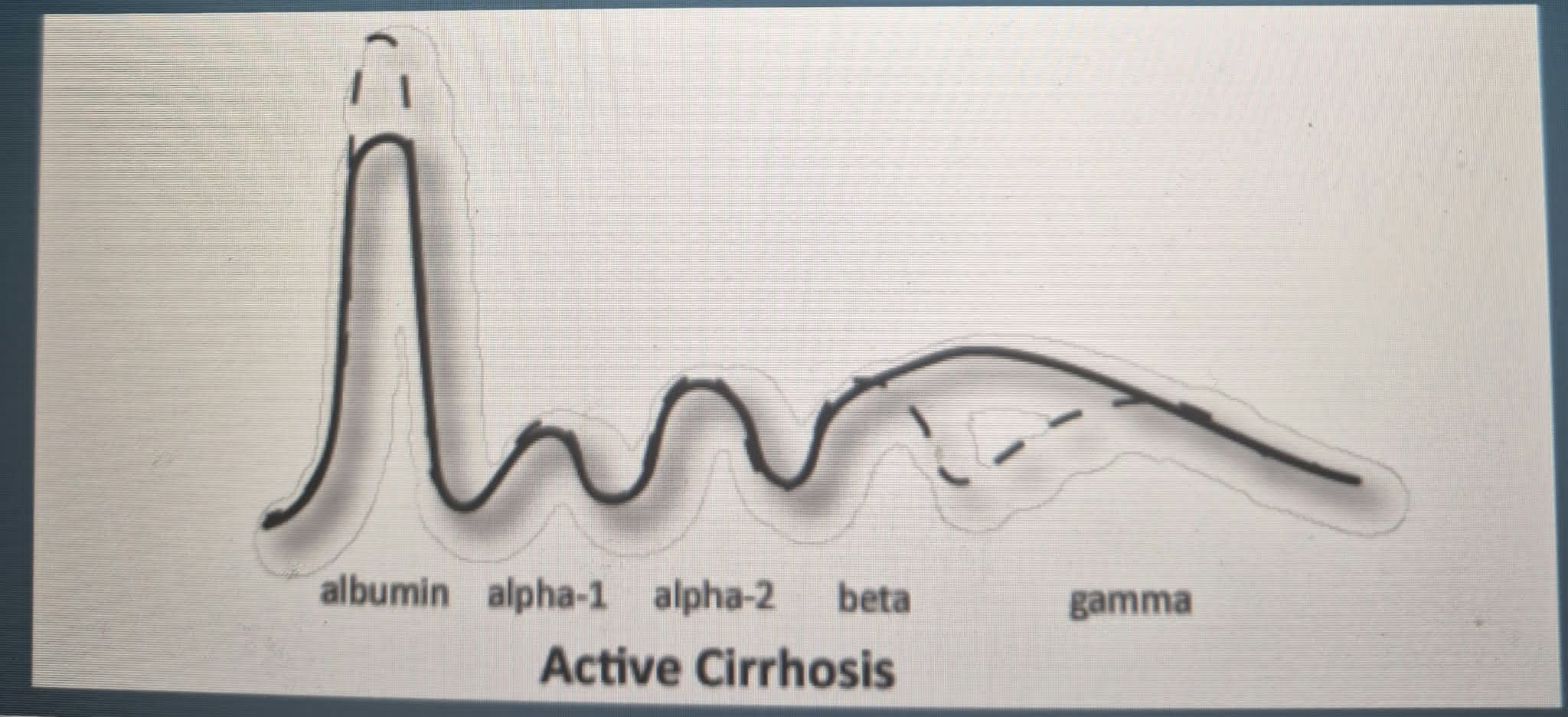
LIVER CIRRHOSIS (Beta) (Gamma globulin bands) (Beta-Gamma bridge of cirrhosis)
• The electrophoretic pattern of serum proteins in liver disease shows the decrease in serum
albumin concentration and the increase in gamma globulin.
• In the pattern of cirrhosis of the liver, there are some fast-moving gamma globulins that prevent
resolution of the (____) and the (______________).
• This is known as the (____________________).