Physics 2 Final
 Studied by 0 people
 Call Kai
 Learn
Learn Practice Test
 Spaced Repetition
 Match
Match Flashcards
 Knowt Play
1/39

There's no tags or description
Looks like no tags are added yet.
Name | Mastery | Learn | Test | Matching | Spaced | Call with Kai |
|---|
No study sessions yet.
40 Terms
When you rub a plastic rod with fur, the plastic rod becomes negatively charged and the fur becomes positively charged. As a consequence of rubbing the rod with the fur,
A. the rod and fur both gain mass
B. the rod and fur both lose mass
C. the rod gains mass and the fur loses mass
D. the rod loses mass and the fur gains mass
E. none of the above
C. the rod gains mass and the fur loses mass
A positively charged piece of plastic exerts an attractive force
on an electrically neutral piece of paper. This is because
A. electrons are less massive than atomic nuclei.
B. the electric force between charged particles decreases with
increasing distance.
C. an atomic nucleus occupies only a small part of the volume
of an atom.
D. a typical atom has many electrons but only one nucleus.
E. plastic and paper have different densities
B. the electric force between charged particles decreases with increasing distance
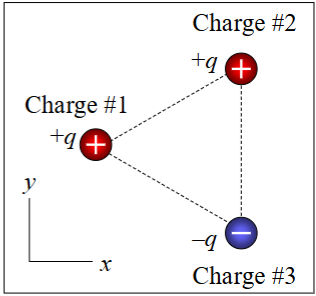
Three point charges lie at the vertices of an equilateral triangle as
shown. All three charges have the same magnitude, but charges #1
and #2 are positive (+q) and charge #3 is negative (–q). The net electric
force that charges #2 and #3 exert on charge #1 is in:
A. the +x-direction
B. the -x-direction
C. the +y-direction
D. the -y-direction
E. none of the above
D. the -y-direction
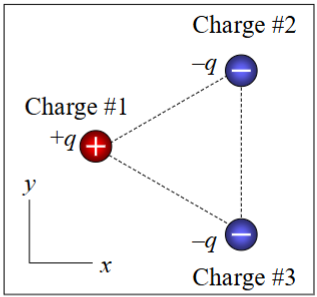
Three point charges lie at the vertices of an equilateral triangle as
shown. All three charges have the same magnitude, but charge #1 is
positive (+q) and charges #2 and #3 are negative (–q). The net electric
force that charges #2 and #3 exert on charge #1 is in:
A. the +x-direction
B. the -x-direction
C. the +y-direction
D. the -y-direction
E. none of the above
A. the +x-direction
A positive point charge +Q is released from rest in an electric field. At any later time, the velocity of the point charge:
A. is in the direction of the electric field at the position of the
point charge.
B. is directly opposite the direction of the electric field at the
position of the point charge.
C. is perpendicular to the direction of the electric field at the
position of the point charge.
D. is zero.
E. Not enough information is given to decide.
E. Not enough information is given to decide
or A. is in the direction of the electric field at the position of the point charge
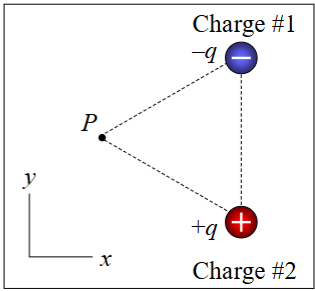
Two point charges and a point P lie at the vertices of an equilateral triangle as shown. Both point charges have the same magnitude q but opposite signs. There is nothing at point P. The net electric field that charges #1 and #2 produce at point P is in
A. the +x-direction
B. the -x-direction
C. the +y-direction
D. the -y-direction
E. none of the above
C. the +y-direction
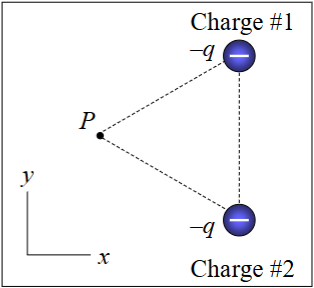
Two point charges and a point P lie at the vertices of an equilateral
triangle as shown. Both point charges have the same negative
charge (–q). There is nothing at point P. The net electric field that
charges #1 and #2 produce at point P is in:
A. the +x-direction
B. the -x-direction
C. the +y-direction
D. the -y-direction
E. none of the above
A. the +x-direction

Two infinite plane sheets with uniform surface charge densities
+σ and -σ are placed parallel to each other with separation d.
In the region between the sheets, where does the total electric
field have the greatest magnitude?
A. at the lower surface of sheet #1
B. at the upper surface of sheet #2
C. halfway between the two sheets
D. both A and B
E. none of the above
E. none of the above
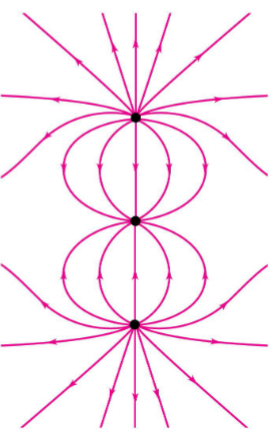
The illustration shows the electric field lines due to three point charges (shown by the black dots). The electric field is strongest
A. where adjacent field lines are closest together
B. where adjacent field lines are farthest apart
C. where adjacent field lines are parallel
D. where the field lines are most strongly curved
A. where adjacent field lines are closest together
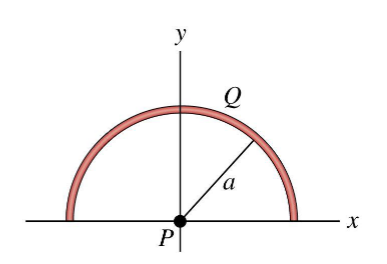
Positive charge is uniformly distributed around a semicircle. The electric field that this charge produces at the center of curvature P is in
A. the +x-direction
B. the -x-direction
C. the +y-direction
D. the -y-direction
E. none of the above
D. the -y-direction

Three point charges lie at the vertices of an equilateral triangle as shown. Charges #2 and #3 make up an electric dipole. The net electric torque that charge #1 exerts on the dipole is:
A. clockwise.
B. counterclockwise.
C. zero.
D. either A or B.
E. any of A, B, or C.
A. clockwise
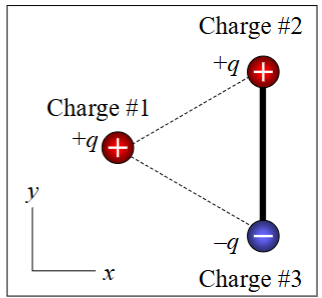
Three point charges lie at the vertices of an equilateral triangle as shown. Charges #2 and #3 make up an electric dipole. The net electric force that charge #1 exerts on the dipole is in:
A. the +x-direction
B. the -x-direction
C. the +y-direction
D. the -y-direction
E. none of the above
C. the +y-direction

The figure shows a Gaussian surface with rectangular sides and positive point charge +q at its center. If all the dimensions of the Gaussian surface double, but charge +q remains at its center, the electric flux through the surface will:
A. increase by a factor of 4.
B. increase by a factor of 2.
C. remain the same.
D. decrease by a factor of 1/2.
E. decrease by a factor of 1/4.
C. remain the same

Spherical Gaussian surface #1 has point charge +q at its center. Spherical Gaussian surface #2, of the same size, also encloses the charge but is not centered on it. There are no other charges inside either Gaussian surface. Compared to the electric flux through surface #1, the flux through surface #2 is:
A. greater.
B. the same.
C. less, but not zero.
D. zero.
E. Not enough information is given to decide.
B. the same
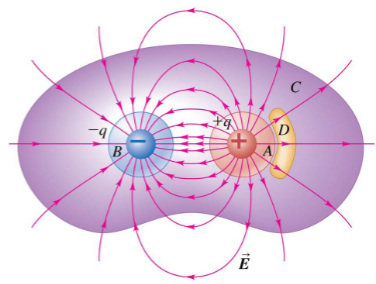
Two point charges, +q (in red) and -q (in blue), are arranged as shown. Through which closed surface(s) is/are the net electric flux equal to zero?
A. surface A
B. surface B
C. surface C
D. surface D
E. both surface C and surface D
E. both surface C and surface D
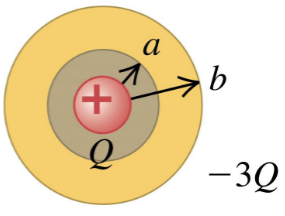
A conducting spherical shell with inner radius a and outer radius b has a positive point charge Q located at its center. The total charge on the shell is –3Q, and it is insulated from its surroundings. In the region a < r < b,
A. the electric field points radially outward.
B. the electric field points radially inward.
C. the electric field points radially outward in parts of the
region and radially inward in other parts of the region.
D. the electric field is zero.
E. Not enough information is given to decide.
D. the electric field is zero
There is a negative surface charge density in a certain region on the surface of a solid conductor. Just beneath the surface of this region, the electric field:
A. points outward, toward the surface of the conductor.
B. points inward, away from the surface of the conductor.
C. points parallel to the surface.
D. is zero.
E. Not enough information is given to decide.
D. is zero
For which of the following charge distributions would Gauss’s law NOT be useful for calculating the electric field:
A. a uniformly charged sphere of radius R
B. a spherical shell of radius R with charge uniformly distributed
over its surface
C. a right circular cylinder of radius R and height h with charge
uniformly distributed over its surface
D. an infinitely long circular cylinder of radius R with charge
uniformly distributed over its surface
E. Gauss’s law would be useful for finding the electric field in all
of these cases.
C. a right circular cylinder of radius R and height h with charge uniformly distributed over its surface
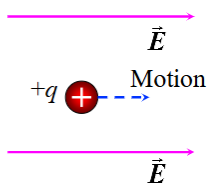
When a positive charge moves in the direction of the electric field,
A. the field does positive work on it and
the potential energy increases.
B. the field does positive work on it and the potential energy
decreases.
C. the field does negative work on it and the potential energy
increases.
D. the field does negative work on it and the potential energy
decreases.
E. the field does zero work on it and the potential energy
remains constant.
B. the field does positive work on it and the potential energy decreases
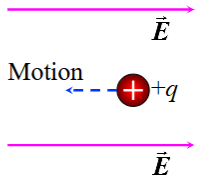
When a positive charge moves opposite to the direction of the electric field,
A. the field does positive work on it and the potential energy increases.
B. the field does positive work on it and the potential energy decreases.
C. the field does negative work on it and the potential energy increases.
D. the field does negative work on it and the potential energy decreases.
E. the field does zero work on it and the potential energy remains constant.
C. the field does negative work on it and the potential energy increases
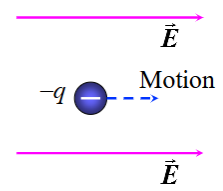
When a negative charge moves in the direction of the electric field,
A. the field does positive work on it and the potential energy increases.
B. the field does positive work on it and the potential energy decreases.
C. the field does negative work on it and the potential energy increases.
D. the field does negative work on it and the potential energy decreases.
E. the field does zero work on it and the potential energy remains constant.
C. the field does negative work on it and the potential energy increases
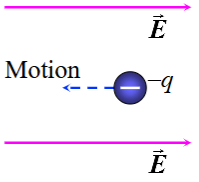
When a negative charge moves opposite to the direction of the electric field,
A. the field does positive work on it and the potential energy increases.
B. the field does positive work on it and the potential energy decreases.
C. the field does negative work on it and the potential energy increases.
D. the field does negative work on it and the potential energy decreases.
E. the field does zero work on it and the potential energy remains constant.
B. the field does positive work on it and the potential energy decreases
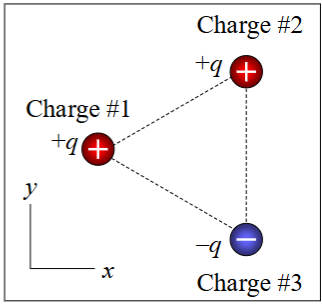
The electric potential energy of two point charges approaches zero as the two point charges move farther away from each other. If the three point charges shown here lie at the vertices of an equilateral triangle, the electric potential energy of the system of three charges is:
A. positive.
B. negative.
C. zero.
D. either positive or negative.
E. either positive, negative, or zero.
B. negative
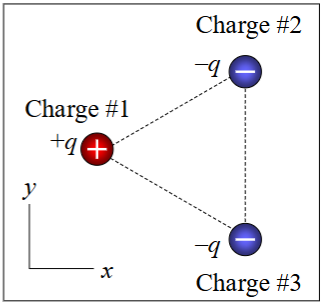
The electric potential energy of two point charges approaches zero as the two point charges move farther away from each other. If the three point charges shown here lie at the vertices of an equilateral triangle, the electric potential energy of the system of three charges is:
A. positive.
B. negative.
C. zero.
D. either positive or negative.
E. either positive, negative, or zero.
B. negative.
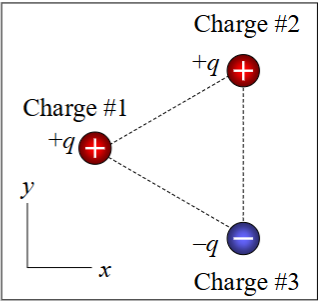
The electric potential due to a point charge approaches zero as you move farther away from the charge. If the three point charges shown here lie at the vertices of an equilateral triangle, the electric potential at the center of the triangle is:
A. positive.
B. negative.
C. zero.
D. either positive or negative.
E. either positive, negative, or zero.
A. positive
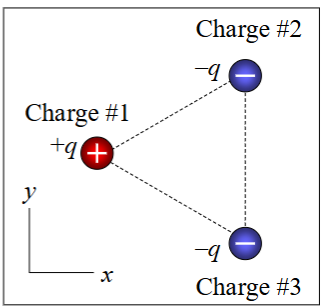
The electric potential due to a point charge approaches zero as you move farther away from the charge. If the three point charges shown here lie at the vertices of an equilateral triangle, the electric potential at the center of the triangle is:
A. positive.
B. negative.
C. zero.
D. either positive or negative.
E. either positive, negative, or zero.
B. negative
Consider a point P in space where the electric potential is zero. Which statement is correct?
A. A positive point charge placed at point P would feel no electric force.
B. A positive point charge placed at point P would feel an electric force, but nothing can be said about the direction of the force.
C. A positive point charge placed near point P would feel an electric force pulling it toward P.
D. A positive point charge placed near point P would feel an electric force pushing it away from P.
E. More than one of the above is possible.
E. More than one of the above is possible.
Where an electric field line crosses an equipotential surface, the angle between the field line and the equipotential is
A. zero.
B. between zero and 90°.
C. 90°.
D. either A or C.
E. either A, B, or C.
C. 90°
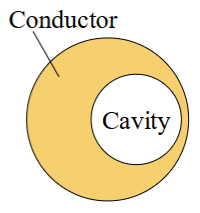
A solid spherical conductor has a spherical cavity in its interior. The cavity is not centered on the center of the conductor. If there is a net positive charge on the conductor, the electric field in the cavity
A. points generally from the center of the conductor toward the
outermost surface of the conductor.
B. points generally from the outermost surface of the conductor
toward the center of the conductor.
C. is uniform and nonzero.
D. is zero.
E. cannot be determined from information given.
D. is zero.
What is the direction of the electric potential gradient at a certain point?
A. the same as the direction of the electric field at that point
B. opposite to the direction of the electric field at that point
C. perpendicular to the direction of the electric field at that point
D. at an angle other than 0°, 90°, or 180° from the direction of the electric field at that point
E. more than one of the above
B. opposite to the direction of the electric field at that point
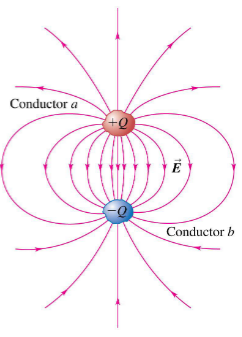
The two conductors a and b are insulated from each other, forming a capacitor. You increase the charge on a to +2Q and increase the charge on b to –2Q, while keeping the conductors in the same positions. As a result of this change, the capacitance C of the two conductors
A. becomes four times as great.
B. becomes twice as great.
C. remains the same.
D. becomes half as great.
E. becomes one-quarter as great.
C. remains the sameY
You reposition the two plates of a capacitor so that the capacitance doubles. There is vacuum between the plates. If the charges +Q and -Q on the two plates are kept constant in this process, what happens to the potential difference Vab between the two plates?
A. Vab becomes four times as great.
B. Vab becomes twice as great.
C. Vab remains the same.
D. Vab becomes half as great.
E. Vab becomes one-quarter as great.
D. Vab becomes half as great.
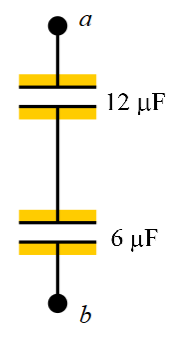
A 12-µF capacitor and a 6-µF capacitor are connected together as shown. What is the equivalent capacitance of the two capacitors as a unit?
A. Ceq = 18 µF
B. Ceq = 9 µF
C. Ceq = 6 µF
D. Ceq = 4 µF
E. Ceq = 2 µF
D. Ceq = 4 µF
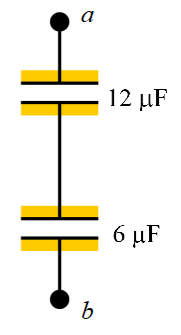
A 12-µF capacitor and a 6-µF capacitor are connected together as shown. If the charge on the 12-µF capacitor is 24 microcoulombs (24 µC), what is the charge on the 6-µF capacitor?
A. 48 µC
B. 36 µC
C. 24 µC
D. 12 µC
E. 6 µC
C. 24 µC
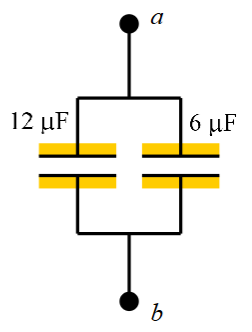
A 12-µF capacitor and a 6-µF capacitor are connected together as shown. What is the equivalent capacitance of the two capacitors as a unit?
A. Ceq = 18 µF
B. Ceq = 9 µF
C. Ceq = 6 µF
D. Ceq = 4 µF
E. Ceq = 2 µF
A. Ceq = 18 µF

A 12-µF capacitor and a 6-µF capacitor are connected together as shown. If the charge on the 12-µF capacitor is 24 microcoulombs (24 µC), what is the charge on the 6-µF capacitor?
A. 48 µC
B. 36 µC
C. 24 µC
D. 12 µC
E. 6 µC
D. 12 µC
You reposition the two plates of a capacitor so that the capacitance doubles. There is vacuum between the plates. If the charges +Q and -Q on the two plates are kept constant in this process, the energy stored in the capacitor
A. becomes four times as great.
B. becomes twice as great.
C. remains the same.
D. becomes half as great.
E. becomes one-quarter as great.
D. becomes half as great
You want to connect a 12-µF capacitor and a 6-µF capacitor. How should you connect them so that when the capacitors are charged, the 12-µF capacitor will have a greater amount of stored energy than the 6-µF capacitor?
A. The two capacitors should be in series.
B. The two capacitors should be in parallel.
C. The two capacitors can be either in series or in parallel—in either case, the 12-µF capacitor will have a greater amount of stored energy.
D. The connection should be neither series nor parallel.
E. This is impossible no matter how the two capacitors are connected.
B. The two capacitors should be in parallel
You slide a slab of dielectric between the plates of a parallel-plate capacitor. As you do this, the charges on the plates remain constant. What effect does adding the dielectric have on the potential difference between the capacitor plates?
A. The potential difference increases.
B. The potential difference decreases.
C. The potential difference remains the same.
D. Two of A, B, and C are possible.
E. All three of A, B, or C are possible.
B. The potential difference decreases.
You slide a slab of dielectric between the plates of a parallel-plate capacitor. As you do this, the charges on the plates remain constant. What effect does adding the dielectric have on the energy stored in the capacitor?
A. The stored energy increases.
B. The stored energy decreases.
C. The stored energy remains the same.
D. Two of A, B, and C are possible.
E. All three of A, B, or C are possible.
B. The stored energy decreases.