Protons & Electrons
 Call Kai
 Learn
Learn Practice Test
 Spaced Repetition
 Match
Match Flashcards
 Knowt Play
1/47

There's no tags or description
Looks like no tags are added yet.
Name | Mastery | Learn | Test | Matching | Spaced | Call with Kai | Chat |
|---|
No analytics yet
Send a link to your students to track their progress
48 Terms
What is the practical range of an electron?
where the “falling off” part of the dose curve runs into the depth axis
the extent to which the electron treatment is clinically useful
Rp=E/2
What does the tail in an electron dose curve represent?
bremmstrahlung x-ray contamination in the beam
between 0.5% and 3% of dmax dose
What are the rules of electron cutouts?
the width of the cutout in cm should be at least as wide as half of the electron energy in MeV
what are cutouts made of?
cerroben: bismuth, lead, tin, cadmium
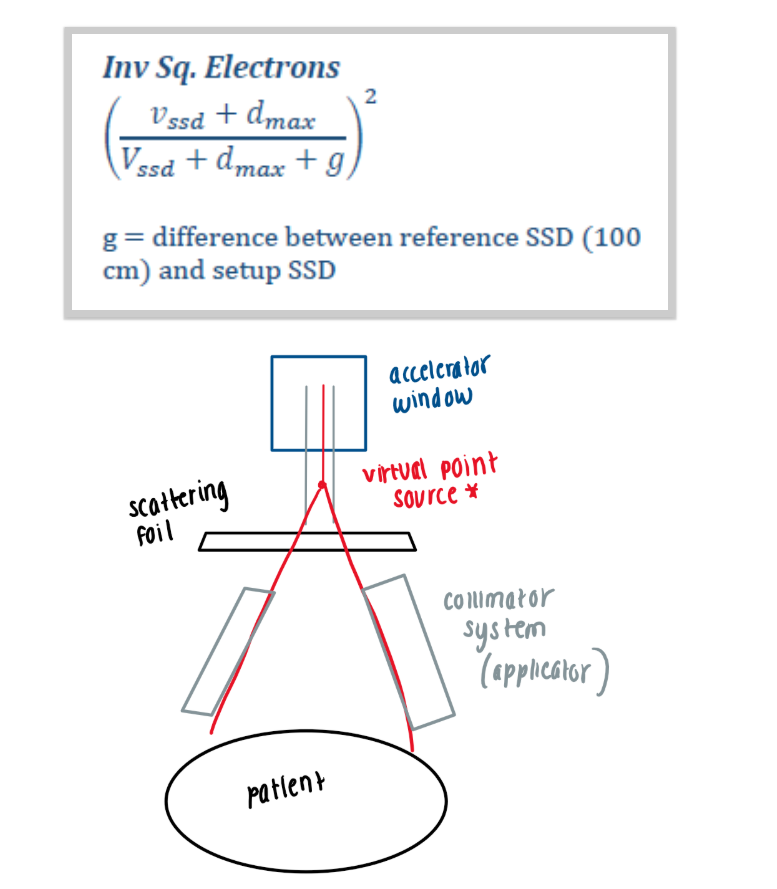
does the inverse square law apply to electrons?
no
we use virtual source distance
what electron energies are used clinically?
6-20 MeV
How do electrons interact?
ionization or excitation
what is the rate of energy loss with depth in water?
2 MeV/cm
How does energy impact dose falloff?
lower energy will have sharper dose fall off
how is depth distribution determined?
by ion chambers, diodes, and film
how does energy impact surface dose?
surface dose increases with increasing energy
How does beam obliquity impact the dose?
increases dose at dmax
decreases deeper dose
if an electron and photon field abut, which will have the hotspot?
photon side because hotspot scatters laterally
where does bolus have to be placed?
on patient’s skin surface
What is the minimum thickness of lead required for shielding?
E/2 in mm of lead
what do we need to be aware of with internal shielding?
backscatter
shouldn’t shoot electron beam directly through lead
what is needed in electron arc therapy to define the treatment field and sharpen dose distribution at field edges?
custom shielding (molded on to the surface)
what are the differences between electrons and superficial x-rays?
superficial x-rays deposit higher dose into bones
electrons have less skin sparing and spare underlying tissue more
electron beam on has greater output and therefore faster treatment
what parameter is used as a beam quality specifier for electron beams?
R50
where do hotspots occur when boosting a sinus with electrons?
along the air cavity interface
How are protons produced?
by cyclotrons
by synchrotrons
what is the difference between a cyclotron and a synchrotron?
cyclotrons have fixed energy, energy degraders to create the spread-out Bragg Peak at any depth
Synchrotrons produce beams of variable energy
What is the RBE (relative biological effectiveness) of protons?
1.1
Why should there not be multiple beams stopping in an OAR in a proton plan?
because LET and RBE increase near the end of the proton’s range
what is range uncertainty in proton planning?
results from mapping of the CT-based HU to the stopping power of protons
How are proton beams delivered?
passive beam spreading or pencil beam scanning
pencil beam scanning involves magnets that shape the beam
what are proton dose calculation algorithms?
pencil beam
convolution/superposition
monte carlo
why use protons?
give conformity comparable to IMRT with less integral dose (dose to body)
why do flattening filters cause dose horns?
they overcompensate at the surface to obtain flatness at 10cm depth
geometric penumbra formula

what is geometric penumbra?
dose decreases on sides of beam bc they’re far from central axis
why is geometric penumbra not the best measure of penumbra?
bc it is not the only cause of penumbra
with reduced side scatter, we also have physical penumbra (between 90 and 20% IDLs)
what IDL does the light field coincide with?
50%
what is the Clarkson method?
a way of calculating dose to an irregularly shaped target by dividing it into pieces that are easier to add together
within what percentage should isodose curves in the TPS be accurate?
2%
what tools can be used to measure isodose curves?
ion chambers
solid state detectors
radiographic films
what is the ICRU?
international commission on radiation units. Named targets
what is the gross tumor volume?
demonstrated tumor
what is the clinical target volume?
GTV + sub-clinical disease
what is the internal target volume?
CTV + margin for motion
What is the planning target volume?
CTVs + ITV + margin for variations in setup, positioning, geometry
what is the treated volume?
volume that receives a dose that is important for local cure or palliation
what is the irradiated volume?
tissue volume that receives a dose that is significant compared to normal tissue tolerance
what is a differential DVH?
represents the volume receiving dose in the corresponding dose bin
shows how homogenous dose is
spiky: not homogenous
smooth: homogenous
what is a cumulative DVH?
represents volume receiving greater than or equal to the value in the corresponding dose bin
this is what we use
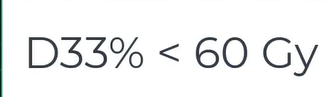
how do you read this?
33% of volume should get less than 60 Gy
what is the conformity index?
rx isodose volume/target volume
if you stack your rx isodose level over target volume, how closely will they fit
perfect score = 1
further from 1, less conformal
what is the homogeneity index?
ratio between the max dose in target volume to rx dose
Assesses hot and cold spots in target volume
further from 1, less homogenous
larger number = more inhomogenous
