laws 1110 complete
 Call Kai
 Learn
Learn Practice Test
 Spaced Repetition
 Match
Match Flashcards
 Knowt Play
1/176

There's no tags or description
Looks like no tags are added yet.
Name | Mastery | Learn | Test | Matching | Spaced | Call with Kai | Chat |
|---|
No analytics yet
Send a link to your students to track their progress
177 Terms
Crime as an interaction
emerges as the result of a complicated interaction between:
-society's need to have an understanding of the concept of crime
-People's need to identify specific events as crimes
-Society's need to administer consequences for these identified actions
Context dependent- influenced by:
(crime as an interaction)
-Governments
-Public concerns
-society's power brokers
-Media
Crime varies over time:
-The definition of crime has varied across time and jurisdictions
-Martin Luther King was imprisoned for supporting the 1960's US Civil Rights movement
-clear crime changes in Australia with respect to:
-Domestic and family violence
-Child abuse
-Gay marriage and homosexuality
-Abortion
-Crime can represent the settled rules of a society
(often imposed to maintain the status quo and support the interests of those already in power)
What are the 5 frameworks for defining crime?
1.) Crime as a reflection of the nation state, defined in terms of criminal law
2.)Crime as a social construction
3.)Crime as social/political theory-beyond the nation state- human rights
4.) Crime as defined by religion
5.)Crime as a social harm
Crime and the criminal law
-An intentional violation of the criminal law committed without excuse and penalised by the state (Tappan 1947)
(Act/omission which may result in prosecution/punishment in a criminal court)
What does the criminal definition of crime miss?
-No moral dimension
-No social context
-eludes how and why some conduct is defined as criminal and some are not. relying on this definition would imply that if there were no criminal law there would be no crime OR no matter what acts someone commits, if that act is not subject to criminal sanction, then it cannot be considered criminal
Crime as a social construction
Criminal law varies over time and space. Therefore, defining crime in terms of violating criminal law means there is nothing given about crime.
-crime now is defined as a product of cultural bounded social interaction
-no ontological reality, the product of an interaction/negotiation between people living in complex social groups
-Definitions tied to formal social control mechanisms
(crime and criminalisation reflect power differentials in society, protecting the status quo)
Crime as a Violation of Human Rights
-Defends basic human rights
-Talk of deviance, not crime and allow the concept to escape legality and create its own frame of reference
-Broadens the focus
-civil and administrative matters
-Economic activities, such as tax evasion, price fixing etc.
-Extends to include state crimes- genocide, mass political killings, state terrorism, torture etc.
-Moves beyond confines of narrow legal definitions
Crime defined by religion
-What is criminal is defined according to religious rule
-Religious interpretation varies within and between religions
Crime as a social harm
-Shift the focus away from crime to social harm
-Crime has no ontological reality
-Criminology perpetuates the myth of crime
-Crime consists of many petty events
-Crime excludes many serious harms
The dramatic fallacy
The media overplay extraordinary crimes and underplay ordinary crimes
The cops and courts fallacy
Most crime:
-Generally goes unreported
-Most reports do not result in arrest
-Most arrests do not lead to trial or a guilty plea
-Most trials do not result in incarceration
The not me fallacy
If social science demonstrates empirically that almost everyone sometimes breaks the law, but there are wide differences in how frequently and seriously individuals do so, delinquency should then be recognised as a matter of degree.
The innocence of youth fallacy
The temptation is to portray young people as innocent, and when they do offend, as having been corrupted by older people.
-48% of offenders aged 15-29 20 16-2017
The ingenuity fallacy
-The reality is that technology has arguably resulted I de-skilling of some crimes
(Tap and go pay pass theft instead of shop lifting)
(theft from cars instead of theft of cars)
Are kids still offending as much as they used to?
The arrest rate for children started to decline sharply from 2007
Is there still as much crime as there used to be?
A lot of crime has been declining for a long time.
What are the 4 reasons to measure crime?
1.) Measure the moral health of nations, cities or regions
2.)Evaluate the effectiveness of the machinery of social control
3.)Estimate the risk of becoming a victim
4.)development and testing of criminological theories
Essentially these measures are comparative in intent:
-over time
-across jurisdictions
-across social and demographic groupings
-environmental influences
Why use police data to measure crime?
-Police statistics can give useful insight into relative trends over time and between areas
-They also provide a great deal of insight into additional information about the incident
-Voluminous data, with lots of detail
-Incomplete reporting does not mean police data isn't useful
Attrition of police date
There are a number of reasons why not all reported incidents make it into police recorded crime statistics:
1.)police may record an incident with multiple victims as a single incident
2.)Police may not regard the reported event as serious enough to record
3.)Informal, unofficial action may be taken
4.)The incident was recorded, but not recorded as something other than what the victim thought it should be
Crime Victimisation Surveys
-An alternative source of information to police recorded crime data (trying to expose some of the dark figure of crime)
-Attempts to measure things that aren't captured by official crime statistics-victim surveys
-Efforts made to capture a representative sample to make judgements about the broader population
-Provide access to information directly from the public
-Can provide insight into changes in reporting behaviour over time.
-Provide insight into prevalence and incidence rates about victimisation (also provide insight into correlates and risk factors)
What do victim surveys involve?
Realists argue that victim surveys provide a better way to measure crime
-crime has meaning/validity regardless of its defining context
-Bypasses problems caused by jurisdictional variations by providing a common definition
Careful interpretation of trends is crucial
Changes in reporting and recording of data can influence official statistical trends
-Coverage can change- influencing what crime types are counted in totals
-Counting rules can change
-Actions can be redefined
-Behaviour could be different
-recording decisions may change
-Reporting rates may change
Representativeness of the news
different styles of the news vary inn how representative they are:
-Sensationalism- emphasises a specific, unusual, graphic crime, and report the event out of context
The problem:
-Sensationalism is more popular, more easily available, and more digestable
-This time of reporting is pushing a broader agenda (religious/political/ideological) that is supported by the media organisation/owner
News entities sift information to:
-select only what they consider to be news worthy
-titillate patrons- stimulating their lives with sensational information
-Emphasise the deliberately shocking
-Simplify events- presenting them as good versus evil or law versus chaos- implicitly assumes a necessary distinction between victims and offender)
-Following conviction, information can be released as fact regardless of its objective veracity
Why does news representation of crime matter?
This matters because it influences fear of crime
-Fear of victimisation is not innate- it is a social and cultural process
-The perception of rising crime rates has the capacity to increase public anxiety. For the overwhelming majority of people who are not themselves directly victimised, it is through such emotional response that crime waves are personally experienced.
-Fear of crime is not related to actual risk of victimisation
-Fear of crime is influenced by the media
-Selective presentation of crime in the media perpetuates the mythical conflict between good and bad.
Succumbing to the temptation of populism
Populism assumes that public opinion does exist and the single opinion is uniform and uni-dimensional.
-Populism claims to speak on behalf of the public and to articulate public opinion (which may at times be hidden)
-Emotional rather than rational
-popular, without the need for experts and responsibility
-Highly aligned with the demands of the media
-extreme, exotic punishment is appealing politically because it is appealing to the media
When did classicism emerge?
Emerged in the 18th century in response to arbitrary, cruel forms of punishment that were dominant at the time. A time of political upheaval and a greater emphasis placed on individuals rights than ever before
What did Beccaria argue for classicism?
Beccaria argued that punishment should be determined by laws and should be proportionate to the harm of the crime caused to society.
*Humans believed to be logical and rational- meaning laws should be Clear and punishment prominent
-If the predictable pain from punishments exceeded the pleasures gained from offending, people would refrain from crime.
What did Beccaria argue was the key to effective prevention of crime?
CCS
-Certainty- how likely punishment is to occur
-Celerity- how quickly punishment is inflicted, relative to the offence
-Severity- how much pain is inflicted
How has classicism had a profound impact on criminology and in particular, criminal justice practices?
-Due process
-Rights of accused
-Notions of deterrence
Limitations of classicism?
-By treating all individuals as rational,it underrepresents problems like mental illness, learning difficulties, cognitive impairments, and maturity
-Eludes the influence of power and wealth discrepancies on behaviour- (why do the poorest make up the bulk of participants in the criminal justice system?)
-A strict classical approach would mean no altered outcomes to take into account individual circumstances
Rigity of classicism
-No adjustment of fines
-No suspended sentences
-No probation or parole
-No special processes for young offenders and people with abnormal mental functionin
What is positivism?
-Determinism: focus on features within the individual to help explain criminality
-the reliance on data and theory
-Alternative to classical ideas
-Focused on causes beyond the individual human actor
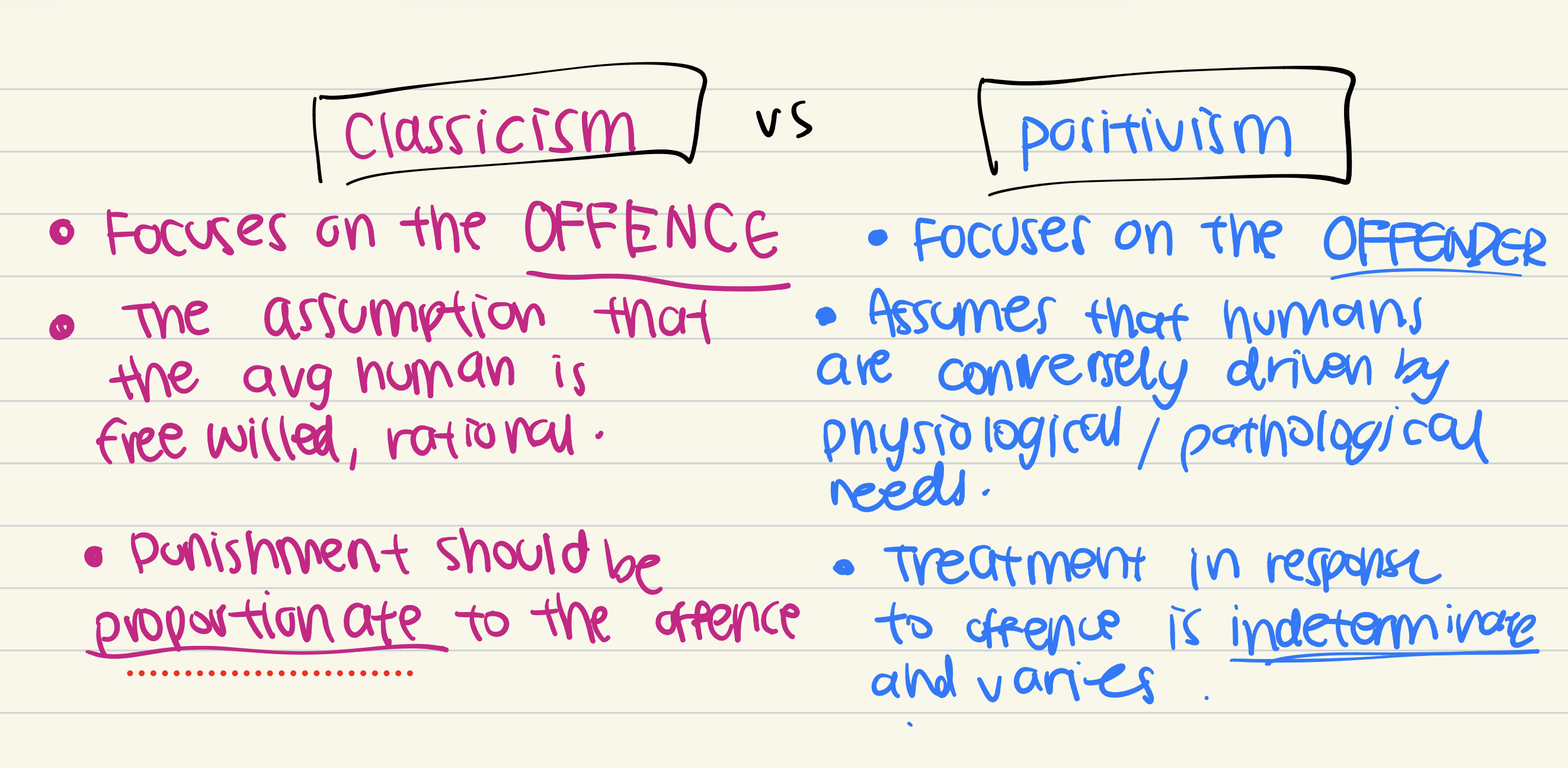
Differences between classicism and positivism:
Classicism= the offence, positivism= the offender
Classicism= free willed, rational, calculating, normal human. Positivism= determined, driven by biological, psychological or other influences, pathological.
Classicism= punishment, proportionate to the offence. Positivism= treatment, indeterminate, depends on individual circumstances
What are the 3 areas of biological positivism?
1) Genes and crime
2) Biochemical factors and crime
3) Mental health and crime
Biochemical influences criminality:
ADHD, acquired brain injury, hormones, nutrition
These may be factors of offending, but offending is not a necessary outcome
the person-situation interaction is key
Mental health and crime:
-Complex link- mediated by the nature of crime and the definition of the disorder
issues regarding mental health are s much more concentrated in prison than in the general public
-Deinstitutionalisation of the mentally ill from the 1980's resulted in 75% decrease in the number of people in psychiatric hospitals inn Australia between 1981 and 2001
Resulted in some mentally ill people coming to the attention of the police for reasons of homelessness. Mental illness + erratic behaviour may come across as threatening
Evaluation of Biological Positivism:
Criminology is reluctant to recognise that biology might be relevant to understand crime and deviance
However:
1) biological factors almost certainly have some role in approximating prevalence of criminal conduct
2) the extent of the role is generally very small
3) These effects are mediated by the interaction with the broader social/environmental context
Psychological positivism IS…
1) Criminality as learned behaviour
2) Cognition, personality, intelligence and their roles in crime
3) Blends cognition and learning- offender expertise
Genes and crime:
1) eugenics- feeble-mindedness was linked with pauperism, promiscuity and criminality
2) Twin studies, adoptions studies, nature versus nurture
Conclusion of Biological theories
-Important for understanding criminal behaviour
-may increase the likelihood of a person engaging in criminal behaviour
-But are not the sole determinate
-Not either/or for biology or the environment
-Behaviour is a complex interaction between biology, environmental factors and psychological factors
Criminality as a learned behaviour:
-In broad terms, a platform based on learning theory considers offending, like all behaviours, to be something that is learned (behavioural psychology)
-learning: classical conditioning and operant conditioning
What is the social learning theory? (criminality as a learned behaviour)
-Learning cognitively through observing the behaviour of others
-Once behaviour is learned, environmental reinforcements and punishments influence ongoing behaviour
-Mediated by attention, memory and understanding
Cognition, personality, intelligence on crime:
There are also learning based behavioural models of offending that build other psychological processes:
-Capacity for moral reasoning: Kohlberg pre-conventional, conventional and post conventional reasoning
-Appeals to personality characteristics: Eysenck biosocial theory- psychoticism, neuroticism and extroversion
-Appeals to intelligence
These approaches are interested in how people:
-process information
-Reason
-Problem solve
-Make decisions
Blending cognition and learning:
1.) Expertise and an explanation for persistent offending
-Building on the principles of cognitive psychology
-Domain specificity, practice effects, skill acquisition
-Structural representations of knowledge and skills in memory
-Observable, behavioural manifestation improving on a continuum, from novice to master
-The end of the continuum achieved through continual, deliberate, challenging practice
2) Examples of cognitive and behavioural processes that fit this model have already been displayed in criminological literature
-Use of automatic cues in sex offenders
-Speedy and superior knowledge of environmental cue by burglars
-Automatic scripts for burglars
Maternal deprivation
Bowlby proposed:
-Children require consistent and continuous care from a primary care giver until age 5
-Disruption to this relationship may have harmful consequences-particularly influencing later ability to form relationships
Original study involved 44 delinquent youths and a matched sample of non delinquents
-39% delinquents had experienced significant maternal disruption
BUT, theres No evidence that damage is irreversible
Adverse Childhood Experiences (ACEs)
Fox 2015 examined the relationship between ACEs and serious, violent and chronic juvenile offending
-Sample of 22 575 delinquent youth referred to the Florida Department of Juvenile Justice:
-History of childhood trauma
-Abuse
-Neglect
-Criminal behaviour
-Other criminological risk factors
What are the 3 main theories for social explanations of crime?
Durkheim and strain
Merton and strain
Agnew's general strain theory
Strain and anomie (Durkheim)
Durkheim saw a certain amount of crime as normal in any society
-variation across contexts in specific acts classified as crimes
-Consistent in the need for enforcement of rules to prevent behaviour violating the moral code
-Definite appeal to the classical perspective-free will and rationality
-During periods of rapid change, regulatory processes that worked effectively in mechanical societies are not replaced quickly and effectively enough-
A potential outcome-anomie (formlessness)- moral constraints are insufficient to limit individual desires.
Durkheim’s proposal of the 2 important functions of crime? (strain and anomie)
1) Adaptive function- introduces new ideas and practices into society, preventing stagnation
2) Boundary maintenance function- reinforcing social values and norms through collective actions against deviance, reaffirming the distinction between right and wrong
Strain Theory of Deviance (Merton)
The fallacy of the 'American dream'-ignores the significance of where you start in the race (ACEs)
Agnew's General Strain Theory
3 causes of strain: failure to achieve positively valued goals, removal of something valued, impose noxious stimuli
Moral strain= more likely deviance will be the outcome
(events which are perceived to be especially negative by those who experience them are positively correlated with a greater likelihood of criminal behavior)
Chicago, space and broader context
1.) Social disorganisation
2.)Differential association (connected to social learning theory)
3.)Social opportunity
Social Disorganisation
1) Factors explaining socio-economic differences were ATTRIBUTED TO social/geographic variation in crime/delinquency- they did NOT claim these factors caused crime
2.) They appealed to social disorganisation as an explanation for the enduing nature of these patterns- key related factor is the capacity for a community to operationalise informal social control
3.)Delinquent values are transmitted from generation to generation through a process of cultural transmission - meaning areas become delinquent areas despite a turn over of residents- crime viewed as inevitable, natural outcome of instability in physical/economic conditions of certain areas in modern cities.
Differential Association
1.) Criminality is a normal learned behaviour that occurs in places- in parallel to the place based explanation provided by social disorganisation, differential association approaches criminality as a consequence of learned behaviour resulting from contextually specific cultural influences and mechanisms
2.) Peer groups are the key- key factor is the degrees of association with criminal values and ideas
-A person becomes delinquent because of an excess of definitions favourable to violation of the law over definitions unfavourable to violation of the law. This is the principle of differential association.
Social opportunity
This theory for criminal behaviour explains variation in offending based on the distribution of legitimate and illegitimate social opportunity structures for individuals
-individuals are simultaneously located in both legitimate and illegitimate social opportunity structures
-Criminal, conflict, or retreats subcultures.
Labelling Theory
The process where others attempt to impose an identity on us.
Labelling theorists argue that:
-Society
-Specifically those in powerful positions
-Creates deviance by overreacting to minor rule breaking
-May lead to negative socialisation
-Influence subsequent construction of one's own identity
-Secondary deviance occurs- strengthening of deviant conduct as a reaction to stigmatising
-How we approach shaming is key- disintegrative vs. reintegrative
Conntrol theories address the question of "Why do we obey the rules of society?"
-In doing this it implies that self-interest is taken for granted and the really vital question is what produces conformity?
-According to this perspective, crime is something we would all engage in were it not for internal or external controls preventing us from doing so
-Links to early strain theory, the classical school generally, social disorganisation, and rational choice
Control theories share the assumption that conformity is maintained by certain social conditions, personal attributes and relationships:
-These factors essentially operate as social controls- producing conformity and providing an obstacle to offending
-The key psychological process is known as socialisation which can be understood as learning to control the self to conform with social expectations.
What are the 3 control theories?
1.) Reckless containment theory
2.) Social bond theory
3.) General theory of crime
Reckless' Containment Theory
Focused on why individuals primary responses were conformity in a world with so many pressures and pulls toward deviance
-Theorised in terms of risk factors- social pressures pushing people towards crime
-Protective factors- referred to as inner containment and outer containment
-Outer containment influenced by social groups, supportive relationships, meaningful inclusion
-Inner containment: 4 factors proposed to influence the individual no matter what the circumstances externally:
1.)Favourable self concept
2.)Goal orientation
3.)Frustration tolerance
4.)Norm retention/erosion
Social Bond Theory
-Developing Reckless's work on the importance of inner containment in understanding deviance
-The central construct of Hirschi's social bond theory is the bond of the individual to conventional society
Hirschi argues that there are 4 elements to this bond:
1.)Attachment- caring about others including respecting others opinions and expectations
2.)Commitment- the investment that people put into particular activities
3.)Involvement- the Devil makes work for idle hands
4.)Belief- assumes the existence of a common value system in society and that there is variation across individuals in the extent to which they agree with society's rules.
General theory of crime
Wanted to revisit the importance of:
-individual differences in offending behaviour
-differences that appear early in the life course
-differences that remain stable over much of the life course
The heart of their story is self control- concern for the long term consequences of one's acts, which allows us to resist temptation
Self control, according to this model, involves impulsiveness, risk-seeking, physicality, self-centredness, and low temper threshold
Parental failure fails to instil self-control and leads to children who are more impulsive etc. making them more likely to engage in criminality.
Crime as a rational choice (opportunity based explanations for crime)
Decisions to offend are constrained by time, cognitive ability and information:
-bounded rationality
-Within the context, to that person, it made sense at the time
-Offenders are rarely in possession of all the necessary facts.
Perceptions of the situation and of risk and rewards is more important than actual circumstances:
-once the decision to offend has been made, criminals focus on the potential reward rather than the risk
-If risks are considered, it is the immediate contextual risks of being caught and not the consequences of punishment that might be imposed
-Individuals who are not normally criminals may choose to offend based on perceived risks and rewards
Decisions vary by the different stages of the offence and among different offenders
Routine Activity Theory
Started as an explanation for predatory crime.
Physical convergence in space and time of 3 minimal elements:
A likely offender ----> A suitable target----> The absence of a capable guardian= crime
What are the 10 principles of opportunity and crime?
1.) Opportunities play a role in causing all crime
2.)Crime opportunities are highly specific
3.)Crime opportunities are concentrated in time and space
4.)Crime opportunities depend on every day movements
5.)One crime produces another
6.)Some products offer more tempting crime opportunities
7.)Social and technological changes produce new crime opportunities
8.)Opportunities for crime can be reduced
9.)Reducing opportunities does not usually displace crime
10.)Focused opportunity reduction can produce wider declines in crime
What are the 3 theory-based interventions building on the principles of situational opportunity and crime?
1.) Crime scripts
2.) SCP (situational prevention)
3.) Place-based policing
What was the Philadelphia Foot Patrol Experiment?
Temple university paired up with the the Philadelphia police department and identified 120 areas that were high in crime. They added foot patrols of police in 60 of these areas and then kept the other 60 as control areas. The experiment was a success as it saw a 23% decrease in crimes of violence in the areas that had patrols. The police officers also got to know the residents of these areas.
*Good example of place-based policing
What other terminology falls into white collar crime?
So this is crimes by and within businesses.
-Crimes of the powerful
-Organisational deviance
-Occupational crime
-Business crime
-Elite crime and an abuse of occupational trust
-State-corporate crime
Where does white collar crime fit in?
It's rare for white collar crime to end up in court:
-Embezzlement, fraud, insider-trading
-Often committed by respectable professionals
-Can involve major corporations
The rarity does not mean these crimes don't happen
-They are policed in different ways
-Subject to different standards
What range of white collar crimes is criminology rightly criticised for failing to examine?
And what are the failures likely connected to?
1.)Environmental pollution
2.)Health and safety violations
3.)Fraud
4.)Consumer affairs issues
5.)Money laundering
6.)Food regulation
-Less powerful interest in these activities
-Different approach by the media to these events- less coverage, less emotive
-Difficult to research-predominantly hidden
-Not captured by general crime statistics-police records, surveys or courts
-Specialised, expert knowledge required to understand a lot of this behaviour
How does white collar crime vary from other forms of criminal activity?
-Generally private
-Offenders are usually legitimately present
-Often involves abuse of trust and insider knowledge
-Often no immediate complainant is less of a source of fear/anxiety
-difficult to determine responsibility and ambiguous legal/criminal status
What are some of the theories that have attempted to explain white collar crime?
-Differential association (Sutherland)
-General theory of crime
-Sub-cultural theory and neutralisation
-Rational choice/opportunity
The limited role of the criminal justice system (white collar crime)
White collar offending receives very little attention from the formal criminal justice system
-Much of what corporations do that is harmful is not criminalised
-Even when corporations are prosecuted, penalties often appear trivial in relation to scale of harm caused
-Corporations are often very well placed to defend themselves
-An area of considerable misconduct, much of which is not prosecuted
What general trends can be summarised about violence and property crime?
-More property than personal
-Decline overall, with increases that make sense
-Not being a victim is normal, but if a victim then revictimisation is a real risk
-Crime happens in specific places
What is FASD? (Foetal alcohol syndrome)
It is a non-diagnostic umbrella term encompassing a spectrum of disorders caused by prenatal alcohol exposure.
Difficulty with abstract reasoning often manifests as a failure to learn from experience, and link consequences with actions.
People with FASD may also experience difficulty seeing the 'big picture', in the sense of imagining a future, thinking about others, explaining actions, or restraining impulses.
How are Indigenous women represented within the legal system?
-Women still form a relatively small proportion of WA's prison population
-However, their numbers have grown quickly, and at a much faster rate than male numbers.
-Today, there are 486 women in prison, a staggering increase of 40% in 5 years.
-Women comprise 9.3% of the prison population.
Youth Justice for Indigenous Australians
-Aboriginal boys and girls are both 40x more likely than their non-aboriginal peers to be in detention, this is the highest rate of overrepresentation of Aboriginal young people in detention in Australia
-They are over-represented at the 'extreme' end of the system.
Systematic Discrimination for Indigenous people
Discriminatory use of 'facially neutral' laws such as Move on Notices, PBOs, and Youth Curfews (Northbridge) as street sweeping tools.
Indigenous people's interaction with the Criminal Justice System
-Research suggests that over half of people with FASD will interact with the criminal justice system
-Around 60% will be arrested, charged or convicted of criminal offence, and about half will have spent time in juvenile detention, prison, inpatient treatment or mental health detention
-Canadian research indicates that young people with FASD are 19x more likely to be arrested than their peers.
-Research at Banksia Hill Detention Centre found 89% had at least some form of severe neurodevelopmental impairment, while 36% were found to have FASD
-Statistically higher rate of detention for youths from rural/remote areas
-There is mounting evidence that Aboriginal youth are more likely to be effected by disorders such as FASD
-Conditions that undermine traditional sentencing principles, individual and general deterrence.
What are some of the push and pull factors for Indigenous people committing crime?
-Inappropriate policing and over-policing
-Systematic racism and bias
-Legacies of colonisation (stolen generations)
-Cultural differences
-Cultural insensivity
-Family crisis and family violence
-Inter-generational trauma
-Drugs, alcohol and abuse
-Disability
In what areas are there systematic bias in the Criminal Justice System?
(Aboriginals)
-Public disorder offences (drunkenness)
-Mandatory sentencing
-Prohibited behaviour orders
-Racist policing
Aboriginal difference
Aboriginal people possess their own body of law and culture
-Law reform commission of WA
-Aboriginal people are bound by law
-Many live within 2 laws
What does the term intersectional mean? (in terms of Aboriginals)
Intersectionality is a concept often used in critical theories to describe the ways in which oppressive institutions are interconnected and cannot be examined separately from one another.
-Violence against indigenous women takes place at the intersection of a range of different forms of oppression, of which gender remains one.
Indigenous women and violence
-Indigenous women are more likely to be victims of family violence than no-Indigenous women
-Indigenous women living in rural and remote areas of WA are up to 45x more likely to experience family violence than other women living in remote areas.
-Further, Indigenous women are 35x more likely to be hospitalised for family violence assaults than other Australian women.
-Young aboriginal women more than 80x more likely to be hospitalised for family violence related injuries.
-Aboriginal women are also more likely to be imprisoned than non-aboriginal women. Indigenous women are the fastest growing group in prison.
*More likely to be victims of state violence, neglect and indifference and die in custody
Prevention for Indigenous people
-Communities want to see a greater focus on prevention that covers the whole spectrum of violence and aggressive behaviours on communities.
-Violence responses need to address the over sale and over consumption of alcohol and the harmful impact of drugs.
-Poor housing conditions and over crowding exacerbates violence and makes women and children vulnerable to abuse from a broad range of potential abusers.
-Women who cannot behave as good victims are rendered deviant by mainstream services
-Making indigenous women fit in unwittingly perpetuates settler colonial practices of assimilation and destruction of Aboriginal society.
What is a Gladue?
A Gladue report is a type of pre-sentencing and bail hearing report that a Canadian court can request when considering sentencing an offender of Aboriginal background.
What is phenomenology?
It is concerned with the ways in which people's subjective experience may be understood and, in particular, one aim is to uncover those underlying structures or rules which guide behaviour.
What would ethnomethodologists look at?
Focused on the ways in which everyday activities are made meaningful and on occasion this was done through shock activities- usually referred to as breaching experiments- that involved disturbing the social world so as to help uncover its taken for grandness stance.
How did the labelling theory emerge?
Frank Tannenbaum's work, early 1930s.
-He agued that delinquents are not inherently different from non-delinquents. Rather, it is the process of defining someone as a juvenile delinquent that arises out of conflict over the definition of particular activities or situations which is important.
-Over time this leads to a hardening of local opinion, and attitudes change not just toward the behaviour concerned but also toward the young person.
-The changed attitudes lead to changes in behaviour- and eventually to the tagging of the youth.
What did Tannnenbaum say about the tagging of the youth?
"the process of making the criminal is a process of tagging, defining, identifying, segregating, describing, emphasising, making conscious and self conscious; it becomes a way of stimulating, suggesting, emphasising and evoking the very traits that are complained of... The person becomes the thing he is described of as being... The way out is through a refusal to dramatise the evil."
-Delinquents in this scenario are good kids doing bad things; they become labelled as bad kids and continue in that vein.
How does secondary deviance occur?
Edwin Lemert- argued that amongst the vast range of acts of rule breaking and deviance, it was those that generate a social response that should be the object of inquiry.
-the social response may lead the offender to make adjustments to their self-conception- their perception and understanding of themselves. Crucially, it may lead them to begin to see themselves as deviant and to act on this basis- that is, to adopt this as their master status. When they do, according to Lemert, their deviance is secondary.
What did Schur 1951, say about secondary deviance?
Secondary deviance occurs when ' a person begins to employ his deviant behaviour or role based upon it as a means of defence, attack, or adjustment to the overt or covert problems created by the consequent societal reaction to him.'
What is primary deviance?
Is the simple commission of a prohibited act. This is something that pretty much everybody does and most of the time is unlabelled, meaning that the people concerned don't develop a deviant identity.
What is moral entrepreneurship?
The activities of those members of society who seek to have rules enforced or the moral constitution of society somehow protected.
How was Becker's outsider theory influential in causing a shift?
Becker was crucial in shifting attention away from crime and toward deviance. This shift acknowledged the inherently problematic and contested nature of how much activity defined as criminal, and sought to explore how deviancy was created and understood.
What is Becker's central contention?
That deviance is 'a consequence of the application by others of rules and sanctions.'
How does the labelling theory differ from biological, psychological and social theories on criminology?
These theories previously stated that we as individuals are the product of our biology, psychology or social environments. Labelling theory puts human creativity, agency and decision-making at the centre of its concerns.
What is the three stage process of rule-breaking, according to Becker?
1.) Rules are created by social groups, and it is the infraction of these rules that create deviance
2.)The rules are applied to particular people
3.) Those to whom the rules are applied are then labelled as outsiders (the selection of particular people or groups is dependent one career contingencies)
This process creates the deviant. At the heart of the interactionist understandings of deviance, and labelling theory in particular, is the argument that what is crucial to the creation of deviance is the application of labels- not the breaking of rules.