Lecture 11: Population and geopolitics
 Call Kai
 Learn
Learn Practice Test
 Spaced Repetition
 Match
Match Flashcards
 Knowt Play
1/22

There's no tags or description
Looks like no tags are added yet.
Name | Mastery | Learn | Test | Matching | Spaced | Call with Kai | Chat |
|---|
No analytics yet
Send a link to your students to track their progress
23 Terms
How does demography (migration, urbanisation etc.) tie into modern political dilemmas?
Discourse around migration and housing crisis
millennials and gen z expressing concerns about finding residency
housing crisis redirected from focus on urban planning and social policy to migrants
Geopolitics and demographic processes of interest
Population size and distribution
new global alliances and shift in geopolitical power
Age transition
divergence between more developed (MDC) and less developed (LDC) countries
International migration
brain drain in origin countries
social cohesion in destination countries
Urbanisation and internal migration
World Trade
World Trade is shifting to the Global South
Geopolitical implications for changing population sizes and distribution
Shift in geopolitical power to the Asia from Europe and the North Atlantic
New global alliances
e.g. BRIC (Brazil, Russia, India, China)
Gain in the economic weight of East, Southeast and South Asia relative to North Atlantic, as well as Africa
Decreasing gap in development outcomes between MDCs and LDCs
Increased demand for resources in LDCs
environmental implications
double burden of diseases
Geopolitical implications for ageing transition
Bifurcation into two global demographic categories
low growth countries with rapid ageing
e.g. Italy 60 million (2020), 39 million (2100); median age 45.8 → 50.8
e.g. Japan 126 million (2020), 75 million (2100); median age 46.5 → 51.0
experiences intergenerational conflict over policy
high growth countries with high fertility and low proportions of older people
e.g. India 1.3 billion (2020), 1.5 billion (2100); median age 26.6 → 47.0
e.g. Nigeria 206 million (2020), 732 million (2100); median age 17.9 → 32.4
youth bulge (young age structure)
demographic dividend (transitional age structure)
Intergenerational conflict over public policy in low growth countries with ageing societies
Divergence in political attitudes between old and young generations
support for Brexit (Hobolt 2016; Fox and Pearce 2018)
political party preferences (Lichtin et al 2023)
electoral turnout (Grasso 2014)
Life-cycle effects or generation differences? (Van der Brug and Kritzinger 2025)
Youth bulge (countries of concern)
Measured as the proportion of the adult population aged 15-29
Middle East, North Africa, Sub-Saharan Africa and South Asia
Unemployment is a factor
Egypt (42%), Libya (41%), Morocco (40%), Jordon (49%), Syria (45%), Tunisia (37%)
Countries with a higher percent of young adults were 2.3 times as likely to experience an outbreak of civil conflict as countries with smaller proportions during the 1990s
too many young people with not enough to do
The Demographic Dividend
The demographic dividend is the accelerated economic growth that may result from a decline in a country's mortality and fertility and the subsequent change in the age structure of the population
window of opportunity for rapid economic growth if the right social and economic policies developed and investments made.
East Asian “economic miracle”
Offers some of recent history’s most compelling evidence of the demographic dividend as it accounts for between one fourth and two-fifths of East Asia’s ‘economic miracle’. These countries absorb and productively employ the extra workers, increased savings rates, human capital and domestic demand.
Age transition implications (summary)
Intergenerational policy conflict for MDCs
Potential for conflict associated with the youth bulge in LDCs
Economic growth for LDCs that can harness the demographic dividend
Changes in consumption patterns due to population ageing in MDCs (IPAT) or large youthful population
Geopolitical implications of international migration
The least predictable and most volatile component of demographic change
Equilibrating mechanism and a response to factors at both origins and destinations
Composition
large proportion of economic migrants
constant stream of humanitarian migrants
high volume of irregular migration
temporary migration
International migration impacts on origin country
Overall effect may be more nuanced:
migration opportunities boosting supply of skilled labor at origin country
income from overseas boosting origin country consumption and human capital investment
temporary migrants acquiring skills that may be useful to origin country
International migration impacts on destination country
A large part of population growth in MDCs is accounted for by international migration
Challenges associated in maintaining social cohesion
divergent policy preferences between migrants and non-migrants
economic concerns
labor market competition (Lancee and Pardos-Prado 2013)
infrastructure pressures linked to migration shocks (Moallemi and Melser 2020)
Cultural concerns (Hangartner et al 2019)
Economic benefits of urbanisation
Greater availability of production inputs for businesses
Knowledge spillovers between firms and between employees
Greater availability and diversity of employment opportunities
Implications of urbanisation
Major urban centres as focus of political power
Cities as engines of economic growth or focus of poverty?
Allocation of fiscal resources in major cities vis-à vis regional/rural areas
Trends in urbanisation post-COVID?
e.g. remote work and counter-urbanisation
Population projections
Population projection
a numerical statement about the future of a population based on a set of assumptions regarding fertility, mortality and migration
Population forecast
a projection regarded as the most likely population future
Projection scenario
a projection which illustrates the consequences of a certain set of social, economic or environmental assumptions, and which may or may not be plausible
Variety of projection methods: extrapolative, ratio, cohort-component
population projections provide a strong foundation on which to base planning and policy making (housing, infrastructure, services, climate policies, etc.)
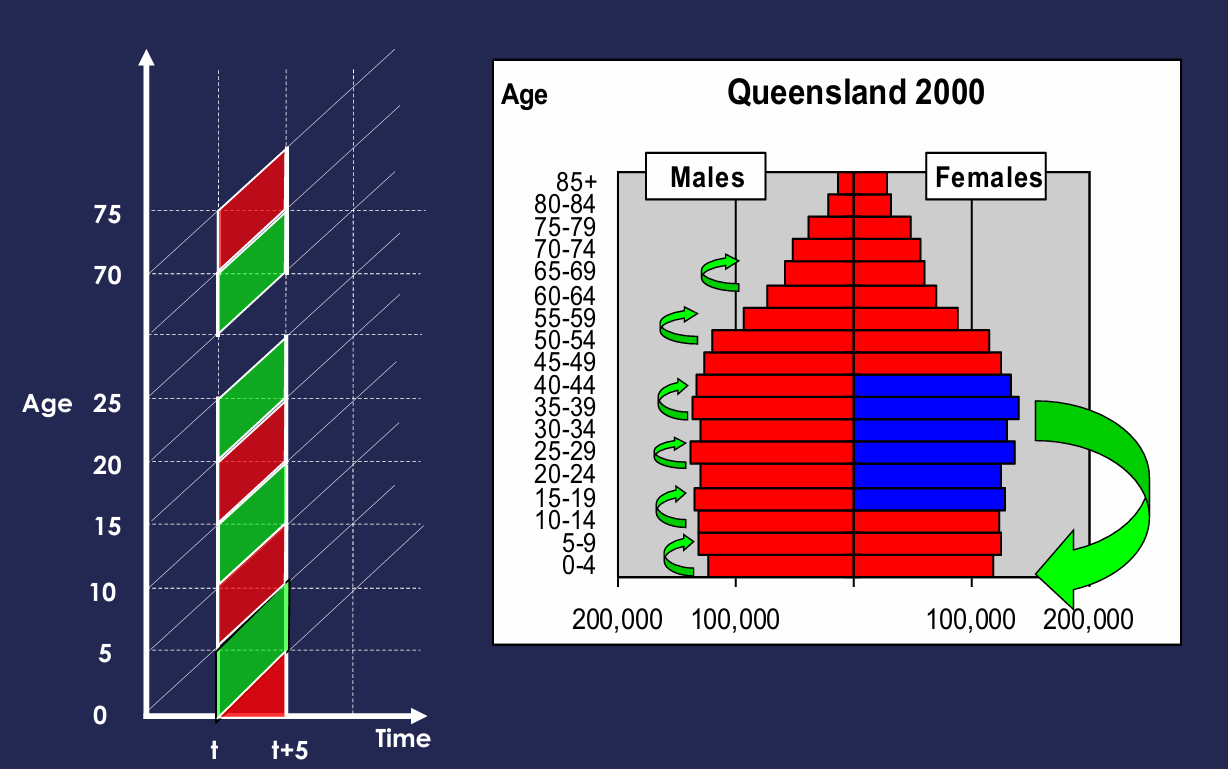
Cohort-component method (population projections)
Takes a base year population disaggregated by age and sex and carries the population forward in time by ageing and applying assumptions about future trends in fertility, mortality and migration
most widely used at the national and regional level
the cohort is a group of people born in a specific interval
The components:
births
deaths
migration
The processes:
fertility
mortality
migration
ageing
UN world population projection
Prepared by the United Nations Population Division
produced for UN agencies
normally produced every 2 years
28 revisions since the 1950s
Projections for all countries and the world prepared for up to 2100
5 year age groups 0-4, 5-9, . . . , 95-99, 100+
Assumptions made about fertility, mortality and migration
variants: medium, high, low, constant fertility, instant replacement
Probabilistic approach to quantify uncertainty
How do demographers set assumptions?
Historical trends
Analogous countries
Theory
Assumptions: fertility (for projection)
Fertility has the biggest impact on future population
A transition from high to low values of the TFR followed by fluctuations and a modest recovery
Future trends are uncertain
Variants:
medium series: assumes a reduction in fertility over time similar to that seen in other countries
high +0.5 child
low -0.5 child
constant fertility
Probabilistic depiction of future outcomes
Assumptions: mortality (for projection)
Universal gains in life expectancy at birth
Takes into account impact of HIV/Aids in impacted countries
Assumptions: migration (for projection)
Most difficult component to project
Many countries do not collect information on international migrants
Highly variable
e.g. Syria
Irregular movement
Pre-COVID 19 assumptions
current trends will remain stable until 2045-2050, then halve by 2100
First time to produce probabilistic projections of net migration for each country (2024 WPP)
Population projections (key takeaways)
Global population is expected to decline in 2080s
fertility decline in China and in many LDCs with high fertility
Population growth through 2054 driven primarily by current youthful age structure (especially in LDCs)
Immigration as driver of population growth in countries with low fertility
Implications on relevant political and economic issues
distribution of geopolitical power?
first demographic dividend among LDCs?
social cohesion in MDCs?
how do other factors climate change, greater usage of AI, geopolitical conflicts, impact demographic and economic/political futures?