BOC High Yield #2
 Call Kai
 Learn
Learn Practice Test
 Spaced Repetition
 Match
Match Flashcards
 Knowt Play
1/480

There's no tags or description
Looks like no tags are added yet.
Name | Mastery | Learn | Test | Matching | Spaced | Call with Kai | Chat |
|---|
No analytics yet
Send a link to your students to track their progress
481 Terms
Mixed field agglutination encountered in ABO forward typing with no history of transfusion would most likely be due to:
A3 red cells
DNA arrays evaluate the encoding genes for common blood groups. These technologies detect small differences in the membrane proteins after amplification of what amino acid residues of genomic DNA?
SNP
The purpose of testing with anti-A,B is to detect:
subgroups of A
Anti-Fya is
capable of causing hemolytic transfusion reactions
In solid phase red cell adherence assays (SPRCA) to detect platelet specific antibodies, the wells of the microtiter plates are coated with immobilized:
platelets
IgG antibody and/or C3b sensitized red blood cells can be phagocytized by cells in the reticuloendothelial system (RES). This phenomenon is clinically recognized as:
extravascular hemolysis
Which of the following antigens gives enhanced reactions with its corresponding antibody following treatment of the red cells with proteolytic enzymes?
E
What do the Oh (Classical Bombay), group O, and Lu(a–b–) phenotypes have in common?
result from inheritance of identical autosomal recessive genes
To prevent donor lymphocytes from engraftment in the bone marrow of an immunosuppressed patient, all transfusion products must be:
irradiated
Pathologic cold autoantibodies differ from benign cold autoantibodies in:
antibody titer
When the red cells of an individual fail to react with anti-U, they usually fail to react with:
anti-S
Which of the following red cell antigens are found on glycophorin-A?
M, N
Based on the results in this table, what is the next step in determination of the patient's ABO/Rh type?

repeat ABO red cell typing and include a control
Severe intravascular hemolysis is most likely caused by antibodies of which blood group system?
ABO
In which of the following clinical situations would DNA-based testing be useful?
evaluation of a patient with warm autoimmune hemolytic anemia and a positive direct antiglobulin test (DAT)
The drug cephalosporin can cause a positive direct antiglobulin test due to modification of the RBC membrane by the drug, which is independent of antibody production. This mechanism related to the drug cephalosporin is best described as:
nonimmunologic protein adsorption
Coughing, hypoxemia and difficult breathing are symptoms of which of the following transfusion reactions?
TACO
Which of the following blood group antibodies will no longer react with its respective antigens once those antigens are treated with proteolytic enzymes?
anti-Fya
When preparing units of blood for emergency release, what information must be written on the label or tie-tag?
statement that compatibility testing has not been completed
Preliminary blood bank testing for neonates <4 months of age must include:
ABO forward typing and Rh testing for D antigen
According to AABB Standards, Apheresis Platelets shall demonstrate with 95% confidence that >75% of units contain ≥ how many platelets?
3.0 × 10^11
Which of the following is a characteristic of anti-i?
found in the serum of patients with infectious mononucleosis
The direct antiglobulin test in a suspected case of warm autoimmune hemolytic anemia is positive. Which of the following monospecific reagents would be used in further direct antiglobulin testing?
anti-C3d
The direct antiglobulin test (DAT) in a patient with warm autoimmune hemolytic anemia (WAIHA) is most often positive for:
IgG and C3
Which of the following is considered to be a high-prevalence antigen?
Vel
Macrophages and monocytes have Fc receptors for which of the following immunoglobulins?
IgG
Which of the following pairs of immunoglobulins is most efficient at activating complement via the classical pathway?
IgG1 and IgG3
A 10% red cell suspension in saline is used in a compatibility test. Which of the following would most likely occur?
false-negative result due to antigen excess
A common strategy to reduce alloimmunization in chronically transfused patients with Sickle Cell Disease (SCD) is to provide red cell units matched for which of the following antigens?
C,E,K
A massive transfusion event can result in what type of complication(s)?
citrate toxicity and hypocalcemia
A 32-year-old male types as group O, D-negative with a positive antibody detection test. Antibody identification studies demonstrate anti-D, anti-Jka, and anti-K. Patient records confirm that he received 12-units of group O, D-positive Red Blood Cells 2 months earlier following a motor vehicle accident. What testing should be performed to verify the patient's red cell phenotype?
microhematocrit cell separation and testing of autologous reticulocytes with monoclonal antisera
Which Apheresis Platelets product should be irradiated?
a directed donation given by a mother for her son
Which of the following must be performed on a patient before, during, and after receiving a blood transfusion?
blood pressure, pulse, respiration rate and temperature
In a Group O individual with Le and Se genes, what ABH and LE antigens are present in their secretions?
Lea, Leb, H
An intraoperative strategy for patient blood management is:
acute normovolemic hemodilution
The results shown in this table are obtained on a patient's blood sample during routine ABO and Rh testing:
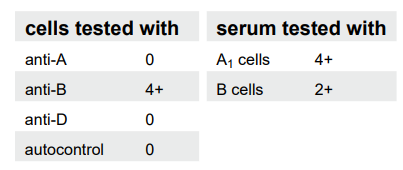
Select the course of action to resolve this problem:
perform antibody screening procedure at immediate spin and AHG using group O cells
Select the course of action to resolve this problem
coagulation factor deficiencies
Intravascular destruction of red blood cells results when:
IgM antibodies activate complement to completion
n a prenatal workup, the results shown in the table are obtained:
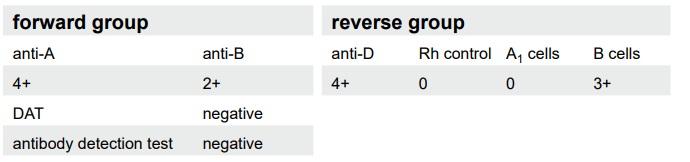
This ABO discrepancy is thought to be due to an antibody directed against a component of the ABO typing sera. Which test would resolve this discrepancy?
saline wash patient’s cells and repeat forward typing
The patient's results are listed in this table. What is the most likely specificity based on the reaction pattern?
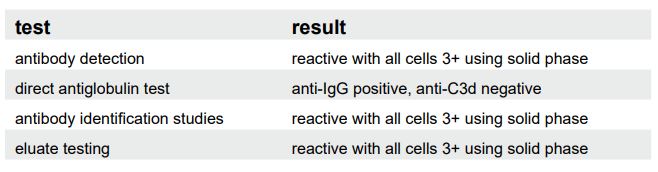
Reactivity of the patient's serum and eluate with all cells tested and the DAT results indicate the presence of warm autoantibody.
autoantibody (warm)
The reason that group O individuals have the most amount of H antigen on their red cells compared to other ABO phenotypes is:
H antigen is left unchanged by the absence of A and/or B transferase enzymes
Which of the following Rh antigens has the highest frequency in Caucasians?
e
Cryoprecipitated AHF transfusion is recommended as a treatment for patients with:
DIC with hypofibrinogenemia
A patient's antibody identification panel demonstrates anti-M. The antibody is most reactive with homozygous M+ cells compared to heterozygous M+ cells. Which of the following cells would demonstrate the strongest reaction?
M+N–S–s+
When the main objective of an exchange transfusion is to remove the infant's antibody-sensitized red blood cells and to control hyperbilirubinemia, the blood product of choice is ABO compatible:
RBC suspended in Fresh Frozen Plasma
Cryoprecipitated AHF:
is indicated for fibrinogen deficiencies
An individual has been sensitized to the k antigen and has produced anti-k. What is the most probable KEL system genotype for this individual?
KK
Which phenotype could not result from the mating of a Jk(a+b+) female and a Jk(a–b+) male?
Jk(a–b–)
A mother has the red cell phenotype D+C+E–c–e+ with anti-c (titer of 32 at AHG) in her serum. The father has the phenotype D+C+E–c+e+. The baby is Rh-negative and not affected with hemolytic disease of the newborn. What is the baby's most probable Rh genotype?
r′r′
A 16-year-old female is admitted to the emergency room with a gunshot wound. A massive transfusion protocol has been activated before a blood type can be completed. In the patient's record, the patient has a history of being group A, D-negative. The laboratorian should:
release group O, D-negative Red Blood Cells
A 25-year-old Caucasian woman, gravida 3, para 2, required 2 units of Red Blood Cells. The antibody screen is positive, and the results of the antibody panel are shown in this table:
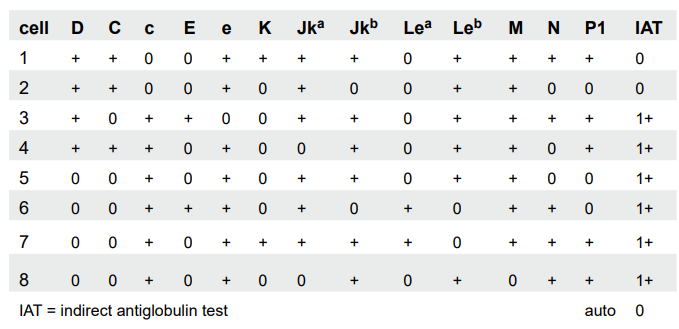
What is the most probable genotype of this patient?
R1R1
During a massive transfusion event, what other blood components are routinely administered in addition to Red Blood Cells or low-titer group O Whole Blood?
Fresh Frozen Plasma and Apheresis Platelets
Which of the following phenotypes is the result of homozygous inheritance of the corresponding genes?
Fy(a–b+)
The most widely accepted QC test to measure probable Hematopoietic Progenitor Cell (HPC) engraftment is:
CD34+ cell enumeration
Which of the following methods may be useful in determining an accurate phenotype in a transfused patient?
density separation
Based on these reactions, what is the patient's ABO type?

A1
The blood typing results shown in this table are noted on a patient's sample:

What is the patient's likely ethnicity?
Black
A group B, Rh-negative patient has a positive direct antiglobulin test (DAT). Which of the following situations would occur?
the weak D test and control would be positive
A 40-year-old man with autoimmune hemolytic anemia due to anti-E has a hemoglobin level of 10.8 g/dL (108 g/L). This patient will most likely be treated with:
no transfusion
AHG control cells (check cells):
are coated only with IgG antibody
A newborn demonstrates petechiae, ecchymosis and mucosal bleeding. The preferred blood component for this infant would be:
Platelets
A mother is Rh-negative and the father Rh-positive. Their baby is Rh-negative. It may be concluded that:
the father is heterozygous for D
Low ionic strength saline (LISS) acts as an enhancement medium and facilitates antibody uptake by:
reducing zeta potential
All donor blood testing must include:
serological test for syphilis
A blood specimen from a pregnant woman is found to be group B, Rh-negative and the serum contains anti-D with a titer of 512. What would be the most appropriate type of blood to have available for a possible exchange transfusion for her infant?
O, Rh-negative
Use of the computer to detect ABO incompatibility (computer crossmatch) can only be used when:
the patient fails to demonstrate clinically significant alloantibodies
Test results are shown in this table for a unit of blood labeled group A, Rh-negative:
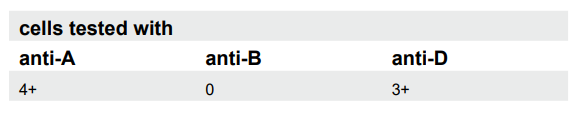
What should be done next?
notify the collecting facility
A cause for indefinite deferral from blood donation is:
positive test forTrypanosoma cruzi (Chagas)
Paroxysmal cold hemoglobinuria (PCH) is associated with antibody specificity toward which of the following?
P antigen
Which of the following tests is most commonly used to detect antibodies attached to a patient's red blood cells in vivo?
direct antiglobulin
A patient's red cells type as shown in this table:

Which is the most probable genotype?
R1R2
The results in this panel are obtained with the serum of a patient from the prenatal clinic.
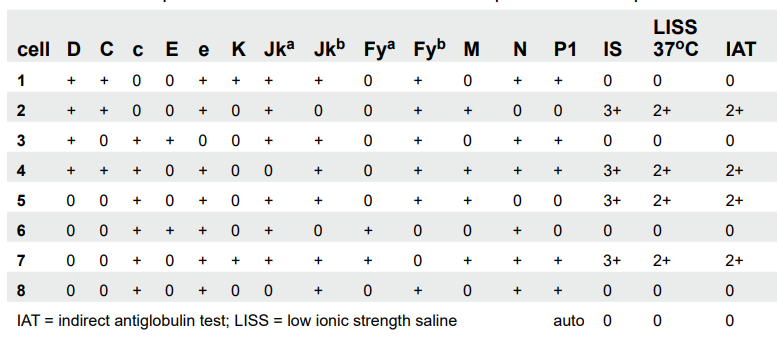
To evaluate potential risk to the fetus, what additional studies should be performed?
treat serum with dithiothreitol and repeat panel
While performing antibody detection studies and compatibility testing, hemolysis is noted following incubation at 37°C. Which of the following alloantibodies might be present?
anti-PP1Pk
Pathogen reduction technology for blood components:
prevents infections by inhibiting microbial nucleic acid replication
A patient's record shows a previous anti-Jkb, but the current antibody screen is negative. What further testing should be done before transfusion?
phenotype donor units and select Jk(b–) units for compatibility testing
Posttransfusion purpura is usually caused by:
anti-HPA-1a
A patient is readmitted to the hospital with a hemoglobin level of 7 g/dL (70 g/L) 3 weeks after receiving 2 units of red cells. The initial serological tests are:
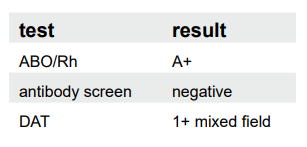
Which test should be performed next?
perform an elution and identify the antibody in the eluate
In what patient population may we observe the results shown in this table?

2-year-old pre-surgical patient
An unexplained fall in hemoglobin and mild jaundice in a patient transfused with Red Blood Cells 1 week previously would most likely indicate:
delayed hemolytic transfusion reaction
What antigens would be found in the saliva of an individual with the genotype Sese Lele AO HH?
Lea, Leb, A, H
A false-positive indirect antiglobulin test can be the result of:
overcentrifugation
A trauma patient who has just received 10 units of blood may develop:
thrombocytopenia
Which of the following is used to treat posttransfusion purpura?
IVIG
Which of the following might cause a false-negative indirect antiglobulin test (IAT)?
too heavy a cell suspension
An important determinant of platelet viability during storage is:
plasma pH
Which of the following antibodies in the LU (Lutheran) system is most likely to be IgM and detected as a direct agglutinin?
anti-Lua
Transfusion of Ch+ (Chido positive) red cells to a patient with anti-Ch has been reported to cause:
no clinically significant red cell destruction
Most blood group system genes and their resulting genetic traits display what type of inheritance?
autosomal codominant
The primary indication for granulocyte transfusion is:
severe neutropenia with an infection that is nonresponsive to antibiotic therapy
What information related to receiving a blood transfusion needs to be documented in a patient's medical record?
signed patient consent for transfusion
The phenomenon of an Rh-positive person whose serum contains anti-D is best explained by:
missing antigen epitopes
The process of separation of antibody from its antigen is known as:
elution
Which of the following blood components must be prepared within 8 hours after phlebotomy?
Fresh Frozen Plasma
In which of the following conditions are HNA antibodies not implicated?
transfusion-associated circulatory overload (TACO)
What is the best interpretation for the laboratory data in this table?
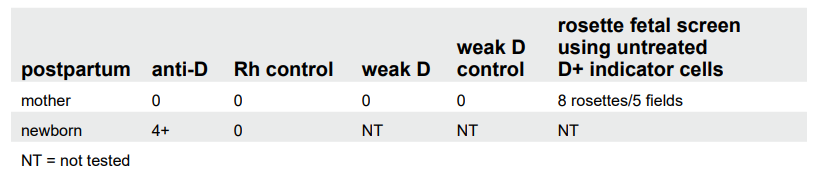
mother has a larger than normal FMH
A patient has an order for a type and screen and 6 units of Red Blood Cells are requested for surgery. At the indirect antiglobulin (IAT) phase of testing, both antibody detection cells and 2 of 6 crossmatched units are incompatible. What is the most likely cause of the incompatibility?
recipient alloantibody
Autoantibodies demonstrating blood group specificity in warm autoimmune hemolytic anemia are associated more often with which blood group system?
Rh
What minimum increment of platelets is expected from each unit of Platelets (Whole Blood-derived) when transfused to a non-HLA-sensitized recipient weighing approximately 70 Kg?
5,000/µL
Indications for an autologous hematopoietic progenitor cell (HPC) transplant include patients who have:
Hodgkin lymphoma with high-dose chemotherapy
A Kleihauer-Betke stain of a postpartum blood film revealed 0.3% fetal cells. What is the estimated volume (mL) of the fetomaternal hemorrhage expressed as whole blood?
15
0.3 × 50 = 15