Emotion and Well-Being
 View linked note
 Call Kai
 Learn
Learn Practice Test
 Spaced Repetition
 Match
Match Flashcards
 Knowt Play
1/23

Earn XP
Description and Tags
Flashcards covering key concepts related to emotion and well-being, including theories of emotion, the neurobiology of emotions, and factors influencing happiness.
Name | Mastery | Learn | Test | Matching | Spaced | Call with Kai | Chat |
|---|
No analytics yet
Send a link to your students to track their progress
24 Terms
Emotion
the coordinated behaviors, feelings, and physiological changes occur when a situation becomes relevant to our goals.
Display rules
cultural rules that govern the expression of emotions in social contexts.
discrete emotions approach
an approach to analyzes emotions that focuses on specific emotions such as anger, fear, and pride.
dimensional approach
An approach to analyzing emotions that focuses on dimensions such as pleasantness and activation.
Subjective Experience
Internal thoughts and feelings that accompany emotions.
Alexithymia
an extreme difficulty in identifying and expressing emotions.
happiness set point
The level of happiness that is characteristic of a given individual.
Expressive Behavior
Facial expressions and vocalizations that convey emotional states.
Bodily Arousal
Physiological activation preparing the body for action in response to stimuli.
Amygdala
A brain structure involved in rapid emotional responses, particularly to fearful stimuli.
Prefrontal Cortex
Brain region involved in the modulation and regulation of emotional responses.
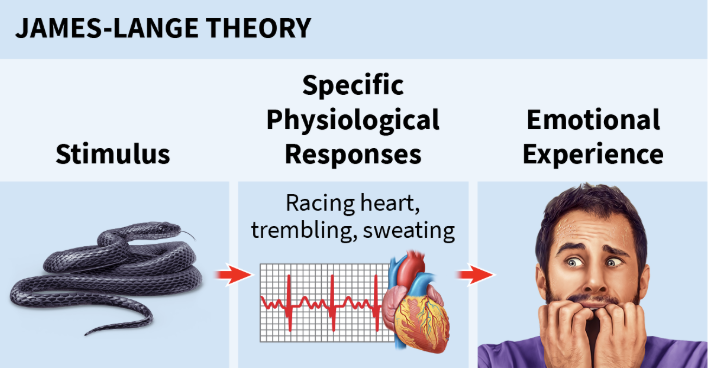
James-Lange Theory
The theory stating that physiological arousal precedes emotional experience.
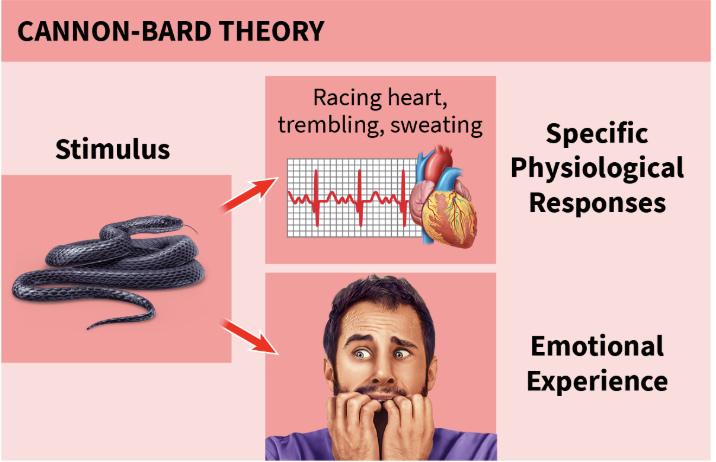
Cannon-Bard Theory
The theory stating that physiological arousal and emotional experience occur simultaneously.
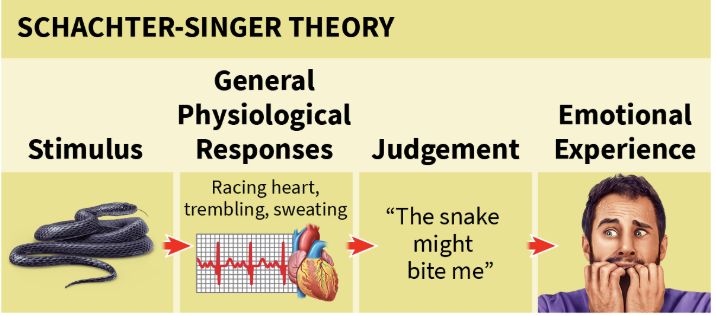
Schachter-Singer Theory
The theory suggesting that physiological arousal is interpreted, leading to conscious emotional experience.
Empathy
The capacity to accurately track what others are feeling.
affect-as-information perspective
The idea that affective states play an important role in shaping problem-solving and decision making.
self-control
The attempt to modify automatic or “default” responses in a particular situation.
Misattribution of Arousal
When physiological arousal is incorrectly attributed to an emotion, affecting perceptions of attraction.
Universal Emotions
Emotions that are universally recognized, including fear, happiness, disgust, anger, surprise, and sadness.
Happiness
A state of well-being characterized by positive emotions and life satisfaction.
Hedonic Adaptation
The tendency to return to a stable level of happiness after experiencing changes in circumstances.
Positive Affect
The extent to which an individual experiences positive moods.
Negative Affect
The extent to which an individual experiences negative moods.
Self-Acceptance
Acknowledgment and acceptance of oneself as a person, important for happiness.