SAT Math Concepts & Desmos
 Call Kai
 Learn
Learn Practice Test
 Spaced Repetition
 Match
Match Flashcards
 Knowt Play
1/71

There's no tags or description
Looks like no tags are added yet.
Name | Mastery | Learn | Test | Matching | Spaced | Call with Kai | Chat |
|---|
No analytics yet
Send a link to your students to track their progress
72 Terms
Parallel lines
- Never intersect
- Have the same slope
Perpendicular lines
- intersect at a 90 degree angle
- slopes are negative inverses of each other (m & -1/m)
how to quickly recognise properties of linear functions
in the form y = mx +b:
- b = y intercept (0, b)
- if m/slope is negative, the line/y value will decrease as x increases
relationship between lines & number of solutions
- 2 different slopes: intersect once, 1 solution
- same slope, diff y-incpt: 0 solutions (parallel)
- same slope, same y-incpt: same line, infinite solutions
mean
the average of a set of numbers
- in desmos: mean(1,2,3)
- removing a value > mean: new mean decreaeses
- removing a value < mean: new mean increases
- if removed value = old mean: new mean remains the same
median
the middle # when all numbers are organised in numerical order
- in desmos: median(1,2,3)
- only changes if the removed number forces the remaining middle numbers to shift (depends on data set)
mode
the number that appears the most
range
the space between the smallest to largest number
- calculated by: (max-min value)
standard deviation
average distance between mean and value in data set
- in desmos: stdev(1,2,3)
- in a bar graph:
=> clustered near centre (ie. a pyramid-shape) -> low standard deviation
=> spread out toward edges (ie. flat shape) -> high standard deviatoin
- on a line graph, the larger range (y), the higher standard deviation is
- removing an outlier (the highest/lowest number) makes the data set less spread out, so standard deviation decreases
- removing a number that is very close or equal to the mean, the average distance grows, so standard deviation increases
samples —> entire populations
sample proportion/percentage x total population
range
estimate ± margin of error
axⁿ ± bxⁿ
(a+b) xⁿ
axᵐ × bxⁿ
ab + xᵐ⁺ⁿ
(axᵐ) / (bxⁿ)
(a / b)xᵐ⁻ⁿ
(aⁿ) / (bⁿ)
(a/b)ⁿ
(axᵐ)ⁿ
aⁿ × xᵐⁿ
(aᵐ)ⁿ
aᵐⁿ
a-ᵐ
1 / (aᵐ)
a⁰
1
√x = 16
Can never equal a negative number; √ (square roots) are always asking to find a POSITIVE number
x² = 256
has a positive and negative number
standard form of quadratic functions
f(x) = ax^2 + bx + c
- directly tell you the y intercept (0, ?)
vertex form of quadratic functions
y = a(x-h)^2 + c
- h: horizontal shift
=> if (x-h): shift right
=> if (x+h): shift left
- k: vertical shift
=> -k: shift down
=> +k: shift up
(h, k) is the vertex, whether it is max or min depends on whether the slope is positive or negative
- a: vertical stretch
=> -a: parabola opens down, vertex is the max
=> +a: parabola opens up, vertex is the min
=> a > 1: vertical stretch
=> 0 < a < 1: vertical compression
factored form of quadratic functions
y = a(x-b)(x-c)
- tells you all the solutions/x intercepts/zeroes of the graph
- the exponent on each bracket tells you the behaviour at each 0
finding vertex
- x = -b/2a
- plug in x to find y
What is the discriminant?
(b²- 4ac)
a quadratic equation in standard form (ax^2 + bx + c) as ___ solutions if...
- 0 solutions if its discriminant (b²- 4ac) < 0
- 1 real solution if (b²- 4ac) 0
- 2 real solutions if (b²- 4ac) > 0
Exponential functions
y = a(b) ᶜ⁽ˣ⁻ʰ⁾ + d
- a: vertical stretch/compression
=> |a| > 1: stretches
=> 0 < |a| < 1: vertical compression
=> positive a: increasing
=> negative a: decreasing
- b: base
=> b > 1: exponential growth
=> 0 < b < 1: exponential decay
- c: horizontal stretch/compression/reflection
=> |c| > 1: compression by 1/|c|
=> 0 < |c| < 1: stretch horizontally by 1/(|c|)
=> positive c: increasing right
=> negative c: increasing left
- h: horizontal translation
=> (x-h): right
=> (x+h): left
- d: vertical translation
=> +d: up
=> -d: down
=> horizontal asymptote at y = d
Exponential equations can never show...
SLOPES; the slopes of exponential functions are always changing
Even functions
f(x) = f(-x)
Odd functions
-f(x) = f(-x)
# of Zeroes
- max = degree (largest exponent)
- min:
=> even degrees: 0
=> odd degrees: 1
# of Turning Pints
- max: degree - 1
- min:
=> even degrees: 1
=> odd degrees: 0
End behaviours
- Even functions:
=> positive: Q2 - Q1
=> negative: Q3 - Q4
- Odd functions:
=> positive: Q3 - Q1
=> negative: Q2 - Q4
Remainder theorem
- When a polynomial function is divided by (x-a), the remainder = p(a)
- if p(a) = 0, then (a,0) is a root, and (x-a) is a factor of p(x)
Formulas for prisms
Volume = B x H
=> Surface area of base (B) depends on the shape of the base
Surface area = 2B + (pxh)
Congruent angles
Have equal measure
Similar triangles
Have the same shape, but are not necessarily the same size
-> They have corresponding angles; equal, corresponding angles are proportional to one another
Angle rules
- All angles in a triangle add up to 180 degrees
- All angles in quadrilateral add up to 360 degrees
- Angles in straight lines add up to 180 degrees
- Opposite angles are ALWAYS EQUAL
Pythagorean theorem
a² + b² = c²
2 complementary angles add up to:
90 degrees
cos of 1 angle =
sin of its complement angle (180 - first angle)
addiding them up together always = 90 degrees
Circle theorems
- arc length / circumference = centre angle / 360 degrees
- sector angle / total area = centre angle / 360 degrees
converting radians to degrees
- pi = 180 degrees
- (central angle / 2pi) = (arc length / circumference) = (sector area / circle area)
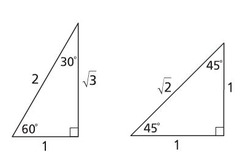
Special triangles
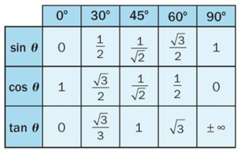
Special angles
Circle equation
(x-h)² + (y-k)² = r²
- the circle's centre is at (h, k), and its radius is r long
- to shift the circle, find the centre and do transformations there; then rewrite the equation
- if there are 2 points, one at the centre an one at r, plug x and y in respectively to find r
Evaluating statistical claims
- positive association: a directly proportional relationship, as 1 thing goes up, so does the other
- negative association: an inversely proportional relationship, as 1 thing goes up, the other goes down
-
Rules to solving rational equations
- Always check for extraneous solutions when the rational equation has 2+ answers
- Remember to check for holes --> if x is an hole, than it is an extraneous solution
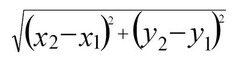
Circle distance formula
Altitude of a triangle
= the height of a triangle
Perimeter formula of an isosceles triangle
p = 2x + x(sqrt2)
2x = two equal legs
x(sqrt2) = hypotenuse
Perimeter formula of an equilateral triangle
p = 3s
Limitations of Regression on desmos
- regression only finds one solution, not ALL; therefore, if there are multiple valid answers and u have to find the smallest/largest, then you have to use another method
- when a question says 'positive interger', try to restrict the variable to be >1; >0 will onlyget an inf
Tangent line in the circle
- touches a circle at exactly one point
- line is always perpendicular to h=the radius and forms a 90 degree angle (remember perpendicular lines have slopes that are negative reciprocals)
A circle's diameter must...
- pass through the centre of the circle
- touch 2 opposite points on the circle's edge
2 tangent theorem
- if 2 tangent segments are drawn to a circle from the same external point, those two segments are always equal in lengh
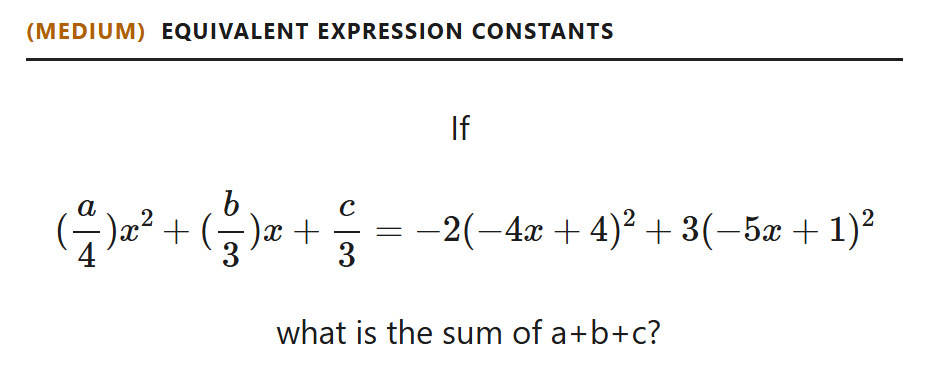
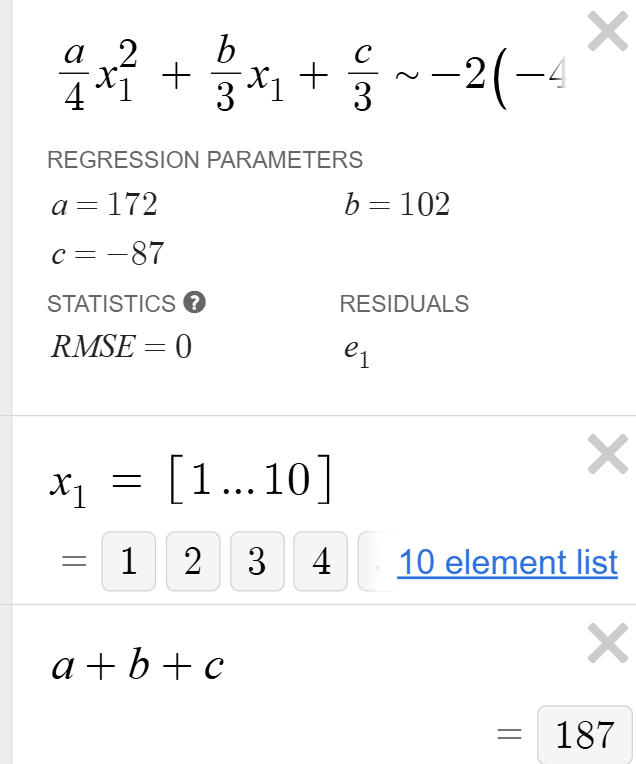
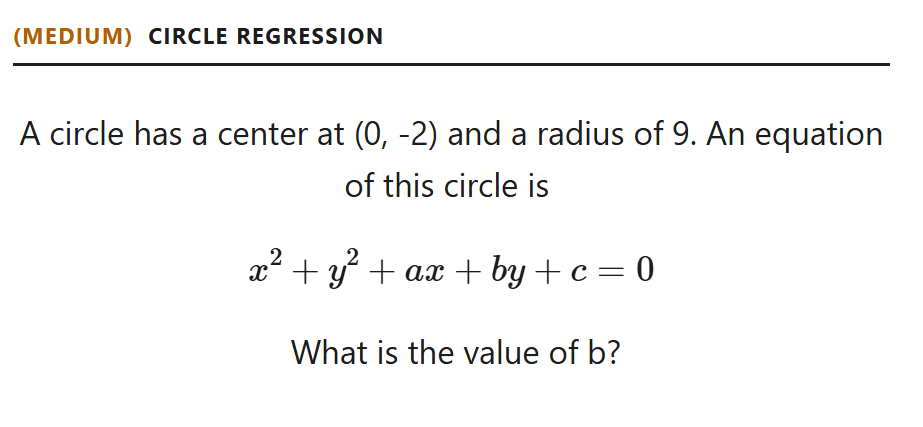
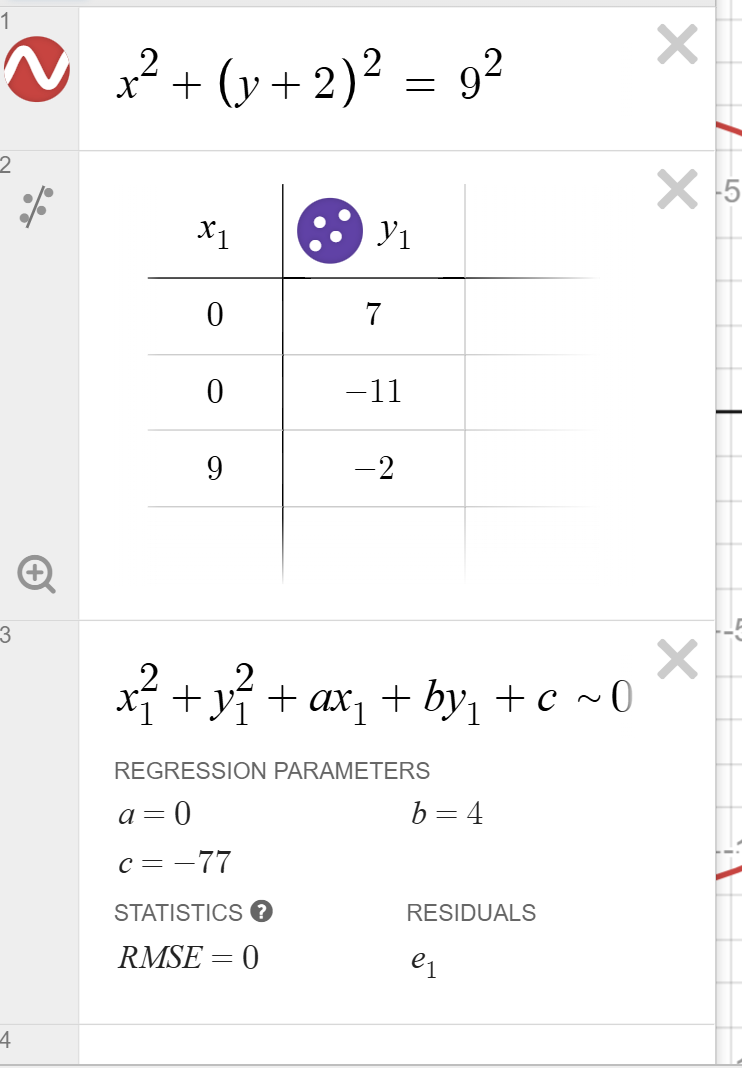
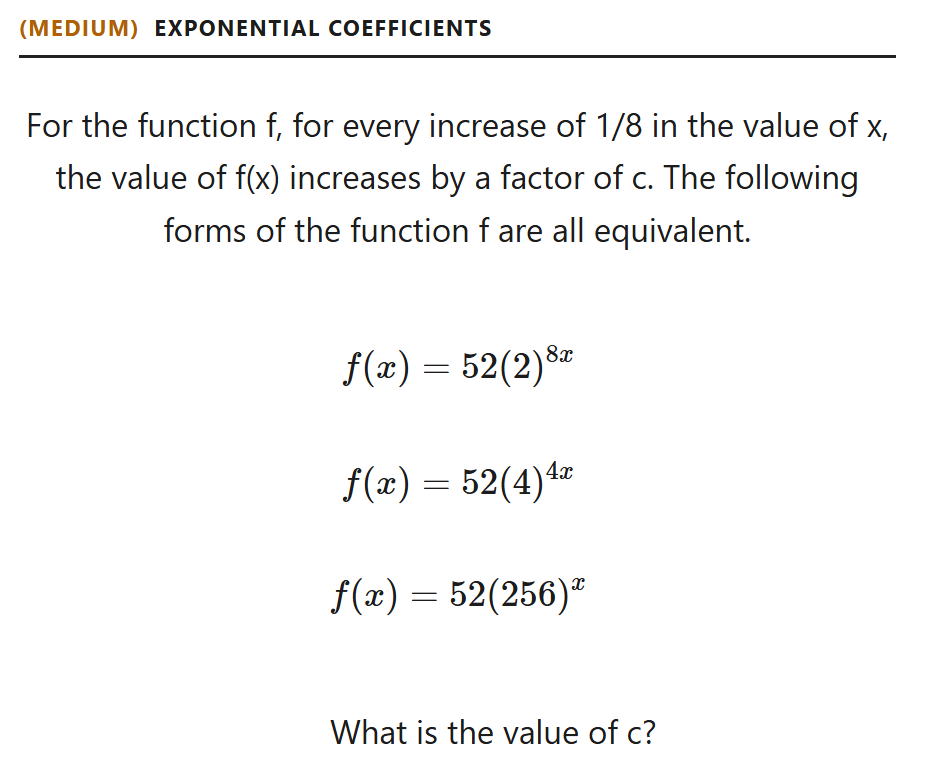
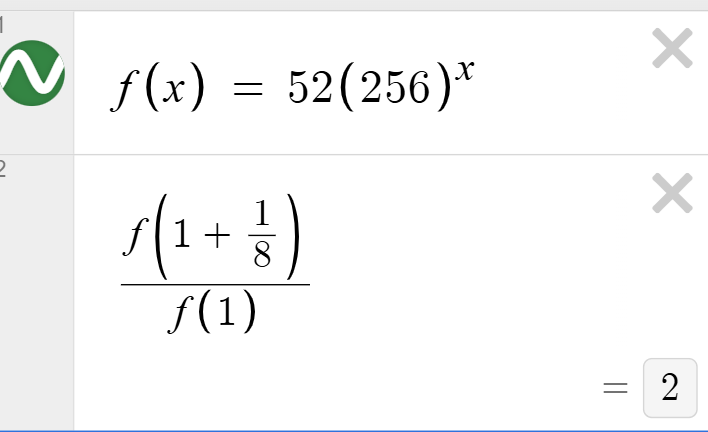
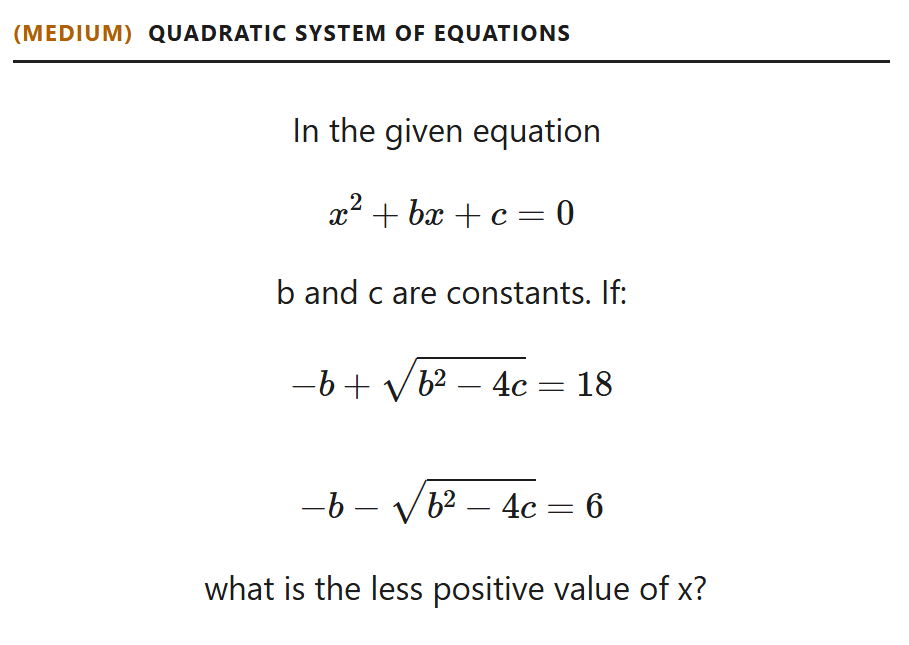
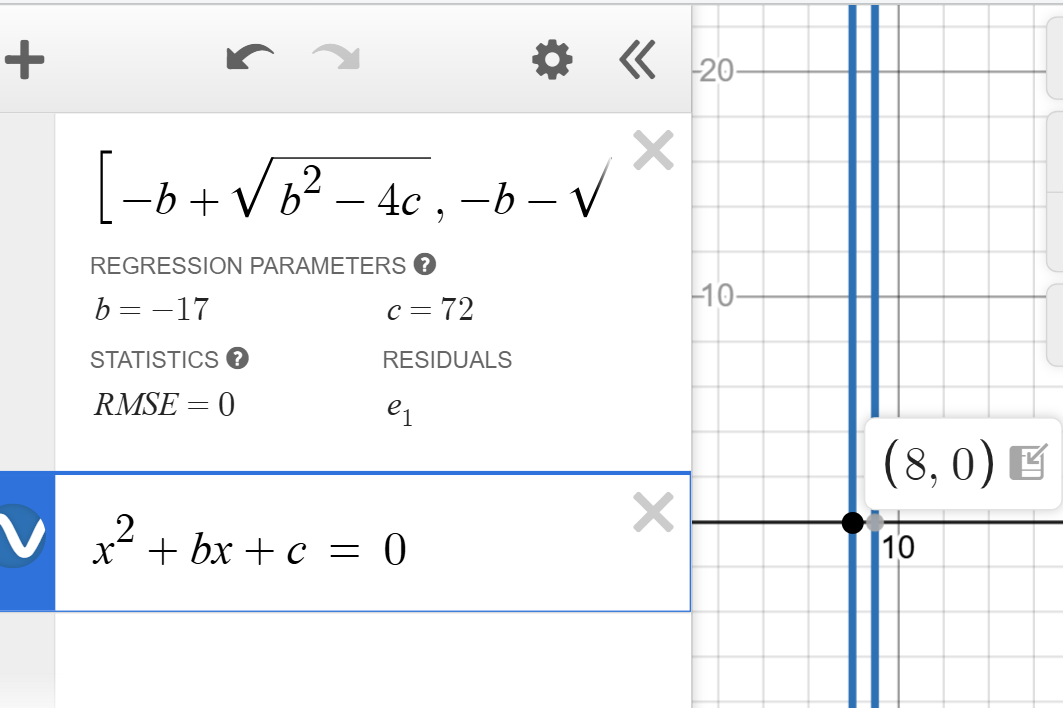
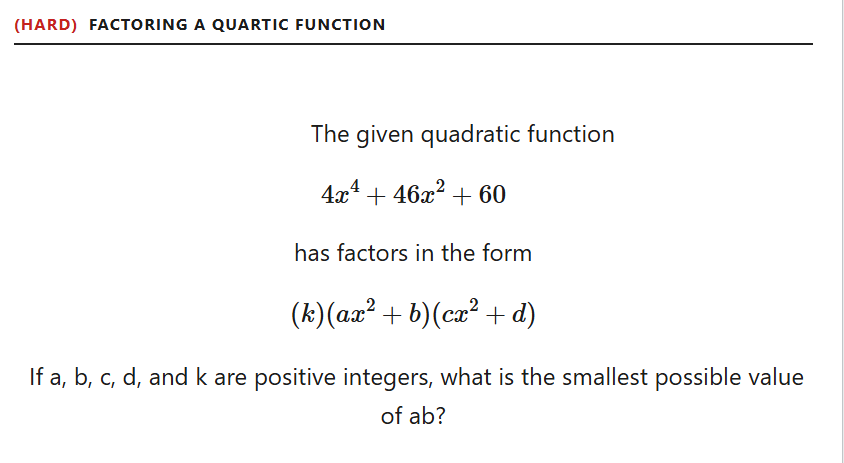
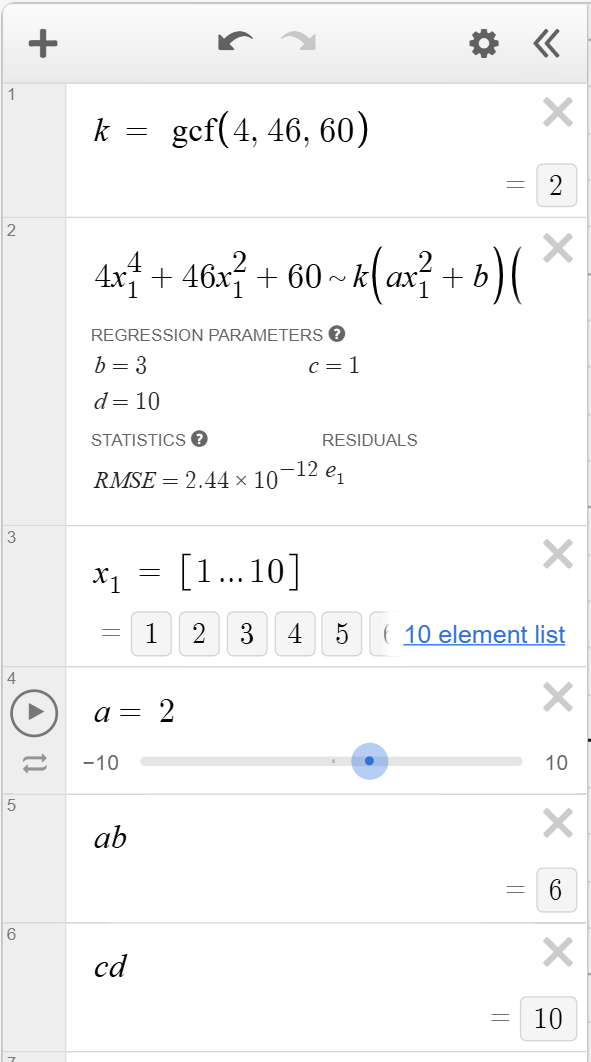
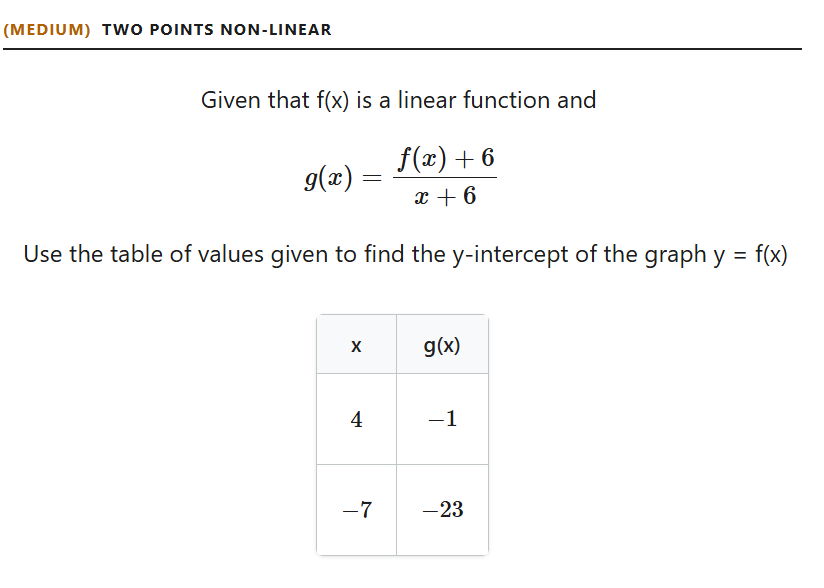
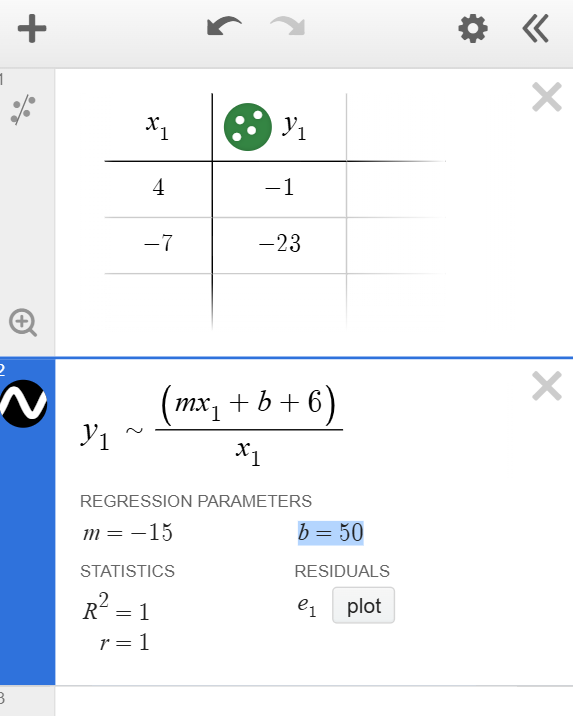
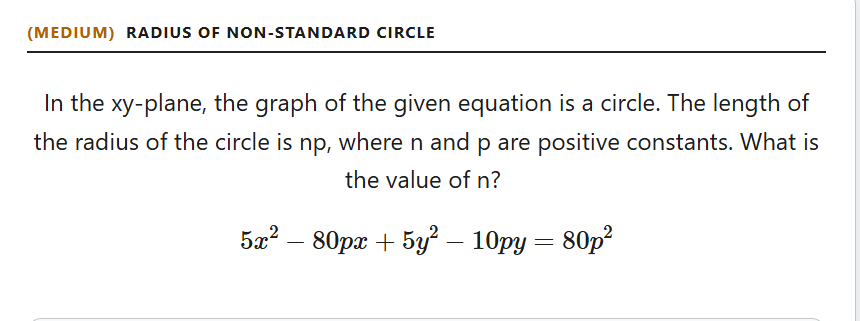
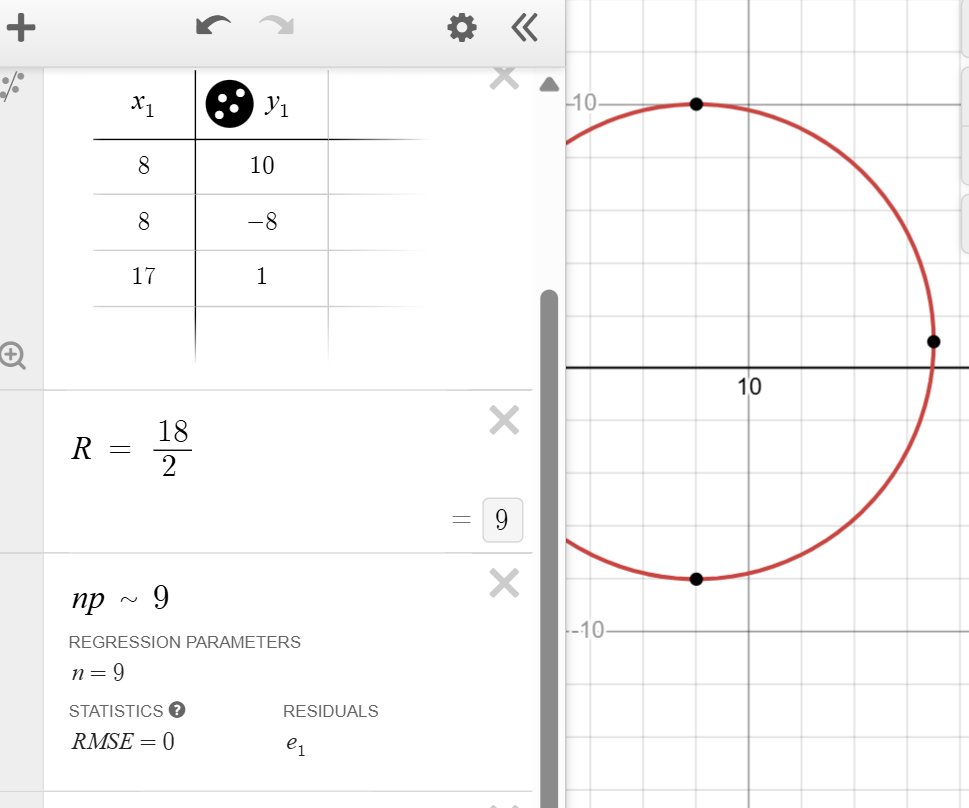
p can be any value
always remember that radius is both distances added together / 2
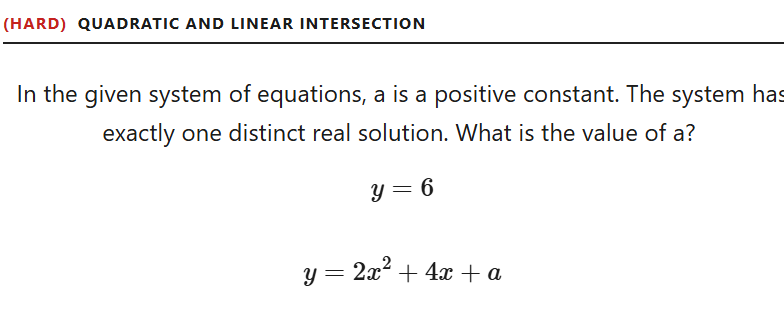
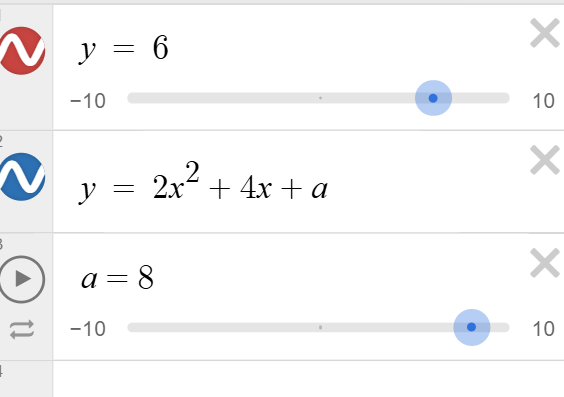
add a slider for a —> manipulte it into the two graphs are touching / have 1 intersection
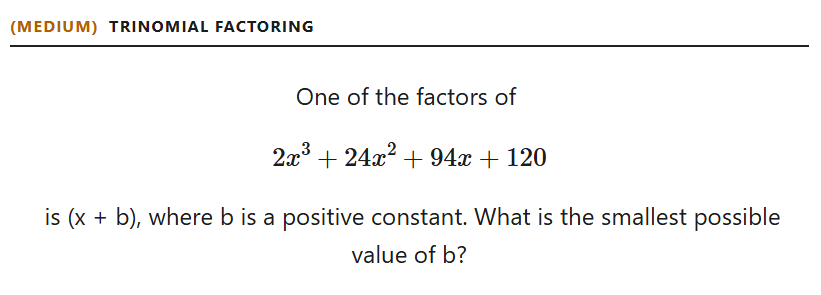
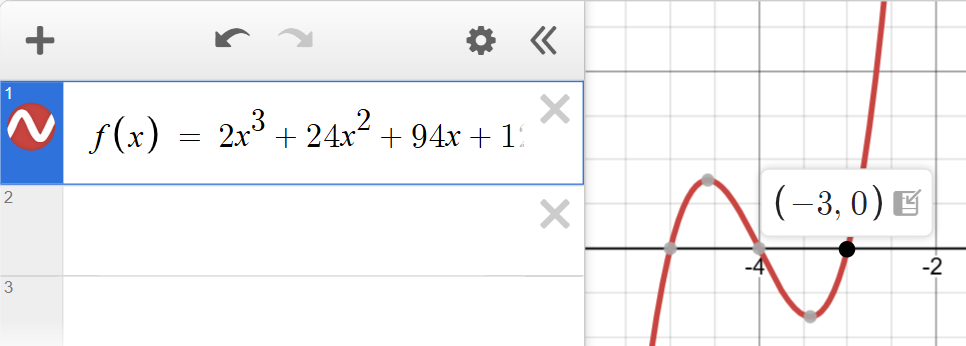
remember that when they are asking for ‘what is the smallest value of b’, you OMIT THE NEGATIVE SIGN; because the factor is actually -(b); they are not asking the smallest overall factor, just the smallest absolute value of b itself
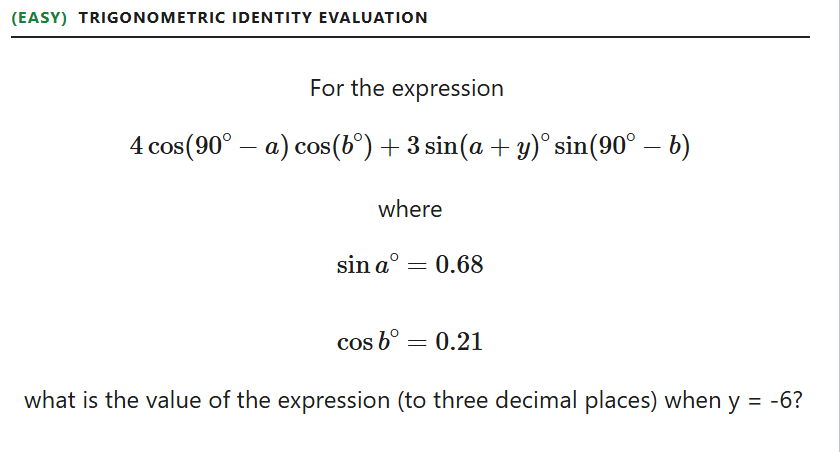
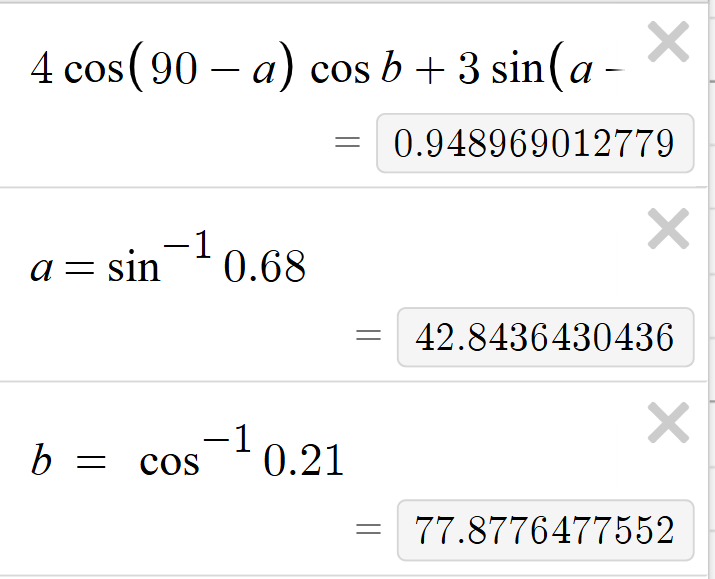
always remember to check if desmos is on DEGREE MODE
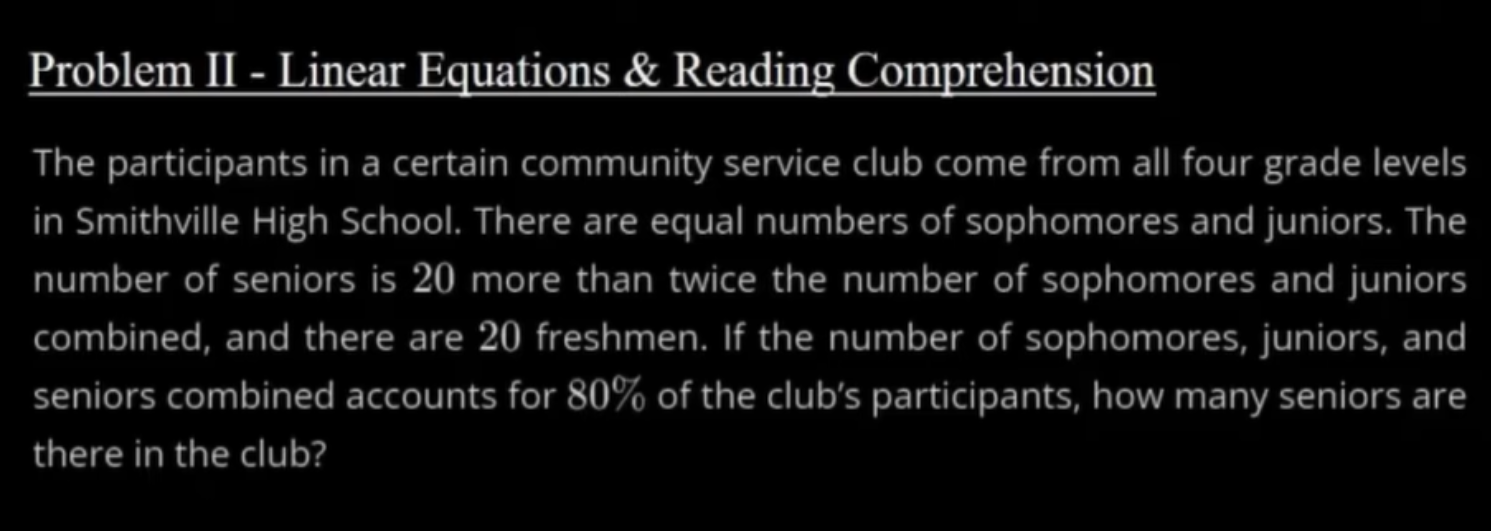
Sum of 4 Equations
Create euations out of all the info you know first:
s = j
p (seniors) = 20 + 2(s+j)
s + j + p = 0.8(s + j + p +f)
Then, put all of these values into brackets and run regression in desmos
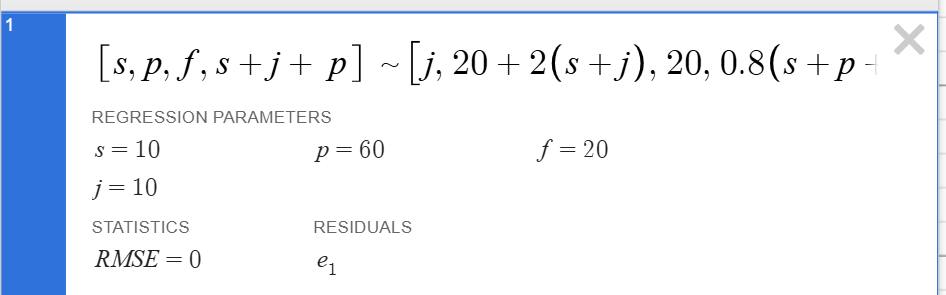
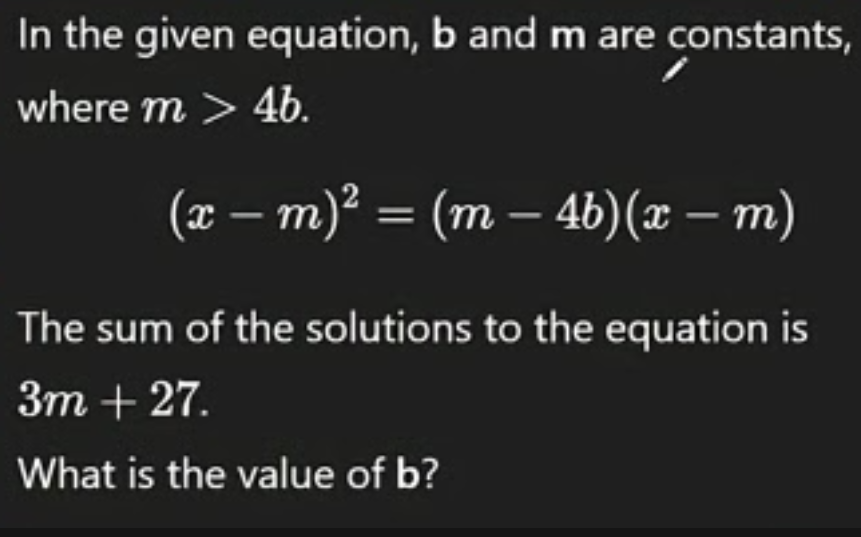
Sum of Solutions
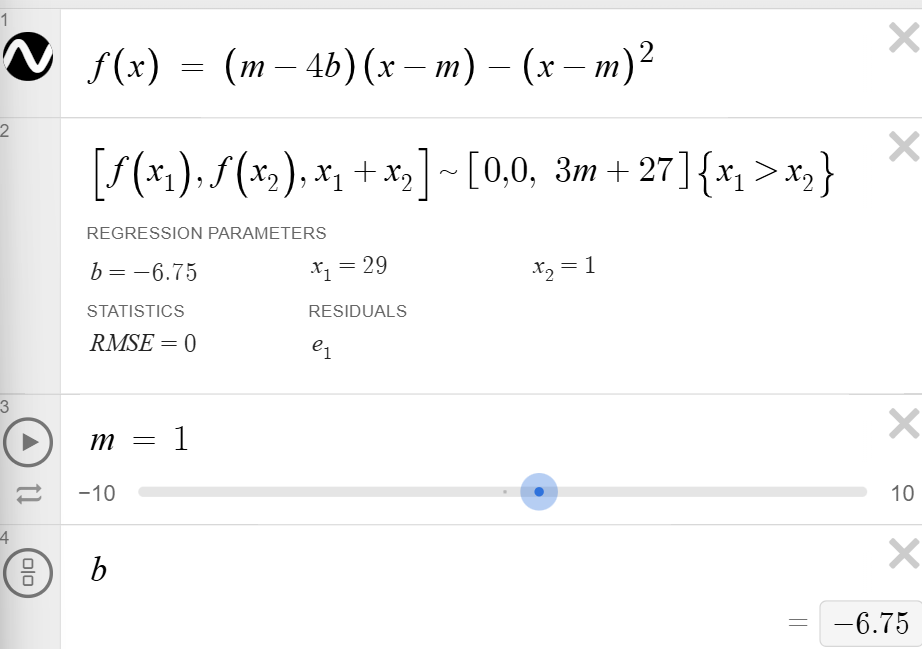
Move equation to one side to find all solutions (which are x--intercepts) → this is your f(x) equation
In this case, f(x) = (m-4b)(x-m) - (x-m)²
In this euation of f(x), there are 2 different values of x here that con cause f(x) = 0 → you can then use a list system to do regression on desmos and find values
If the sum of the solutions to the euation is 3m + 27, that means the sum of all zeros = 3m + 27
Rememebr to set {x1 > x2}; this forces desmos to treat the different solutions as 2 different numbers —> they cannot equal each other
Set m = 1 (can be whatever number as this wil not change the graph)
b
Simple Quadratic Regression / Quadratic word problems
Use a table & insert all known values
y1 ~ax²+bx + c → regression will find all the vlalues you need, unless you need a product of some numbers/etc
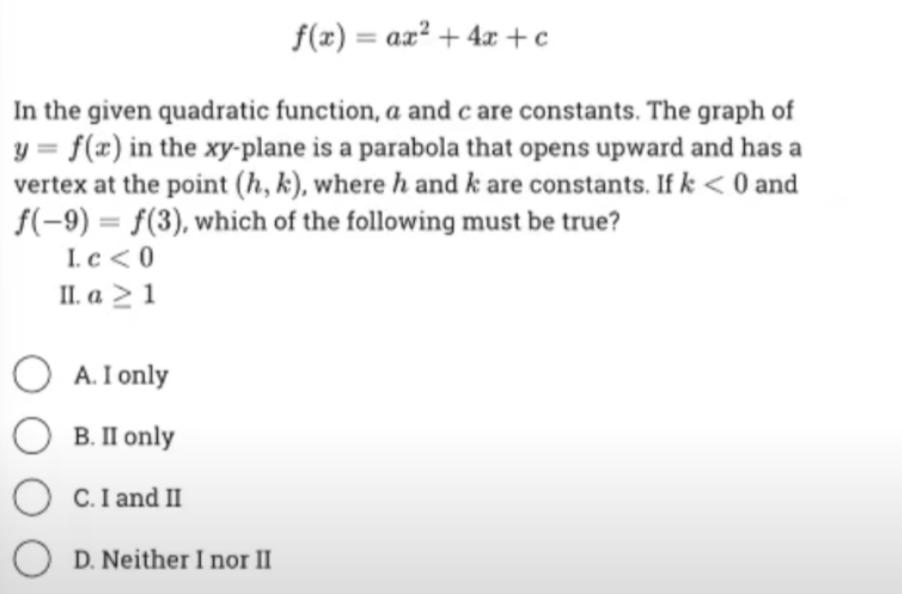
Quadratic constants and clauses
Since f(-9) = f(3, then these are x intercepts, and you can find the vertex thorugh
(-9+3)/2 = -3Since the formula for the x value of the vertex = -b/2a, then
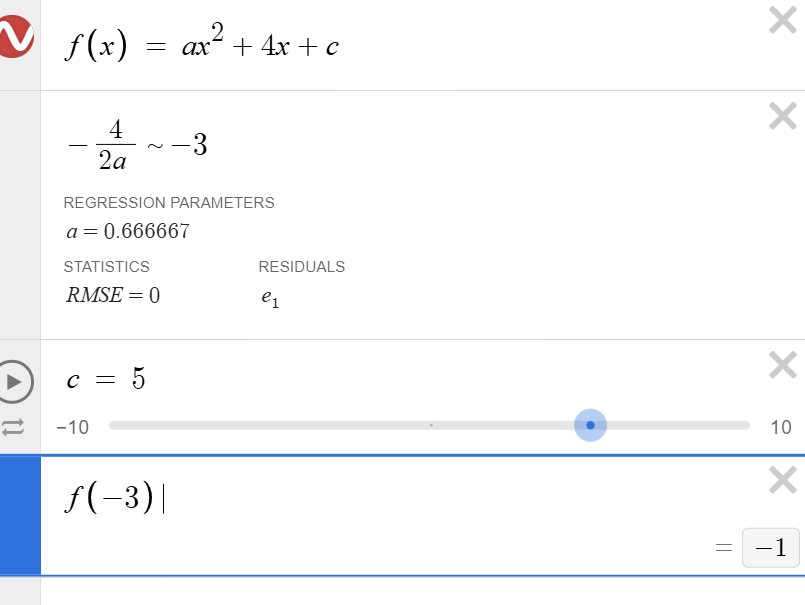
-4/2a ~ -3You can use regression to find the value of a
When you find the value of a using regresssion, see if II is right; it is NOT
To test if c < 0, set c to an arbitrary number that is bigger than 0; then, set f(x) to the vertex, and see the y value is < 0
f(-3) = -2.2; so even though when c > 0, k is still < 0, so I is not necessarily true
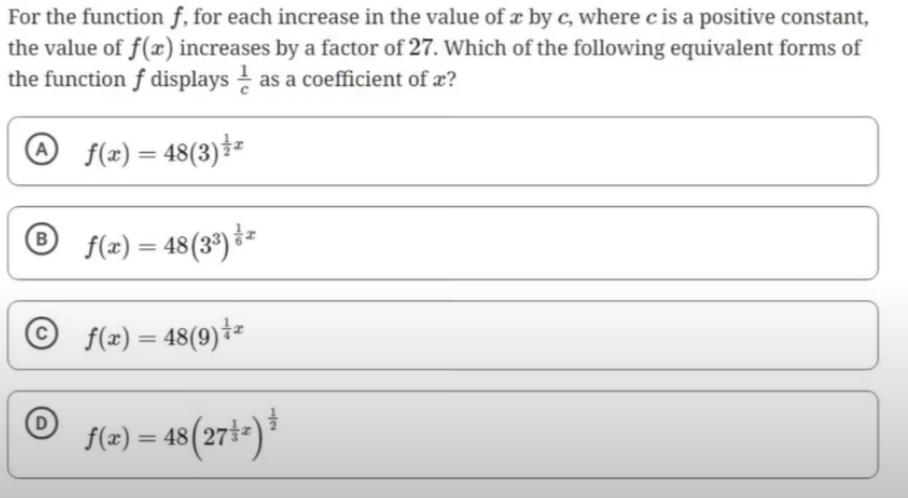
Function of Geometric Series 4
All of the answers are equivalent forms of each other, just structured differently
Choose the simpest form to plug into desmos