Mass Spectrometry
 Call Kai
 Learn
Learn Practice Test
 Spaced Repetition
 Match
Match Flashcards
 Knowt Play
1/16

There's no tags or description
Looks like no tags are added yet.
Name | Mastery | Learn | Test | Matching | Spaced | Call with Kai | Chat |
|---|
No analytics yet
Send a link to your students to track their progress
17 Terms
Mass Spectrometry
tells you:
molecular weight
possible molecular formula
fragments of the molecules
How MS works
A beam of electrons hits the molecule
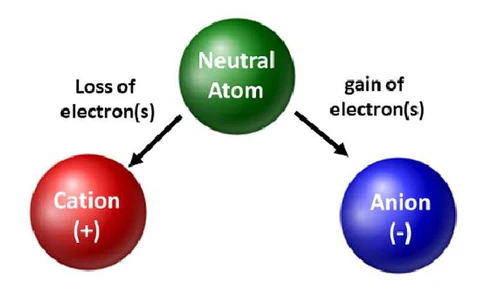
An electron is knocked off, now the molecule has one less electron, and becomes positively charged. (ionization)
Ionization
Making an ion
neutral molecule —> lose one electron —> positive ion
EX: CH4 —> CH4+(dot)
Cation Radical
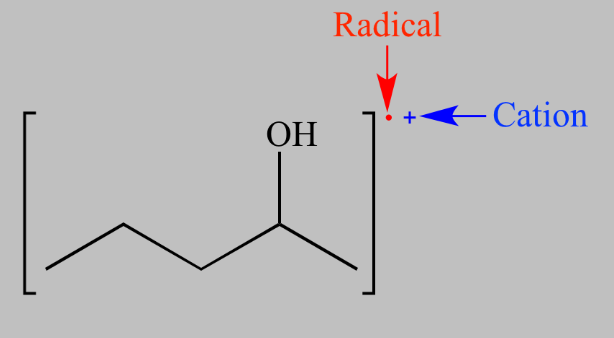
the molecule with a lost electron now has a positive charge and one unpaired electron, this is called a molecular ion, or, a cation radical
Molecular Ion (Molecule im)
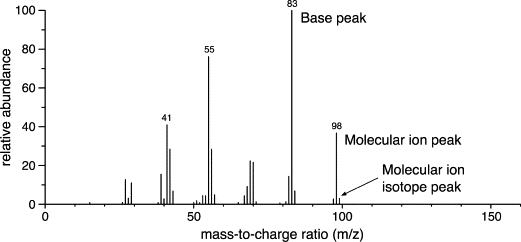
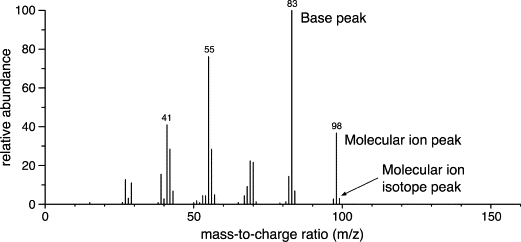
heaviest & most important peak. (notice how peak 98 is the molecular ion, it is the heaviest peak). If M+ = 98 m/z , the molecule weighs approximately 98 g/mol (formula mass).
X-axis for MS
m/z: Mass-to-Charge Ratio
m: mass
z: charge
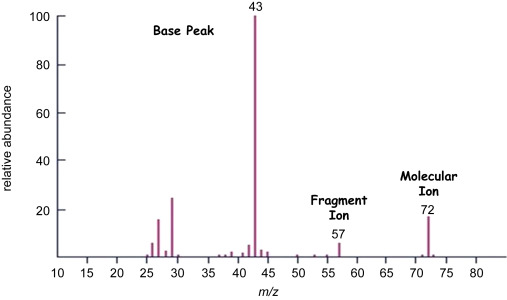
EX:
Y-axis for MS
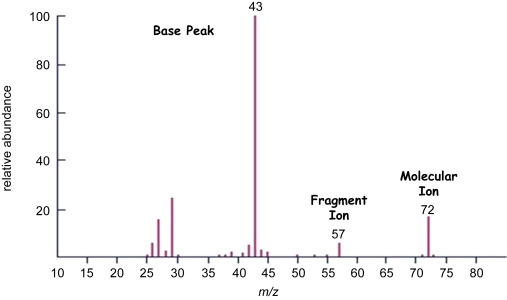
Relative abundance (or relative intensity). The y-axis tells you how many ions of a particular m/z were detected. "How common is this fragment?" The taller the peak, the more molecules broke apart to make that fragment.
Fragments
A molecular ion is unstable, it breaks apart. Each fragment makes its own peak. If a molecule loses even a Hydrogen, it is still a fragment.
EX: CH3-CH2-CH3 , 15+14+15= 44 m/z. If a signal is found at 29 m/z, that is a CH3CH2+ fragment
Base Peak
Tallest Peak is the base peak. It is assigned a relative abundance of 100%. It does NOT necessarily represent the whole molecule, the base peak is the most abundant ion detected. It is the fragment that forms most often when the molecule breaks apart.
EX: Suppose after smashing 100 houses, you find:
70 roofs
50 windows
20 doors
10 chimneys
The roof is the most common piece.
The roof is like the base peak.
Nitrogen Rule
Even # of Nitrogens = Even # molecular mass
Odd # of Nitrogens = Odd # of Nitrogens
EX: M+ = 73, there’s most likely 1 Nitrogen
M+ = 86, most likely 0 or 2 Nitrogens.
Isotopes
Atoms have naturally occurring isotopes. For example: Carbon:
¹²C = about 98.9% (most common)
¹³C = about 1.1%
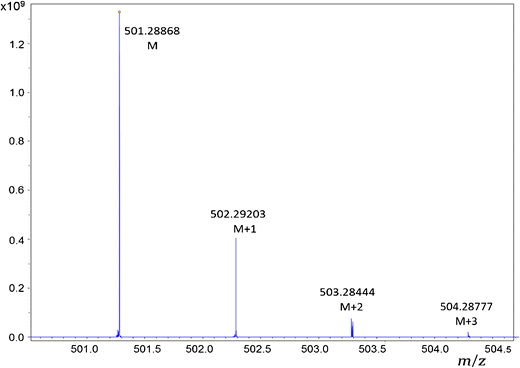
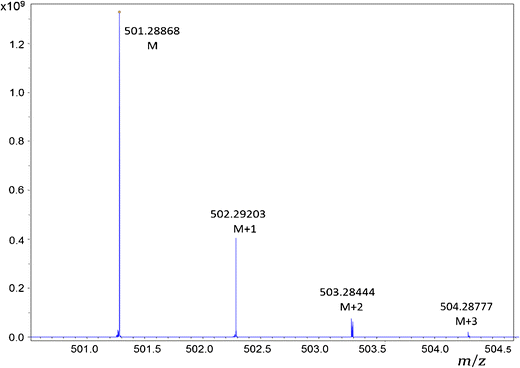
If your molecule contains one ¹³C instead of ¹²C, it weighs 1 amu more, giving the M+1 peak.
EX: Ethanol:
M = 46
M+1 = 47 (because some ethanol molecules contain one ¹³C)
What about M+2? Some elements have isotopes that are 2 amu heavier.
Ratio
The ratio is simply comparing the peak heights.
3:1 = the first peak is 3× taller than the second.
1:1 = both peaks are the same height.
10:1 = the first peak is 10× taller than the second.
EX: If the heights are: M = 90, M+2 = 30
The ratio is:
90:30= 3:1 The M peak is 3 times taller than the M+2 peak.
Common Isotopes of Carbon
Carbon-12
Carbon-13
Small M + 1 peak,
M = molecule containing only ¹²C
M+1 = molecule containing one ¹³C
M+1 gets larger as the number of carbons increases.
Common Isotopes of Chlorine
Chlorine-35
Chlorine-
M and M + 2, ratio 3:1.
75% of molecules contain ³⁵Cl
25% contain ³⁷Cl
Common Isotopes of Bromine
Bromine-79
Bromine-81
M and M + 2, ratio 1:1.
About half contain ⁷⁹Br
About half contain ⁸¹Br
M + 1
One heavier amu than regular M
M + 2
Two heavier amu’s than regular M