Science Olympiad Dynamic Planet
 Call Kai
 Learn
Learn Practice Test
 Spaced Repetition
 Match
Match Flashcards
 Knowt Play
1/217

There's no tags or description
Looks like no tags are added yet.
Name | Mastery | Learn | Test | Matching | Spaced | Call with Kai | Chat |
|---|
No analytics yet
Send a link to your students to track their progress
218 Terms
volcano
a weak spot in the crust where magma has come through the surface
magma
the molten mixture of rock-forming substances, gases and water from the mantle
lava
liquid magma that reaches Earth's surface
Ring of Fire
a major belt of volcanoes that rims the Pacific Ocean
island arc
a string of volcanoes that form as a result of subduction of one oceanic plate beneath a second oceanic plate
hot spot
an area where magma from deep within the mantle melts through the crust above it
magma chamber
the pocket beneath a volcano where magma collects
pipe
a long tube through which magma moves from the magma chamber to earths surface
vent
the opening through which molten rock and gas leave a volcano
lava flow
the area covered by lava as it pours out of a volcano's vent
crater
a bowl-shaped area that forms around a volcano's central opening
silica
a material found in magma that is formed from the elements oxygen and silicon; it is primary substance of Earth's crust and mantle
pyroclastic flow
the flow of ash, cinders, bombs and gases down the side of a volcano during an explosive eruption
dormant
not currently active but able to become active in the future
extinct
term used to describe a volcano that is no longer active and unlikely to erupt again
caldera
the large hole at the top of a volcano formed when a roof of a volcano's magma chamber collapses
cinder cone
a steep, cone shaped hill or small mountain made of volcanic ash, cinders, and bombs piled up around a volcano's opening
composite volcano
a tall, cone shaped mountain in which layers of lava alternate with layers of ash and other volcanic materials
shield volcano
a wide, gently sloping mountain made of layers of lava an formed by quiet eruptions
volcanic neck
a deposit of hardened magma in a volcano's pipe
dike
a slab of volcanic rock formed when magma forces itself across rock layers
sill
a slab of volcanic rock formed when magma squeezes between layers of rock
batholith
a mass of rock formed when a large body of magma cools inside the crust.
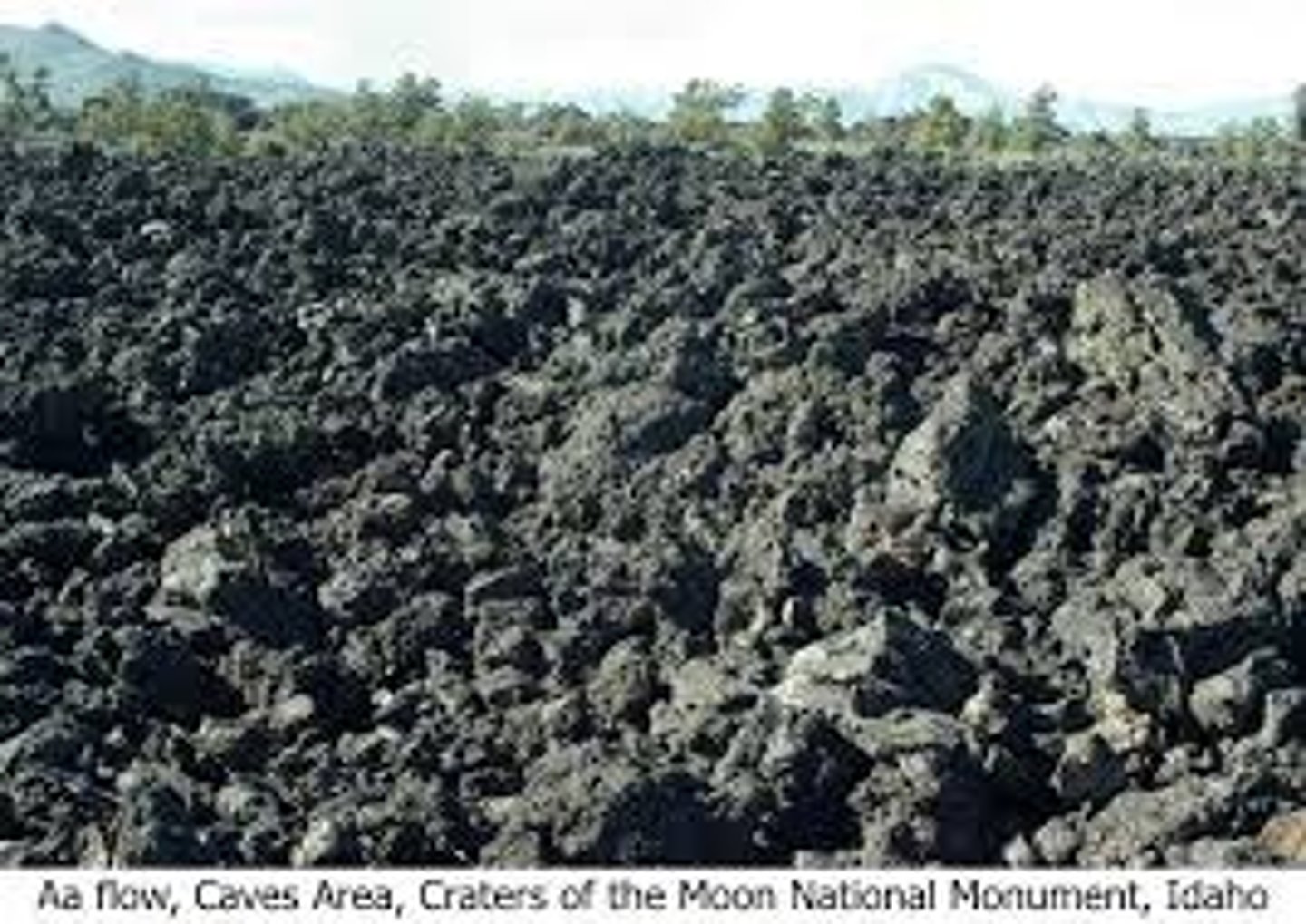
Aa
basaltic lava having a rough surface
pahoehoe
A type of lava having a smooth (rope like), swirled surface. It is highly fluid and spreads out in shiny sheets

Epicenter
The point on Earth's surface directly above an earthquake's focus.
Earthquake
The shaking that results from the movement of rock beneath Earth's surface.
Compression
Stress that squeezes rock until it folds or breaks.
Focus
The point beneath Earth's surface where rock first breaks under stress and causes an earthquake.
Magnitude
The measurement of an earthquake's strength based on seismic waves and movement along faults.
Modified Mercalli Scale
A scale that rates the amount of shaking from an earthquake.
Moment Magnitude Scale
A scale that rates earthquakes by estimating the total energy released by an earthquake.
Normal Fault
A type of fault where the hanging wall slides downward; caused by tension in the crust.
Plateau
A large landform that has high elevation and a more or less level surface.
P wave
A type of seismic wave that compresses and expands the ground; the fastest seismic wave
Richter Scale
A scale that rates an earthquake's magnitude based on the size of seismic waves.
Reverse Fault
A type of fault where the hanging wall slides upwards; caused by compression in the crust.
Seismograph
A device that records ground movements caused by seismic waves as they move through Earth.
S wave
A type of seismic wave in which the shaking is perpendicular to the direction of the wave. Shearing/Transverse waves.
Surface Wave
A type of seismic wave that forms when P waves and S waves reach Earth's surface.
Shearing
Stress that pushes masses of rock in opposite directions of, in a sideways movement
Stress
A force that acts on rock to change its shape or volume.
Tension
Stress that stretches rock so that it becomes thinner in the middle.
Strike-slip fault
A type of fault in which rocks on either side move past each other sideways with little or no downward motion.
Seismogram
The record of an earthquake's seismic waves produced by a seismograph.
Continental Drift
the hypothesis that the continents slowly move across Earth's surface.
Pangaea
The name of the single landmass that began to break apart 200 million years ago and produced today's continents.
Fossil
The preserved remains or trances of an organism that lived in the past.
Mid-ocean ridge
An undersea mountain chain where new ocean floor is produced; a divergent plate boundary
Sea-floor spreading
The process by which molten material add new oceanic crust to the ocean floor.
Deep-ocean trench
A deep valley along the ocean floor beneath which oceanic crust slowly sinks towards the mantle.
Subduction
The process by which oceanic crust sinks beneath a deep-ocean trench and back into the mantle at a convergent plate boundary.
Plate
broken pieces of the Earth's lithosphere.
Divergent Boundary
A plate boundary where two plates move away from each other.
Convergent Boundary
A plate boundary where two plates move towards each other.
Transform Boundary
A plate boundary where two plates move past each other in opposite directions.
Plate Tectonics
The theory that pieces of Earth's lithosphere are in constant motion, driven by convection currents in the mantle.
Fault
A break in Earth's crust along which rocks move.
Rift Valley
A deep valley that forms where two plates move apart (divergent boundary).
system
a group of related parts that work together to perform a function.
energy
the ability to do work or cause change.
atmosphere
the relatively thin layer of gases that form Earth's outermost layer.
geosphere
the densest part of the Earth that includes the crust, mantle, and core.
hydrosphere
the portion of the Earth that consists of water in any of its forms.
biosphere
the parts of the Earth that contain living organisms.
constructive forces
any natural force that builds up Earth's surface.
destructive forces
any natural force that tears down or wears away Earth's surface.
seismic wave
vibrations that travel through Earth carrying the energy released during an earthquake.
pressure
the force pushing on a surface divided by the area of that surface.
crust
the layer of rock that forms the Earth's surface.
basalt
a dark, dense, igneous rock that is found in oceanic crust.
granite
a usually light colored igneous rock that is found in continental crust.
mantle
the layer of hot, solid material between Earth's crust and outer core.
lithosphere
a rigid layer made up of the must uppermost part of the mantle and the crust.
asthenosphere
the soft layer of the mantle on which the lithosphere floats.
outer core
a layer of molten iron and nickel that surrounds the solid sphere at the center of the Earth.
inner core
a dense sphere of solid iron and nickel at the center of Earth.
radiation
the transfer of energy by electromagnetic waves.
convection
the transfer of heat by the movement of a fluid.
conduction
the transfer of heat from one particle of matter to another (by touching)
density
the measurement of how much mass of a substance is contained in a given volume.
convection current
the movement of a fluid caused by differences in temperature, that transfers heat from one part of a fluid to another.
weathering
the breaking down of rock by natural processes (wind, rain, ice temp.)
erosion
the movement of broken rock by natural forces such as wind or rain.
Abraham Ortelius 1596
noted that the coastlines of the continents appear to fit together
Alfred Wegener 1912
father of the theory he called "the continental drift"
"the continental drift"
modern continents formed a single landmass in the past
considered wrong bc both continents and ocean floor form solid plates, which "float" on the asthenosphere, the underlying rock that is under such tremendous heat and pressure that it behaves as an extremely viscous liquid
stratum
a layer or a series of layers of rock in the ground
seafloor spreading
a process that occurs at mid-ocean ridges, where new oceanic crust is formed through volcanic activity and then gradually moves away from the ridge.
subduction process
is a geological process that takes place at convergent boundaries of tectonic plates where one plate moves under another and is forced or sinks due to gravity into the mantle
Arthur Holmes 1929
proposed that convection in the mantle is the force driving continental drift
oceanographic vessels 1950s
Kinda like submarines that mapped the ocean floor and provided data on the topographic features of the ocean basin. This led to the discovery of mid-ocean ridges. These underwater mountain ranges encircling the planet form as Earth's plates separate.
seafloor spreading 1960
-Harry H. Hess developed the idea that oceanic crust forms along mid-ocean ridges and spreads out laterally away from the ridges.
-Robert S. Dietz named the phenomenon seafloor spreading.
-helped develop modern theory of plate tectonics.
magnetization of new crust with Earth's geomagnetic field 1963
-Frederick J. Vine, Drummond H. Matthews, & Laurence W. Morley suggested that new crust would have a magnetization aligned with Earth's geomagnetic field. Over a geologic time, this would appear as bands of crust that exhibit alternating patterns of magnetic polarity. This provided more evidence that Earth's plates separate at mid-ocean ridges.
hydroacoustic signals mid 1960s
A global network of sensors designed to detect hydroacoustic signals that recorded earthquake activity. Scientists later found that earthquakes and volcanic activity occur almost exclusively at the edges of tectonic plates.
vessel Glomar Challenger 1968
(in mid-ocean ridge between South America and Africa) collected core samples obtained from drilling revealed that rocks close to mid-ocean ridges are younger than rocks that are farther away from the ridges.
seismic tomography mid 1970s
enables scientists to investigate the dynamic processes in the deep interior of Earth.
Scientists created three-dimensional images of Earth's interior by combining information from many earthquakes using an approach similar to computed tomography (CT) scanning.
Igneous
form from the cooling of magma deep inside the earth, often have large crystals
Metamorphic
formed through the change (metamorphosis) of igneous and sedimentary rocks, can form both underground and at the surface
Sedimentary
formed through the solidification of sediment, can be based off of organic remains (such as limestone) or just form from the cementing of other rocks