fish exam 2
 Call Kai
 Learn
Learn Practice Test
 Spaced Repetition
 Match
Match Flashcards
 Knowt Play
1/42

Earn XP
Description and Tags
aUGHHHH
Name | Mastery | Learn | Test | Matching | Spaced | Call with Kai | Chat |
|---|
No analytics yet
Send a link to your students to track their progress
43 Terms
Petromyzontidae
Class: Petromyzontida
Order: Petromyzontiformes
● Mouth surrounded by funnel-like oral
disk with spiky epidermal teeth
● 7 gill openings on each side of head
● No paired fins
● Well-developed eyes
Ichthyomyzon sp.
Family: Petromyzontidae
● Etymology: “fish to suck”
● Dorsal fin continuous; not divided
● Teeth well developed
● Two non-parasitic and three parasitic
species in TN
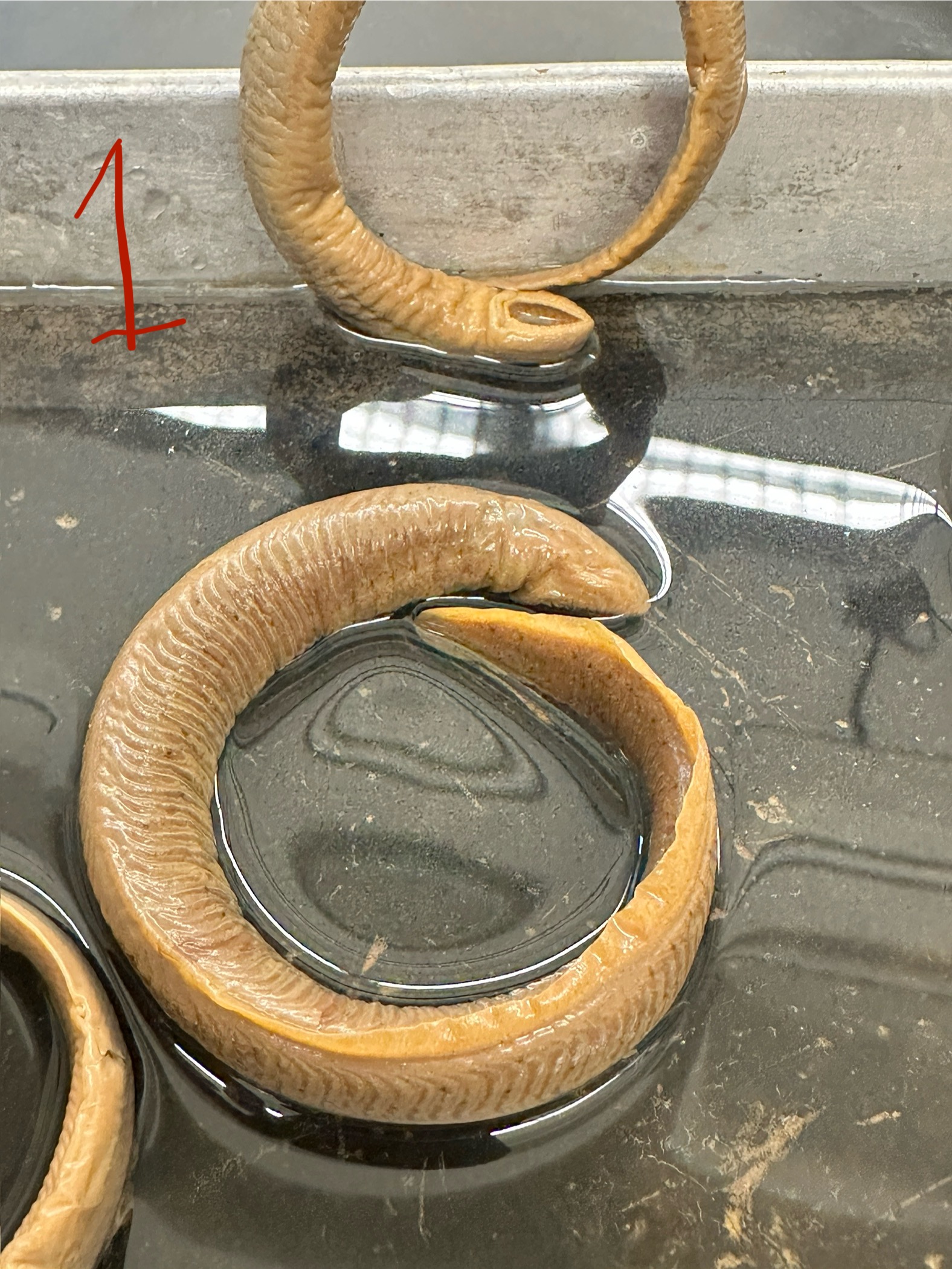
Lampetra sp.
Family: Petromyzontidae
● Etymology: “stone licker”
● Dorsal fin is divided
● Funnel-like oral disk with spiky epidermal teeth
● No paired fins
● Well developed eyes

Anguilla rostrata
Class: Actinopterygii
Order: Anguilliformes
Family: Anguillidae
● Dorsal fin that begins well behind the
gill opening
● Well-developed pectoral fins
● Lower jaw usually projects past
upper jaw
● Minute scales present
● G4 Apparently secure
(Natureserve), Endangered
(IUCN), Not Listed (USFWS)

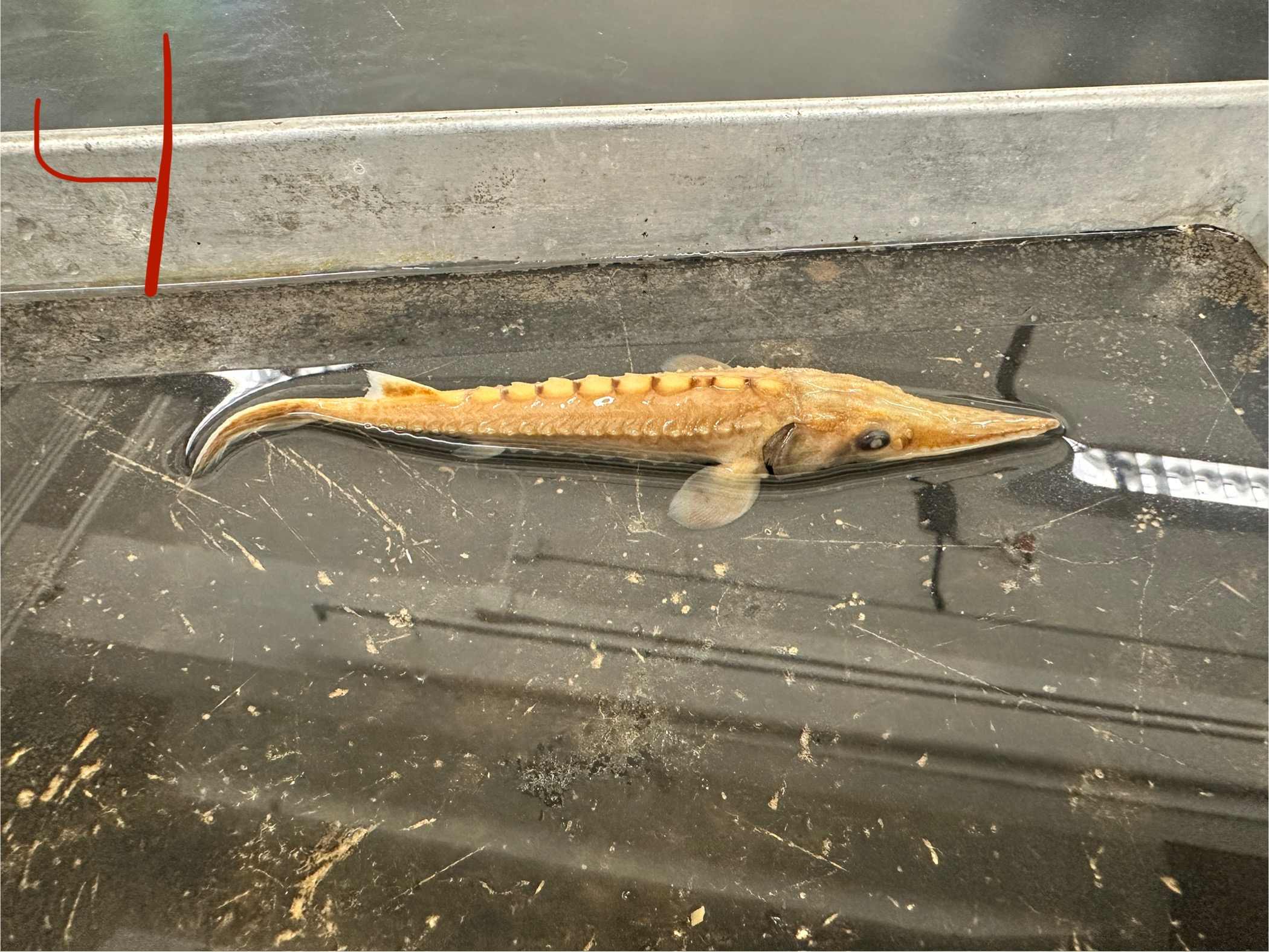
Acipenseridae
Class: Actinopterygii
Order: Acipenseriformes
● Caudal fin heterocercal
● Five rows of bony scutes
● Snout flattened with four barbels
● Mouth inferior and protrusible
● MANY listed species
● Very old family
Acipenser fulvescens
Family: Acipenseridae
Spiracle present
● Thicker caudal peduncle than Scaphirhynchus sp.
● Confined to freshwaters of Mississippi River basin.
Nearly extirpated from TN.
● G3 Vulnerable (Natureserve), Endangered (IUCN),
Not listed (USFWS)
Scaphirhynchus sp.
Family: Acipenseridae
● Differ from Acipenser by having a very slender
caudal peduncle entirely encased in bony plates.
● Rostrum wide like a “shovel”.
● Spiracle absent
● Two species in Mississippi River and a rare species
in the Mobile Basin.

Polyodon spathula
Family: Polyodontidae
● Paddle-like snout - sensory receptors
● Gigantic mouth
● Has large, slightly triangular gill covers
● Lacks large scutes
● G3 Vulnerable (Natureserve), Vulnerable (IUCN),
Not listed (USFWS)

Lepisosteidae
Class: Actinopterygii
Order: Lepisosteiformes
● Ganoid scales
● Body and jaws elongate
● Dorsal fin far back on body
● Heterocercal caudal fin
● Mouth with needle-like teeth
Atractosteus spatula
Family: Lepisosteidae
● Largest member of the family
● Alligator-like in appearance
● Snout length <7.5x the width

Lepisosteus osseus
Family: Lepisosteidae
● Snout long and slender with length 13x the width

Lepisosteus oculatus
Family: Lepisosteidae
● Snout and lower jaw with dark blotches

Lepisosteus platostomus
Family: Lepisosteidae
● Snout length <10x the width
● Snout and lower jaw lack dark blotches

Amia ocellicauda
Class: Actinopterygii
Order: Amiiformes
Family: Amiidae
● Long dorsal fin base
● Large median gular plate between lower jaws
● Abbreviated heterocercal caudal fin

Hiodontidae
Class: Actinopterygii
Order: Hiodontiformes
● Herring-like fishes with smooth rather than
serrated keel on belly
● Cycloid scales
● Well-developed lateral line
● Prominent teeth on tongue
● Two species, both found in North America
● Closely related to Osteoglossiformes
Hiodon alosoides
Family: Hiodontidae
● Keel on ventral surface extends
forward to near throat
● Dorsal fin well behind anal fin
● From west TN

Hiodon tergisus
Family: Hiodontidae
● Keel only from anus to pelvic fin base
● Dorsal fin even with or in front of anal fin
● Common in local reservoirs and large rivers.

Clupeidae
Class: Actinopterygii
Order: Clupeiformes
● Body is strongly compressed
● Caudal fin deeply forked
● Single dorsal fin located at midbody
● Eye partly covered by adipose eyelid
● Scales easily lost
● Most species with ventral scutes forming
saw-like appearance
● Several marine genera
Alosa chrysochloris
Family: Clupeidae
● Last ray of dorsal fin not elongate
● Tip of lower jaw protruding well beyond tip of upper
jaw

Dorosoma cepedianum
Family: Clupeidae
● Last ray of dorsal fin a long filament
● Snout bulbous and fleshy projecting past upper
jaw

Dorosoma petenense
Family: Clupeidae
● Last ray of dorsal fin is elongated
● Last ray of dorsal fin a long filament
● Snout more pointed and not
projected past upper jaw

Esocidae
Class: Actinopterygii
Order: Esociformes
● Duckbill-like snouts
● Dorsal and anal fins
located posteriorly
● Small cycloid scales
● Forked caudal fin
Esox americanus
Family: Esocidae – Pikes
● Opercle fully scaled
● 8 mandibular pores
● Oblique suborbital bar present
● 12 or fewer branchiostegal rays

Esox niger
Family: Esocidae
● Suborbital bar more vertical than
in E. americanus
● Opercle fully scaled
● 8 mandibular pores
● 14 or more branchiostegal rays

Esox masquinongy
Family: Esocidae
● Upper half of opercle scaled, lower
half of check naked
● 12 or more mandibular pores
● No suborbital bar

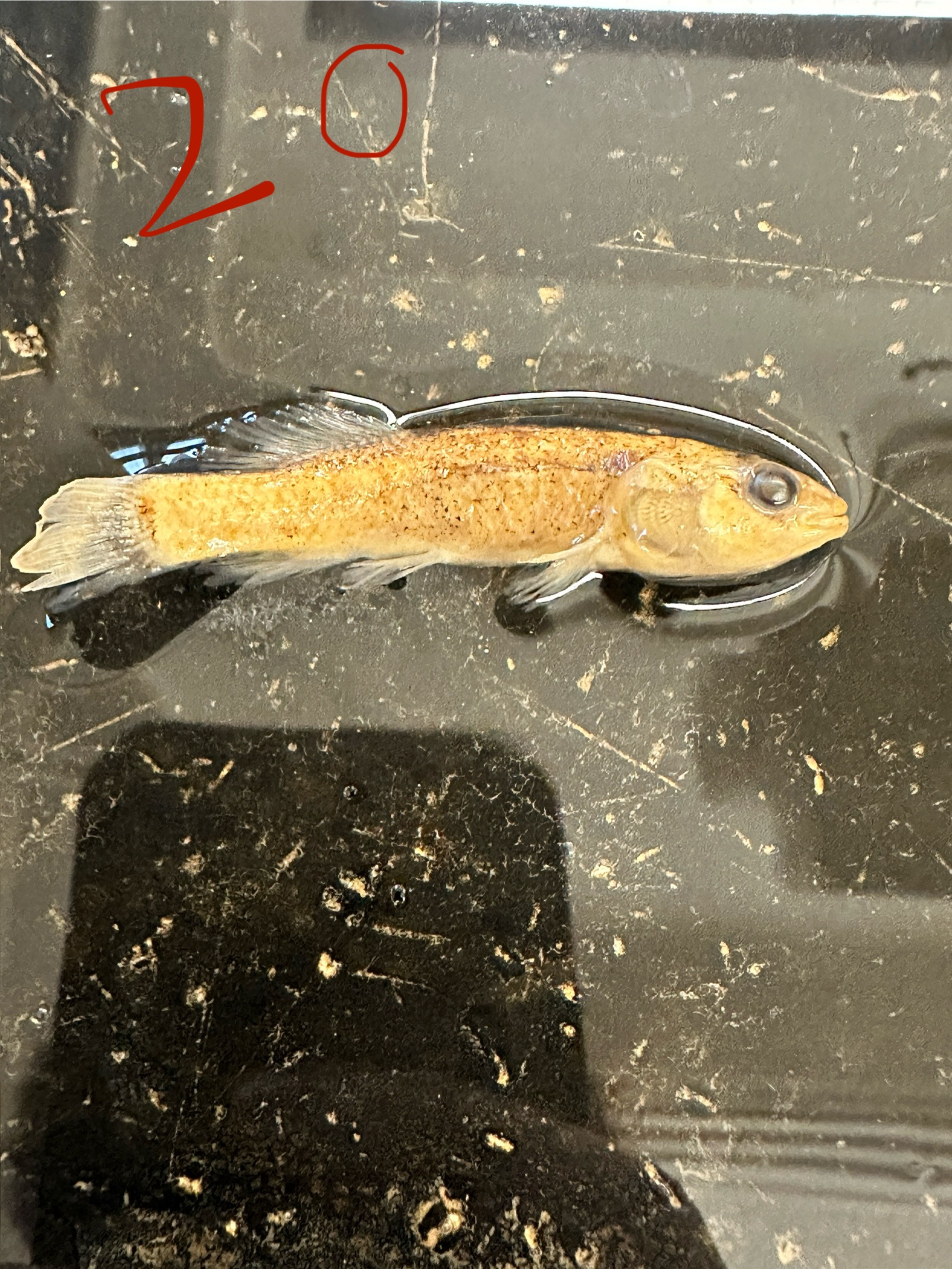
Umbra limi
Class: Actinopterygii
Order: Esociformes
Family: Umbridae
● Single dorsal fin positioned posteriorly
● Dark vertical bar on base of caudal fin
● Lateral line absent; large scales over the
head and body
Aphredoderus gibbosus
Class: Actinopterygii
Order: Percopsiformes
Family: Aphredoderidae
● Perch-like with anus near throat
● Dorsal fin with 2 – 3 spines
● A dark vertical bar at caudal base

Amblyopsidae
Class: Actinopterygii
Order: Percopsiformes
● Head naked with reduced or no eyes
● Sensory papillae in rows on the head, body, and tail
● No pelvic fins
● Anus near throat
Forbesichthys agassizii
Family: Amblyopsidae
● Darkly-pigmented with small eyes

Typhlichthys subterraneus
Family: Amblyopsidae
● Lacks eyes and pigment

Fundulidae
Class: Actinopterygii
Order: Cyprinodontiformes
● Twisted maxilla, not straight
● Superior mouth
● Elongate bodies
Fundulus catenatus
Family: Fundulidae
● Has distinct lateral striping pattern
● Dorsal fin base near anal fin base
● Large topminnow that lacks a dark
mid-lateral stripe

Fundulus notatus
Family: Fundulidae
● Very few discrete black spots on dorsal half
● Prominent lateral stripe
● Rounded caudal fin
● Similar to F. olivaceus, but spots above the
prominent dark lateral stripe are lighter
than stripe

Fundulus olivaceus
Family: Fundulidae
● Similar to F. notatus, but with discrete dark spots above mid-lateral
stripe that are as dark as stripe

Gambusia affinis
Class: Actinopterygii
Order: Cyprinodontiformes
Family: Poeciliidae
● Twisted maxilla, not straight
● Superior mouth
● Elongate bodies

Labidesthes sicculus
Class: Actinopterygii
Order: Atheriniformes
Family: Atherinopsidae
● Slender fish with tiny scales and inconspicuous spiny dorsal fin
● Flesh opaque in preserved specimens, translucent in life

Menidia audens
Class: Actinopterygii
Order: Atheriniformes
Family: Atherinopsidae
● Similar to Labidesthes sicculus, but larger scales and less elongate
snout

Culaea inconstans
Class: Actinopterygii
Order: Gasterosteiformes
Family: Gasterosteidae
● Slender caudal peduncle
● 2 – 7 free dorsal spines
● Elongate, cigar shaped body with lateral bony scutes
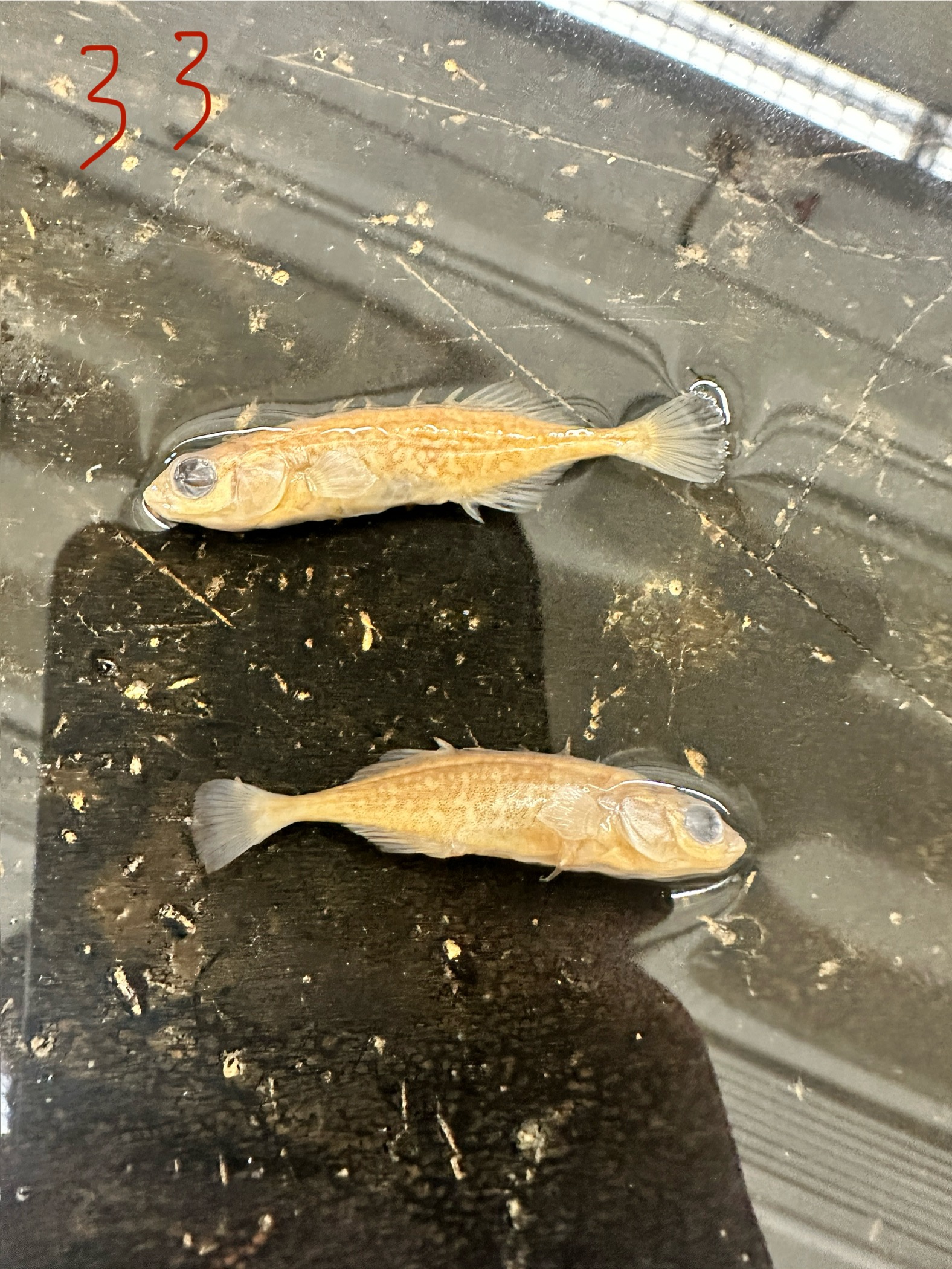
Aplodinotus grunniens
Class: Actinopterygii
Order: Perciformes
Family: Sciaenidae
● Two dorsal fins with a notch in between
● Anal fin with 1 – 2 spines
● Rounded slightly-goofy snout
● High bodied, especially for a Sciaenid
● Arguably the silliest guy on this exam

Salmonidae
Class: Actinopterygii
Order: Salmoniformes
● Adipose fin present
● Small cycloid scales
● Notable food and game fishes
Salmo trutta
Family: Salmonidae
● Caudal fin lacking black spots
● Sides with scattered red spots circled in white
● 12–14 dorsal fin rays

Oncorhynchus mykiss
Family: Salmonidae
● Caudal fin with black spots
● Sides with broad pink lateral stripe
● 10–12 dorsal fin rays

Salvelinus fontinalis
Family: Salmonidae
● Dorsum with pale spots on dark background
● Ventral fin edges with black and white seam
