LING: lesson 5 (dialects pt1)
 Call Kai
 Learn
Learn Practice Test
 Spaced Repetition
 Match
Match Flashcards
 Knowt Play
1/25

There's no tags or description
Looks like no tags are added yet.
Name | Mastery | Learn | Test | Matching | Spaced | Call with Kai | Chat |
|---|
No analytics yet
Send a link to your students to track their progress
26 Terms
Seven traditional dialect groups in China:
Guanhua (Mandarin)
Wu
Gan
Xiang
Kejia
Yue
Min
history of the Sinitic languages
2nd millenium BCE:
Chinese ancestral language in North China Plain
spread not clear
8th - 5th cent BCE:
indications for dialects/ languages: e.g. people of Chu spoke Chu but the junzi spoke Yawen (cultured language like putonghua)
importance of wenyanwen as it was a standardized writtig languages that overcame dialects
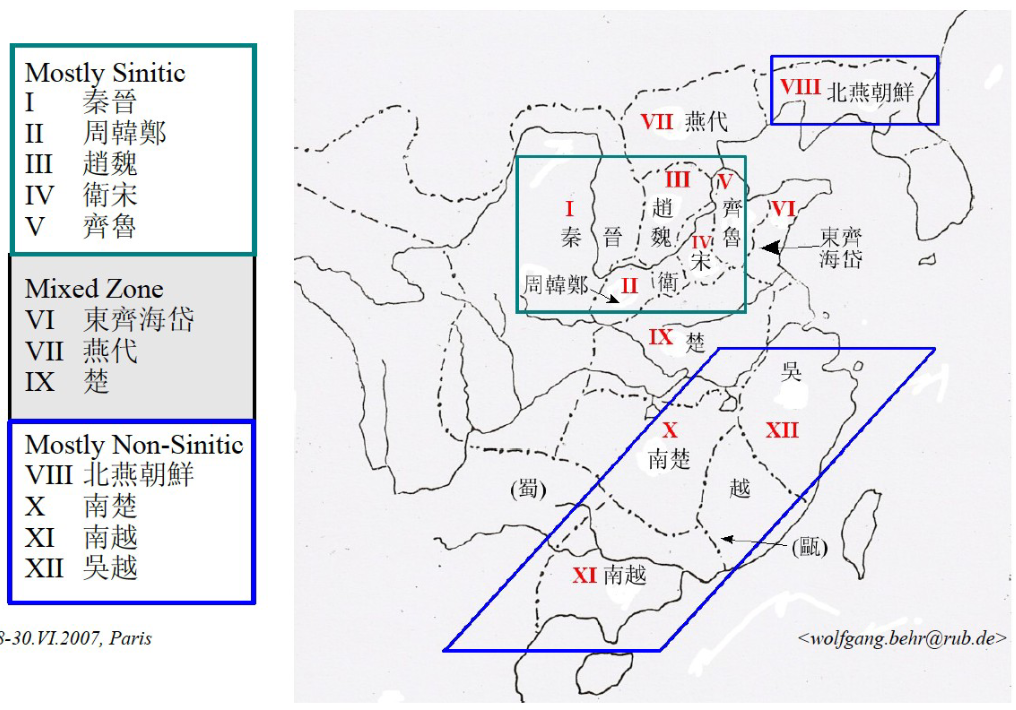
pre-modern dialects
ancient chu language preserved in some Southern variants of Chinese
Chu had own version of character forms
some scholars think that all old dialects either come from Northern varieties or the Chu variety
Yue language (state of Yue and Wu)
Chu and Yue could not communicate
differentiation between common language (Tai-Kadai probably) and Yawen (cultured language)
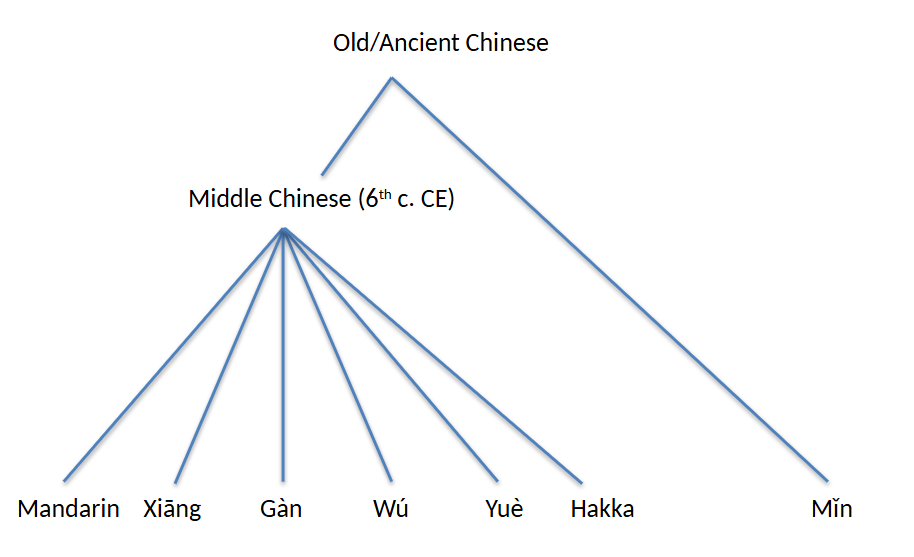
traditional model of dialect diversification of “Sinitic”
Based on the work of Karlgren
BUT problematic because
only based on phonological evidence (Qieyun)
based on literati language (takes this as the basis of all language)
projects a significant diversification to a relative short period of time
status of the Min dialect?
most scholars agree that since it shows ancient features not encountered in other dialects, it should splits from other Chinese varieties in a very early stage
What are the factors of dialect diversification?
Geographical spread
language contact
dialect layering
historical features
cultural features
internal language change
Geographical spread as a factor of dialect diversification:
sandwich theory (Hashimoto): small in between dialects get absorbed into one of the two bordering dominating dialects (e.g. Xiang and Gan)
Sinospheric/ Non-Sinospheric (Matisoff): where Chinese has influence on both the spoken and written language; basic idea: the more communities spread, the more their language drifts apart
Language contact as a factor of dialect diversification:
language shift to Chinese (e.g. Manchu disappearing, and now varieties of Tibetan, Uighur, Mongolian,….)
substratum effect on Chinese: when a population shifts to a new language and features of their old language seep through (e.g. Altaic, Tai-Kadai, Miao-Yao)
Dialect layering as a factor of dialect diversification:
when lots of dialects near each other overlap and influence each other, not one dominating factor, just all interlingual influences
Historical features as a factor of dialect diversification:
periods of unification and fragmentation leads to diversification
situation of the capital
→ migration (language contact and substratum effect)
cultural features as a factor of dialect diversification:
significance of a uniform written language
common spoken language (koiné)
diglossia
prestige dialects (e.g. cantonese)
internal language change as a factor of dialect diversification:
from generation to generation
modern developments in dialect diversification:
20th century:
abolishment of Literary Chinese as standard
replacement by baihuawen
promotion of Modern Standard Mandarin (Putonghua)
a new form of diglossia has developped
increased influence of Mandarin in recent times
political and social reasons
What is diglossia?
when two languages/ dialects are used by one single language community
What are the features to determine diversity?
Phonology
Morphology
Grammar
How to determine diversity through Phonology?
look at:
tones
tone sandhi
vowel system
p, t, k development (voiced stops)
How to determine diversity through morphology?
look at:
monosyllabic vs. polysyllabic
forms of compounding
How to determine diversity through grammar?
look at:
direct/ indirect object ordering
system of classifiers
system of pronouns (esp. 3rd pronouns)
Situate the seven traditional dialect groups of China on a map.
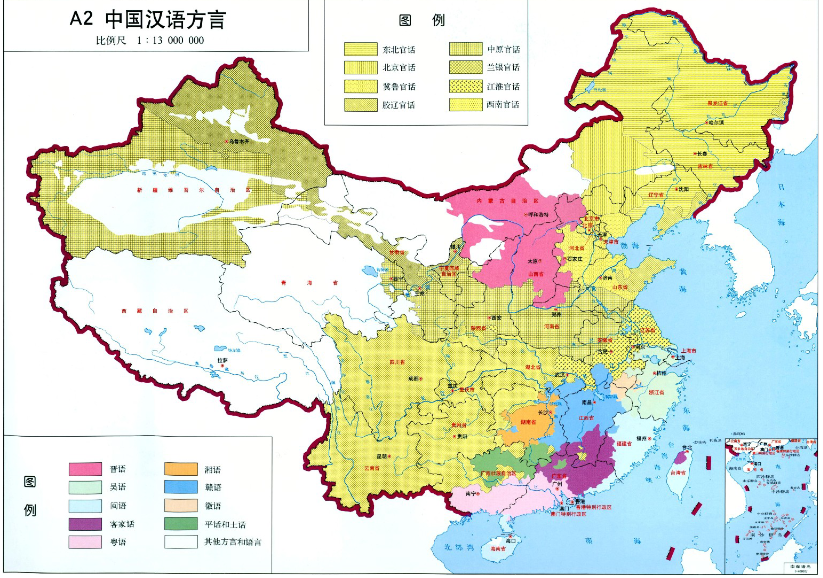
What about Jin-, Hui-, and Pinghua?
Jin: was classified as a Mandarin variety, however it is now grouped as a separate dialect group (because it was not intelligible for mandarin speakers)
Hui: spoken in Anhui was previously grouped with Wu but is now classified as a separate dialect group
Pinghua: still under discussion
What do we mean by Northern Chinese?
a relative homogenous Mandarin in the north due to geographical characteristics
ca. 900 million speakers
4 → 8 varieties
around the city of NAnjing most prestigious dialect until 19th century
What are the 8 types of Mandarin?
东北
Jiaoliao (Eastern art of Shandong and Liaoning)
北京
Jilu (北方)
中原
Jianghuai (Yangtze and Huai rivers)
Lanyin
西南 (southwest)
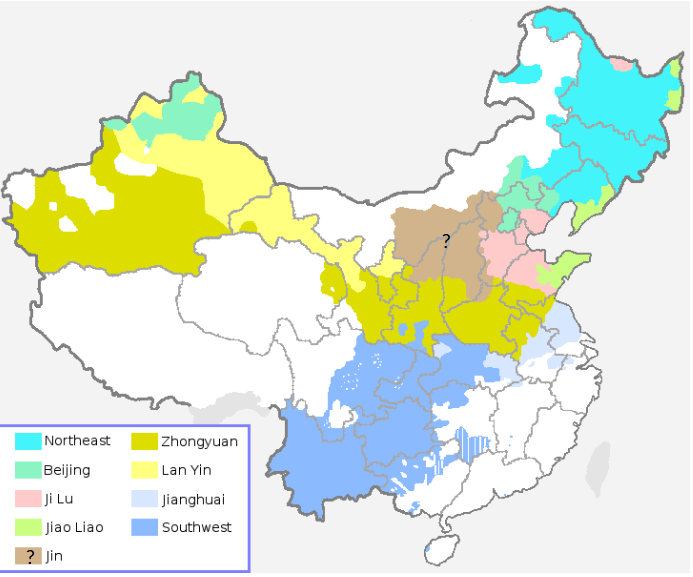
Basic features of Mandarin
no voiced stops
system of 4 tones
no final stops (-p, -t, -k, -m)
specific pronoun system (她, 他, 们, 咱们)
particles (的/ 地)
specific constructions for passives and object disposal (被,把)
Nanjing dialect
around the city of Nanjing most prestigious dialect until 19th century
earliest layer: the language of the State of Wu
previous capital: Jiankang
4th c.: Imigration from Northern China (yǎyán 雅言 , lit. ‘elegant language’)
Development of Jiānghuái dialect 江淮官話
entering tone 入聲 is preserved as a glottal stop (/ /)ʔ
Initial n- → l- (compare Southwestern dialect!)
What does a prestigious dialect mean?
AN
Southern dialects
many isolated areas in the South due to geographical characteristics like mountains and rivers
many mutually unintelligible dialects
six major dialects: Wu, Xiang, Min, Yue, Gan, Kejia, (Hui)