Membrane Potential
 Call Kai
 Learn
Learn Practice Test
 Spaced Repetition
 Match
Match Flashcards
 Knowt Play
1/48

There's no tags or description
Looks like no tags are added yet.
Name | Mastery | Learn | Test | Matching | Spaced | Call with Kai | Chat |
|---|
No analytics yet
Send a link to your students to track their progress
49 Terms
What is membrane potential?
Gradient of electrical potential energy across a cell membrane.
What is the importance of homeostatsis and its relationship to membrane potential.
Since the extracellular conectration of K is very important in determining the resting membrane potential and the rate at which K diffuses out of cells, changes in the concentration of this ion can have drastic consequences.
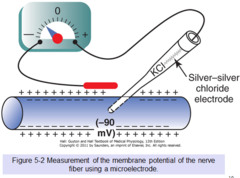
How does one measure the memrbane potentail of a cell?
By placing an intracelluar electrode inside the cell and an extracellular electod in the ECF.
A voltmeter could then mearuse the potental difference across the cell membrane.
outside the cell is considered OmV
inside of a cell at rest is always neg relative to the outside so the cell memrbane potential is a neg number.
What is membrane potential due to?
Separation of electrical charges across the membrane.
work must be performed to separate opposite charges.
Separated charges have the potential to do work-hence term membrane potential.
How do the charges get separated to create membrane potential?
What is the principle of Electrical Neutrality?
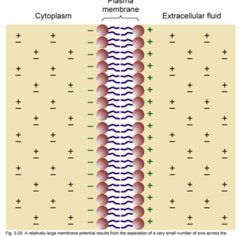
Any macroscopic region of a solution must have equal numbers of positive and negative charges.
So almost all the extracellular and intracellular ions are paired + with -, with just a small number of excess neg charges just inside the membrane paired with a small excess of positive charges just outside the membrane.
The bulk of the cytoplasm and ECF is electroneutral. Only a small relative number of excess charge is found on either side of hte membrane.
What is an electrical capacitor?
Two pieces of conducting material separated from each other by an insulating materail.
The capacitor stores charges of opposite sign on the facing surfaces.
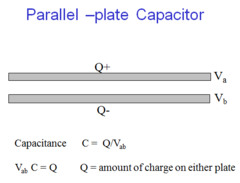
Which part of the cell acts an the insultaor part of a capacitor?
bilayer of the cell membrane
ion channels through the membrane make the cell membrane a leaky capacitor.
changing the amount of charge stored on either side of the membrane changes the membrane potential
Which part of the cell acts as the conducting materal?
The ECF and cytoplasm
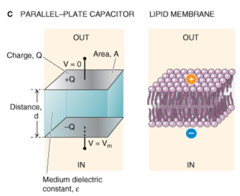
Whenever the membrane potential is neg the electrical force will draw ___ ions in to the cell.
positive ions
A neg membrane potential woud exert an electrical force that pushed ____ ions out of the cell.
neg ions
How much of a
charge need to be move to change the membrane potential of the cell?
SO little charge has to move
For a certain cell size the amount of excess charge is just a very small fraction (1/200,000) of the total number of positive and negative charges in solution within the cytoplasm.
Describe the resting membrane potential. Where is the neg charge located? Where is the pos charge located? Are they balanced? What does the membrane act like?
Membrane acts as a capacitor
Excess negative charge on side of membrane touching the cytoplasm
Excess positive charge on side of membrane facing the extracellular fluid.
Negative charge on cytoplasmic side balanced by positive charge on extracellular side
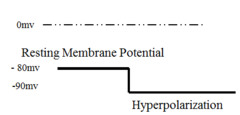
What happens to the cell during hyper-polarization?
membrane becomes more neg inside and more positive outside
changes from -80mV to-90mV
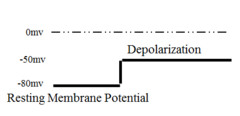
What happens during hypopolarization or Depolarization?
membrane becomes less neg inside the and less pos outside
ex -80mV to -50mV
When the cell is depolarized there is a fall or reduction in the membrane potential since the absolute differences in the potential between the inside and the outside of the cell has decreased.
What is the chemical force?
force only due to the chemical concentration gradient-it makes it move from an area of high con to an area of low conc
neither the sign of the ion nor the strength of the membrane potential affect the direction or size of the chemical force.
What is the electrochemical gradient?
since ions are acted upon by two different forces, we must know the strngths and directions of both forces to determin the electrochemical gradient.
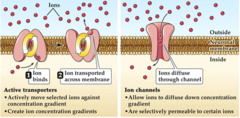
ions will diffuse down their electrochemical gradients.
Movements of ion can change the membrane potential-
If a pos ion move out of a cell the cell will become more ______.
If a pos ion moves into a cell the cell will become more_______.
more neg
less neg
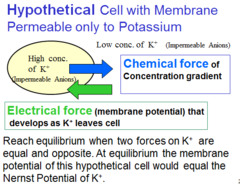
What would happen in a hypotheical cell with membrane permeable only to K+?
K+ diffues out of the cell until chemical force due to concentration gradient is opposed by sufficient electtrical focre due to the membrane potential to prevent any more net diffusion. This value of electrical force is called Nernst potential for potassium or the equilibrium potential for potassium.
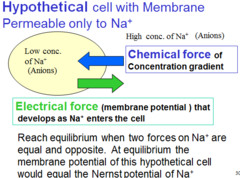
What would happen in a hypothetical cell with membrane permebale only to Na+?
Na+ diffuses into the cell until the chemical foce due the concentration gradient is opposed by sufficeinet electrical force due to the membrane potential to proevent any more net diffusion. This is the value of electircal force is called Nernst potnetial for sodium or equilibrium potneial for sodium.
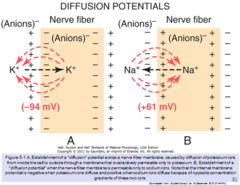
What is the membrane potential of a real cell and how does it differ from a hypothetical one?
Normally the electrical forces and chemical forces on K and and are not equal and these ions are not at equilibrium. Real cells have a membrane potential which is close to but less negative than the Nernst potential of K.
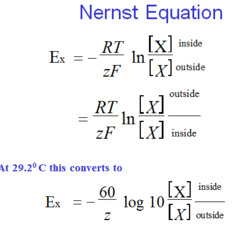
How can we get a numerical value for equilibrium potential when we know the concentrations of an ion inside and outside a cell?
The bottom equation is one you don't have to do math for. memorize it.
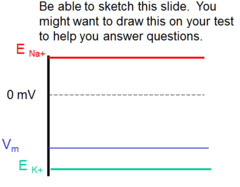
Describe ENa+, EK+, Vm relative to each other.
Vm is membrane potential. Value is between the Ena and Ek
actual membrane potential of cell is balance between Ek which changes if K concentration change and Ena. At rest the cell is much more permeable to K than to Na so the membrane potential is closer to Ek. During an action potential the permeability of the membrane to Na increasing and the membrane potential moves closer to Ena
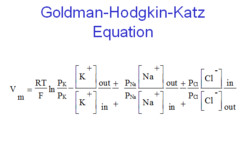
What equation do you use for diffusion potential when the membrane is permeable to several different ions?
by using the above equation, you can figure out how a change in ion concentration or ion permeability can change the membrane potential.
Describe how the membrane has been modeled as an electrical circuit.
When discussing the electrical circuit model we use the term conductance of an ion rather than permeability of the membrane to an ion.
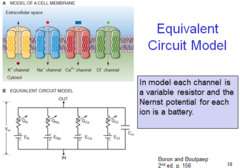
Describe conductance. What happens to the membrane potential if Conducance is increased?
g
Reciprocoal of resistance
Term used in the Equivalent Circuit Model of the electrical properties of the cell membrane.
As the relative conductance of ion increases the membrane potential moves closer to the Nerst potential of that ion
Compare permeability with conductance.
permeability is a property of the membrane
conductance depnds on poreptiess of both the membrane and concnetration of ions in solution.
Example: a membrane could have a very high permeability to K+ but if there are no K+ ions in solution the conductance of the membrane will be zero
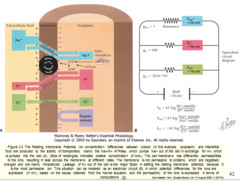
Draw out the Electical Circuit Model.
What happens to cell's K potential when the ECF con is rasied?
It is decreased bc they are almost equal.
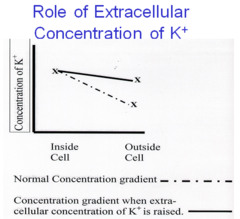
Why does a higher than normal excellular concentraion of K hyper kalemia depolarize a cell making the cell's resting membrane potential less negative?
At rest a cell is much morep ermeable to K than it is to na
resting potential is largely neg bc intracellular con of K is much higher than extracellular conc and the cell membrane is slightly permebale to K
when K flows down its con gradient, leaving the cell, the cell membrane would become more neg, which this electrical force would tend to oppose the movement of K out of the cell.
if the membrane potnetial became less negative for any reason the electrical force holding K in the cell would decrease, so additonal k would leave the cell making the cell more neg again
As EC con of K is raised, the cheomical force driving K out of the cell decreases in size. Ek is the chemical force so it decreases in size.
If the extracellular con was raised to the level of the intracelluar con, Ek wwould equal zero since there would be no chemical force on the ion this value is only found post mortem.
Describe the resting potential of squid giant axon?
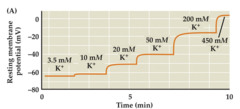
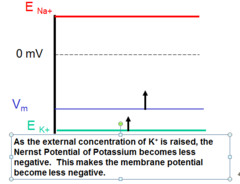
AS the external concentration of K+ is raised, what happens to the Nernst Potential of Potassium?
Resting membrane potential always moves in the same direction as the value of Ek+. If Ek+ becomes less neg, the membrane becomes less neg-depolarizes.
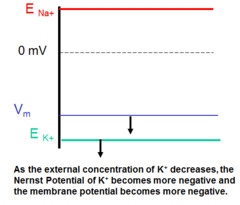
As the external concentration of K decreases, what happens to the Nernst Potnetial of K?
Becomes more negative and the membrane potential becomes more negative.
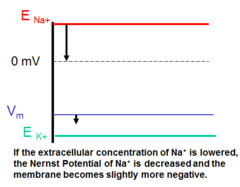
What hapens if the extracelluar concentration of Na is lowered, what happens to Nernst Potential of Na?
Na lowered, Nerst Potential of na decreaed an
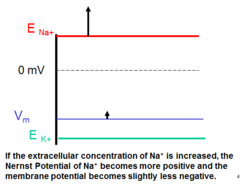
What happens if the extracelluar concentration of Na is increased, the Nerst potential becomes...
more positive and the membrane potential becomes slightly negative.
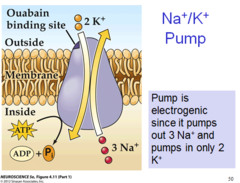
Describe the role of Na/K pump?s
It is electrogenic
every cycle the cell loses 1 pos charge and thus becomes more neg inside
how muc the pump contributes directly to membrane potential varies among differnt tissues.
What is the main importane of pump in maintaining membrane potential
an indirect one of maintaing ion concetnration gradeints for K and Na
At cells resting potential is the cell at equilibrium?
NO
steady state bc K is leaking out and na is leaking in
this leakage is exactly balanced by the Na K pump which pump Na out and K in the metabolic energy is necessary to maintain ion gradients
How is Na k pump necessary to regulate cell volume
pumping Na out of the cell, it decreaes the osmotic pressure in the cytoplasm and incresase the osmotic pressue of teh ECF
What is the Nerst for Cl- when there is no Net Pumping of Cl- into or Out of the cell
The membrane potnetial will determin the concentration of Cl-, instead of the Cl- determing the membrane potential.
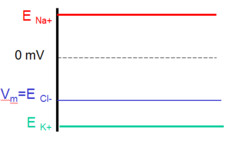
What happens when Cl- is pumped out of the Cell?
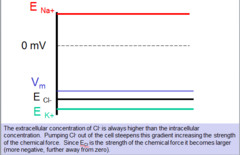
Describe the importance of calcium?
Concentration of free ionized Ca++ in the cytoplasm is kept very low.
Most intracellular calcium is sequestered in the smooth endoplasmic reticulum and thus does not directly affect ECa++
The equilibrium potential of Ca++ varies but is always a large positive number.
The membrane is usually impermeable to Ca++
If X is a positive ion
With inside concentration of 1 M
And outside concentration of 0.1 M
What is the direction of the Chemical force due to this concentration gradient ?
What is the strength of this force?
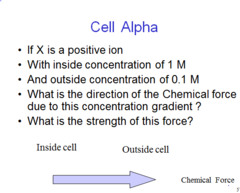
What determines the direction and strength of the chemical force?
The direction of the chemical force arrow is from the area with the higher concentration towards the area with the lower concentration.
The numerical value for the strength of the chemical force is gotten by solving the Nernst Equation. Any time there is a ten fold difference between the inside and outside concentrations the strength of the chemical force is + or - 60mV.
If the cell membrane potential is -80 mV
What direction will the electrical force of this membrane potential push positive ion X+ ?
What is the strength of this force?
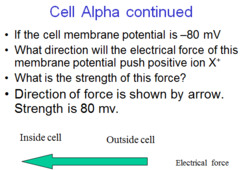
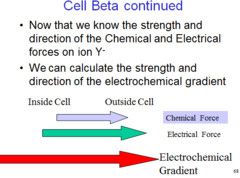
What is the strength and direction of the electrochemical gradient for the alpha cell.
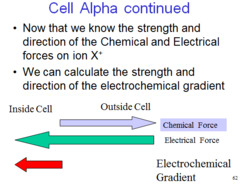
Cell beta
If Y- is a negative ion
With inside concentration of 1 M
And outside concentration of 0.1 M
What is the direction of the Chemical force due to this concentration gradient ?
What is the strength of this force?
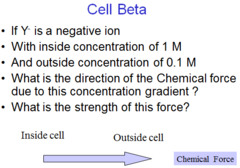
Beta cell
If the cell membrane potential is -80 mV
What direction will the electrical force of this membrane potential push negative ion Y-
What is the strength of this force?
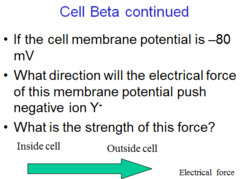
What is the electrochemical gradient for the beta cell?