Circuits and electricity
 Call Kai
 Learn
Learn Practice Test
 Spaced Repetition
 Match
Match Flashcards
 Knowt Play
1/28

Earn XP
Description and Tags
Name | Mastery | Learn | Test | Matching | Spaced | Call with Kai |
|---|
No analytics yet
Send a link to your students to track their progress
29 Terms
What is Kirchhoff’s voltage law (KVL)?
∮CE⋅dl=0
Where E is the electrostatic field and dl is a vector element of the path/loop.
The sum of all electromotive forces and potential differences around any closed loop of a circuit is zero.
Equation for vector current density
j=nqvd
where n is the concentration of moving charged particles, q is charge per particle and vd is drift velocity.
(Current per cross-sectional area - scalar)
Current density
dI=j⋅dS
What is Kirchhoff’s current law (KCL)?
∂t∂ρc+∇⋅j=0
Where j is the current density vector.
The sum of all currents entering a junction equals the sum of all currents leaving a junction.
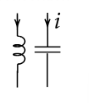
Draw receptor convention (circuits)
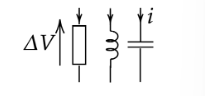
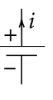
Draw generator convention (circuits)
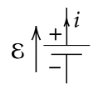
What is the electromotive force?
/
What is Faraday’s Law?
∮CE⋅dl=−dtdΦB
What is Lenz’s law?
The direction of magnetic induction effect is in the direction opposing the cause of that effect.
Maxwell-flux equation
∇⋅B=0
Maxwell-Gauss equation
∇⋅E=ϵ0ρc
Maxwell-Faraday equation
∇×E=−∂t∂B
Maxwell-Ampere equation
∇×B=μ0j+μ0ϵ0∂t∂E
Laplace force (derived from magnetic of Lorenz)
FL=∫wireIdl×B
Resistance equation (receptor convention)
VR=RI
Capacitance equation (receptor convention)
VC=CQ
Equation for capacitor in parallel and in series (receptor convention)
In parallel: Ceq=C1+C2
In series: Ceq1=C11+C21 or Ceq=C1+C2C1C2
Voltage of an inductor equation (receptor convention)
VL=LdtdI where L is inductance
Power consumed by an electrical component (receptor convention)
P=VI
What is the electric field inside a conductor?
E=0
Current and current density equation
I=∬Sj⋅dS
Definition of self-inductance
ΦB=LI where L is the self-inductance
The ability of a circuit to create magnetic flux through itself
Definition of mutual inductance
ΦB=MI where M is the mutual inductance (between two circuits)
The ability of a circuit to create magnetic flux through another circuit is mutual inductance.
Known result for self-inductance of a solenoid
L=μ0n2Sl
How do we find mutual inductance (M)?
Calculate magnetic field through one circuit
Calculate the flux through the second circuit
Use the definition of mutual inductance to find M
Mutual inductance of two solenoids (known result)
M=μ0n1n2Sl
What is the surface enclosed by a solenoid?
S⋅n where n is the number of loops. And S is approximated to the area of a circle.
Magnetic curl definition
A measure of whether the electromagnetic field rotates around a point and how much
essential for determining how electric currents and changing electric fields generate rotating magnetic fields
curl(A)=∇×A
curl >0 is anti-clockwise, < 0 is clockwise and =0 is no curl
Power supplied by a voltage source
P=Icell⋅Vterminal