EXAM 1
 Call Kai
 Learn
Learn Practice Test
 Spaced Repetition
 Match
Match Flashcards
 Knowt Play
1/77

There's no tags or description
Looks like no tags are added yet.
Name | Mastery | Learn | Test | Matching | Spaced | Call with Kai | Chat |
|---|
No analytics yet
Send a link to your students to track their progress
78 Terms
What are the sources of data evolutionary biologists use to test hypothesis?
Fossil record
Behavioral Data (ex: grooming behavior)
Morphological (ex: wing patterns/colors)
Embryological (ex: magnetic resonance)
Molecular genetics (ex: DNA sequence)
What are the 3 Applications of Evolution?
Artificial selection developed food we eat and therefore changed our bodies
Development of disease and therefore pharmacy/drugs (antibiotic resistance)
Phylogenetic Trees for hypothesis (scientific and math models explain the past)
Empirical Research
Testing ideas/hypothesis/theories using real world experience
Observation versus manipulation
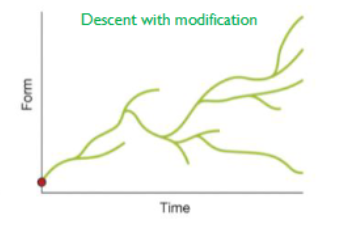
Descent with Modification
evolution of how species change over time
populations have variations in traits
differences in traits result in differences in reproduction
populations will resemble the most successful individuals of the previous generation
Anthropogenic evolution
evolutionary change due to humans
Anthropocene Era
“recent age of man”
1950s on
Uniformitarianism
slow processes over long time produce large results (ex: erosion producing canyon)
Theories
8ngerstandings form ovservation, experiements, reflection, using tests
Hierarchical patterns of similarity
species cluster due to similarity at hierarchical diversity levels
Carl Linnaeus (1707-1778)
developed hierarchical classification of nature
Viewed species as an ideal form, created and unchanging (‘type specimen’)
Young Earth (approximately 6000 years old)
James Hutton and Charles Lyell
founded modern geology field by developing uniformitarianism
Mary Anning
fossil purveyor and paleontologist
in communique with several geologists including Lyell
her remarkably detailed and accurate depictions of fossilized remains contributed to the growing acceptance of extinction
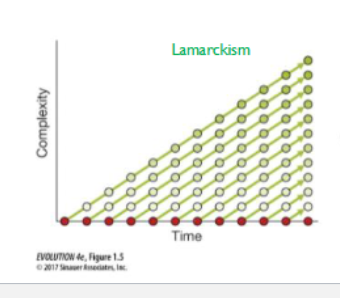
Lamarckism
new traits are result of new environmental pressure
as organisms use a trait, they build that trait
offspring then inherit the changed trait and continue to build on it
Natural Selection
describes the circumstances under which a population changes over time
survival of fittest
Criteria of modern theory of natural selection
variation- genes can differ in DNA sequence (alleles)
Heritability- genetic information (DNA) can be passed from parents to offspring
Differential reproduction- some alleles are spread more in a population, because the traits they code for are selectively advantageous
Why is heritability a requirement for natural selection?
without it, evolution can not ensure that adaptations are maintained in population
must be correlation for causation!
Why can’t organisms ever be perfectly adapted to their environment?
Environment is always changing!
Adaptation
trait that increases fitness of organism
change thorugh heritability
Acclimation
process of adjusting physiology and behavior to maintain homeostasis under prevailing conditions
change through exposure
Individuals acclimate while populations adapt!
What are the 4 types of selection?
directional
stabilizing
disruptive
Balancing
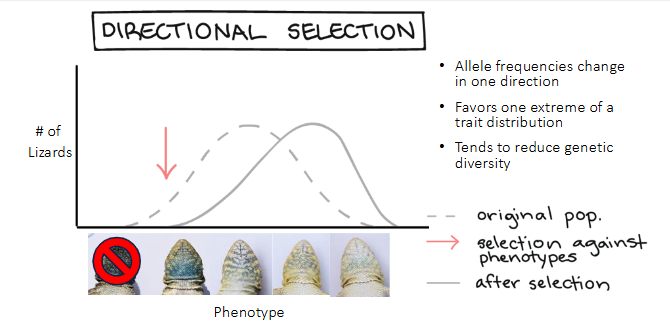
directional selection
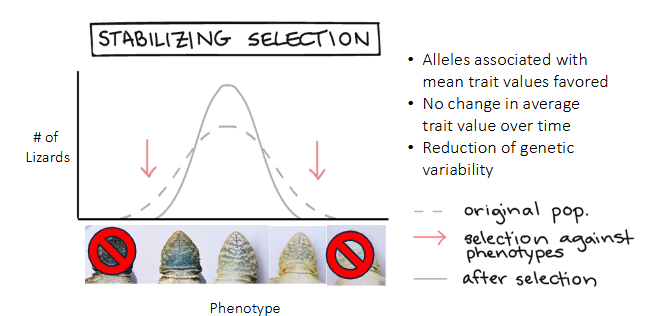
Stabilizing selection
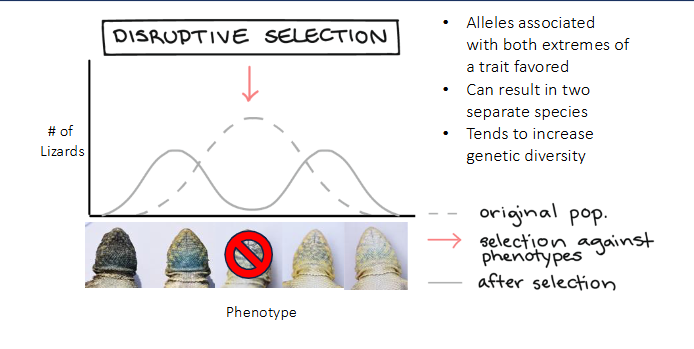
Disruptive selection
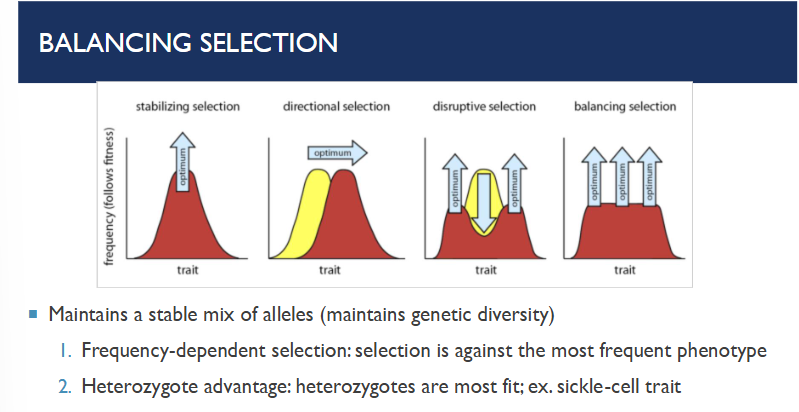
Balancing selection
Phylogeny
model/hypothesis of branching relationships of lineages as they give rise to multiple descendant lineages (AKA evolutionary ancestry)
Branches v.s. Nodes of phylogenetic tree
branches=lineages evolving through time
nodes=points in time when lineages diverge (ex: speciation events in a taxon tree)
Cladogram
show branching order (does not include length of time which is how its different from phylogeny)
Clade
collection of branches and nodes including common ancestor and all of its descendants
Monophyletic
Phylogeny=nested hierarchy of clades
Clade v.s Taxon
different bc all phylogenies are hypothesis and therefore subject to change
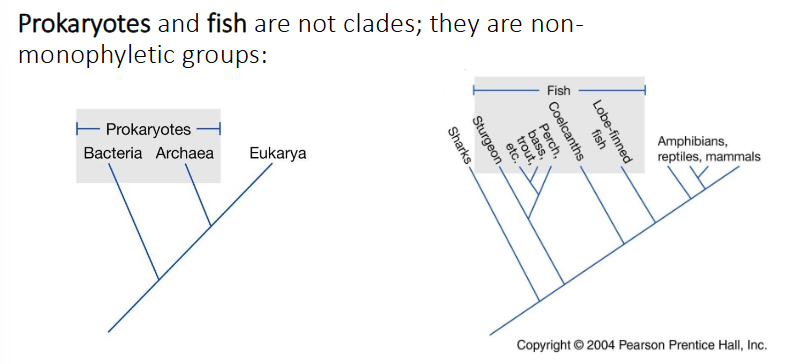
Non-monophyletic groups
do NOT contain all descendants of most recent common ancestor
ex: prokaryotes and fish
Apomorphy
derived trait
Synapomorphy
derived characteristics shared by all members of the clade
unites monophyletic groups
homologous characteristics
Plesiomorphy
ancestral trait
Symplesiomorphy
ancestral traits occurring before MRCA
found in paraphyletic groups
Homoplasy
similar traits because of similar environmental pressures
can unite polyphyletic groups
Analogous characterstics
Parsimony/most parsimonious model
Ockham’s Razor
fewest evolutionary changes is often correct
Outgroup
lineage that split off prior to common ancestor of ingroup
Homologous v.s Analogous Characters
Homo-shared b/c inherited from CA
Ana- shared b/c of similar environments that selected for similar characters (convergent evolution)
Types of Fossils
Preserved remains-compressions, casts/molds, petrified/mineralized, amber
Trace fossils- coprolites, trackways, burrows, nests, gastroliths
Index fossils- help estimate time, widely distributed and easily recognizable
3 Biases in the Fossil Record
Habitat-marine organisms dominate but make up only 10% of living species
Taxonomic- organisms with hard parts dominant without DNA
Temporal- old fossils are very rare
Relative Dating
Deeper fossils=older
used to match distant locations
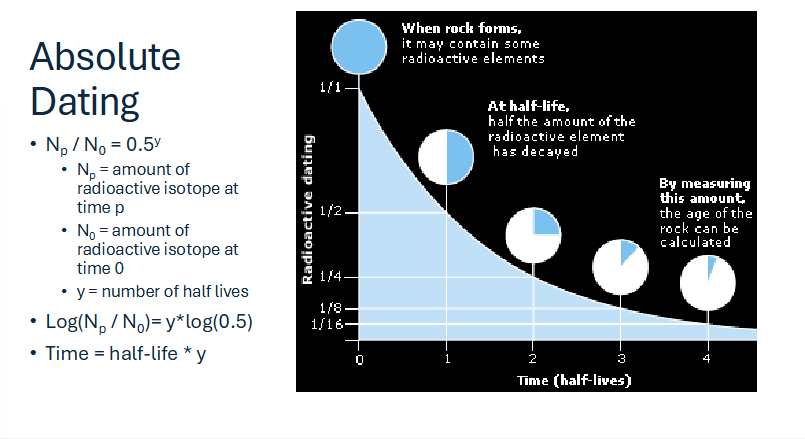
Absolute Dating
Background Extinction
normal rate at which species go extinct
species typically go extinct after 1-10 my of existence
extinction rate < speciation rate
Mass Extinction
extinction rate > speciation rate
60%+ of all species go extinct within a relatively short (<3 million years) geologic time
“Big 5” Mass extinction events are best studied
Primary Extinction
extinction of species whereas secondary extinction is the extinction of a species because of its dependency on another, now extinct species
Secondary extinction
only occurs if another essential species goes extinct
Extinction Cascade
enough primary extinctions in ecosystem cause community to collapse
more diverse ecosystems are more resilient to collapse
Mass extinction-worldwide extinction cascade
5 Big Mass Extinctions
End Ordovician
Late Devonian
Permian Triassic
Triassic-Jurassic
K-Pg Mass Extinction
End Ordovician Mass Extinction
445 MYA
only plants and insects made it to land
60-70% of all species went extinct
Massive glaciation=new climate patterns (glaciation dropped sea levels and changes in ocean circulation deprived depths of oxygen)
brief “ice age” straight into rapid warming period=environmental stress
Late Devonian Mass Extinction
370 MYA
75% species extinct
Volcanism=gases and atmosphere change
led to brief cooling then rapid global warming
increased weathering of rocks oversupplied nutrients to shallow water and oxygen dropped
Permian Triassic Extinction
252 MYA
AKA “Great Dying”, > 90% species extinct
Volcanism released CO2 and Sulfur dioxide
temp increase and acidified ocean, methane hydrates from warming of ocean depleted oxygen and warmed planet
Triassic-Jurassic Extinction
201 MYA
70-80% extinct
massive volcanism, ect.
K-Pg Mass Extinction
66 MYA
75% extinct
Asteroid impact vaporized rock, released CO2 and heat
climate change ensued
What causes mass extinction?
extraordinary and sudden environmental changes
What causes Background extinction?
poor adaptation, specialization, environment change, new competitors, and predators
4 Ways to Survive Mass Extinction
Be able to go dormant
Have wide geographic range (marine bivalve genera w/wide geographic ranges were less likely to become extinct)
Small with many offspring
Have luck!
Whats the equation for the molecular clock?
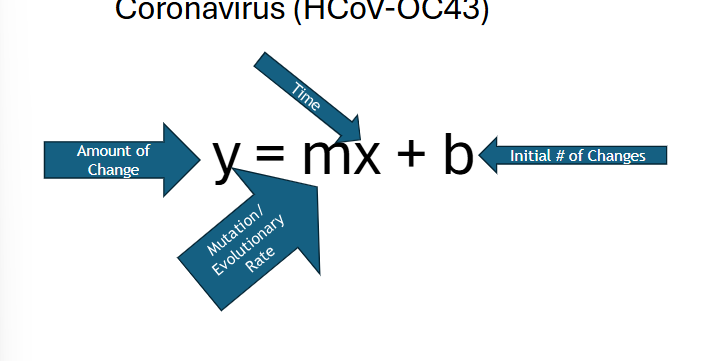
What are the assumptions of molecular clocks?
Constant mutation rate-different genes can have different rates but mutation rate needs to be constant
Mutations are neutral-beneficial mutations “accelerate” mol. clock and high constraint slows it down
Homologous genes- same gene in different species, same as phylogenies
Adaptive Theory v.s Neutral Theory
today we balance adaptive molecular evolution and neutral molecular evolution
reductionist/reductionism= adaptive theory of evolution (same as Darwins)
What other considerations must be made with the molecular clock?
choosing right DNA segment (present in all samples and not under selection)
Calibration (initial # of changes, fossil data, geographic data, known sampling data)
Uncertainty
What is a common use of molecular clocks?
questionable infections to estimate timing and origin of infection
ex: tripoli six
HWE
null model
no mutations
no selection
no migration
random mating
infinite population size
No evolution!
Does Mendelian Inheritance alone cause a change in genotype/allele frequencies? Is Mendelian Inheritance an evolutionary force?
No! B/c its a null model :)
When is a population considered to be in HWE?
genotype frequencies are p² , 2pq, and q²
genotype frequencies are NOT changing over time
Never assume a pop is in HWE!!
Absolute fitness (W)
number of offspring per individual over lifetime
0→ infinite
=1, then individuals replace themselves
Relative Fitness (w)
fitness relative to highest fitness genotype
0→1
=(absolute fitness)/(AF of most fit phenotype)
lets us calculate allele frequency after selection
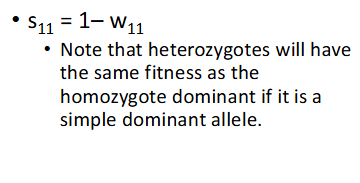
Strength of Selection (s)
difference in fitness between one genotype and another
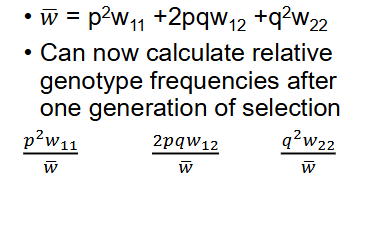
Mean Population Fitness
weighted average of all fitnesses
Single locus v.s many loci for variation in traits?
single=2 alleles=discontinuous variation
many=continuous variation
Polygenic traits
many loci influencing the same trait
# phenotypes=2n+1, n=# of loci
What equation describes variance?
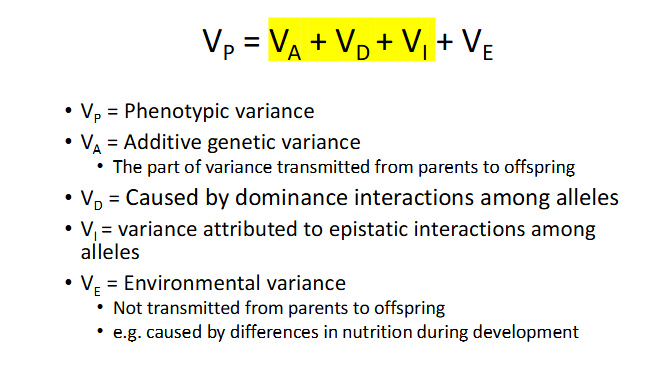
Epistatic Genetic Variation (Vi)
variation due to interactions among loci
Dominance genetic variation (Vd)
variation due to dominance relationships among alleles
Additive genetic variance (Va)
variation due to additive effects of alleles
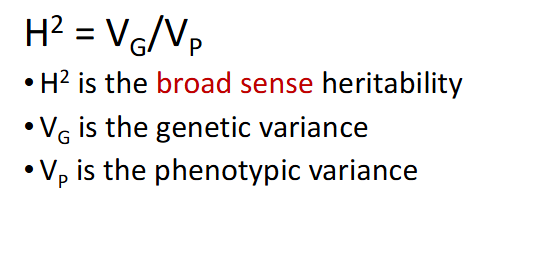
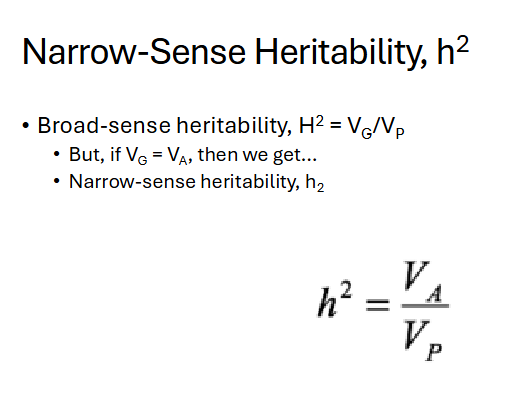
many polygenic traits assume Vg=Va
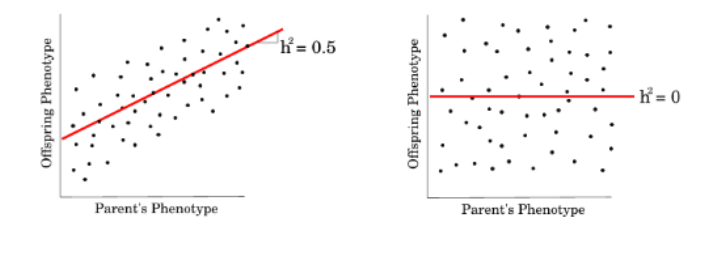
How is heritability calculated?
Variance
measures how much variation exists in population around the mean value
same mean but different variances
Narrow sense heritability
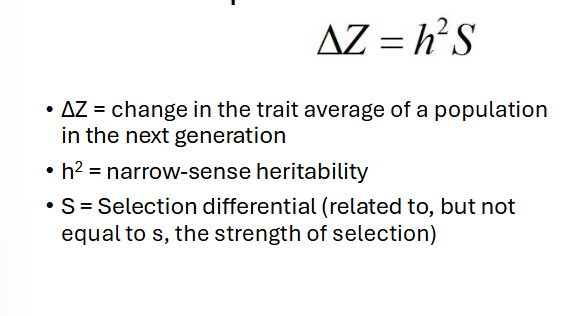
Breeder’s Equation