BIO 204
 Call Kai
 Learn
Learn Practice Test
 Spaced Repetition
 Match
Match Flashcards
 Knowt Play
1/174

There's no tags or description
Looks like no tags are added yet.
Name | Mastery | Learn | Test | Matching | Spaced | Call with Kai | Chat |
|---|
No analytics yet
Send a link to your students to track their progress
175 Terms
What is an atom?
The smallest unit of an element that still behaves and interacts like such element
What is a molecule?
two or more types of atoms bonded together
What are the parts of an atom? Draw and label.
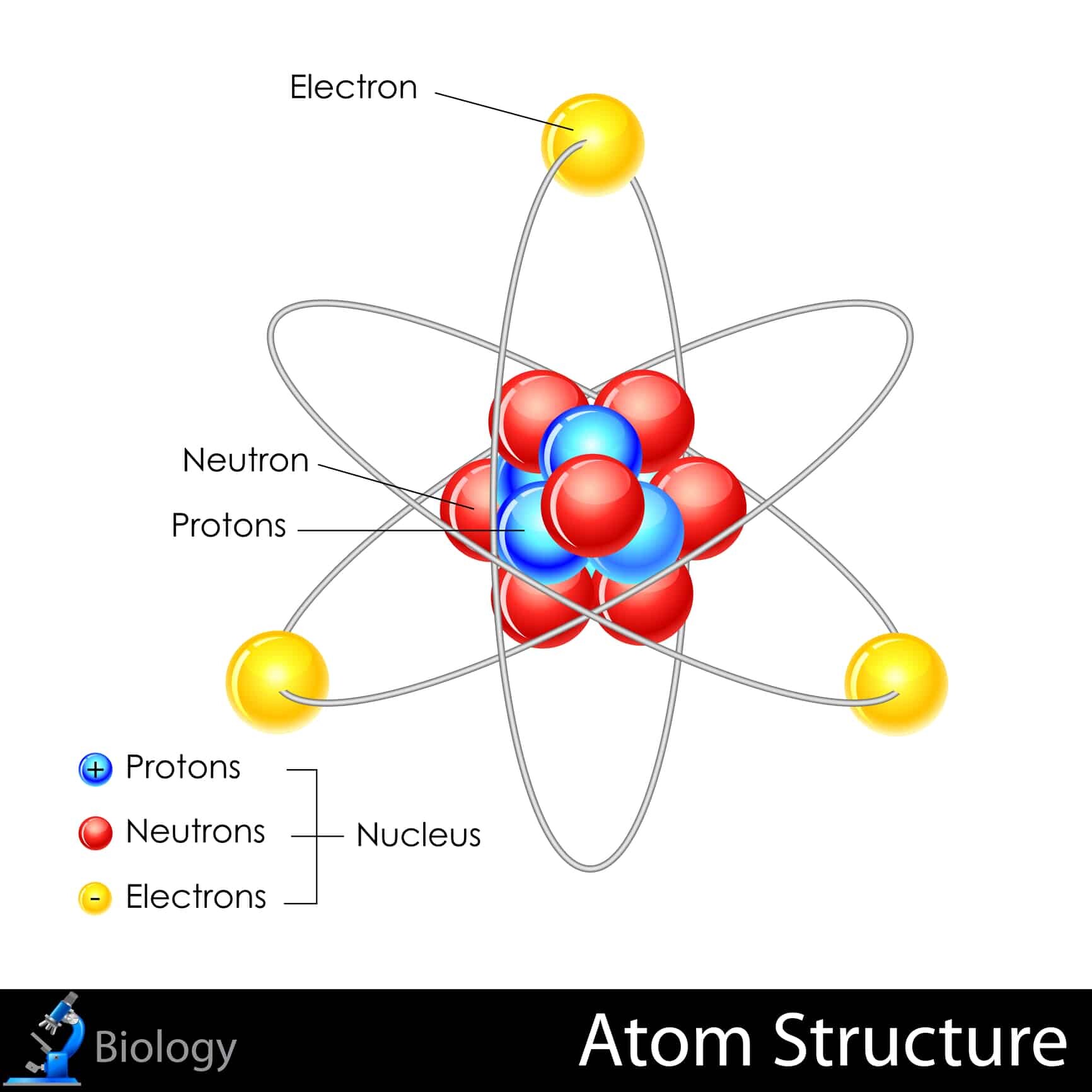
What is the weight of
a proton
a neutron
an electron
Proton - 1 atomic mass unit (amu)
Neutron - 1 atomic mass unit (amu)
Electron - nearly massless compared to the weight of the protons and neutrons
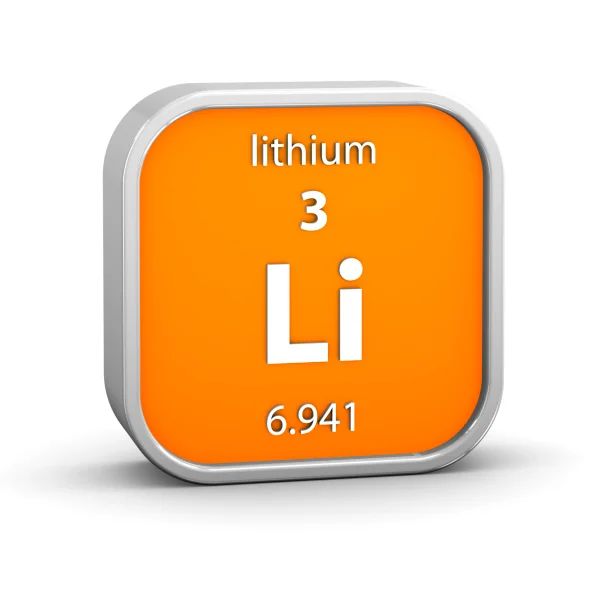
Label and explain each part of the picture
3 - atomic number (also number of protons)
Li - element symbol
6.941 - atomic mass number (the average mass of the element and its various isotopes)
What is an isotope?
A version of an element that has the same number of protons and electrons, but either less than or more than the standard number of neutrons
Why is atomic mass not just a whole number (since mass is measured in AMU, and protons and neutrons make up the mass of an atom and weigh 1 AMU)?
It is the average mass of the element and its isotopes. It is calculated based off of how common each isotope is in nature, so it is multiplying the mass of each natural isotope by its fractional abundance.
What is a valence electron?
The electron(s) on the outermost shell of an atom.

How many electrons are held in each shell of an atom (in terms of biology, 3rd shell is not exact)?
1st shell - two electrons max
2nd shell - 8 electrons max
3rd shell (has 3 sub-shells) - the first two sub shells hold 2 and 6 (8 total) max
For neutral elements, how do you find the number of electrons?
The number of protons (atomic number)
What are two important characteristics about noble gasses when relating to their electrons and interactions?
All electron shells are full
They do not form bonds with other atoms
What are the two fundamental “desires” of an atom? How do they fill these desires?
They want to fill their outer shell
They want to be neutral
by bonding!
What happens to the electrons of atoms in a covalent bond?
the bonded atoms share their electrons to fill their shells
What happens to the electrons of atoms in an ionic bond?
the bonded atoms either give up their electrons or gain electrons from the other atom
What is the new valence electron shell for the atom that gave up their atom(s) during ionic bonding?
The closest, filled shell becomes the new valence shell.
For example, if an atom gave up the electrons on their third shell, the second shell becomes the new valence electron shell.

How can you use the periodic table of elements to find the number of valence electrons for an atom?
For columns 1 and 2, the column number is equal to the number of valence electrons
For columns 13-18, the column number minus 10 is equal to the number of valence electrons
For other columns, this trick does not work and you must perform electron configuration
What are the three kinds of subatomic particles?
protons
neutrons
electrons
What determines each element’s particular chemical behavior?
the number of its subatomic particles
Why are neutrons essential for atoms?
they allow multiple protons to exist in the nucleus and prevent them from repelling against each other because each proton sticks to the attractive neutron
How many protons and neutrons are in hydrogen? Why?
only one proton, no neutrons
since there is no other proton in the nucleus to repel hydrogen’s proton, no neutron is needed
Describe the movement of the different subatomic particles in the nucleus.
proton - still, in the nucleus
neutron - still, in the nucleus
electron - moving rapidly around the nucleus
What is the group of the most stable and “happy” elements called? What makes them stable?
Noble gasses
All of their electron shells are filled, so they are balanced and have no cravings for electrons
Are the noble gasses important for living processes?
Not really
Chlorine has 7 electrons on its third shell, so how “hungry” for electrons is chlorine?
VERY hungry, the most
Lithium and sodium have 1 valence electron, so how hungry are they for electrons? What is the fastest path to getting them stable?
Not hungry
To stabilize, it is easier for them to lose one electron
Carbon has 4 valence electrons, so which is the best path for this element to stabilize? What does this make carbon good for?
it can lose or gain 4 electrons just as easily, both are good
it is an ideal element for carrying on chemical reactions
Based off of the annotated periodic table from the beginning of the semester, from memory, annotate a periodic table describing which side is hungry for electrons, ready to give up electrons, which are ambivalent, and which are stable.
Look to BIO 204 journal pg. 5
What is another element that is “electron neutral”, similar to carbon?
Hydrogen
it just needs one electron, but also only has one electron
so, gaining or losing an electron would make it stable
What is a covalent bond?
a bond between two or more atoms where electrons are shared to fill both of the electron shells and make the atoms more stable
When two oxygen atoms bond together, how many electrons are shared? What is this type of bond called?
four electrons are shared
double bond

Which elements does SPONCH stand for?
Sulfur
Phosphorus
Oxygen
Nitrogen
Carbon
Hydrogen
What is the preferred number of covalent bonds for each element in SPONCH?
Sulfur - 2
Phosphorus - 5
Oxygen - 2
Nitrogen - 3
Carbon - 4
Hydrogen - 1
Think of SPONCH 252(like my student id)341
252341
What type of force is a covalent bond? Describe its strength in relation to other bond types.
Intramolecular force
Very strong compared to other bond types
What happens to an atom when it gains an extra electron? What type of molecule is this called (it is now a molecule because gaining an electron is a result of bonding)?
It becomes negatively charged
It is now an ion (that is bonded w the other molecule)
What happens to atoms like lithium when they lose their electron? What do we call this molecule now?
it becomes positively charged
it is also an ion now (but is still bonded with the other ion)
What happens when a “hungry” atom and an atom that is more ready to give up an atom form a covalent bond? Why? What does this create?
the sharing of electrons is uneven
electrons spend longer around the more “hungry” atom
it creates a partial charge
What do we call molecules with charge separation?
polar molecules
What does it mean that water is maximally polar? What unique ability does this give the molecule?
it has a large separation of charges
it is the “universal solvent” and can dissolve more molecules than any other liquid
What do δ⁺ and δ− indicate? In a water molecule, which would be on the oxygen side and which would be on the hydrogen side?
partially positive and partially negative
the δ− would be on the oxygen side
the δ+ would be on the hydrogen side
Why is it particularly helpful that living cells are 70% water?
a very wide range of chemicals can be used and absorbed
What quality of water make it attracted to itself?
its polarity/partial charge (the δ+ side/H side is attracted to the δ− side/O side)
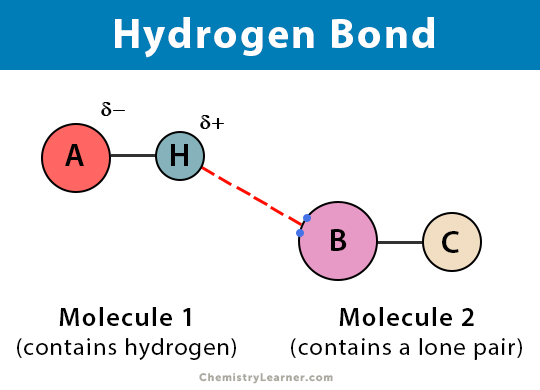
What are the weakest intermolecular interactions called? Describe the interaction?
hydrogen bonds
the partially positive part of a molecule/ion (hydrogen is usually the partially positive part) is attracted to the partially negative part of another molecule/ion
What are the five unusual properties of water?
Heat capacity - the hydrogen bonds between water molecules store heat energy
Hydrogen bonds between water are more separate in the solid form, so ice is less dense and thus floats
It takes a lot of heat energy to break the bonds between multiple water molecules, so evaporation makes the surrounding atmosphere cooler (think of dry heat vs. humid heat)
Cohesion - water molecules stay together strongly in the face of forces like gravity and wind
Polarity - water molecules are attracted to the opposite charges on other water molecules
What does it mean when a molecule is non-polar? Do atoms in a non-polar molecule have the same or different level of “craving” for electrons?
it has no charge and no separation of charges
they have equal affinity for electrons (eg. two hydrogen atoms or a carbon and a hydrogen atom)
What combination of carbon and hydrogen have “electron hoarding” leading to a partial electric charge?
none!
Much of life consists of bonds between which two elements? Why is this?
carbon and hydrogen
all combinations are non-polar and have no separation of charges
What is a consequence of being non-polar? (Why grease doesn’t wash away with water)
water cannot dissolve it
What happens to a molecule that is bonded ionically when it is placed in water? What is one example of this?
it is separated into charged ions
NaCl (salt) dissolves in water
Draw an example of two atoms that would covalently bond.
check with internet
Draw an example of two molecules that would ionically bond.
check with internet
What are two examples of atoms that have a non-polar covalent bond?
Carbon-Carbon, Carbon-Hydrogen
What are four examples of atoms that have a polar covalent bond together?
Carbon-Oxygen
Carbon-Nitrogen
Nitrogen-Hydrogen
Hydrogen-Oxygen
What are two examples of atoms that have an ionic bond together?
Sodium+Chlorine
Lithium+Flourine
Although the electronegativity difference between carbon and oxygen suggests that there would be a polar covalent bond in CO2, what makes CO2 non-polar?
since it has double bonds on both sides that maintain a strong a linear shape, the oxygen on both sides of the carbon pull the electrons at the same force, canceling out the charge
(this is a pretty rare case for biology, though)
What atoms are most likely to be in a covalent bond, sharing electrons (name them and explain why)?
SPONCH
Sulfur, Phosphorus, Oxygen, Nitrogen, Carbon, Hydrogen
They are all not extremely hungry for electrons, but are also not ambivalent to losing them
They are pretty in the middle on the scale of electronegativity
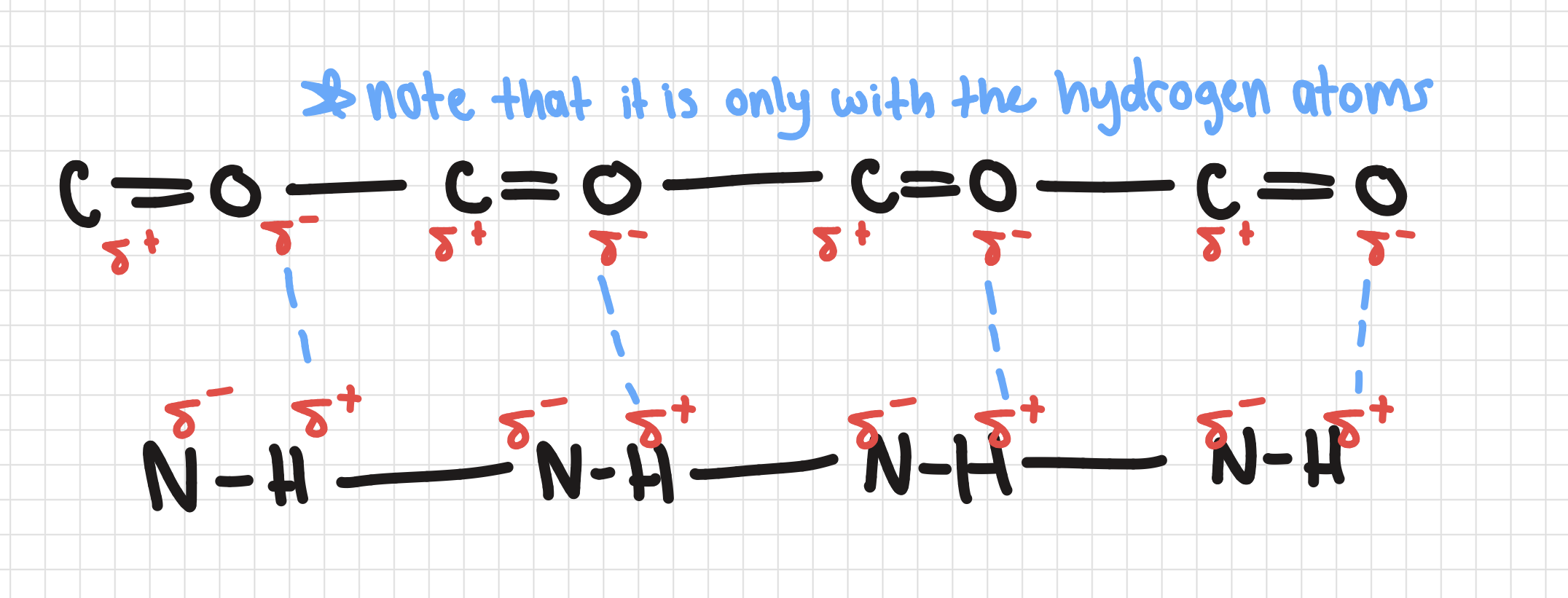
What do hydrogen bonds mostly form between?
between molecules, never atoms
in a very very large molecule, hydrogen bonds will form inside of one molecule
note that it is only ever between charged molecules

Is this molecule polar or non-polar? Why?
polar
although there are both non-polar and polar bonds in this molecule, there are far too little non-polar bonds to cancel out the charges from the polar bonds
In a molecule with polar covalent bonds, which atom has the partial negative charge and which atom has the partial positive charge?
the atom that is more electronegative has the partial negative charge
the atom that is less electronegative has the partial positive charge
Draw and label whether these molecules are polar or non-polar
water, N2, ammonia, methane, and CO2
check with internet
What types of molecules are hydrophilic? What does it mean to be hydrophilic?
ions and polar molecules (charged molecules)
they dissolve in water
What type of molecules are hydrophobic? What does it mean to be hydrophobic?
non-polar, uncharged molecules
they do not dissolve in water
Chapter 2 - Bio Molecules
What are the four classes of biomolecules?
carbohydrates
lipids
protein
nucleic acid
What three elements are in carbohydrates? Which element is it always missing?
So, what is the ratio between these three elements in a carb?
carbon, hydrogen, oxygen
it is always missing nitrogen
C1H2O1
Glucose being C6H12O6

Do lipids have very many or very little oxygens? What three elements are lipids composed of? What element are lipids USUALLY missing?
very little oxygens
Carbon, hydrogen, oxygen
usually also missing nitrogen
What is the backbone of proteins made out of? What is the specific repetition of elements in this backbone?
nitrogen and carbon
NCC-NCC-NCC
*R signifies the amino acid

In each repetition of nitrogen, carbon, carbon in the backbone of a protein, what is attached? Specifically, which atom in each repetition is it attached to?
an amino acid
the central carbon (the central carbon is actually part of the amino acid)
What is the name for the individual building blocks of biomolecules? What is the product called when these building blocks are linked together?
monomer - building block
polymer - monomers linked together
What is the chemical reaction that links polymers together called? (it has two different names)
polymerization
condensation
think, condensation removes water molecules from the air and to CONDENSE is to bring closer together
Describe what goes on in a polymerization reaction. What is the energy requirement?
What is another term for this reaction?
monomers link together to form polymers
a water molecule is taken out
it requires energy input
dehydration condensation
Describe a depolymerization reaction. What is the energy requirement?
What is another term for this reaction?
polymer is broken apart
a water molecule is inserted (think of it as jamming itself in to break the bond)
it generates energy
hydrolysis
What are carbohydrate monomers called? What is the term for two carb monomers together (full+ “slang” term)? What is it called when you join more than two carb monomers?
monosaccharide
disaccharide (“dimer")
polysaccharide
What are the monomers of lipids?
it is not just one type of monomer; there are two specific ones that must be joined to form a lipid
3 fatty acids
a glycerol

Fatty acids are are a long chain of _______ primarily bonded to a _____.
carbons
hydrogen
What is a glycerol? Describe its structure.
one of the lipid monomers
it is a 3-carbon molecule
What is a triglyceride molecule?
a lipid; three fatty acids bonded to a glycerol
What element/version of an element did not exist in primordial earth?
gaseous oxygen (free O2)
Why was the lack of gaseous oxygen important in primordial earth?
if gaseous oxygen was present, molecules would often oxidize (degrade into smaller molecules)
without gaseous oxygen, molecules didn’t degrade and instead POLYMERIZED and eventually formed the biomolecules
What was tested in the famous “Miller & Urey” experiment? What did they find?
they put simple molecules (thought to be common in primordial Earth, including water, H2, N2, methane, ammonia, and carbon dioxide) in a lab setting without oxygen and with high heat and electrical energy
Many of the monomers for today’s biomolecules were formed
While the absence of gaseous oxygen on primordial Earth allowed more polymerization to occur, depolymerization and other chemical changes were also rampant, so molecules could never persist. However, what was the one way a chemical form could persist in these conditions?
by making a template of itself and replicating
nucleic acids
What was the first nucleic acid in primordial Earth that made templates and replicated itself?
RNA/ribonucleic acid
What are the two components/parts of ribonucleic acid? Describe their orientation.
Which component is further divided into two other parts, what are those two parts?
1 to 3 phosphates on the left
Nucleoside on the right
ribose sugar
base (one of the four nucleotides)
What is a nucleotide?
the building block of a nucleic acid; an actual nucleic acid (eg. RNA) are many of these linked together

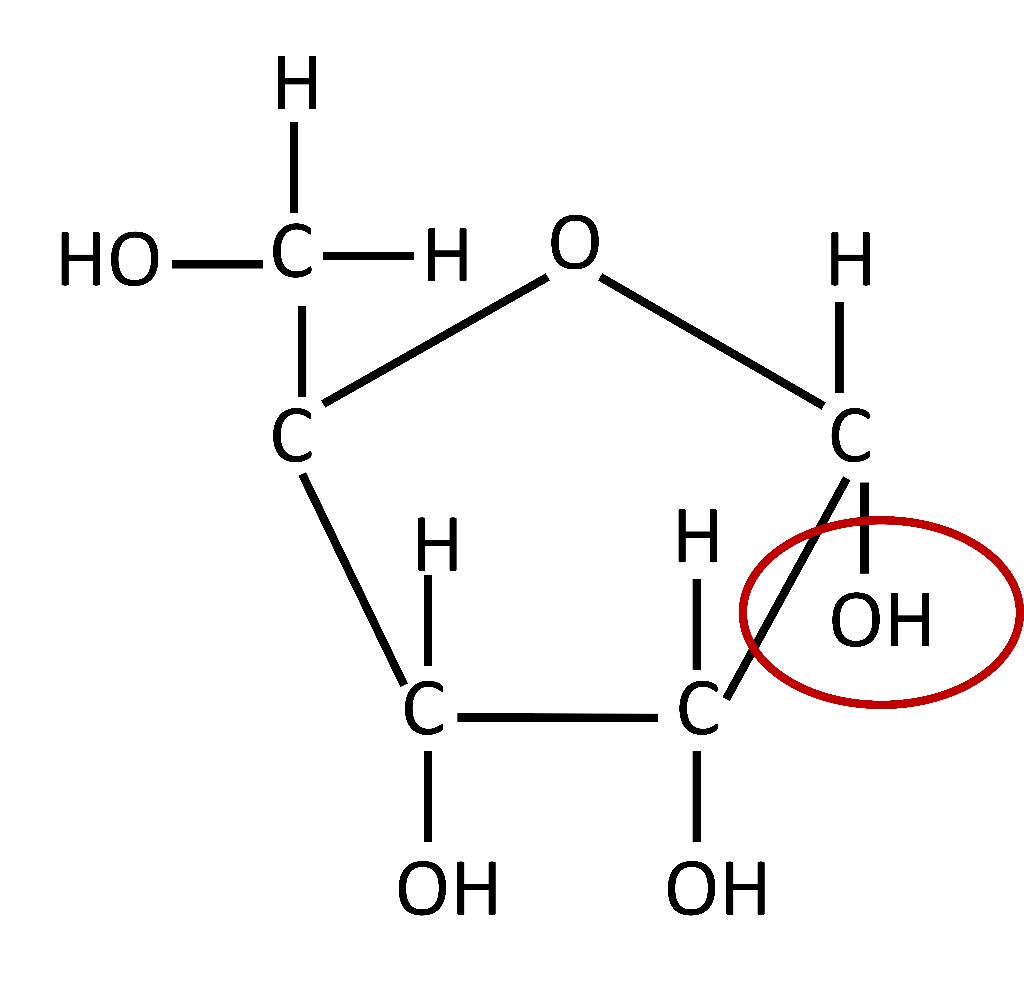
Label the carbons on the ribose sugar.
Which carbon is the nucleotide base connected to?
Which carbon is the first phosphate connected to?
*Draw this out
base binds to 1’ carbon
first phosphate connects to 5’ carbon

What is a nucleoside triphosphate?
a nucleic acid that specifically has 3 phosphates
When undergoing RNA polymerization, where does a nucleoside triphosphate attach its first phosphate?
the OH group of the 3’ carbon

While oligomer is used by the textbook to refer to a parent RNA strand, what is the common definition of the term?
a few subunits bonded together (less than a polymer)
What are the four steps to RNA polymerization?
*Try to draw it out
Nucleoside triphosphate attaches to the OH group of the 3’ carbon (on the ribose sugar)
The other two phosphates break off, generating energy
This energy is used for the polymerization, which then releases H2O molecules
These H2O molecules are used to separate the newly broken off phosphates into individual phosphates, which further releases energy for polymerization
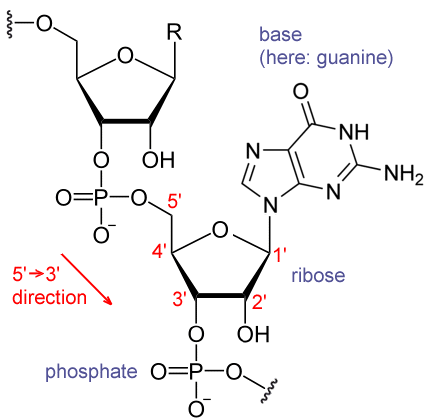
What is a constant fact about carbon’s bonds?"
carbon always makes 4 bonds
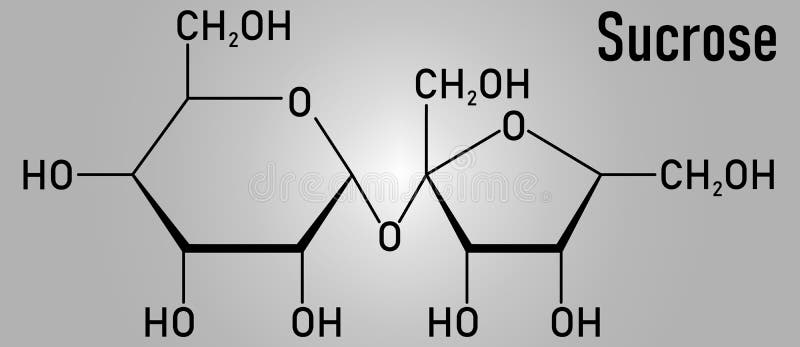
What two things can we assume about each of the unlabeled bends/corners in this molecule?
each corner is a carbon
if not all four bonds to the carbon are drawn, the remaining, undrawn ones are hydrogen

Draw out this molecule, including the unlabeled carbon and hydrogen molecules.
Check with the internet/AI
What is glycosidic bond formation?
polymerization, but specifically for carbohydrates
thus, a glycosidic bond is between two carb monomers
Draw a phospholipid and label the parts. Be as specific as possible.

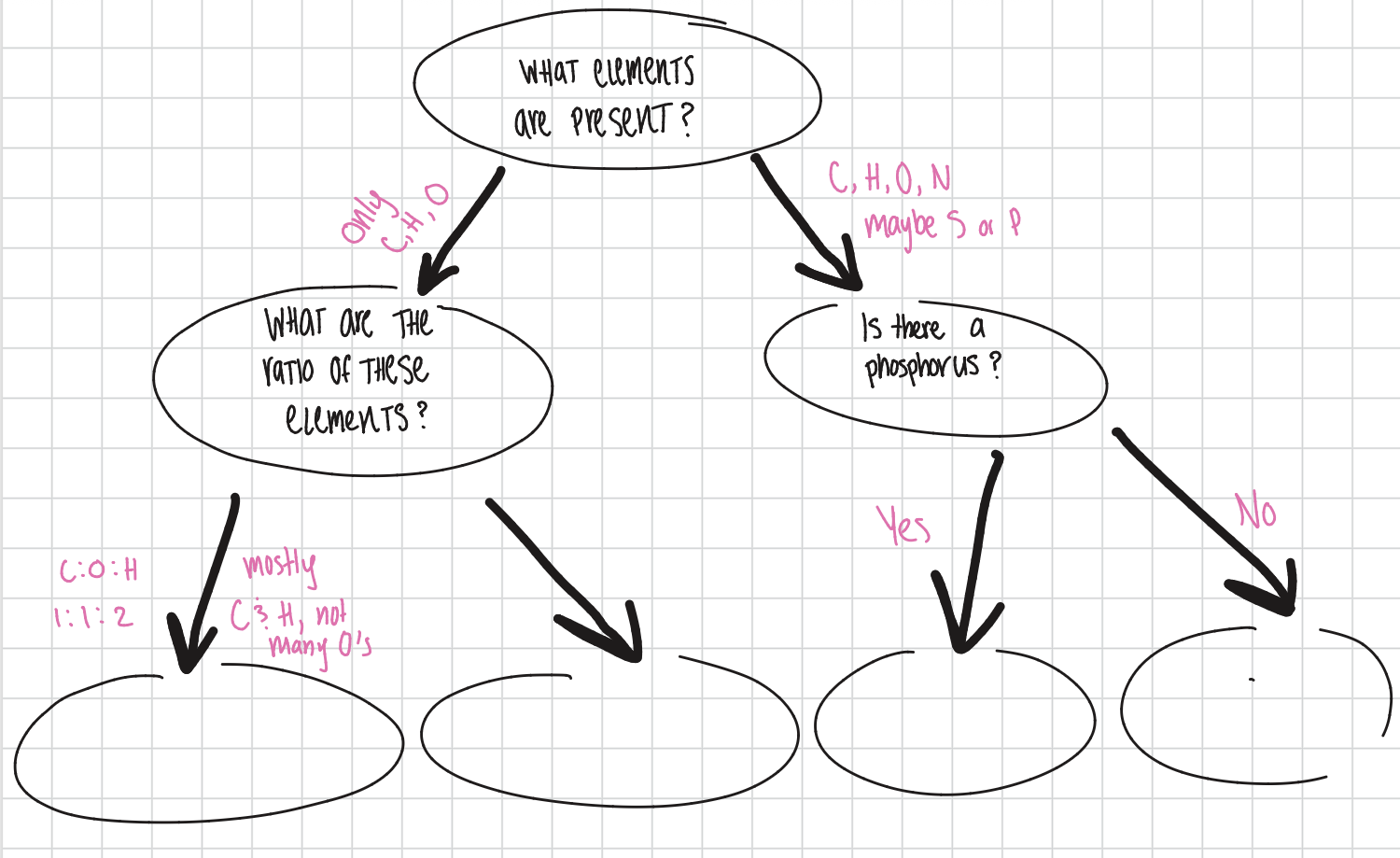
Fill in the bottom bubbles of the flow chart.
Carbohydrate, lipid, nucleic acid, protein
Draw and label the parts of an amino acid. Which part of an amino acid is the only one that changes?
the R group is the only one that changes
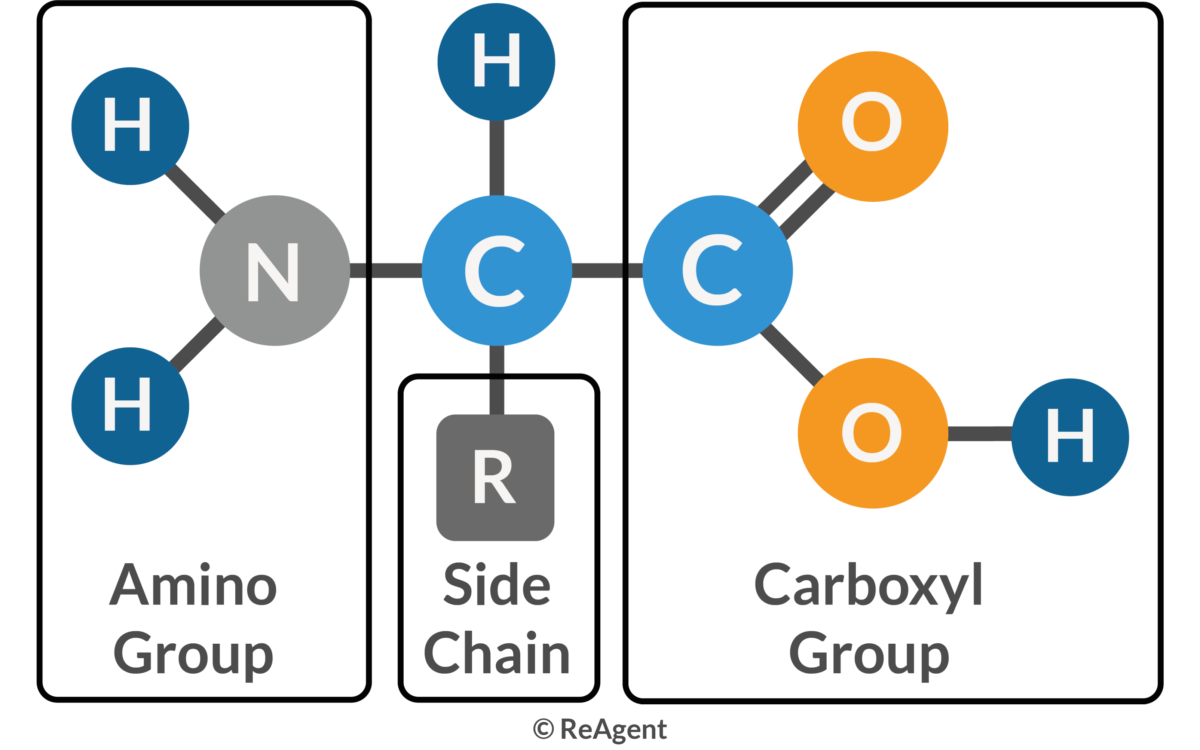
How many different amino acids are there?
20
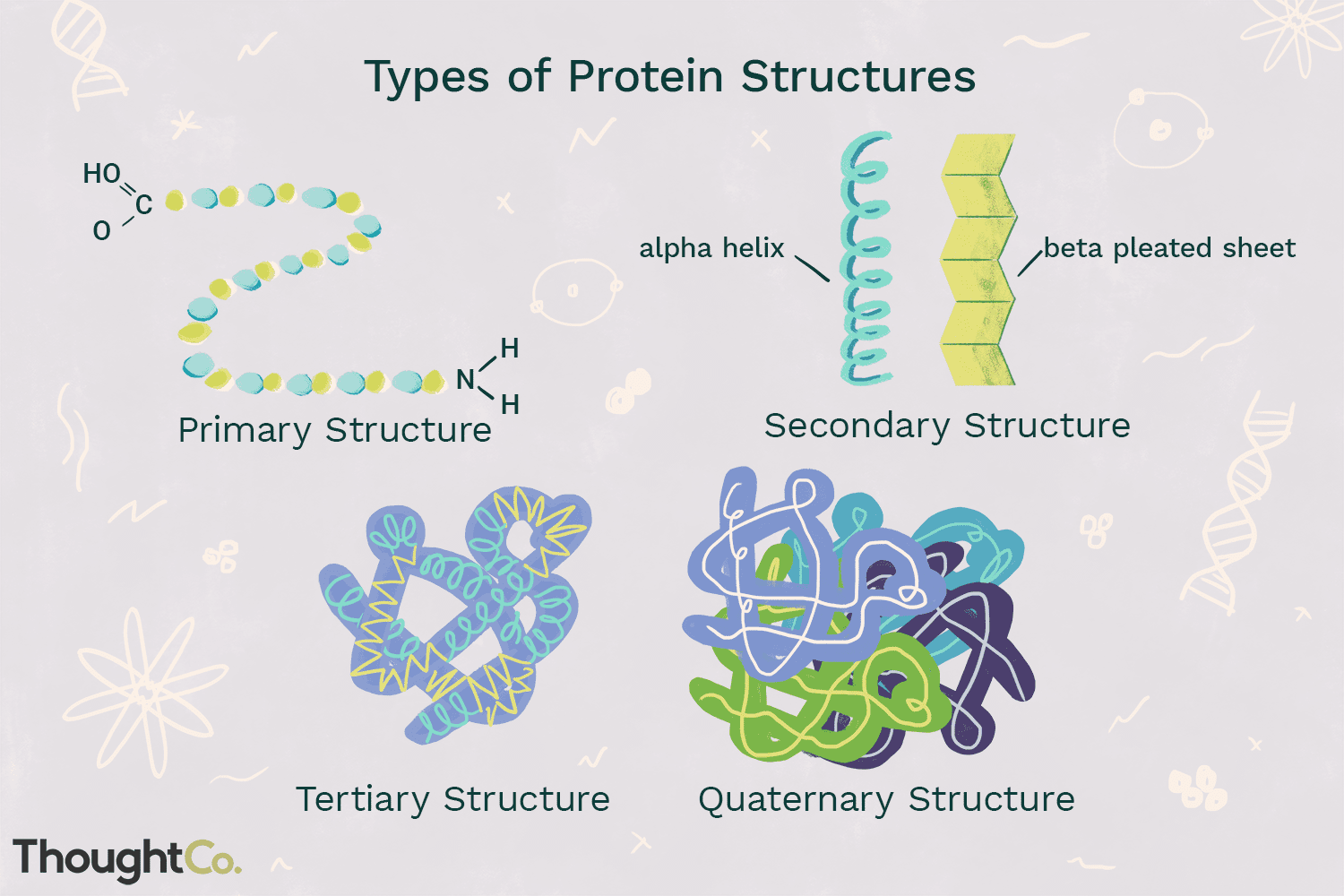
What are the different levels of protein structure? Explain the types and types of bonds for each. Draw each level.
Primary
peptide bonds hold the chain together
Secondary
hydrogen bonds form the polypeptide chain into either an alpha helix or beta pleated sheet
Tertiary
the protein wraps around itself to form a 3D shape, using disulfide bridges, ionic interactions, hydrogen bonds, hydrophobic interactions
Quaternary
multiple chains wrap around each other in a 3D shape using disulfide bridges, ionic interactions, hydrogen bonds, hydrophobic interactions
What are the three types of lipids? What are there purposes?
triglycerides (common lipids in food, for energy storage)
phospholipids (in the cell membrane)
steroids (signaling, hormones like cholesterol)
Look up the structure of asparagine, lysine, and valine. Label whether the R groups are charged, polar, or uncharged.
asparagine = polar, lysine = charged, valine = non-polar

Draw the partial charges and where hydrogen bonds take place (these are the groups on the end of peptide chains (carboxyl and amine group))