chemaitry peroidicity and controlling the rate
 Call Kai
 Learn
Learn Practice Test
 Spaced Repetition
 Match
Match Flashcards
 Knowt Play
1/62

There's no tags or description
Looks like no tags are added yet.
Name | Mastery | Learn | Test | Matching | Spaced | Call with Kai | Chat |
|---|
No analytics yet
Send a link to your students to track their progress
63 Terms
Write equations for the 3 successive ionisation energies of aluminium.
Al(g) -> Al+(g) + e-;
Al+(g) -> Al2+(g) + e-;
Al2+(g) -> Al3+(g) + e-
YOU must add the symbols of gas
How and why does ionisation energy change across a period and down a group?
Down a group: decreases - more shells shield the outer electron, easier to remove. Across a period: increases - more protons = more nuclear charge = more energy needed to remove electron.
Define electronegativity, and explain how/why it changes down a group and across a period.
Electronegativity is how strongly an atom pulls on shared electrons in a chemical bond.
Decreases down a group (more shielding); increases across a period (more nuclear charge). Lowest: Fr, highest: F.
What type of bond forms when there is a large electronegativity difference, and why do noble gases have no electronegativity value?
An ionic bond forms, as the bonding electron(s) are essentially transferred rather than shared. Noble gases have no value because they already have a full outer shell.
What is the size difference between a metal cation and its atom?
Metal cations are smaller than their atoms - they lose their outer electron shell, and the remaining electrons are held more tightly by the same nuclear charge.
What is the size difference between a non-metal anion and its atom?
Non-metal anions are larger than their atoms - they gain extra outer electrons with the same nuclear charge, so electrons are held less tightly.
Why is the covalent radius of sodium larger than its ionic radius (Na+)?
Covalent Radius (Neutral Atom): Measures a neutral sodium atom (\(Na\)) with 11 electrons spread across 3 shells (\(2, 8, 1\)).
Ionic Radius (Always an Ion): Measures the sodium cation (\(Na^{+}\)). It loses its lone valence electron, completely eliminating the 3rd electron shell.
Increased Proton Pull: The nucleus still has 11 protons pulling inward, but now only 10 electrons total.
The Result: One less electron shell combined with a stronger inward nuclear pull makes the ionic radius significantly smaller than the covalent radius.
What are the trends in ionic radius across a period and down a group?
Down a Group (Increases):
Elements gain more electron shells as you go down.
More shells create a shielding effect, pushing electrons further out.
Result: Ionic radius increases down a group.
Across a Period (Decreases, with a split):
Protons increase across a period, pulling electrons tighter toward the nucleus.
The Split: Cations (positive ions) lose electrons and drop a shell, making them very small. Anions (negative ions) gain electrons, expanding due to electron repulsion.
Result: While anions are larger than cations, the overall trend decreases within each group (cations decrease, then anions decrease).
Define first ionisation energy, with equation.
The minimum energy required to remove one electron from each atom in one mole of gaseous atoms. M(g) -> M+(g) + e-
Define second ionisation energy, with equation.
The minimum energy required to remove one electron from each ion in one mole of gaseous 1+ ions. M+(g) -> M2+(g) + e-
Define third ionisation energy, with equation.
The minimum energy required to remove one electron from each ion in one mole of gaseous 2+ ions. M2+(g) -> M3+(g) + e-
What happens to the covalent radius as you go down a group?
It increases - more electron shells shield the outer electrons from the nucleus, so they are pulled less tightly.
What happens to the covalent radius as you go across a period?
It decreases - more protons increase nuclear charge, with no extra shielding, so outer electrons are pulled in tighter.
What is shielding?
The inner, filled electron shells reduce the attractive pull of the nucleus on the outer electrons. More shielding = larger radius.
What is ionic radius?
The distance between the nucleus and the outer electron shell of an ion.
What is a cation and an anion?
Cation: a positive ion, formed by losing electron(s). Anion: a negative ion, formed by gaining electron(s).
Explain the difference in atomic size between lithium and fluorine.
Fluorine has more protons (9) than lithium (3) in a similar energy level, so it has a bigger nuclear charge, pulling its outer electrons in tighter and making the atom smaller.
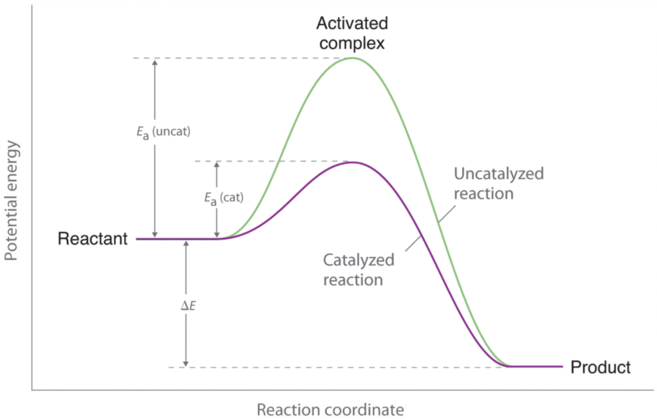
Remember this diagram - how a catalyst compares to no catalyst.
Maxwell-Boltzmann distribution showing Ea with a catalyst (lower) and without a catalyst (higher); the shaded area shows particles with enough energy to react.

What are the three types of catalyst, with examples?
Heterogeneous (different state, e.g. Haber process - solid Fe catalyst, gaseous reactants); Homogeneous (same state); Biological/enzyme (in plants and animals).
How does a catalyst in a different state work?
Absorption of reactants onto the catalyst surface weakens their bonds, holds them in the correct orientation to react, then releases the products.
What are the meanings of exothermic and endothermic reactions?
Exothermic: releases energy to surroundings, temperature rises, e.g. combustion. Endothermic: absorbs energy from surroundings, temperature falls.
What is enthalpy change (delta H)?
The difference in energy between the products and the reactants.
Draw and label an exothermic reaction profile - why is delta H always negative?
Reactants start higher than products, energy rises to a peak (activated complex, Ea) then falls to products. Because products have less energy than reactants, delta H is always negative.

Draw and label an endothermic reaction profile - why is delta H always positive?
Reactants start lower than products, energy rises to a peak (activated complex, Ea) then falls (but not as low) to products. Because products have more energy than reactants, delta H is always positive.

How can enthalpy change be calculated?
Deltas = Energy of products - Energy of reactants
What happens to delta H between a catalysed and an uncatalysed reaction?
Delta H remains the same - a catalyst only lowers the activation energy, not the energy of reactants or products.
How are elements organised in the periodic table?
By increasing atomic number.
What is a period?
A horizontal row of elements in order of increasing atomic number, showing an increase in outer electrons across the row.
What is a group?
A vertical column of elements with similar chemical properties due to a common number of outer electrons.
Group 1 & 7: what happens to atomic size and electron shielding down the group, and why?
Atomic size increases and electron shielding increases, because more electron shells are added going down the group.
How does reactivity change going down Groups 1 & 7?
Group 1: increases (easier to lose outer electron - further from nucleus, more shielding). Group 7: decreases (harder to gain an electron - nucleus too far/shielded to attract one).
How do melting and boiling point change going down Groups 1 & 7?
Group 1: decreases (weaker metallic bonds as atoms get bigger). Group 7: increases (stronger van der Waals forces as molecules get bigger).
What happens to density as you go down Groups 1 & 7?
Increases - the atoms become heavier.
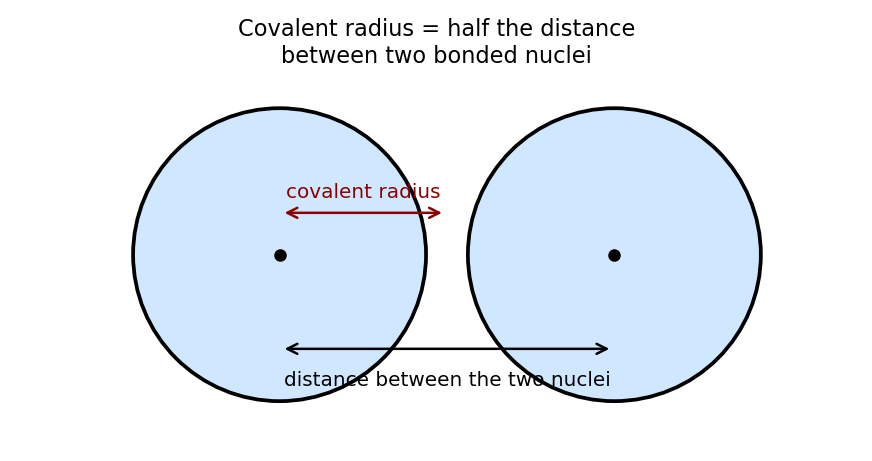
What is covalent radius?
Half the distance between the nuclei of two atoms joined by a covalent bond.
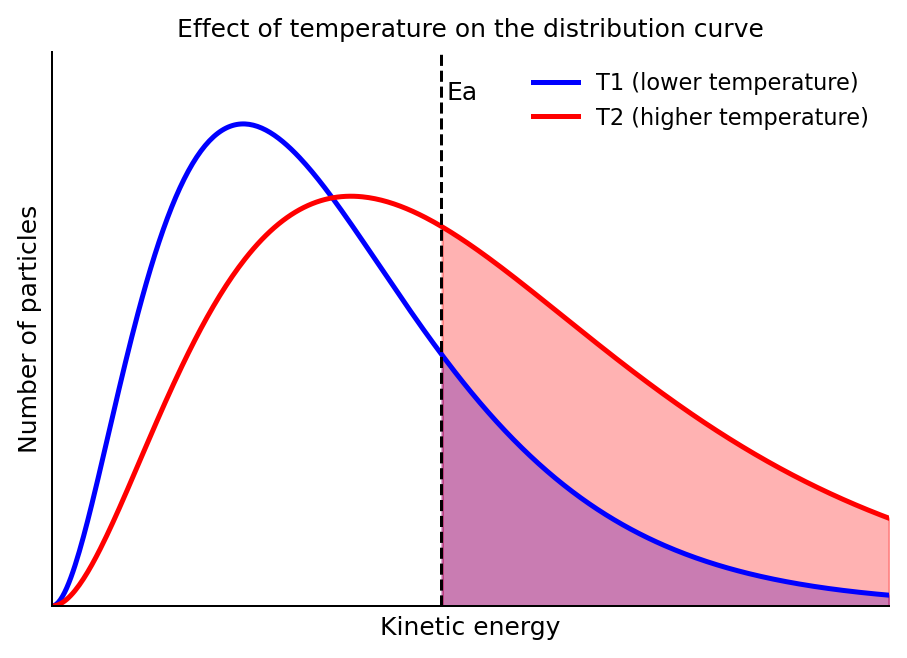
What are the effects of temperature on the Maxwell-Boltzmann distribution curve?
Higher temperature spreads the curve out and shifts it right, so more particles have energy greater than or equal to Ea, increasing the rate.
Why does increasing the concentration increase the reaction rate?
More reactant particles per unit volume causes more frequent collisions with energy >= Ea.
Does increasing the surface area change the amount of product formed?
No - it has no effect on the amount of product formed, only on the rate.
Why does decreasing particle size increase the reaction rate?
It breaks a solid into smaller pieces, exposing more surface area, increasing the frequency of successful collisions.
What are the advantages of using a catalyst?
It increases the rate of reaction and is not used up during the reaction (mass unchanged).
How does a catalyst increase the rate of reaction?
It provides an alternative pathway with a lower activation energy, so more particles have sufficient energy to react, allowing lower reaction temperatures.
How does a catalyst work?
It brings particles together in the correct orientation so they can collide and react more easily.
Why must the reaction rate be controlled in an industrial process?
Too low a rate is not economically viable; too high a rate can cause a thermal explosion.
What two ways can the rate of a reaction be described?
Decrease in concentration of a reactant over time, or increase in concentration of a product over time.
What 5 ways can the change in concentration be monitored?
Mass change, volume of gas, colour change, pH change, electrical conductivity.
What is a reliable way to measure gas?
A gas syringe.

How do you calculate the average rate of reaction, and when is it used?
Average rate = delta quantity / delta time. Used to find the rate over a specific period of time.
How do you calculate relative rate, and when is it used?
Relative rate = 1/t. Used for a clock reaction, where the reaction finishes with a sudden change.
What are the five factors that affect reaction rate?
Pressure, temperature, particle size, catalyst, concentration.
What is the meaning of activation energy?
The minimum kinetic energy required by colliding particles before a reaction can occur.
What is the activated complex?
An unstable, high-energy arrangement of atoms formed at the peak of a chemical reaction.
What are the four factors that influence whether a collision results in a successful reaction?
1) Enough energy (>= Ea). 2) Correct collision geometry. 3) Enough energy to break existing bonds and overcome repulsion. 4) Chance of collision decreases as the reaction proceeds, so rate decreases.
What is the energy requirement for a successful reaction?
Particles must collide with kinetic energy greater than or equal to the activation energy.
What is the geometry requirement for a successful reaction?
Particles must collide with the correct orientation.

What are the effects of temperature on rate?
As temperature increases, rate increases - particles have more kinetic energy, move faster, collide more frequently and successfully, and more particles have energy >= Ea.