Clin Lab IV: Virology/Serology Review
 Call Kai
 Learn
Learn Practice Test
 Spaced Repetition
 Match
Match Flashcards
 Knowt Play
1/44

There's no tags or description
Looks like no tags are added yet.
Name | Mastery | Learn | Test | Matching | Spaced | Call with Kai | Chat |
|---|
No analytics yet
Send a link to your students to track their progress
45 Terms
**What are monocytes called once they have migrated to various tissues and organs?
Macrophages.
**Viruses are what type of parasite?
Obligate intraceullar.
**The virus will first encounter the body’s ____________ immune system and then it encounters the ____________ immune system.
Innate; adaptive.
How are viruses classified?
By host or chemical and physical properties.
**What does the nuclear material of a virus consist of?
RNA or DNA; never both.
**Are viruses larger or smaller than bacteria?
**Do they require a specialized microscope to visualize?
Smaller
Yes; electron or fluorescent microscope.
**A virus that does not possess an envelope is called a:
Naked virus (non-enveloped).
Are enveloped or non-enveloped viruses harder to kill and disinfect?
Non-eneveloped.
**What viral structure is the infectious part of the virus?
Nucleic acid.
**What viral structures protect the nucleic acid core and help the virus attach to a susceptible host?
Protein coat/capsid + capsule/envelope.
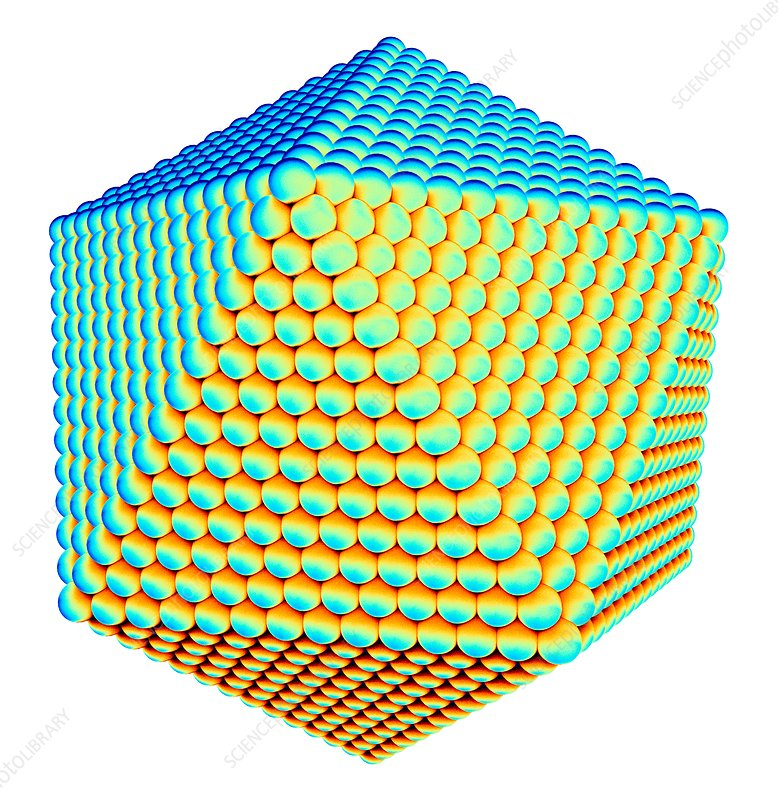
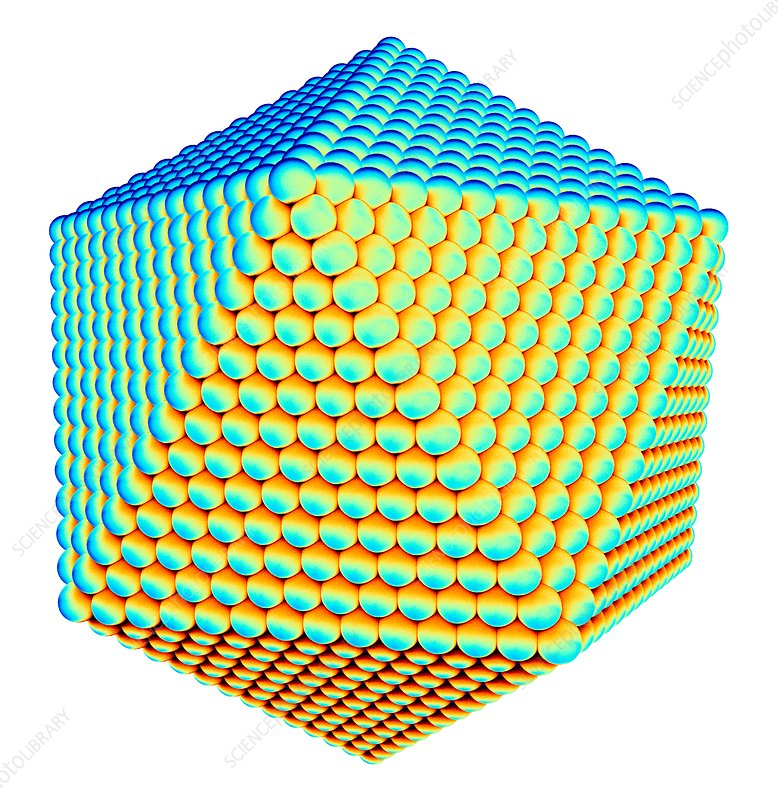
**What viral shape looks like a polyhedron (having many sides/surfaces)?
Icosahedral.
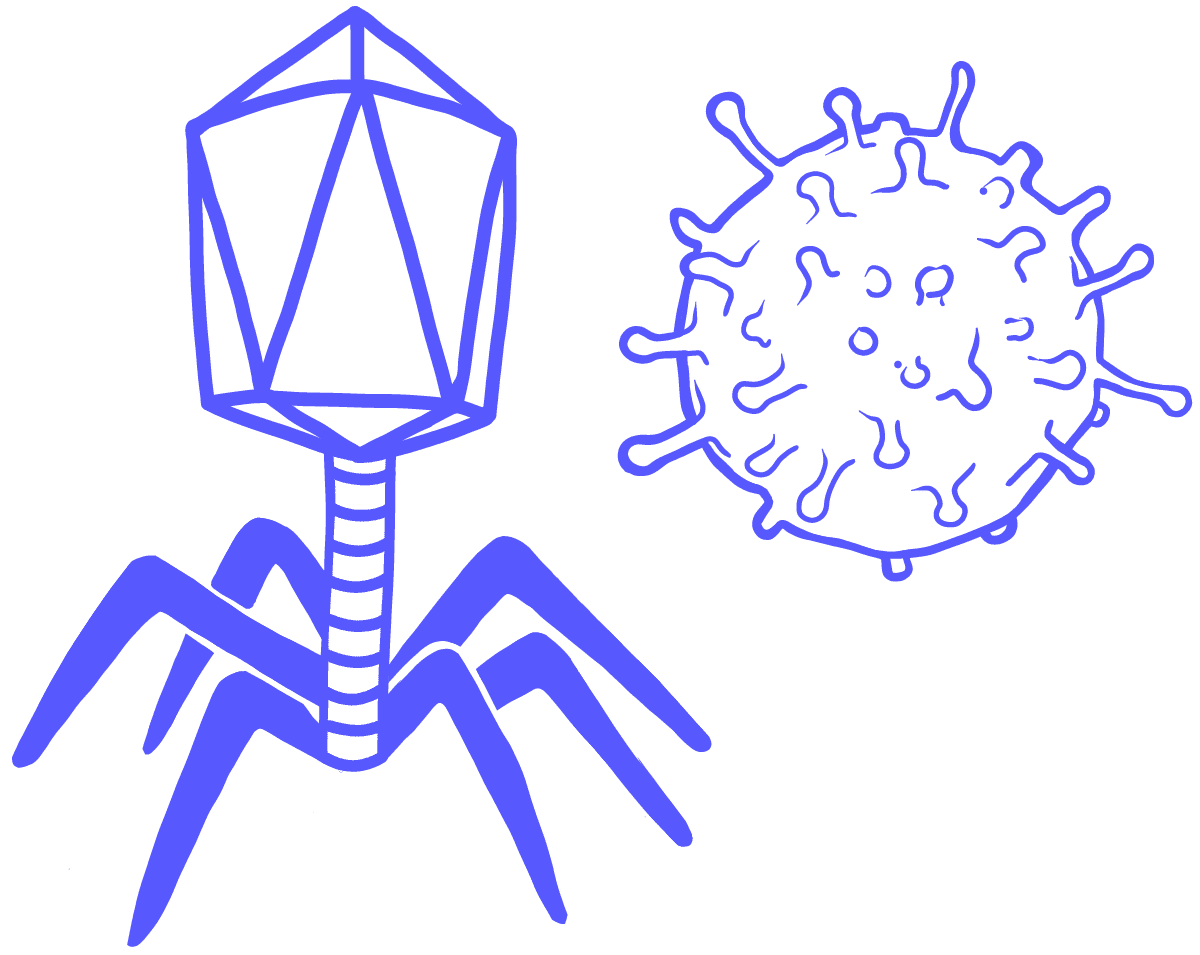
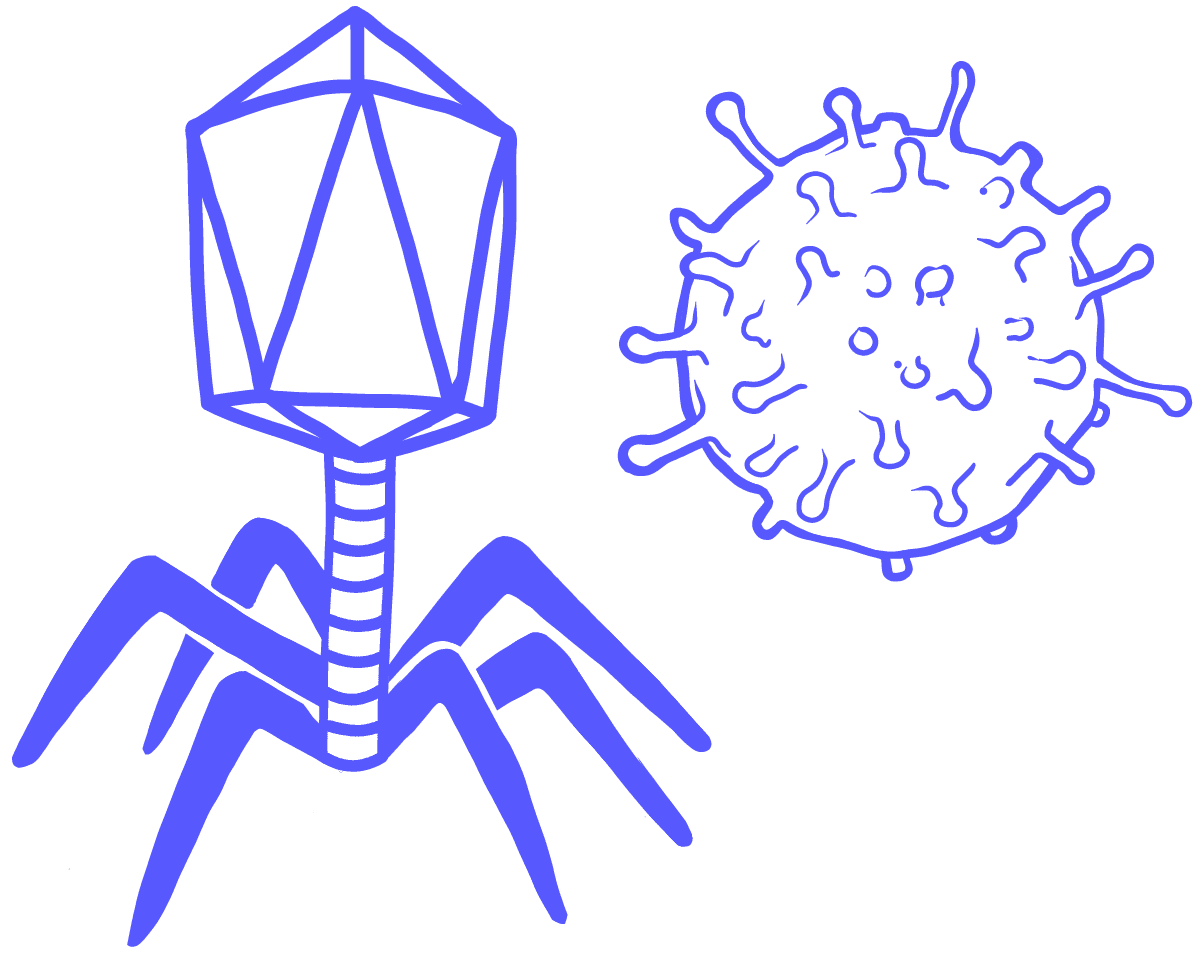
**What viral shape is a combination of forms and has leg-like structures?
Complex.
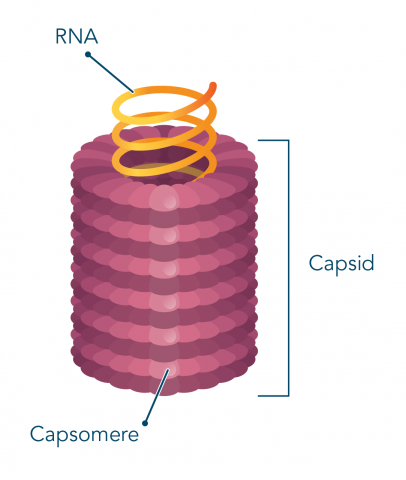
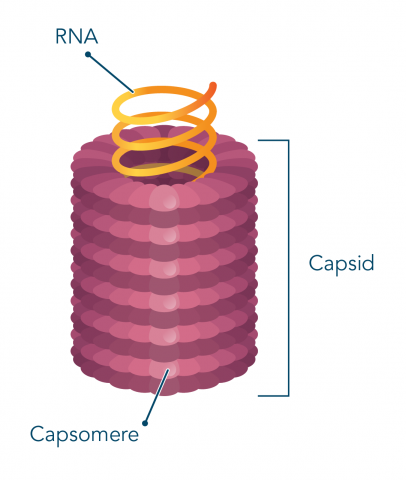
**What viral shape is a coiled structure, similar to a long rod?
Helical.
**Where in the cell does DNA replicate?
Nucleus.
**Where in the cell does RNA replicate?
Cytoplasm.
**What phase of viral replication involved entry into the cell via viropexis/endocytosis?
Penetration.
**Which phase of viral replication is considered the non-infective period?
Latent period.
**What phase of viral replication involves before entering the cell, the virus must attach itself to specific receptor sites on the host cell?
Attachment.
**What phase of viral replication is where the new virus is released from the cell causing the cell to be destroyed?
Release.
**What phase of viral replication involves the viral nucleic acid directs the host cell to make more viral nucleic acid, protein, and enzymes, thus producing thousands of copies of itself to survive?
Replication.
**Which phase of viral replication involves the release of nucleic acid into the host cell?
Uncoating.
**Which phase of viral replication involves nucleic acid and protein are assembled into a new, mature virus?
Assembly.
**What is a bacterial virus called?
Bacteriophage.
**What is unique about bacterial viruses in regards to how it transfers the nuclear material (DNA)?
The entire bacteriophage doesn’t enter the bacterium, the tail injects DNA into the bacterium.
**The function of interferon is to inhibit what?
Viral multiplication/replication.
What are the three types of interferons?
Alpha
Beta
Gamma
**Can abx therapy cure most viral infections?
No.
**What can be done to prevent the spread of most viral infections
Practice good health measures such as goos hygiene, vaccinate animal possible/keep vaccines current.
**What does a virus require to replicate?
Living tissue/living host animal.
**What is an antibody titer measuring?
The level of antibodies in serum.
**During the time of ___________ the animal may be febrile, and this is when the greatest number of microorganisms are present; therefore it is more ilkely to transmit the infectious agent at this time.
Clinical illness.
**Continues production of antibodies after the animal is no longer ill is referred to as the:
Convalescent phase.
**What two blood tubes are commonly used for serological testing and would those tubes yield plasma or serum?
Red: serum
Purple (lavender)": serum
**If you are uncertain about specific requirements needed for a sample you are sending to an outside lab, what should you do?
Contact the lab.
**For serological testing specifically, how long and at what speed is the blood sample centrifuged for?
10 minutes
No faster than 1500 rpm.
So it doesn’t damage the proteins/immunoglobulins).
**Using a wooden applicator stick to loosen a clot after centrifugation is termed:
Rimming or ringing.
**Is the presence of antibodies to a particular organism in an animal’s serum always a simple and absolute diagnosis of illness cause by that organism?
No.
**In most situations, it may require the collection of 2 samples; one sample early in the disease/illness or _________ phase and again later during the ____________ phase to demonstrate a change in the antibody titer indicating recent antigenic stimulation.
Acute; convalescent.
**In regards to the previous question, the change must be at least 2 dilution increments (fourfold/4x) to be considered diagnostically significant, this is known as:
Seroconversion.
**The presence of antibodies in serum can also be reported what two ways and which of the two is less diagnostic?
Quantitively
Qualitatively— less diagnostic
**In regards to the previous question, which one reports the presence of antibodies in serum as positive or negative?
Qualitatively.
**What immunoglobulin is the first antibody type produced in response to an antigen and comprises only 5% of the circulating immunoglobulins?
IgM.
**What immunoglobulin is the most abundant, comprising 75% of the circulating immunoglobulins, and remains in circulation the longest?
IgG.
**If the antibody response to a virus of the ________ type, the animal has recently been exposed and if the response is mostly of the __________ type, it was exposed several weeks to months previously.
IgM, IgG.
What are the most frequent mistakes made when performing seroligical etsting?
The use of dirty or contaminated equipment
Failure to adhere to instructions (especially incubation times)
Unfamiliarity with reading results.