Science notes - Bright Sparks
0.0(0)
Studied by 1 person Call Kai
 Learn
Learn Practice Test
 Spaced Repetition
 Match
Match Flashcards
 Knowt Play
Card Sorting
1/4

Earn XP
Last updated 5:01 AM on 3/18/23
Name | Mastery | Learn | Test | Matching | Spaced | Call with Kai | Chat |
|---|
No analytics yet
Send a link to your students to track their progress
5 Terms
1
New cards
- Assess risks associated in using electric circuits.
Electrocution/electric shock: it will interfere with, or possibly stop your breathing, and if severe may cause death.
Explosion: caused by unsuitable electrical apparatus or static electricity igniting flammable vapours
Explosion: caused by unsuitable electrical apparatus or static electricity igniting flammable vapours
2
New cards
- Describe voltage, current and resistance in terms of energy applied, carried, and dissipated.
Voltage: A measure of the electrical energy carried by the charges in a circuit. The energy is applied.
Current: The flow of charge in a circuit is called an electric current. The energy is carried.
Resistance: A measure of how difficult it is for electrons to flow through part of a circuit The energy is dissipated
Current: The flow of charge in a circuit is called an electric current. The energy is carried.
Resistance: A measure of how difficult it is for electrons to flow through part of a circuit The energy is dissipated
3
New cards
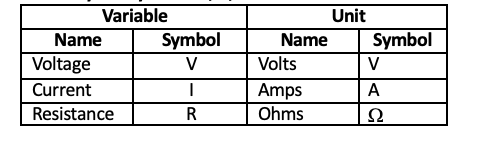
- Identify the symbols V, R, and I
4
New cards
- Compare the characteristics and applications of series and parallel circuits.
In a series circuit the components are connected one after another in a row. The same current flows through each component, however the voltage provided by the power supply is shared between each of the components.
In a parallel circuit the components are connected in separate branches. The current is divided between each of the components in the separate branches, but each branch uses the full voltage provided by the power supply.
In a parallel circuit the components are connected in separate branches. The current is divided between each of the components in the separate branches, but each branch uses the full voltage provided by the power supply.
5
New cards
- Outline recent examples where scientific or technological developments have involved specialist teams from different branches of science, engineering, and technology, e.g., low-emissions electricity generation and reduction in atmospheric pollution.
Wind turbines: The wind makes the blades turn that makes a generator spin inside the fan producing electricity. There are copper windings that turn through a magnetic field in the generator which produces electricity. The electricity is passed through a transformer on site which makes the energy available for people to use.