3 - Equilibrium, Resting Membrane, and Action Potentials
 Call Kai
 Learn
Learn Practice Test
 Spaced Repetition
 Match
Match Flashcards
 Knowt Play
1/150

There's no tags or description
Looks like no tags are added yet.
Name | Mastery | Learn | Test | Matching | Spaced | Call with Kai | Chat |
|---|
No analytics yet
Send a link to your students to track their progress
151 Terms
resting membrane potential (RMP)
Potential difference that exists across membranes in the period between action potentials
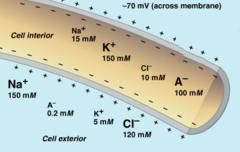
diffusion potentials
RMP is established by _____
down
RMP is defined as the potential difference generated across a membrane when a charged ion diffuses [up/down] a concentration gradient
true
A RMP can be positive or negative. True or false?
charge of ion
A RMP can be positive or negative, depending on what?
K+ leak channels; Na+/K+ ATPase pump
A RMP is set by _____ and maintained by _____
most
Ions with high permeabilities contribute [most/least] to RMP
high
K+ and Cl- are ions with [high/low] permeabilities, and therefore contribute most to RMP
false
K+ is not separated from immobile anions inside cell. True or false?
-70 to -90 mV
What is usually the RMP range?
K+; K+
Na+/K+ ATPase helps maintain _____ concentration gradient across the cell membrane and set _____ diffusion potential
true
Resting membrane potential always close to potassium equilibrium potential. True or false?
Na; K
RMP is negative because more _____ ions outside cell than _____ ions inside cell
more
Membrane is [more/less] permeable to K+ than Na+
-85; -90
K equilibrium potential is _____ to _____ mV
lower
K+ is in equilibrium when cell is 85-90 mV [higher/lower] than EC environment
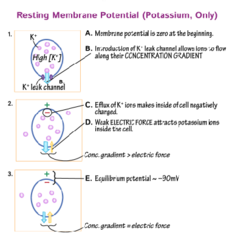
K+ equilibrium potential
_____ is point at which movement of K+ INTO cell because of negative electrical potential is balanced by diffusion of K+ OUT of cell due to concentration gradient
into; out
K+ equilibrium potential is point at
which movement of K+ [into/out] cell
because of negative electrical
potential is balanced by diffusion
of K+ [into/out] of cell due to
concentration gradient
equal; opposite
At K+ equilibrium, electrical and diffusion forces are _____ and _____
+65 mV
What is the typica equilibrium potential value for Na+?
+120mV
What is the typica equilibrium potential value for Ca2+?
-85 mV
What is the typica equilibrium potential value for K+?
reviewed
Review
driving force
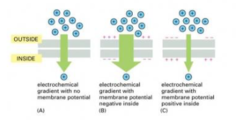
Difference between the measured membrane potential and the ion's calculated equilibrium potential
cation; anion
When driving force is negative, ion will enter cell if it is a _____ and leave cell if it is an _____
negative
When driving force is [positive/negative], ion will enter cell if it is a cation and leave cell if it is an anion
equilibrium
Membrane potential is too negative - try to bring it towards _____ potential
action potential (AP)
Transmit information in nervous system and all muscle
depolarization; repolarization
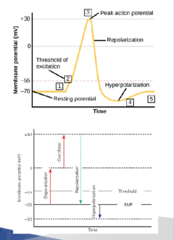
AP occurs in excitable cells - rapid _____ followed by _____
depolarization
Membrane potential is less negative with [depolarization/ hyperpolarization]
hyperpolarization
Membrane potential is more negative with [depolarization/ hyperpolarization]
inward
[Inward/outward] current is the flow of positive charge into cell
outward
[Inward/outward] current is the flow of positive charge out of cell
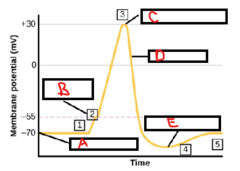
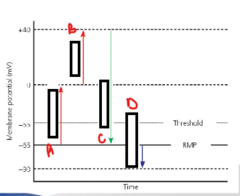
resting potential
What is A?
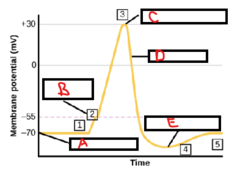
threshold of excitation
What is B?
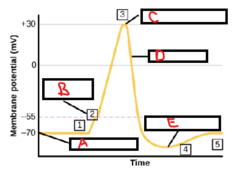
peak action potential
What is C?
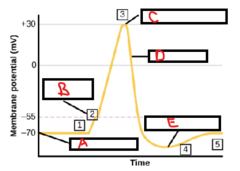
repolarization
What is D?
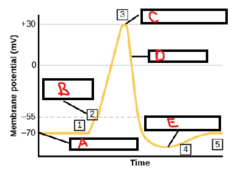
hyperpolarization
What is E?
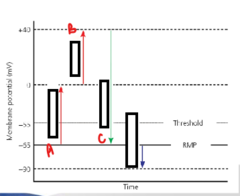
depolarization
What is A?
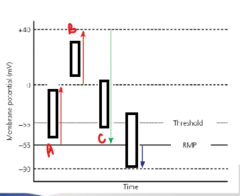
overshoot
What is B?
repolarization
What is C?
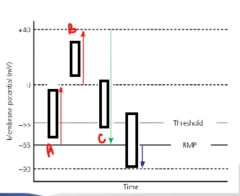
hyperpolarization
What is D?
threshold potential
Membrane potential at which an AP is inevitable
overshoot
Portion of AP where membrane potential is positive
undershoot
Portion of AP where membrane potential is more negative than RMP
refractory period
Period during which another AP can't be generated
high; low
When the RMP is -70 mV, K+ conductance is [low/high] and Na+ conductance is [low/high]
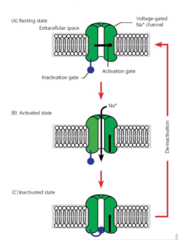
Na+; K+
During repolarization, inactivation gates on _____ channels close and _____ channels open
higher
During undershoot (hyperpolarization), K+ conductance is [higher/lower] than at rest
threshold
During upstroke of AP, the membrane is depolarization to _____ (-60mV)
refractory periods
Excitable cells unable to produce normal APs during _____
absolute refractory period (ARP)
-Overlaps with most of the AP
-No stimulus can occur to cause another AP
true
No stimulus can occur to cause another AP during the absolute refractory period (ARP). True or false?
relative refractory period (RRP)
-From end of ARP until through most of hyperpolarization
-AP occurs with greater than normal depolarization
greater
During the relative refractory period (RRP), AP occurs with [greater/lesser] than normal depolarization
voltage; ligand
The activated state of the refractory period is _____ and _____ gated
inactivated
During the _____ state of the refractory period, time and return to RMP is required for reset
reviewed
Review
1. Size and shape typical for a given cell type
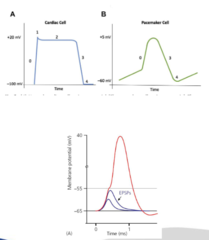
2. Propagation
3. All-or-none response
What are the 3 main characteristics of AP?
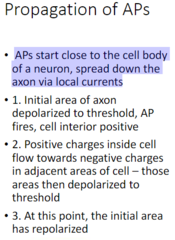
local currents
APs start close to the cell body of a neuron, spread down the axon via _____
reviewed
Review
reviewed
Review: Propagation of APs
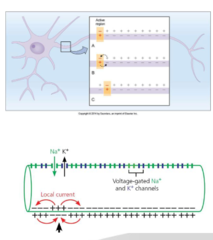
conduction velocity
-Speed at which an AP travels along a nerve or muscle fiber
-How quickly a membrane depolarizes in response to inward Na+ current
depolarizes; Na+
Conduction velocity is how quickly a membrane _____ in response to inward _____ current
resistance; capacitance
Membrane _____ and _____ affect the time constant when it comes to conduction velocity of APs
length constant
How far depolarization current will spread along a nerve, in association with conduction velocity of APs
resistance; internal resistance
Membrane _____ and _____ affect length constant
increase
To increase conduction velocity, we need to [increase/decrease] the size of the nerve fiber
decreases
By increasing diameter of a fiber, internal resistance [increases/decreases]
true
There are anatomical limits to nerve size. True or false?
myelinate
To increase conduction velocity, we need to _____ the nerve fiber
increase; decrease
Insulation of nerves with lipid will [increase/decrease] membrane resistance and [increase/decrease] capacitance
nodes of Ranvier
Breaks in myelin sheath every 1-2mm
saltatory conduction
APs jump from node to node
1. increase size of the nerve fiber
2. myelinate the nerve fiber
3. breaks in myelin sheath every 1-2mm
What are the 3 ways to increase conduction velocity?
increase; smaller
The myelin coating [increases/decreases] the thickness of the membrane, making the capacitance [smaller/larger]
![<p>The myelin coating [increases/decreases] the thickness of the membrane, making the capacitance [smaller/larger]</p>](https://assets.knowt.com/user-attachments/3a5fef90-d075-4ede-b8d6-32d337eb25a3.png)
reviewed
Review: Changing Conduction Velocity:
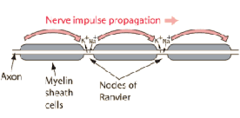
length constant
How far depolarization current will spread along a nerve
saltatory conduction
APs jump from node to node
potassium
Which ion is always high inside the cell?
out; down
Potassium diffuses [in/out] of the cell, [up/down] its concentration gradient
outside
Sodium is high [inside/outside] the cell
allow potassium to leak out of the cell slowly, carrying a positive charge
What do K+ leak channels do?
negatively
Because K+ leaks out of the cell, and takes a positive charge with it, the inside of the cell is _____ charged
high
Ions that have really [high/low] permeability will contribute most to resting membrane potential
potassium
Resting membrane potential is determined by _____
inside of the cell
When there is an action potential, sodium will go where?
-85 to -90 mV
What is usually the RMP range for potassium?
potassium equilibrium
Because RMP is determined by potassium in most cells, its always going to be close to the _____ potential
equilibrium potential
Point at which the movement of potassium into the cell (because of negative electrical potential) is balanced by diffusion of potassium out of the cell due to its concentration gradient
positively
Potassium wants to move out because its high inside the cell -> leaking out -> creating negative charge inside cell -> attraction of _____ charged ions back into the cell
movement stops (-85 to -90 mV)
At K+ equilibrium, electrical & diffusion forces are equal and opposite. What happens after?
how you get info transmitted in the nervous system & muscle (leads to contraction)
What is the point of an action potential?
depolarize; repolarize
In order to get an action potential, you need to _____a cell & excite it, and then _____ it to get it back to the resting membrane potential
make membrane potential less negative
What does it mean to depolarize a cell?
membrane potential more negative than the resting membrane potential
What does it mean when a cell is hyper-polarized?
harder b/c it has to reach threshold of excitation again
While a cell is in the hyper-polarized state, is it harder or easier to get another action potential during that time? Why?
refractory period
Period at which you cant get another action potential
more
The further away you are from a threshold, the [more/less] stimulus is required to reach it
inward
There has to be an [inward/outward] current of an ion in order to get an action potential