P5: forces
 Call Kai
 Learn
Learn Practice Test
 Spaced Repetition
 Match
Match Flashcards
 Knowt Play
1/12

There's no tags or description
Looks like no tags are added yet.
Name | Mastery | Learn | Test | Matching | Spaced | Call with Kai | Chat |
|---|
No analytics yet
Send a link to your students to track their progress
13 Terms
What’s the difference between scalar and vector quantities?
Scalar quantities have magnitude (size) only e.g. mass, temperature, distance, time
Vector quantities have magnitude (size) and direction e.g. velocity, force, acceleration, displacement (distance in a given direction)
How can vector quantities be represented?
With an arrow, the length representing the magnitude, and the direction representing the direction.
What is a force?
A push or a pull that acts on an object due to the interaction with another object. It is a vector quantity.
What’s the difference between between a contact and a non-contact force?
Contact - the two objects are physically touching e.g. tension, friction, air resistance, and normal contact force
Non-contact - the two objects are physically separated e.g. gravity, electrostatic force (between two charged objects), and magnetic force
What is weight (N)?
The force acting on it due to gravity. It depends on the gravitational field strength at the point where the object is. Weight is directly proportional to mass (e.g. if we double mass, weight doubles)
How is weight measured?
Using a calibrated spring-balance / newtonmeter.
What is centre of mass?
The single point that the weight of an object acts at.
What is a resultant force?
A single force with the same effect as all of the original forces acting together. To work this out, subtract the smaller force from the larger force.
How is a free body diagram drawn?
A point drawn, with arrows coming out of it in correct direction and length (not to scale).
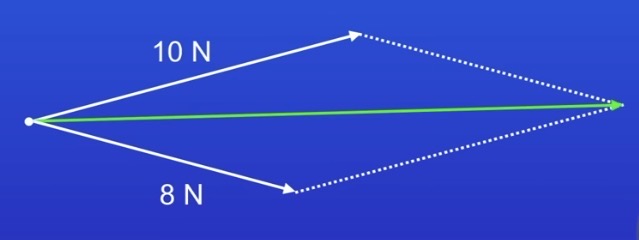
How is a vector diagram used to work out the resultant force of two forces acting at an angle?
A point drawn, with arrows coming out of it in correct direction (use a protractor to draw angle between forces) and length (use a scale e.g. 1N = 1cm). Copy the bottom line at the top, connecting to the top, and the top line at the bottom, connecting to the bottom. Draw a line from the tails of the force vectors to the other side of the parallelogram. Measure this - use your scale - it is the resultant force.
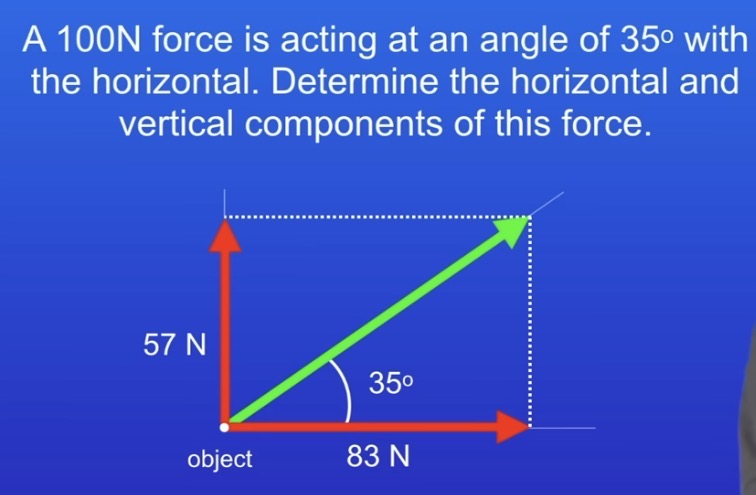
How is a vector diagram used to resolve one force into two forces?
Write them at right angles as shown. Measure lengths of horizontal and vertical forces and use your scale.
What is work done in terms of forces?
When a force is used to move an object and the energy is transferred.
What causes one joule of work to be done?
When a force of 1N moves an object by 1m