Nucleotides & Nucleic Acids

0.0(0)
Studied by 0 people
call kaiCall Kai
Locked
learnLearn
examPractice Test
spaced repetitionSpaced Repetition
heart puzzleMatch
flashcardsFlashcards
GameKnowt Play
Card Sorting

1/14

flashcard set

Earn XP

Description and Tags

Chapter 3

Last updated 2:08 AM on 9/9/26
Name
Mastery
Learn
Test
Matching
Spaced
Call with Kai
Chat

No analytics yet

Send a link to your students to track their progress

15 Terms

1
New cards

Nucleotides

Monomers for both DNA and RNA (ribonucleic acid)

Include 3 components:

1. Pentose sugar (DNA= deoxyribose & double stranded, RNA= ribose & single stranded)

2. Nitrogenous base

3. One or more phosphate

<p>Monomers for both DNA and RNA (ribonucleic acid)</p><p>Include 3 components:</p><p>1. Pentose sugar (DNA= deoxyribose &amp; double stranded, RNA= ribose &amp; single stranded)</p><p>2. Nitrogenous base</p><p>3. One or more phosphate</p>
2
New cards

Nitrogenous Base- Pyrimidines (6 member rings)

Nitrogenous Bases- Nitrogen-containing rings attach to the 1’ carbon of the pentose sugar

Includes:

Cytosine (C, in both)

Thymine (T, only in DNA)

Uracil (U, only in RNA)

<p>Nitrogenous Bases- Nitrogen-containing rings attach to the 1’ carbon of the pentose sugar</p><p>Includes: </p><p><span data-name="black_small_square" data-type="emoji">▪</span> Cytosine (C, in both)</p><p><span data-name="black_small_square" data-type="emoji">▪</span> Thymine (T, only in DNA)</p><p><span data-name="black_small_square" data-type="emoji">▪</span> Uracil (U, only in RNA) </p>
3
New cards

Nitrogenous Base- Purines (6 membered ring + 5 membered ring)

Includes:

Guanine (G, in both DNA and RNA)

Adenine (A, in both)

All nitrogenous bases can participate in acid-base reactions

<p>Includes: </p><p><span data-name="black_small_square" data-type="emoji">▪</span> Guanine (G, in both DNA and RNA)</p><p><span data-name="black_small_square" data-type="emoji">▪</span> Adenine (A, in both)</p><p>All nitrogenous bases can participate in acid-base reactions</p>
4
New cards

Nucleoside

Include A Pentose Sugar + Nitrogenous Base

Not yet a nucleotide (need a phosphate to become DNA or RNA)

Nucleotide = nucleoside + one or more phosphates

<p>Include A Pentose Sugar + Nitrogenous Base</p><p>Not yet a nucleotide (need a phosphate to become DNA or RNA)</p><p>Nucleotide = nucleoside + one or more phosphates</p>
5
New cards

Nucleoside/Nucleotide Nomenclature

Nucleoside names have an –osine OR –idine suffix

Nucleotide names have an –ylate suffix OR nucleoside name + # of phosphates

<p>Nucleoside names have an –osine OR –idine suffix</p><p>Nucleotide names have an –ylate suffix OR nucleoside name + # of phosphates</p>
6
New cards

Nucleotide Bonding

  • Nucleotides are connected through phosphodiester bonds

  • Requires a nucleotide triphosphate (NTP)

  • Phosphate forms ester bond between C3’ and C5’

  • Incorporated nucleotides are known as residues


<ul><li><p>Nucleotides are connected through phosphodiester bonds </p></li><li><p>Requires a nucleotide triphosphate (NTP)</p></li><li><p>Phosphate forms ester bond between C3’ and C5’ </p></li><li><p>Incorporated nucleotides are known as residues</p></li></ul><p></p>
7
New cards

Polynucleotide Bonding (Nucleotide Bonding Part 2)

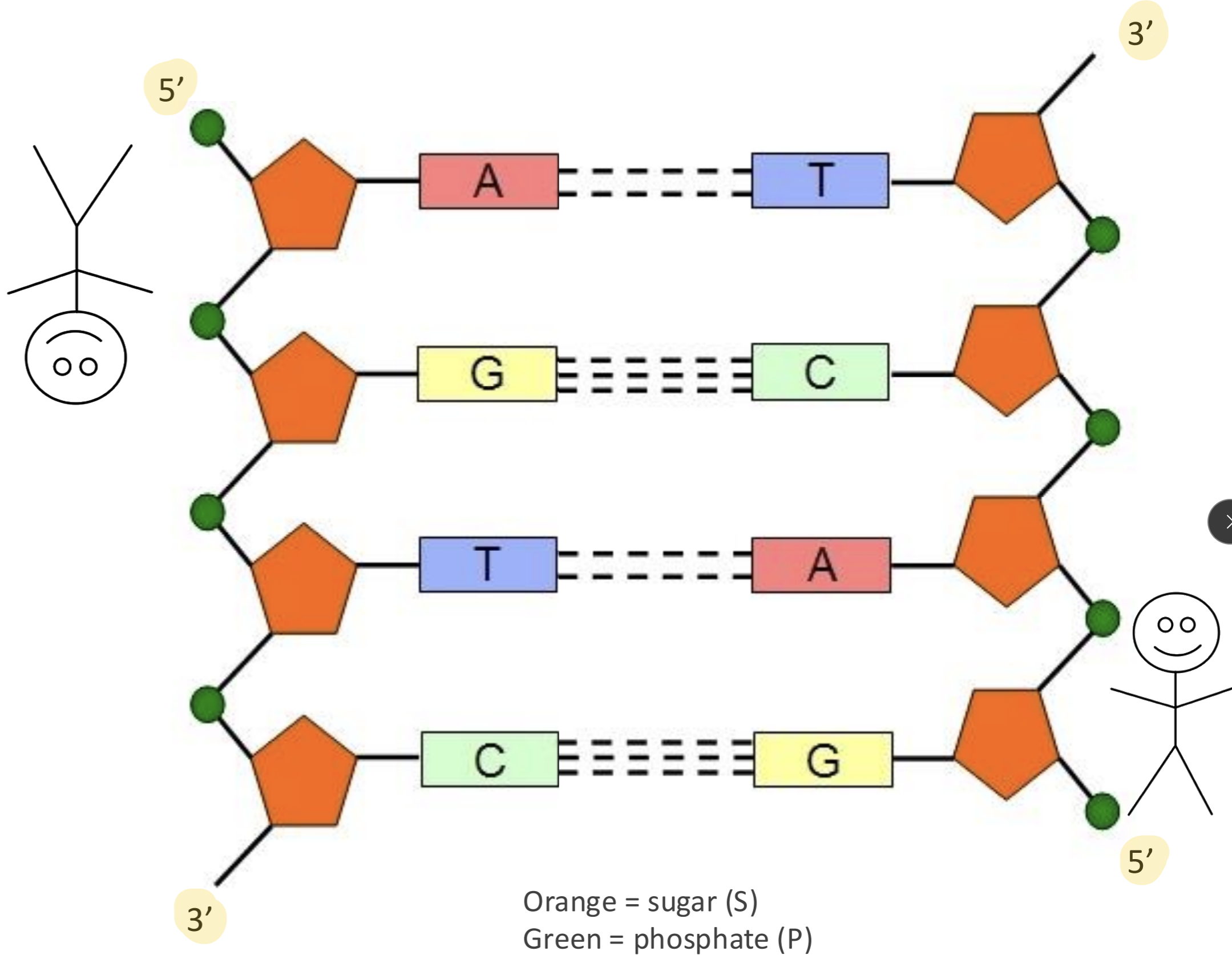
  • Establishes polar strands

  • Read sequence of bases from 5’→ 3

  • Resembles a necklace with beads

  • Two polynucleotide strands align to create complementary pairs (base pairs)

  • Base pairs hang off S-P backbones

  • Each nucleotide pair fits because of antiparallel organization

  • Allows for consistent stacking of base pairs

<ul><li><p>Establishes polar strands</p></li><li><p>Read sequence of bases from 5’→ 3</p></li><li><p>Resembles a necklace with beads </p></li><li><p>Two polynucleotide strands align to create complementary pairs (base pairs)</p></li><li><p>Base pairs hang off S-P backbones</p></li><li><p>Each nucleotide pair fits because of antiparallel organization </p></li><li><p>Allows for consistent stacking of base pairs</p></li></ul><p></p>
8
New cards

Nucleotide Bonding Part 3→ DNA double helix and Rules

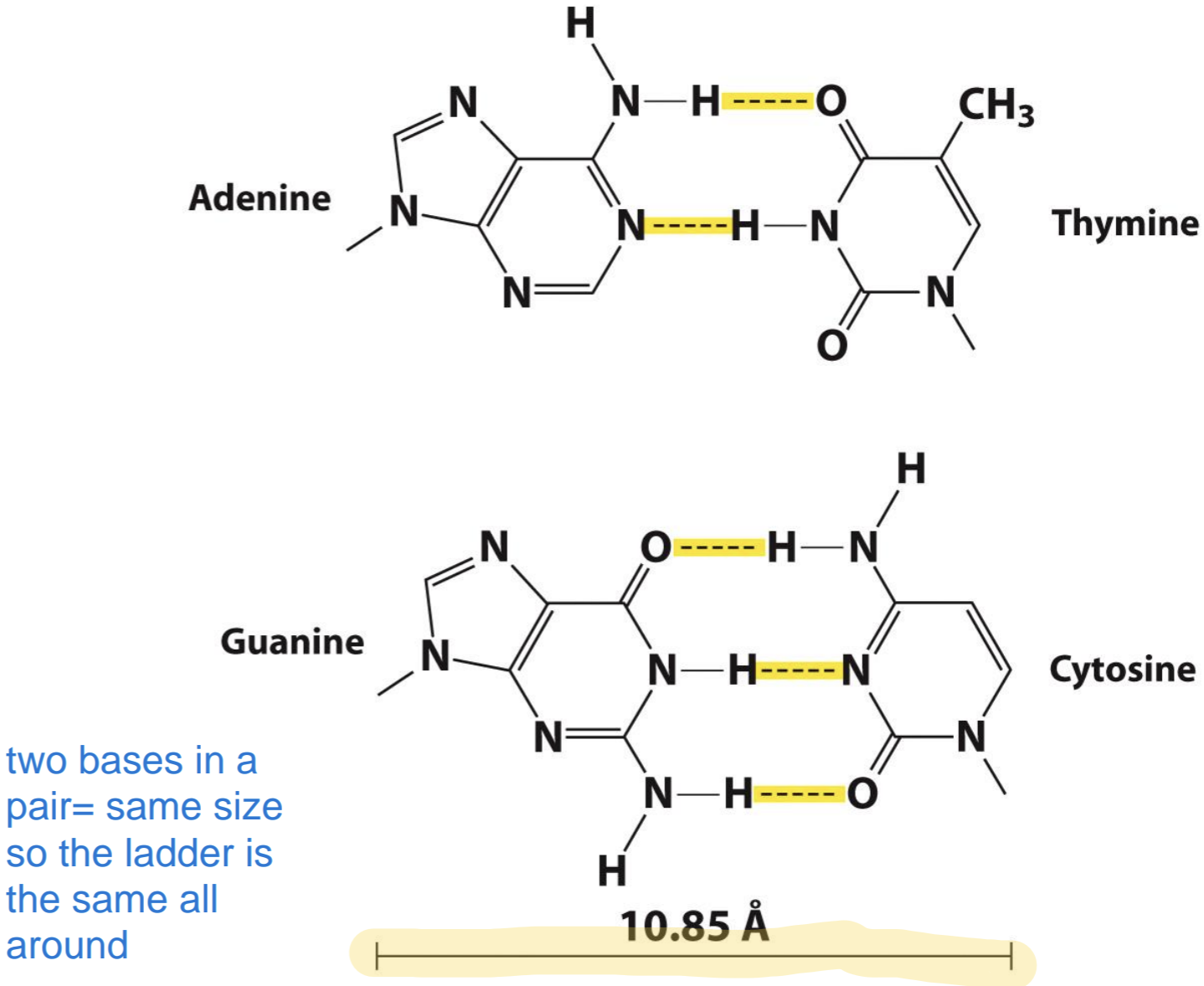
Nucleotides pairs are held together by hydrogen bonds between complementary bases (base pairs)

A bonds with T

C bonds to G


Law of complementary base pairing – the sequence of one strand governs the base sequence of the other (if yk one string you can guess the other because of base pairs, just remember 5’ bonds to 3’ and vice versa)


Chargaff’s rule established:

1. Amount of A = amount of T

2. Amount of C = amount of G

3. A+G = C+T

Ex: 15% A= 15% T; A+T= 30%; 100-30= 70; ½ 70= 35 which means 35% C and 35 % G


Double-stranded DNA twists into a right-handed helical organization, driven by the hydrophobic

effect


Watson and Crick’s Double Helical DNA Features:

1. 2 antiparallel strands

2. DNA “ladder” is a right- handed helix

3.S-P backbone defines the exterior of helix

4. Base pairs are in the center of helix

5. Base pairs stack

6. Diameter is about 20 Å

7. Twisting creates major and minor grooves
<p>Nucleotides pairs are held together by hydrogen bonds between complementary bases (base pairs)</p><p><span data-name="black_small_square" data-type="emoji">▪</span> A bonds with T</p><p><span data-name="black_small_square" data-type="emoji">▪</span> C bonds to G</p><p></p><p>Law of complementary base pairing – the sequence of one strand governs the base sequence of the other (if yk one string you can guess the other because of base pairs, just remember 5’ bonds to 3’ and vice versa) </p><p></p><p>Chargaff’s rule established:</p><p>1. Amount of A = amount of T</p><p>2. Amount of C = amount of G</p><p>3. A+G = C+T</p><p>Ex: 15% A= 15% T;  A+T= 30%; 100-30= 70; ½ 70= 35 which means 35% C and 35 % G </p><p></p><p>Double-stranded DNA twists into a right-handed helical organization, driven by the hydrophobic </p><p>effect </p><p></p><p>Watson and Crick’s Double Helical DNA Features:</p><p>1. 2 antiparallel strands</p><p>2. DNA “ladder” is a right- handed helix</p><p>3.S-P backbone defines the exterior of helix</p><p>4. Base pairs are in the center of helix</p><p>5. Base pairs stack</p><p>6. Diameter is about 20 Å</p><p>7. Twisting creates major and minor grooves</p>
9
New cards

DNA Replication Is Semi-Conservative

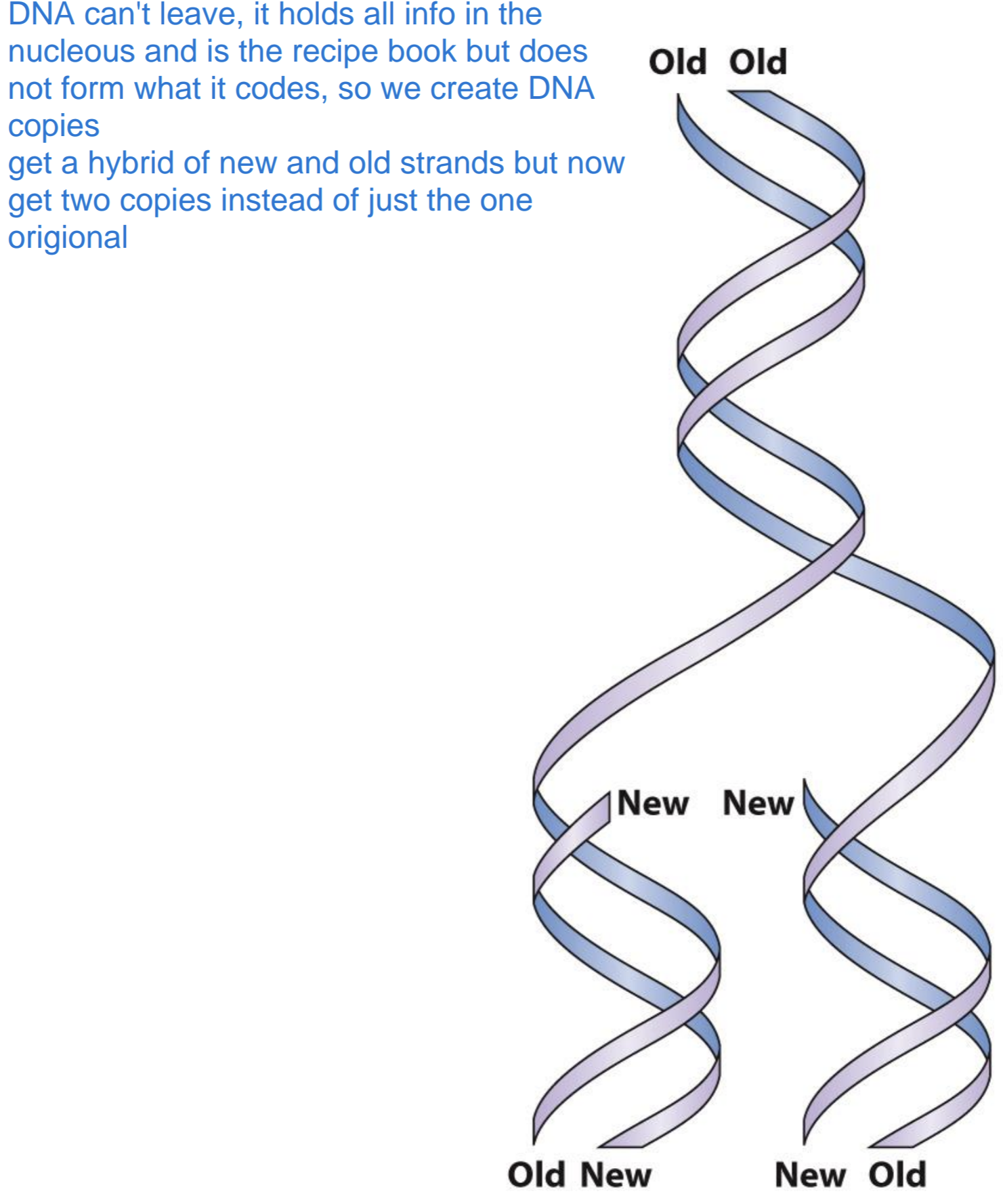
  • Old (parental) strands serve as templates for creating new DNA copies

  • Allows for DNA to be maintained and passed on

<ul><li><p>Old (parental) strands serve as templates for creating new DNA copies</p></li><li><p>Allows for DNA to be maintained and passed on</p></li></ul><p></p>
10
New cards

Gene

unique sequence of nucleotides that act as the “instructions” for producing a specific polypeptide or RNA

Gene expression requires copying DNA through replication → transcription which gives us RNA→ translation which produces the protein/ the doer

<p>unique sequence of nucleotides that act as the “instructions” for producing a specific polypeptide or RNA</p><p>Gene expression requires copying DNA through replication → transcription which gives us RNA→ translation which produces the protein/ the doer </p>
11
New cards

Transcription

The process of RNA synthesis

<p>The process of RNA synthesis </p>
12
New cards

Translation

Turning RNA into a protein

<p>Turning RNA into a protein </p>
13
New cards

Base Triplet

  • A sequence of 3 nucleotides that correspond to 1 amino acid

  • mRNA carries the message based on DNA triplets


14
New cards

Codon

  • A 3-base sequence in mRNA

  • Our genetic code is expressed in terms of codons

  • pairs with complementary and anti- codons

  • mRNA codons are read to determine which amino acid is correct

  • 64 codons total: 61 represent 20 different amino acids

  • Redundant/degenerate- 3 are “stop” codons


15
New cards

Anticodon

  • A sequence of 3 nucleotides forming a unit of genetic code in a transfer RNA (tRNA) molecule

  • Pairs to a complementary mRNA codon



