Radiation Therapy Board Review
 Call Kai
 Learn
Learn Practice Test
 Spaced Repetition
 Match
Match Flashcards
 Knowt Play
1/208

There's no tags or description
Looks like no tags are added yet.
Name | Mastery | Learn | Test | Matching | Spaced | Call with Kai | Chat |
|---|
No analytics yet
Send a link to your students to track their progress
209 Terms
Prophylactic cranial irradiation for ALL is administered to a total dose of:
A. 1200 cGy
B. 1800 cGy
C. 3000 cGy
D. 4500 cGy
E. 6000 cGy
B. 1800 cGy
The treatment time for a field requiring 350 monitor units while the linear acellerator dose rate is 220 units/minute is:
A. .394 minutes
B. .629 minutes
C. 1.59 minutes
D. 2.52 minutes
C. 1.59 minutes
Placing marks on the central axis only is:
A. Sufficient for daily realignment and targeting
B. Sufficient when target margins are small
C. Adequate for treating small fields
D. Insufficient for daily realignment and targeting
D. Insufficient for daily realignment and targeting
*Marks should be placed on the central axis and along coordinate planes to assure the patient and location target is accurately reproduced.
During total CNS irradiation, the patient is:
A. Supine with an extended chin
B. Supine with chin flexed
C. Prone with chin slightly extended
D. Prone with chin flexed
C. Prone with chin slightly extended
Electron contamination from high energy photon beams may result from photon interactions with the:
A. Room air
B. Collimators
C. Bolus
D. Lucite trays
B. Collimators
Lucite is often used as the material for positioning devices. One major concern when this material is in the path of the treatment beam is:
A. Electron contamination
B. Beam attenuation
C. Decreased rigidity
D. Acquired radioactivity
B. Beam attenuation
Advantages of networked digital image management do not include:
A. Dispersed access to images
B. Multiple users can share images
C. Physical storage space is minimized
D. Computer disk space is not an issue
D. Computer disk space is not an issue
In the treatment of seminoma, an external testicular shield should be used for the remaining testicle. This is Important since the TD 5/5 for the testis is as low as:
A. 1 Gy
B. 10 Gy
C. 20 Gy
D. 40 Gy
A. 1 Gy
Which of the following cannot produce a 3 dimensional image?
A. MRI
B. CT
C. Ultrasound
D. Electronic portal imaging
D. Electronic portal imaging
A procedure in which an implant is made using a trocar, with radioactive sources introduced into the trocar and then the trocar is removed is called:
A. Self-attenuation
B. Interstitial preloading
C. Intracavitary microloading
D. Interstitial afterloading
D. Interstitial afterloading
The precise daily reproduction of patient position depends on:
1. Patient age
2. Type of treatment machine
3. Anatomical site treated
4. Patients overall health
A. 1 & 2
B. 2 & 3
C. 3 & 4
D. 1 & 4
C. 3 & 4
The linear scales on the treatment table are used as an aid for:
A. Translation of patient position on the table
B. Verifying filament voltage
C. Verifying gantry readout accuracy
D. Documentation of treatment dose
A. Translation of patient position on the table
Compared to water, the density of bone is:
A. 1.00
B. 1.65-1.85
C. 0.33-0.35
D. 0.2-0.26
B. 1.65-1.85
If the width of the vertebral body is 5.3 cm and measures 7.5 cm on the portal verification film, the magnification factor is:
A. 0.706
B. 1.0
C. 1.41
D. 2.00
C. 1.41
7.5/5.3 = 1.41
A patient's treatment will be 2.54 minutes. How many seconds is this?
A. 174
B. 152.4
C. 114
D. 254.0
B. 152.4
(60/1)(x/2.54)
1x = 60(2.54)
X = 152.4
How many cobalt sources are contained in the gamma knife unit?
A. 25
B. 105
C. 201
D. 280
C. 201
Which of the following is a nonmalignant condition treated by stereotactic radiosurgery?
A. Nasopharyngeal tumors
B. Medulloblastoma
C. Astrocytoma
D. Arteriovenous malformation
D. Arteriovenous malformation
The distance between the entrance and exit points for parallel opposed fields is called the:
A. Source to skin distance
B. Source to axis distance
C. Interfield distance
D. Source to tray distance
C. Interfield distance
A lateral portal verification shows the spinal cord to be at a measured depth of 9 cm from the skin surface. If the film magnification is 1.5, the actual depth of the cord is:
A. 4 cm
B. 6 cm
D. 9 cm
E. Not enough information
B. 6 cm
9/1.5 = 6
In craniospinal irradiation, using 100 cm SSD, the spinal cord field length is 30 cm. The skull field length is 15 cm. To align the skull field with the divergent spinal field, the amount of collimator rotation required for the skull field is:
A. 4.3 degrees
B. 10 degrees
C. 5 degrees
D. 8.53 degrees
D. 8.53 degrees
* the rotation of the collimator for the skull field is given by applying the divergence formula:
Tan⁻¹ ((A/2)(SSD))
The divergence of the spine field is what needs to be known so the collimator angle is parallel.
Therefore,
Tan⁻¹ ((30/2)(100)) = 8.53
In craniospinal irradiation, using 100 cm SSD, the spinal cord field length is 30 cm. The skull field length is 15 cm. To eliminate divergence of the the brain portal into the spinal portal while treating the lateral brain fields, the couch should be rotated ____ degrees toward the gantry.
A. 8.53 degrees
B. 6.3 degrees
C. 5.3 degrees
D. 4.3 degrees
D. 4.3 degrees
When treating a left lateral field, the gantry is 90 degrees and the collimator angle is 25 degrees. If an opposing right lateral port is planned with a gantry angle of 270 degrees, the collimator angle should be:
A. 25 degrees
B. 335 degrees
C. 245 degrees
D. 0 degrees
B. 335 degrees
90 - 25 = 65
270 + 65 = 335
If a 1.0 cm Bolus is applied to an area being treated with a 6 MV beam. The maximum dose point will be located at:
A. The skin surface
B. 0.5 cm below the skin surface
C. 1.0 cm below the skin surface
D. 1.5 cm below the skin surface
B. 0.5 cm below the skin surface
*dose maximum is located at 1.5 cm below the skin for a 6 MV beam. If a 1.0 cm Bolus is then used, the dose maximum is raised to 0.5 cm below the skin surface.
A patient is mistakenly treated at 82 cm SSD instead of 8o cm SSD due to a misalignment of the ODI. The planned dose was 300 cGy. What was the approximate dose delivered?
A. 285 cGy
B. 292 cGy
C. 308 cGy
D. 315 cGy
A. 285 cGy
300/x = 82^/80^2
82^2 = 6724
80^2 = 6400
300 x 6400 = 1,920,000
X = 1,920,000/6724
X = 285.54
A 360 degree rotation has an MU/degree of 0.72 MU/degree. How many monitor units will be delivered?
A. 180
B. 200
C. 259
D. 360
C. 259
360 x 0.72 = 259
An air filled balloon positioned with a catheter in the bladder is an example of _____ contrast.
A. Soluble
B. Insoluble
C. Negative
D. Positive
C. Negative
Contrast media may be administered:
1. IV
2. Oral
3. Catheter
A. 1 & 2
B. 1 & 3
C. 2 & 3
D. All of the above
D. All of the above
In CT simulation, therapists may alter kVp to lower dose.
A. True
B. False
B. False
The identification of treatment fields relative to stable landmarks is:
A. Localization
B. Simulation
C. Radiographic technique
D. Virtual simulation
A. Localization
Visible contrast may be enhanced with digital imaging by ____ the window width _____ the available gray scale.
A. Decreasing/spreading
B. Increasing/spreading
C. Decreasing/narrowing
D. Increasing/narrowing
A. Decreasing/spreading
Which best describe what a 3D plan is not:
A. DVH analysis
B. A single, open treatment beam
C. Multiple fields
D. Static MLC's
B. A single, open treatment beam
How is the 4D modality different from the 3D modality?
A. 4D uses MLC's
B. 4D makes use of the CT scanner
C. 4D accounts for relaxation and role movement
D. 4D accounts for target movement during treatment
D. 4D accounts for target movement during treatment
IMRT sometimes uses arc fields.
A. True
B. False
A. True
SRS treatments are typically given in 5 consecutive days.
A. True
B. False
B. False
The field light on the linear accelerator is intended to represent:
A. The area of radiation exposure
B. The size of the target
C. The width, length, and depth of the treatment
D. The distance from the source of radiation to the patient's skin
A. The area of radiation exposure
A mechanical distance indicator is used to verify:
A. Gantry rotation
B. Collimator rotation
C. Field size congruence
D. Accuracy of the optical distance indicator
D. Accuracy of the optical distance indicator
When a missing tissue compensator is used in a photon beam, the compensator should be:
A. Placed at some distance from the skin surface
B. Placed directly on the skin surface to be most effective
C. Made the same size as the missing tissue volume and be placed at some distance from the skin surface
D. Placed directly on the skin surface to take advantage of the skin soaring properties of a compensator
B. Placed directly on the skin surface to be most effective
A patient's separation is measured 32 cm in the AP/PA protection. An anterior SSD of 90 cm is measured with a 100 cm SAD treatment machine. The posterior SSD should be:
A. 100 cm
B. 88 cm
C. 86 cm
D. 78 cm
D. 78 cm
Why do we use electron treatments?
A. Increase beam penetration
B. To compensate for missing tissue
C. Increases the surface dose
D. Increase electron contamination
E. A & C
C. Increases the surface dose
What is the acceptable amount of primary beam transmission through MLC's?
A. 1-2%
B. 0%
C. 98%
D. 100%
E. 0.2%
A. 1-2%
Which of the following techniques may be used to adequately irradiate the internal mammary lymph nodes while limiting exposure to other organs?
A. AP 6MV only
B. AP photon/electron combo
C. AP 6 MeV only
D. Extended medial tangent
B. AP photon/electron combo
The gantry is angled ____ while treating the S/clav field?
A. 0 degrees
B. 5-10 degrees
C. 10-15 degrees
D. 15-20 degrees
C. 10-15 degrees
If a woman presents with a right lower outer quadrant tumor, state the typical lymphatic drainage?
A. IM, axillary level 3, S/clav
B. Axillary level 1, axillary level 2, axillary level 3, S/clav
C. Transpectoral, axillary level 3, S/clav
D. Axillary level 3, axillary level 2, axillary level 1, S/clav
B. Axillary level 1, axillary level 2, axillary level 3, S/clav
Patient undergoing irradiation for Breast cancer can be treated?
1. Lithotomy position
2. Supine position
3. Prone position
4. Decubitus position
A. 1 only
B. 2 only
C. 1 & 2
D. 2 & 3
E. 1, 2, & 3
F. 2, 3, & 4
F. 2, 3, & 4
Lung correction factors depend on all of the following EXCEPT:
A. Beam energy
B. Electron density of lung
C. Depth of lung traversed by the beam
D. SSD
E. Distance from lung to point of calculation
D. SSD
In the treatment of head and neck cancer, dosimetry corrections for the presence of bone and sinuses are most important for:
A.60Co gamma rays
B. 4MV
C. 6MV
D. 12 MeV electrons
E. Equally important for all these
D. 12 MeV electrons
If 203 monitor units deliver 180 cGy, how many monitor units will deliver 250 cGy?
A. 250
B. 273
C. 282
D. 300
C. 282
203/180 = 1.127
1.127 x 250 = 281.9 = 282 cGy
You have a shortcut sheet with monitor units for the delivery of 100 cGy. For a field size of 15 x 21 at a depth of 9cm the monitor units required are 125. If the dose to be delivered for this field size and depth is 150 cGy, what will the monitor units be?
A. 55
B. 83
C. 188
D. 281
C. 188
125/100 = 1.25
1.25 x 150 = 187.5 = 188 Mu
The prescription says to deliver 50 Gy total. This is equivalent to how many rads?
A. 0.50
B. 5o
C. 500
D. 5000
D. 5000
The rad is the old unit for absorbed dose and 1 rad is equivalent to 1 cGy.
50 Gy = 5000 cGy = 5000 rads
A 10 x 10 cm lung field has a blocked area that is 2 x 5 cm. The blocked equivalent is:
A. 8 x 8
B. 8 x 5
C. 9.5 x 9.5
D. 12 x 15
C. 9.5 x 9.5
10(10) - 2(5) = 100 - 10 = 90
√90 = 9.48 = 9.5 cm
You are called to treat a spinal cord compression. The physician asks you to set a preliminary field to cover thoracic vertebrae 4, 5, and 6 on the treatment table. The approximate field size will be:
A. 6 x 6
B. 8 x 8
C. 10 x 10
D. 8 x 12
B. 8 x 8
The thoracic vertebrae are about 2.5 cm in length. 3(2.5) = 7.5. To include the transverse processes, the width of the field will be about 8 cm.
You have an emergency spinal cord compression at the level of L2. The physician orders a preliminary field to cover L1-L3. The approximate field size will be:
A. 6 x 6
B. 8 x 10
C. 12 x 15
D. 11 x 14
B. 8 x 10
The lumbar spine is about 3-3.5 cm in length. 3(3.5) = 10.5. To include the transverse processes, the width of the field will be about 8 cm.
The treatment field for a right upper lobe tumor has the central axis at the level of the Sternal angle. The verification port will likely show the central axis at about the level of the:
A. Carina
B. T7
C. Aortic arch
D. Diaphragm
A. Carina
The Sternal angle, or angle of Louis, is a good landmark for the carina and T4.
The upper border of the anterior pancreas field is at the xiphoid process. The verification port will likely show the upper border at about the level of the:
A. Diaphragm
B. T10
C. L1
D. T12
B. T10
#55 The DRR on the back of this card is likely an initial treatment field for Cancer of the:
A. Nasopharynx
B. Base of tongue
C. Oropharynx
D. Hypopharynx

The answer to #55 is:
D. Hypopharynx
The DRR shows inclusion of the larynx and Hypopharynx and drainage lymph nodes from the jugulodigastric to supraclavicular, anterior, and posterior cervical.
The answer to #55 is:
D. Hypopharynx
#57 The DRR on the back of this card is likely an initial treatment field for Cancer of the:
A. Wilm's tumor
B. Ovarian cancer
C. Seminoma
D. Hodgkin's lymphoma
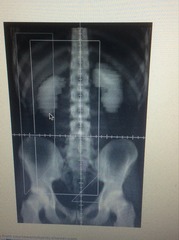
The answer to #57 is:
C. Seminoma
C. Seminoma
#59 The DRR on the back of this card is likely an initial treatment field for Cancer of the:
A. Hypopharynx
B. Nasopharynx
C. Base of tongue
D. Supraglotic larynx

The answer to #57 is:
B. Nasopharynx
The DRR shown is likely a treatment for Nasopharynx carcinoma with margin on the Nasopharynx and inclusion of jugulodigastric, submandibular, mid jugular and posterior cervical lymphatics.
The answer to #57 is:
B. Nasopharynx
#61 The DRR on the back of this card is likely an initial treatment field for Cancer of the:
A. Ovarian cancer
B. Hodgkin's disease
C. Seminoma
D. Wilm's Tumor

The answer to #61 is:
A. Ovarian cancer
The whole abdomen field is most likely for the management of ovarian cancer.
The answer to #57 is:
A. Ovarian cancer
#63 The pea shaped blocks in the DRR on the back of this card are placed to protect the:
A. Liver
B. Small bowel
C. Colon flexures
D. Kidneys

The answer to #63 is:
D. Kidneys
The answer to #63 is:
D. Kidneys
#65 According to the dose volume histogram on the back of this card, the whole heart receives:
A. 0 cGy
B. 250 cGy
C. 1000 cGy
D. 1400 cGy
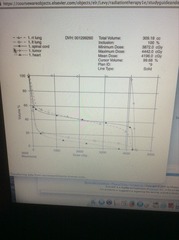
The answer to #67 is:
A. 0 cGy
The answer to #65 is:
A. 0 cGy
#65 According to the dose volume histogram on the back of this card, 50% of the GTV receives:
A. 4000 cGy
B. 4100 cGy
C. 4250 cGy
D. 4500 cGy
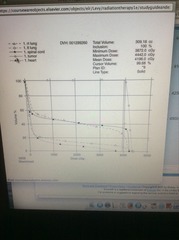
The answer to #67 is:
B. 4100 cGy
The answer to #65 is:
B. 4100 cGy
#69 According to the treatment plan isodose on the back of this card, which field requires a wedge:
A. Right lateral
B. Left lateral
C. Anterior
D. Posterior

The answer to #69 is:
C. Anterior
The answer to #67 is:
C. Anterior
#71 The isodose distribution shown on the back of this card is for what beam arrangement?
A. 270 degree arc
B. 360 degree arc
C. 3 field
D. 4 field box

The answer to #71 is:
B. 360 degree arc
The isodose distribution shown in a circular pattern represents a 360 degree arc.
The answer to #71 is:
B. 360 degree arc
A good surface landmark for the true vocal cords is the:
A. Cricoid cartilage
B. Suprasternal notch
C. Thyroid cartilage
D. Hyoid bone
C. Thyroid cartilage
The space in front of the epiglottis is called the:
A. Supraglottis
B. Vallecula
C. Uvula
D. Pyriform sinus
B. Vallecula
The clavicle and the 1st rib articulate with the:
A. Manubrium
B. Body of the sternum
C. Xiphoid process
D. T1
A. Manubrium
The physicist has completed monthly calibrations and discovers that the dose rate has been 248 MU/min instead of the intended 250 MU/min for the last month. This means that all patients within that time have received:
A. 2 more monitor units than calculated
B. 2 less monitor units than calculated
C. The intended dose over a longer period of time
D. The intended dose over a shorter period of time
C. The intended dose over a longer period of time
The discrepancy in dose rates had only affected the treatment time. The dose rate was slower than intended.
The maximum allowable transmission though the MLC's is:
A. 1%
B. 5%
C. 10%
D. 15%
B. 5%
For portal verification, bone tissue contrast is better using KV imagers rather than MV imagers due to the absence of:
A. Screens in the MV beam
B. Screens in the KV beam
C. Photoelectric interactions in the MV beam
D. Vacuum tube in the KV beam
C. Photoelectric interactions in the MV beam
The purpose of the room lasers is to aid in patient positioning and to indicate:
A. Isocenter of the machine
B. Rotational axis of the gantry
C. Rotational axis of the collimator
D. All of the above
D. All of the above
Your patient began treatment with an enlarged cervical node. By the fourth week, the node has greatly reduced in size, and a new contour needs to be taken. You may acquire the new external contour by using:
A. Plaster of Paris
B. Solder wire
C. CT
D. All of the above
D. All of the above
The main components of an electronic portal imaging device include all of the following EXCEPT:
A. Viewing monitor
B. Fluorescent screen
C. Television camera
D. Klystron
D. Klystron
To prevent the distant spread of prostatic tumors, the ____ should be included in the treatment fields.
A. Seminal vesicles
B. Bladder
C. Common iliac nodes
D. Inguinal nodes
C. Common iliac nodes
Custom shielding blocks that are divergent reduce:
A. Beam shadowing
B. Side scatter
C. Transmission
D. Beam edge cutoff
D. Beam edge cutoff
The main reason for tattooing is to indicate:
A. The location of the tumor
B. The location of the treatment fields
C. Critical organs in relation to fields
D. Half distance between fields
B. The location of the treatment fields
The patient experiencing confluent mucositis should be advised to:
A. Gargle with a commercial mouthwash
B. Eat only acidic foods
C. Avoid acidic foods
D. Drink cold liquids only
C. Avoid acidic foods
Patients with mucositis should be advised to eat soft, bland foods.
The normal range of platelets in the adult is:
A. 5 - 10 thousand/mm^3
B. 4 - 6 million/mm^3
C. 5 - 10 million/mm^3
D. 150 - 500 thousand/mm^3
D. 150 - 500 thousand/mm^3
Signs of increased cranial pressure include all EXCEPT:
A. Nausea
B. Coma
C. Intense headache
D. Bradycardia
D. Bradycardia
When transporting a patient with a chest drainage tube, you should:
A. Make sure there are no kinks in the tube
B. Place the bottle on the patient's chest
C. Clamp off the tube
D. All of the above
A. Make sure there are no kinks in the tube
The systolic pressure represents:
A. The highest point reached during contraction of the ventricles
B. The lowest point reached during contraction of the ventricles
C. The highest point reached during contraction of the aorta
D. The lowest point reached during contraction of the aorta
A. The highest point reached during contraction of the ventricles
General signs and symptoms of shock include all of the following EXCEPT:
A. A weak, thready pulse
B. Rapid heartbeat
C. Increased temperature
D. Hypotension
C. Increased temperature
Measuring the heart rate by using a stethoscope over the patient's heart is an assessment of the:
A. Carotid pulse
B. Apical pulse
C. Pedal pulse
D. Radial pulse
B. Apical pulse
As you are escorting the patient into the room, she begins to collapse. You allow her to slowly slip to the floor. The next appropriate thing to do is:
A. Call a code
B. Get the crash cart
C. Start CPR
D. Shake the patient and shout name
D. Shake the patient and shout name
Neutropenia describes a decrease in the number of:
A. Basophils
B. WBC's
C. Neutrophils
D. RBC's
C. Neutrophils
Which of the following is a symptom of dehydration?
A. Poor skin turgor
B. Esophagitis
C. Increased urinalysis output
D. Improved wound healing
A. Poor skin turgor
Poor skin turgor, decreased urinary output, and slow wound healing are signs of dehydration.
Your patient receiving radiation to the neck complains of dry mouth and thick, ropy, saliva,meh is experiencing:
A. Dysphasia
B. Xerostomia
C. Mucositis
D. Trismus
B. Xerostomia
Mucositis is more likely to occur in which of the following malignant conditions?
A. Basal cell carcinoma
B. Bladder carcinoma
C. Breast carcinoma
D. Leukemia
D. Leukemia
Mucositis is irritation of the mucous membranes in the GI tract, among the cases listed, the patient receiving systemic therapy for leukemia is more likely to experience mucositis.
An American Indian woman with advanced Cancer is comatose and comes for palliative radiation to the cervical spine. She wears a small discolored pouch on a string around her neck. The most appropriate action for the therapist is to:
A. Discard the pouch as it may interfere with treatment
B. Remove it and place it in an envelope for safe keeping
C. Leave it on
D. Remove it and tell the family to remove it for future treatment
C. Leave it on
American Indians may wear or carry objects that a sacred and considered curative. As long as it does not interfere with therapy, it should remain on. If any other item would interfere with therapy, it is best to speak with the family before removing it since the patient cannot communicate.
125 lbs is equivalent to ____ kg.
A. 276
B. 57
C. 125
D. 63
B. 57
Use the conversion factor:
1 kg = 2.2 lbs
125/2.2 = 57 kg
The average rate of respiration in the adult is ___ breaths/minute.
A. 40-50
B. 60-70
C. 10-20
D. 80-90
C. 10-20
Hair loss is usually permanent when the scalp is exposed to radiation doses exceeding:
A. 30 Gy
B. 45 Gy
C. 50 Gy
D. 60 Gy
D. 60 Gy