Lecture 1/2: Vertebrate Evolution
 Call Kai
 Learn
Learn Practice Test
 Spaced Repetition
 Match
Match Flashcards
 Knowt Play
1/31

There's no tags or description
Looks like no tags are added yet.
Name | Mastery | Learn | Test | Matching | Spaced | Call with Kai | Chat |
|---|
No analytics yet
Send a link to your students to track their progress
32 Terms
why is evolution central to vert. biology?
because it provides a principle that organizes the diversity we see among extant vert
describe the proportion of Metazoan diversity?
inverts > plants > fungi > unicellular protists > verts
why do we care about verts?
bc we are verts, conspicuous (big/complex), charismatic
describe the proportion of marine vert phylogeny?
fish/sharks/lungfish (1/2 of all verts) > reptiles > amphibians > mammals
describe the behaviors of the 65,000+ extant vert species.
what is the weight range?
where do they live?
composed of a full spectrum of diverse and complex behaviors (eating, reproduction, metabolic)
0.1g - 100,000 kg
live in ALL of Earth’s habitats
for each extant sp, there may be 100’s of extinct species
what are the 3 main differences between non-amniotes and amniotes:
where do they live?
describe what produces the embryos and membranes
what organisms are these found in?
non-amniotes
aquatic
embryos enclosed and protected by membranes that are produced by the female reproductive tract
seen in inverts and retained in fishes and amphibians
amniotes
terrestrial (well established on land by the Permian/300mya)
fetal membranes are derived from the embryo itself
seen in secondarily aquatic animals which used to live on land but are back in the water (i.e., sea turtles, whales, salamanders, frogs)
what are the 4 groups of non-amniotes?
jawless fishes, Chondrichthyes, Osteichthyes, and Lissamphibia
what 2 types of organisms make up the jawless fish group and where do each live? what are the 5 traits of the jawless fish group?
hagfishes are marine
lampreys are anadromous (spawn freshwater)
limbless, scaleless, jawless, slimy, no internal bony structure
what 3 types of organisms make up Chondrichthyes? what is the overall characteristic?
sharks, rays, and ratfish/chimaeras
cartilaginous skeletons
what is the organism that makes up Osteichthyes?
bony fish
what is the organism that makes up Lissamphibia?
modern amphibians (i.e., salamanders, frog, caecilians)
what 2 groups of organisms are in amniotes?
sauropsids = reptiles including birds
synapsids = mammals
what is the order of evolved verts?
jawed verts (cartilaginous fishes) => bony fishes => ray fined fishes (non-teleost ray-finned fishes and teleosts) => lobe-finned fishes (coelacanth => african lungfish) => first vert landing (tetrapods)
what are the 4 groups of organisms in the Sauropsid Amniotes group? provide trait for each
Testudinia = turtles
shelled
Lepidosauria (tuatara, lizards, snakes)
scaled skin
Crocodilia (alligators, crocs)
bony skin, parental care
Aves = birds
feathers = derived from ornamental feathers of dinos for courtship
what is the major group of Synapsid Amniotes and its trait?
Mammalia; lactation
what are the three groups of Mammalia
Monotremes = egg laying mammals
Marsupials
Placentals
what trait do placentals and marsupials have?
both placentals and marsupials have a placenta that transfers nutrients and removes waste
define systematics
evolutionary classification of organisms
why does systematics matter?
to better understand diversity (i.e., who is related to who, evolution), biomed purposes (i.e., testing drugs on related animals to humans)
define bionomical nomenclature
genus species name in universal Latin language
what is the importance of scientific names over common names?
allows universal communication no matter where you are in the world, common names are confusing and inaccurate (i.e., crawdad, little lobster, crayfish)
define taxa
species are arranged in hierarchical categories
define phylogenetic systematics
method of determining evolutionary relationships in which groups of organisms are linked by a nested series of characters that trace the evolutionary history of the lineage
define phylogeny
diagram showing sequences of branching during evolution => it’s a hypothesis
define apomorphy
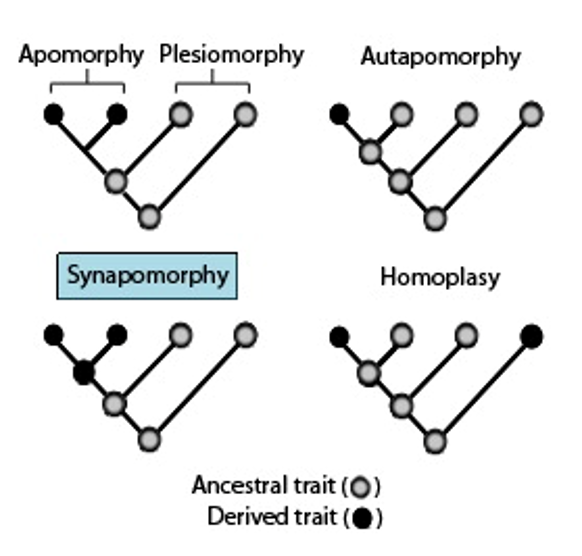
derived character, away from the ancestral condition that cannot distinguish between lineages
define synapomorphy
shared derived characters used to build phylogeny
define plesiomorphies
ancestral characters, inherited unchanged from ancestors
How do scientists know which character state is ancestral (plesiomorphic) and which is derived (apomorphic)? How can we determine the direction of evolutionary transformation of characters?
additional info is needed
define outgroup
reference group that is less closely related to any member of the ingroup
how has the creating of phylogenies evolved over time?
originally, anatomical traits were used as characters. today, molecular biology and genetics and computers. best is the combo of molecular and morphological data
what is included in tree nomenclature?
root, branch, node, branch length, clade
what are phylogenetic trees used for?
to ask questions about evolution
make inferences about the biology of species