CHO: digestion and absorption
 Call Kai
 Learn
Learn Practice Test
 Spaced Repetition
 Match
Match Flashcards
 Knowt Play
1/209

There's no tags or description
Looks like no tags are added yet.
Name | Mastery | Learn | Test | Matching | Spaced | Call with Kai | Chat |
|---|
No analytics yet
Send a link to your students to track their progress
210 Terms
how much of our typical diet comes from CHO in %
45-80% of energy
1,000kcals or 250g
what are the 2 main categories of CHO?
simple and complex
what are simple carbs
monosaccharides and disaccharides
what are complex carbs
polysaccharides including digestible, partially, and non-digestible
according to dietary guidelines, how much added sugar should be in your diet
<10% (200kcals, 12tsp for
OVERVIEW OF CHO DIGESTION
in what forms does our body intake CHO (types of carbs)
Starch, lactose, sucrose, nonstarch polysaccharides, and oligosaccharides
where does digestion begin
in the mouth
in our mouth, we begin to break down what
starch
starch is broken down into what?
starch dextrins and amylose
what enzyme in the mouth breaks down starch?
salivary a-amylase
in the stomach, what takes place with CHO
no digestion
why is there no digestion of CHO in stomach?
Low pH of stomach will limit the action of salivary alpha-amylase
where does the most digestion and absorption of CHO occur
small intestines
in the SI, starch is broken down into what?
starch dextrins, maltotriose, and maltose
what enzyme breaks down starch into starch dextrins, maltotriose, and maltose in the SI
pancreatic a-amylase
Starch dextrins, maltotriose, and maltose get broken down into what
glucose
how do Starch dextrins, maltotriose, and maltose get broken down into glucose (by what)
sucrase-isomaltase; maltase-glucoamylase
complexes
sucrase-isomaltase and maltase-glucoamylase complexes include what which is of most importance
isomaltase and maltase
sucrose in broken down into what? by what enzyme?
fructose and glucose
sucrase
lactose in broken down into what? by what enzyme?
glucose and fructose
Enzyme: sucrase
trehalose in broken down into what? by what enzyme?
glucose and glucose
Enzyme: trehalase
where are the enzymes that break down carbs in the SI located?
in the villi (apical side/ brush border)
absorption of CHO occurs via
transporters
carbs are absorbed as what structure?
monosaccharides!!
glucose is absorbed into enterocyte via? into blood?
gets absorbed into enterocytes via SGLT1
Enters the blood via GLUT2
galactose is absorbed into enterocyte via? into blood?
gets absorbed into enterocytes via SGLT1
Enters the blood via GLUT2
fructose is absorbed into enterocyte via? into blood?
gets absorbed into enterocytes via GLUT5
Enters the blood via GLUT2
in the colon, what enters there?
Undigested/unavailable carbs (fiber)
what will occur to the Undigested/unavailable carbs (fiber) that enters the colon
will be fermented by bacterial enzymes
what are the types of Undigested/unavailable carbs that reach the colon?
resistant starch
nonstarch polysaccharides
indigestible polysaccharides
malbasorbed carbs
bacterial enzymes will ferment the CHO in colon to produce what?
SCFA
what are the 3 main SFA’s made via fermentation in the colon
butyrate, propionate, acetate
butyrate importance
MAJOR energy source for colonocytes
what happens to the SCFA’s
enter portal blood to have different actions on peripheral tissues
what will happen to Undigested/unfermented carbs?
excreted via feces
CHO DIGESTION AND ABSORPTION IN DEPTH
What are available CHO
those that are glycemic →Those that are digested by endogenous enzymes and utilized fully in the SI
available CHO include
Monosaccharides
Disaccharides
Some oligosaccharides
Polysaccharides (mostly starch)
where does our CHO come from in our diet?
About half are found in grains and some vegetables
Mono and disaccharides from fruits and vegetables
About 50g from added sugars
why is available = glycemic
they contribute to our blood glucose concentrations
what is unavailable CHO
not glycemic —> those that are not digested in the SI by endogenous enzymes, do not contribute to BG, usually called fiber
CHO digestion begins with what enzyme?
amylase
what does amylase do? (bond)
Cleaves alpha 1,4 linear bonds
what are the 2 types of amylase?
salivary and pancreatic amylase
salivary amylase production is based on what?
Amylase production is based on saliva flow rate
salivary amylase is produced where?
parotid gland
salivary amylase production is related to what (what triggers it)
smell, sight, taste of food
salivary amylase is active at what pH
neutral
pancreatic amylase is released from what cells?
pancreatic acinar cells (exocrine cells)
when is pancreatic amylase released? (what triggers)
neural or hormonal signals
pancreatic amylase is released in what form?
zymogen
when is pancreatic amylase activated?
higher (more neutral) pH of duodenum = activates enzyme
what helps increase the pH of the SI to activate pancreatic amylase?
Bicarbonate from pancreatic juice and bicarbonate from Brunner cells
starch is made up of what 2 components?
amylose and amylopectin
how does amylase act upon amylose
will break the alpha-1,4 bonds of amylose

amylase acting on amylose will result in what products
maltotriose and maltose molecules
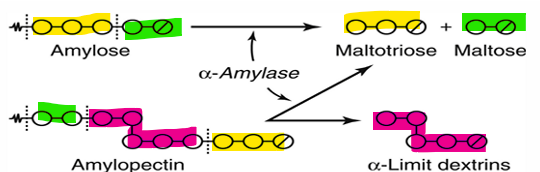
how does amylose act on amylopectin
break alpha-1,4 bonds from amylopectin
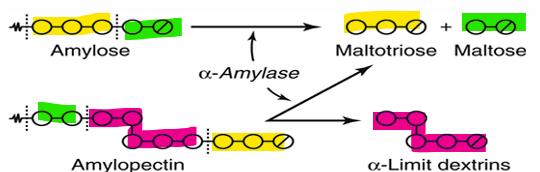
amylase acting on amylopectin results in what products
a-limit dextrins, maltotriose, and maltose

what enzyme will act upon amylopectin due to branches
isomaltase
isomaltase acts upon what bonds?
alpha 1,6 bonds
what does isomaltase do to amylopectin?
when a branch point is reached, will break the alpha 1,6 bonds of the a-limit dextrins
once we have the maltose, maltotriose, and alpha-dextrins what will happen to them
undergo more processing to eventually break it down to glucose (or monosaccharides)
for a alpha-dextrin, what enzyme will act on it when brach has 2+ monomers
maltase
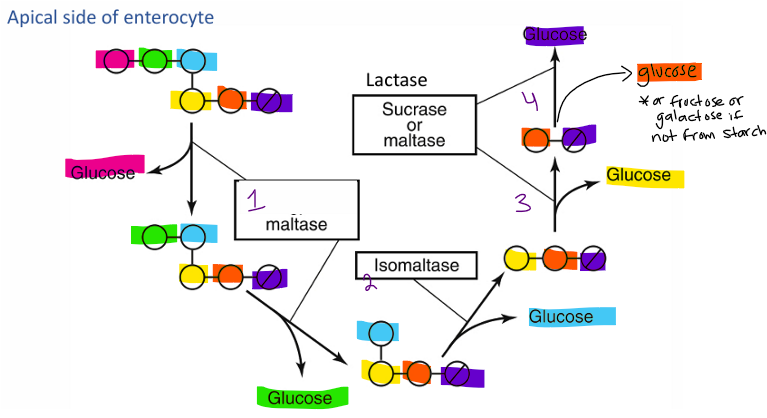
what will maltase do?
cleave a glucose by breaking a-1,4 bond (repeat until reach the branch point)
once our alpha-dextrin is broken down to only the glucose monomer making the branch, what enzyme acts on it?
isomaltase
what does isomaltase do?
cleave off the branched glucose attached via a-1,6 bond

the resulting maltotriose will be acted upon by
maltase

what will maltase do to the maltotriose?
remove a glucose via a-1,4 cleavage resulting in a disaccharide

the resulting disaccharide will be acted upon by what enzyme?
maltase (if maltose)
sucrase (if sucrose)
lactase (if lactose)

for starch breakdown, what will be the resulting dissacharide
maltose (glu+glu)

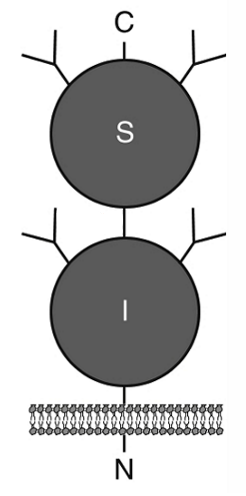
what is the sucrase-isomaltase complex?
digestive enzyme composed of 2 subunits derived from a precursor protein
sucrase-isomaltase complex is usually composed of what 2 subunits?
sucrase and isomaltase
when is the sucrase-isomaltase complex activated?
it will be cleaved between the subunits via pancreatic protease
the sucrase-isomaltase complex is part of what part of the cell?
cell membrane of the enterocyte in the villi
lactase is present in what form
as lactase phlorizin hydrolase complex

what does lactase do?
breaks the b-1,4 bond between glucose and galactose
lactase prevalence
northern Europe
Asia and Africa
full term infants
pre-mes
High in Northen European populations
Low in Asian and African populations
High in full-term infants
lower in pre-me infants
lactase varies through
different population groups
what occurs to lactase in our bodies by age 5
decreases by 90%
what is the maltase-glucoamylase complex
our maltase complex composed of 2 subunits
what does maltase do?
breaks alpha-1,4 bonds
where is most of starch digested in the body (specific body part)
lumen of duodenum
where does complete hydrolysis or oligosaccharides and disaccharides into monosaccharides occur in the body?
jejunum
how are our digestive enzymes produced in the SI made and activated?
made within the cell and then shuttled to apical side of cell where they will move their way up the villi and become activated

enzymes are produced where (cellular)→ go where→ and finally reach what part of the cell?
produced at the ER--> further processed in Golgi--> taken to apical side of cell
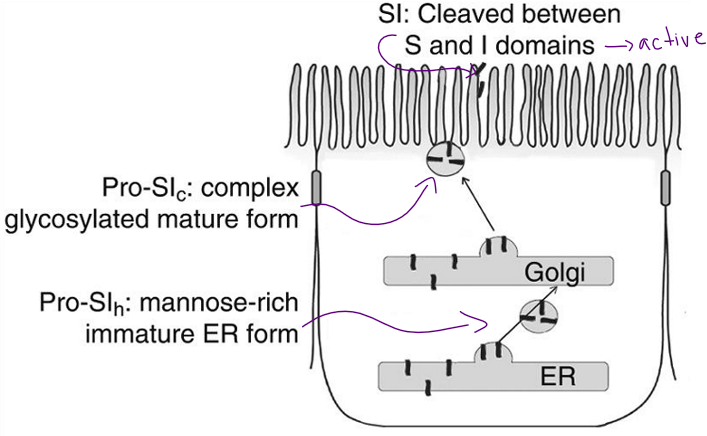
how are digestive enzymes activated (referring to our complexes that digest CHO)
At the crypts, the cells are inactive and not functional (inactive enzymes)
As the cells mature and reach the top of villi, they will gain more function
the cells at the very top of the villi have the most absorptive and enzymatic activity (enzymes will be activated via cleavage)
how is SI (sucrase-isomaltase complex) activated?
will be cleaved to be activated once it reaches the top of the villi

CHO absorption occurs primarily in the
SI
what structure of the SI allows for for catalytic ability?
villi
how are the villi related to catalytic activity?
Cells will mature as they move towards the top of the villi (gain catalytic activity)
the villi contain what that allows for absorption?
capillaries --> monosaccharides will enter capillaries to then enter portal vein when absorbed
what line the villi?
enterocytes
enterocytes will use what for energy
glucose and also butyrate
glucose and galactose enter the enterocyte via
SGLT1
SGLT1 does what?
takes 2Na and 1 glucose/galactose into the cell
taking in 2 different molecules into the cell makes it a
cotransporter
SGLT 1 is what type of protein
integral protein
SGLT1 is what type of transport
facilitative active transport
SGLT1 is what type of active transport
secondary active transport