Last Chunk of Exam 1

0.0(0)
Studied by 0 people
call kaiCall Kai
Locked
learnLearn
examPractice Test
spaced repetitionSpaced Repetition
heart puzzleMatch
flashcardsFlashcards
GameKnowt Play
Card Sorting

1/164

encourage image

There's no tags or description

Looks like no tags are added yet.

Last updated 3:21 AM on 9/18/26
Name
Mastery
Learn
Test
Matching
Spaced
Call with Kai
Chat

No analytics yet

Send a link to your students to track their progress

165 Terms

1
New cards

Catbolic Pathway

Enzymes in Metabolic Pathways

________: Enzymes in a pathway can function to breakdown biomolecules and release energy.

  • Eg. The steps involved in the breakdown of glucose to lactate.


<p><strong><u>Enzymes in Metabolic Pathways </u></strong></p><p>________: Enzymes in a pathway can <strong>function to </strong><span style="color: blue;"><strong>breakdown </strong></span><strong>biomolecules and release energy.</strong></p><ul><li><p>Eg. The steps involved in the breakdown of glucose to lactate. </p></li></ul><p></p>
2
New cards

Anabolic Pathway

Enzymes in Metabolic Pathways

________: Enzymes in a pathway can also make complex biomolecules, needed by the cell, from small precursors.

  • Eg. The steps involved in the synthesis of amino acids from simplier precursor


<p><strong><u>Enzymes in Metabolic Pathways </u></strong></p><p>________: Enzymes in a pathway<strong> can also make </strong><span style="color: green;"><strong>complex biomolecules</strong></span><strong>, needed by the cell, from <mark data-color="green" style="background-color: green; color: inherit;">small precursors.</mark></strong></p><ul><li><p>Eg. The steps involved in the synthesis of amino acids from simplier precursor</p></li></ul><p></p>
3
New cards

regulatory enzymes

Metabolomics

Metabolic pathways

  • Numerous interconnecting pathways, there needs to be signals to indicate - rate, quantity and timing of each enzyme, specifically these enzymes need to be functionally compartmentalized.

  • Enzymes are tightly controlled by ____________.


<p><strong><em>Metabolomics</em></strong></p><p><strong><u>Metabolic pathways</u></strong></p><ul><li><p>Numerous<strong><u> interconnecting pathways</u></strong>, there needs to be signals to indicate - <strong>rate, quantity and timing of each enzyme, specifically these enzymes need to be functionally compartmentalized</strong>. </p></li><li><p>Enzymes are <span style="color: red;"><strong>tightly controlled</strong></span> by ____________. </p></li></ul><p></p>
4
New cards

signals

Metabolomics

Regulatory Enzymes

  • catalytic activity increases or decreases in response to certain ______.

  • allows the cell to meet changing needs for energy and biomolecules.


<p><strong><em>Metabolomics</em></strong></p><p><strong><u>Regulatory Enzymes</u></strong></p><ul><li><p>catalytic activity<strong> </strong><span style="color: blue;"><strong>increases </strong></span>or <span style="color: red;"><strong>decreases </strong></span>in response to certain ______.</p></li><li><p>allows the cell to <strong>meet changing needs for energy and biomolecules. </strong></p></li></ul><p></p>
5
New cards

Unfavorable

Roles of Regulatory Enzymes

  • Pathways may contain __________ reactions - An unfavorable reaction can be driven forward by a favorable reaction

    • E.g. If the equilibrium contsant for the 2nd reaction favors W or X, but 3rd reaction uses X with a more favorable equilibrium constant, this can drive the 2nd reaction forward.


<p><strong><u>Roles of Regulatory Enzymes</u></strong></p><ul><li><p>Pathways may contain __________ reactions - An <strong>unfavorable reaction can be driven forward by a </strong><span style="color: blue;"><strong>favorable reaction</strong></span></p><ul><li><p>E.g. If the <strong>equilibrium contsant for the 2nd reaction favors W or X</strong>, but 3rd reaction uses X with a more favorable equilibrium constant, this can drive the 2nd reaction forward. </p></li></ul></li></ul><p></p>
6
New cards

Regulated

Roles of Regulatory Enzymes

  • Pathways are ________- Substrates or products of one step in the pathway can interact with one of the enzymes to affect its activity and alter the effeciency of the entire pathway

    • E.g. Product Z may inhibit E1, to down-regulate the pathway.


<p><strong><u>Roles of Regulatory Enzymes </u></strong></p><ul><li><p>Pathways are ________- <strong>Substrates or products of one step in the pathwa</strong>y can <span style="color: red;"><strong>interact </strong></span>with <strong>one of the enzymes to affect its activity and alter the effeciency of the entire pathway </strong></p><ul><li><p>E.g. Product Z may inhibit E1, to down-regulate the pathway. </p></li></ul></li></ul><p></p>
7
New cards

decrease

Roles of Regulatory Enzymes

  • Cells do not waste energy, or building blocks, making biomolecules that are already plentiful enough, or that are not needed under a given enviornmental condition.

    • In this case, a pathway may be down-regulated to _____ its production of end-product.


<p><strong><u>Roles of Regulatory Enzymes</u></strong></p><ul><li><p>Cells <strong><u>do not waste energy, or building blocks</u></strong>, making biomolecules that <strong>are already plentiful enough, or that are not needed under a given enviornmental condition.</strong></p><ul><li><p>In this case, a pathway may be <strong><mark data-color="red" style="background-color: red; color: inherit;">down-regulated </mark></strong>to _____ its production of end-product. </p></li></ul></li></ul><p></p>
8
New cards

increase

Roles of Regulatory Enzymes

  • If a cell needs more energy, or more of a particular biomolecule, under a given set of circumstances, the cell will produce more.

    • In this case, a pathway may be up-regulated to ______ its production of the end product.


<p><strong><u>Roles of Regulatory Enzymes</u></strong></p><ul><li><p>If a cell <strong>needs more energy, or more of a particular biomolecule, under a given set of circumstances, the cell will produce more.</strong></p><ul><li><p>In this case, a pathway may be <strong><mark data-color="blue" style="background-color: blue; color: inherit;">up-regulated </mark></strong>to ______ its production of the end product.</p></li></ul></li></ul><p></p>
9
New cards

regulatory enzyme

Characteristics of Regulatory Enzymes

  • The first enzyme (E1) is often the ________. This more effecient since other steps do not waste energy unnecessarily.


10
New cards

Michaelis-Menten

Other enzymes follow _________ kinetics, but regulatroy enzumes usually do not.

  • All regulatory enzymes do not follow Michaelis-Menten kinetics.


11
New cards

multi-subunit

Regulatroy enzymes tend to be ________ proteins.

12
New cards

Allosteric enzymes

Modulation of Regulatory Enzymes

  • ___________- function through reversible, noncovalent binding of regulatory compounds called allosteric modulators or allosteric effectors (small metabolites or cofactors)

    • Reversible covalent modification

    • Binding of a separate regulatory protein/s

    • Removal of peptide segments ny proteolytic cleavage


13
New cards

modulator binding site

Allosteric Regulation of Enzymes

  • In many allosteric enzymes, the substrate binding site and the __________ are of different subunits, the catalytic (C) and the regulatroy (R), respectively.
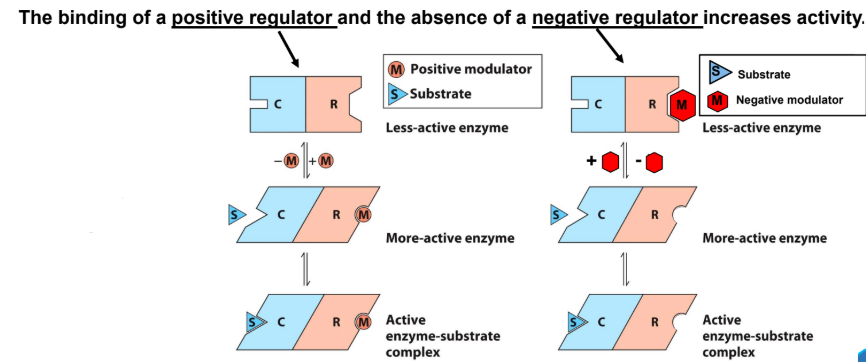

<p><strong><u>Allosteric Regulation of Enzymes</u></strong></p><ul><li><p>In many <strong><em>allosteric enzymes</em></strong>, the<span style="color: blue;"><strong> substrate binding site </strong></span>and the __________ are of<strong> different subunits, the catalytic (C) and the regulatroy (R), respectively. </strong></p></li></ul><p></p>
14
New cards

activity

Allosteric Regulation of Enzymes

  • The binding of positive regulator and the absence of a negative regulator increases ________.


<p><strong><u>Allosteric Regulation of Enzymes</u></strong></p><ul><li><p>The binding of <span style="color: blue;"><strong>positive regulator</strong></span> and the <strong><em>absence </em></strong>of a<span style="color: red;"><strong> negative regulator</strong></span> increases ________. </p></li></ul><p></p>
15
New cards

Homotropic

Allosteric Regulation of Enzymes

______- regulation in which the substrate and modulator are identifcal

16
New cards

Heterotropic

Allosteric Regulation of Enzymes

______- regulation in which the modulator is a moelcule other than a substrate

17
New cards

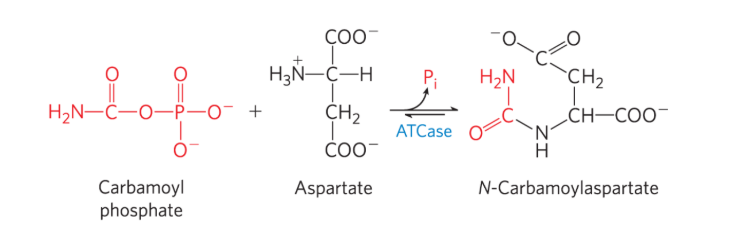
Aspartate transcarbamoylase

______________(ATCase) - catalyzes the formation of carbamoyl aspartate, an early step in pyrimidine biosynthesis.

  • Regulatory Enzyme


<p>______________(ATCase) - catalyzes the<strong> formation of carbamoyl aspartate, an early step in pyrimidine biosynthesis.</strong></p><ul><li><p>Regulatory Enzyme </p></li></ul><p></p>
18
New cards

Quaternary

The _____________ Structure of Aspartate Transcarbamoylase
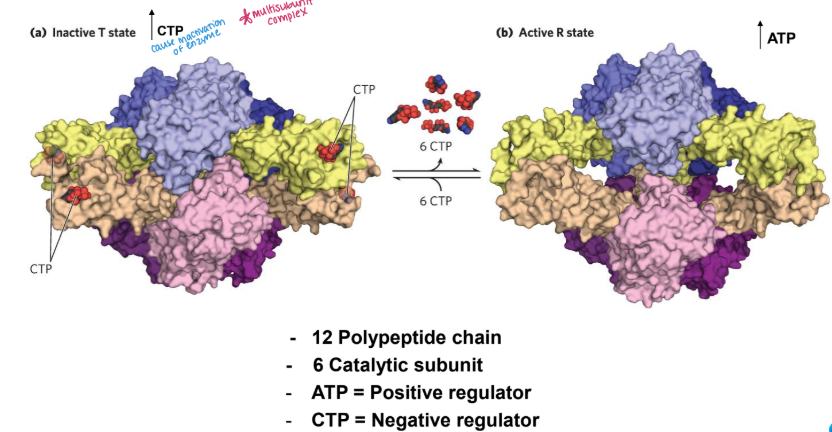
<p>The _____________ Structure of Aspartate Transcarbamoylase </p>
19
New cards

Diverge

The Kinetic Properties of Allosteric Enzymes _____from Michealis-Menten Behavior

20
New cards

sigmoid saturation curve

Allosteric Enzymes

  • Plot of V0 versus [S] usually produce a _________, rather than a hyperbolic curve.

  • [S]0.5 or K0.5 represents the [S] giving half-maximal velocity of the reaction which is different from the Km


<p><strong><u>Allosteric Enzymes</u></strong></p><ul><li><p>Plot of <strong>V0 versus [S]</strong> usually produce a _________, rather than a <span style="color: purple;"><strong><em>hyperbolic curve</em></strong></span>. </p></li><li><p><mark data-color="yellow" style="background-color: yellow; color: inherit;">[S]0.5 or K0.5 represents the [S] giving half-maximal velocity</mark> of the reaction which is different from the Km</p></li></ul><p></p>
21
New cards

[S]

Allosteric Enzymes

  • A relatively small increase in ____ in the steep part of the curve causes a comparatively large increase in V0*


<p><strong><u>Allosteric Enzymes</u></strong></p><ul><li><p>A relatively<strong> small increase</strong> in ____ in the<strong> steep part of the curve causes a comparatively large increase in V0*</strong></p></li></ul><p></p>
22
New cards
  • Activators

  • Inhibitors


Modulations to alter either K0.5 or Vmax

  • For heterotrophic allosteric enzymes

    • _______: may cause the curve to become more hyperbolic.

    • ________: may cause the curve to become more sigmoidal.


<p><strong><u>Modulations to alter either K0.5 or Vmax</u></strong></p><ul><li><p>For <span style="color: red;"><strong>heterotrophic allosteric enzymes</strong></span></p><ul><li><p>_______: may <strong>cause the curve to become more </strong><span style="color: blue;"><strong>hyperbolic</strong></span><strong>.</strong></p></li><li><p>________: may <strong>cause the curve to become more </strong><span style="color: green;"><strong>sigmoidal</strong></span><strong>.</strong></p></li></ul></li></ul><p></p>
23
New cards

Homotrophic modulator

A substrate that causes a conformational change in an enzyme to enhance its own binding is a(n):

___________

24
New cards

reversible

Some enzymes are regulated by _______ covalent modification

25
New cards

Protein Kinases

Phosphoryl Groups Affect the Structure and Catalytic Activity of Enzymes

  • __________ = catalyze the attachement of phosphoryl groups to specific amino acid residues (Ser, Thr, Tyr, His)
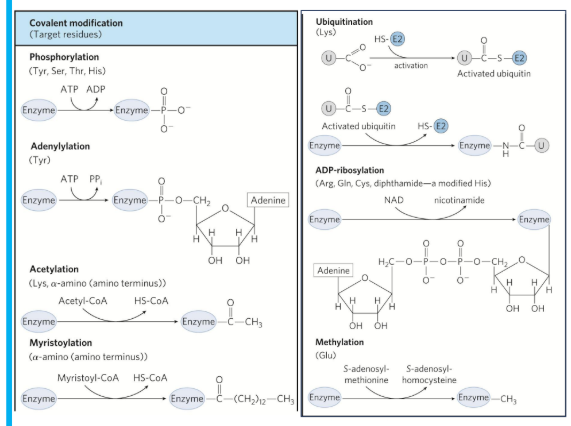

<p><strong>Phosphoryl Groups Affect the Structure and Catalytic Activity of Enzymes</strong></p><ul><li><p>__________ = catalyze the <span style="color: blue;"><strong>attachement of phosphoryl groups to specific amino acid residues </strong></span>(Ser, Thr, Tyr, His) </p></li></ul><p></p>
26
New cards

phosphoprotein phosphatases/protein phosphatases

Phosphoryl Groups Affect the Structure and Catalytic Activity of Enzymes

  • ___________________= remove phosphoryl groups from the same target proteins


<p><strong>Phosphoryl Groups Affect the Structure and Catalytic Activity of Enzymes </strong></p><ul><li><p>___________________= remove <strong>phosphoryl groups from the same target proteins</strong></p></li></ul><p></p>
27
New cards

Phosphorylation

Regulation of Muscle Glycogen Phsophorylase (Regulatory Protein) Activity by _________

  • Glycogen phsophorylase is regulated by 2 other proteins → phosphorylase (adds a phosphate) and phosphoprotein phosphatase 1 (removes a phosphate)


<p><strong><u>Regulation of Muscle Glycogen Phsophorylase (Regulatory Protein) Activity by</u></strong> _________</p><ul><li><p><span style="color: blue;"><strong>Glycogen phsophorylase is regulated by 2 other proteins</strong></span> → phosphorylase (adds a phosphate) and phosphoprotein phosphatase 1 (removes a phosphate) </p></li></ul><p></p>
28
New cards

cleaved

Regulation by Proteolytic Cleavage of an Enzyme Precursor

  • Protein/enzyme needs to be ____ for it to be activated


<p><strong><u>Regulation by Proteolytic Cleavage of an Enzyme Precursor</u></strong></p><ul><li><p>Protein/enzyme needs to be ____ for it to be <strong>activated</strong></p></li></ul><p></p>
29
New cards

Zymogen

______- inactive precursor that is cleaved to for an active protease

<p>______- <strong>inactive precursor</strong> that is <span style="color: red;">cleaved </span>to for an active protease </p>
30
New cards

Proprotein or proenzyme

________- precursors that are cleaved to form other proteins (Already activated)

<p>________- <strong>precursors </strong>that are <span style="color: blue;"><strong>cleaved </strong></span>to <strong>form other proteins</strong> (Already activated) </p>
31
New cards

Coagulation

A Cascade of Proteolytically Activated Zymogens Leads to Blood ______________
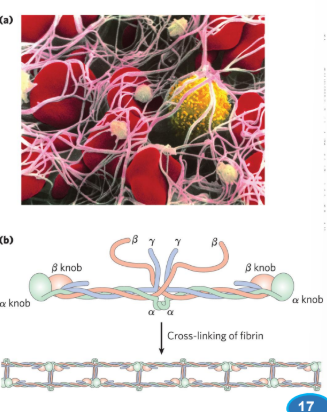
<p>A Cascade of <strong>Proteolytically Activated Zymogen</strong>s Leads to Blood ______________</p>
32
New cards

Regulatory Cascade

______ = a mechanism that allows a very senestive response to ‘and amplification of’ a molecular signal

  • Example = formation of a blood clot


<p>______ = a mechanism that allows<strong> a very senestive response</strong> to <span style="color: red;"><strong><mark data-color="red" style="background-color: red; color: inherit;">‘and amplification of’</mark></strong></span> a molecular signal </p><ul><li><p>Example = formation of a<strong> blood clo</strong>t </p></li></ul><p></p>
33
New cards

Blood Clot

________= aggregate of specialized cell fragments that lack nuclei (platelets) cross-linked and stabilized by proteinaceous fibers consisting maingly of the protein fibrin (dervied from the soluble zymogen fibrinogen)

<p>________= <strong>aggregate</strong> of <strong>specialized cell fragments that lack nuclei</strong> <span style="color: red;"><strong><mark data-color="red" style="background-color: red; color: inherit;">(platelets)</mark></strong></span> <em>cross-linked and stabilized by proteinaceous fibers consisting maingly of the protein </em><strong><em>fibrin</em> </strong>(dervied from the soluble zymogen fibrinogen) </p>
34
New cards

thromboxanes

Blood Coagulation Cascade (1)

  • Caused by collagen exposure to blood (tissue damage)

  • Causes the release of signaling molecules such as _______to stimulate the activiation of additional platelets.
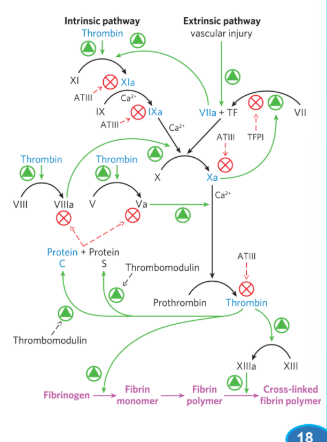

<p><strong><u>Blood Coagulation Cascade (1)</u></strong></p><ul><li><p>Caused by <strong>collagen</strong> exposure to <span style="color: red;"><strong>blood</strong></span> (tissue damage) </p></li><li><p>Causes the <span style="color: blue;"><strong><em>release of signaling molecules</em></strong></span> such as _______to<strong> stimulate the activiation of additional platelets. </strong></p></li></ul><p></p>
35
New cards

fibrin

Blood Coagulation Cascade (2)

  • Fibrinogen is converted to _____ by the preoteolytic removal of amino acid residues.

  • Thromin - serine protease that catalyzes peptide removal

  • Factor xiia - transglutaminase enzyme that catalyzes the formation of covalent cross-links between fibrins


<p><strong><u>Blood Coagulation Cascade (2)</u></strong></p><ul><li><p><strong>Fibrinogen </strong>is converted to _____ by the<span style="color: purple;"><strong> preoteolytic removal of amino acid residues. </strong></span></p></li><li><p><strong><em><mark data-color="yellow" style="background-color: yellow; color: inherit;">Thromin</mark></em></strong> - serine protease that<u> catalyzes peptide removal </u></p></li><li><p><strong><em><mark data-color="yellow" style="background-color: yellow; color: inherit;">Factor xiia </mark></em></strong>- transglutaminase enzyme that catalyzes the formation of covalent <u>cross-links between fibrins </u></p></li></ul><p></p>
36
New cards

Intrinsic pathway

Blood Coagulation Cascade

_______- involes all compounds found in the blood plasma (internal injury)

<p><strong><u>Blood Coagulation Cascade </u></strong></p><p>_______- involes <strong>all compounds found in the blood plasma </strong>(internal injury) </p>
37
New cards

Extrinsic pathway

Blood Coagulation Cascade

______- tissue factor pathway = involves the protein tissue factor (tf) which is not present in blood

<p><strong><u>Blood Coagulation Cascade</u></strong></p><p>______- tissue factor pathway = involves the <strong><u>protein tissue factor (tf) which is not present in blood</u></strong></p>
38
New cards

transductions

Bioenergenetics is the stidy of energy ________ in living systems.

  • How do cells extract energy from the enviornment and sue this energy to synthesize biomolecules?


39
New cards

thermodynamics

Biological energy transuctions obey the laws of ________

  • First Law of Theormodynamics: Energy may change form, and may be transported, but energy cannot be created or destroyed.

  • Second Law of Thermodynamics: The entropy (randomness) of the universe will always increase


40
New cards

Universe

Thermodynamic Laws apply to the ______(Biochemical)

  • The reacting system and its surroundings.


41
New cards

form

Energy Transofrmations in Living Organisms

  • The first law of thermodynamics: in any physcial or chemical change, the total amount of energy in the universe remains constant, although the _____ of energy may change.
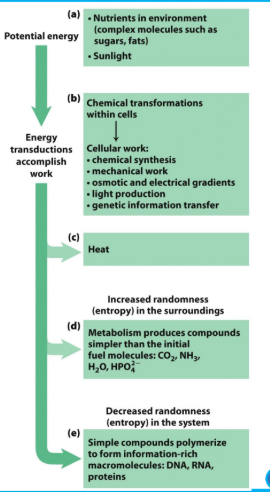

<p><strong><u>Energy Transofrmations in Living Organisms </u></strong></p><ul><li><p>The<strong> first law of thermodynamics: </strong>in any physcial or chemical change, the total amount of energy in the universe remains constant, <strong><mark data-color="blue" style="background-color: blue; color: inherit;">although the _____ of energy may change.</mark></strong></p></li></ul><p></p>
42
New cards

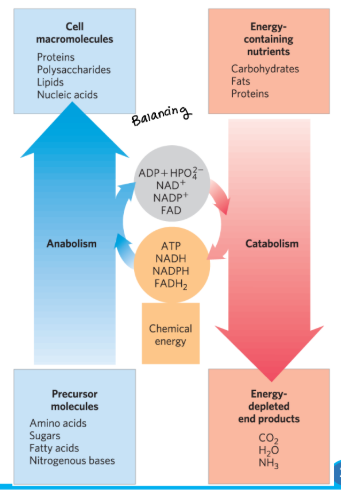
catabolism

The Relationship Between Catbolic and Anabolic Pathways

  • __________- the degradative phase of metabolism

    • releases energy


<p><strong>The Relationship Between Catbolic and Anabolic Pathways </strong></p><ul><li><p>__________- the <span style="color: blue;"><strong>degradative</strong></span> phase of <span style="color: green;"><strong>metabolism </strong></span></p><ul><li><p><mark data-color="green" style="background-color: green; color: inherit;">releases energy </mark></p></li></ul></li></ul><p></p>
43
New cards

anabolism

The Relationship Between Catabolic and Anabolic Pathways

  • _________(biosynthesis) - the building phase of metabolism

    • requires energy


<p><strong>The Relationship Between Catabolic and Anabolic Pathways </strong></p><ul><li><p>_________(biosynthesis) - the <span style="color: red;"><strong>building phase</strong></span><strong> </strong>of <span style="color: green;"><strong>metabolism </strong></span></p><ul><li><p><mark data-color="green" style="background-color: green; color: inherit;">requires energy </mark></p></li></ul></li></ul><p></p>
44
New cards

Diverge

Catabolic Pathways and Anabolic Pathways _________

  • Acetate (Acetyl-CoA) is at the center of a bunch of catabolic and anabolic pathways in living organisms


<p><strong><u>Catabolic Pathways and Anabolic Pathways _________</u></strong></p><ul><li><p><span style="color: blue;"><strong><u>Acetate (Acetyl-CoA)</u></strong></span> is at the <em>center of a bunch of catabolic and anabolic pathways in living organisms </em></p></li></ul><p></p>
45
New cards

Gibbs free energy

Thermodynamics

  • __________, G, a measure of the amount of work a system can perform at constant temperature and pressure.


46
New cards

DeltaG

____: Changes in G allows prediction of the direction of chemical reactions (i.e. whether favored and the equilibirum position)

  • Exergonic reaction; releases free energy -Delta G (Favorable)

  • Endergonic reaction; gains free energy +Delta G (Not favorable)


47
New cards

H

Enthalpy, ___, or heat contant, reflects the number and kinds of bonds in reactants (substrate, S), and product, P. Units: J/mol

  • Exothermic reaction, heat is releases -Delta H

  • Endothermic reaction heat is absorbed +Delta H


48
New cards

increase

Entropy, S, measures randomness or disorder. Units J/mol x K

  • Entropy ____; gain entropy when products are less complex or more disordered than reactants +Delta S

    • The change in Gibbs free energy: (view equation)


<p><strong>Entropy, S, measures <mark data-color="red" style="background-color: red; color: inherit;">randomness or disorder</mark>. Units J/mol x K</strong></p><ul><li><p>Entropy ____; gain entropy when<strong> products are less complex or more disordered than reactants +Delta S </strong></p><ul><li><p>The change in Gibbs free energy: (view equation) </p></li></ul></li></ul><p></p>
49
New cards
term image

Standard Free Energy Change → ______

  • Free energy associated with a specific equation at a specific concentration/pressure/temperature

  • Reacting systems tend to move toward equilibrium.

    • At equilibrium, the forward and reverse reaction rates are equal. Also, the concentrations of reactants and products define the equilibrium constant.


50
New cards
term image

Tendency toward equilibrium represents a driving force that can be expressed by the _____ for the reaction.

<p>Tendency toward equilibrium represents a driving force that can be expressed by the _____ for the reaction. </p>
51
New cards

constant

DeltaG’o is a measure of how far a reaction must go to reach equilbirum, when initial concentrations of each component are 1M, with standard state conditions (1atm and 298K)

  • DeltaG’o is ________ for a given reaction


52
New cards

actual

Kinetics vs Thermodynamics

  • The actual free energy for a reaction depends on the initial concentrations of substrates and products, and on the tempature.

  • These are unlikely to be standard conditions.

    • In this equation, the concentration terms and temperature are the ____ conditions.
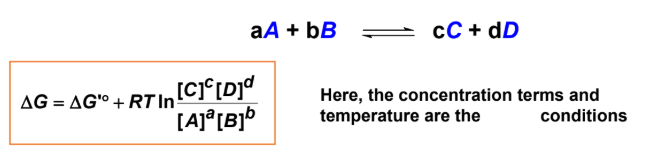

<p><strong><u>Kinetics vs Thermodynamics </u></strong></p><ul><li><p>The actual free energy for a reaction <strong>depends on the initial concentrations of substrates and products, and on the tempature.</strong> </p></li><li><p>These are unlikely to be standard conditions. </p><ul><li><p>In this equation, the concentration terms and temperature are the ____ conditions. </p></li></ul></li></ul><p></p>
53
New cards

forward direction

When Delta G < 0 reaction tends to go in the __________

54
New cards

Reverse direction

When Delta G > 0 reaction tends to go in the _______

55
New cards

equilbirum

When Delta G = 0 the reaction is at _______

  • But this does not say how fast, just where it will end


56
New cards

DO NOT

Gibbs Free Energy

  • Reaction rate constant, k, is a function of DeltaG(TS) (Delta G (Tcat) < Delta G (Tuncat)

  • Equilibrium constant K’eq is a function of DeltaGo

  • Enzymes _________ affect the rate of equilibirum, only the reaction rate and the rate of approach to equilibrium.


<p><strong><u>Gibbs Free Energy </u></strong></p><ul><li><p>Reaction rate constant, <strong>k</strong>, is a <strong>function of DeltaG(TS) (Delta G (Tcat) &lt; Delta G (Tuncat) </strong></p></li><li><p>Equilibrium constant K’eq is a function of DeltaGo</p></li><li><p>Enzymes _________ affect the<span style="color: red;"><strong> rate of equilibirum, only the reaction rate and the rate of approach to equilibrium</strong></span>. </p></li></ul><p></p>
57
New cards

coupled

Biochemical Bookkeeping

  • Standard free energy changes for sequention reactions are additive

  • Therefore, a thermodynamically unfavorable reaction (DeltaG’o > 0 or endergonic) can be _____ to a thermodynamically favored reaction (DeltaG’o < 0, exergonic) to drive the unfavorable reaction forward.


<p><strong><u>Biochemical Bookkeeping </u></strong></p><ul><li><p><strong>Standard free energy changes </strong>for sequention reactions are <span style="color: green;"><strong>additive</strong></span></p></li><li><p>Therefore, a<strong><mark data-color="green" style="background-color: green; color: inherit;"> thermodynamically unfavorable reaction (DeltaG’o &gt; 0 or endergonic) can be _____ to a thermodynamically favored reaction (DeltaG’o &lt; 0, exergonic) to drive the unfavorable reaction forward. </mark></strong></p></li></ul><p></p>
58
New cards

Currency

ATP is the Energy “_____” of cells

  • ATP hydrolysis is a coupling reaction that couple reactions


59
New cards

exergonic

  • The DeltaG’o for ATP hydrolysis is large and negative

  • The _____ process of ATP hydrolysis is coupled to many endergonic reactions and processes.


<ul><li><p>The DeltaG’o for<strong> ATP hydrolysis</strong> is <span style="color: red;"><strong>large </strong></span>and <span style="color: red;"><strong>negative </strong></span></p></li><li><p>The _____ process of ATP<strong> hydrolysis is coupled</strong> to many <strong>endergonic reactions and processes. </strong></p></li></ul><p></p>
60
New cards

group transfer

In metabolism, it is not ATP hydrolysis, but ________ that couples the energy of ATP breakdown to endergonic reactions

  • i.e. Phosphoryl, pyrophosphoryl, or adenylyl group transfer.

  • For some mechanoenzymes, energy of ATP hydrolysis drives conformational changes to drive reactions.

    • e.g. DNA helicase hydrolyze ATP to unwind DNA


61
New cards

3

Hydrolysis of ATP

  • There are __ phosphates that can be hydrolyzed
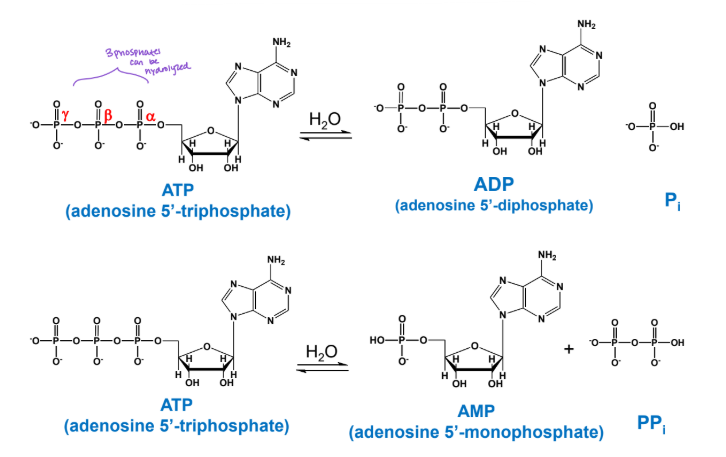

<p><strong><u>Hydrolysis of ATP</u></strong></p><ul><li><p>There are __ phosphates that can be hydrolyzed </p></li></ul><p></p>
62
New cards

nucelophilic

Group Transfer by ATP 1

  • each of the three phosphates of ATP is susceptible to _________ attack
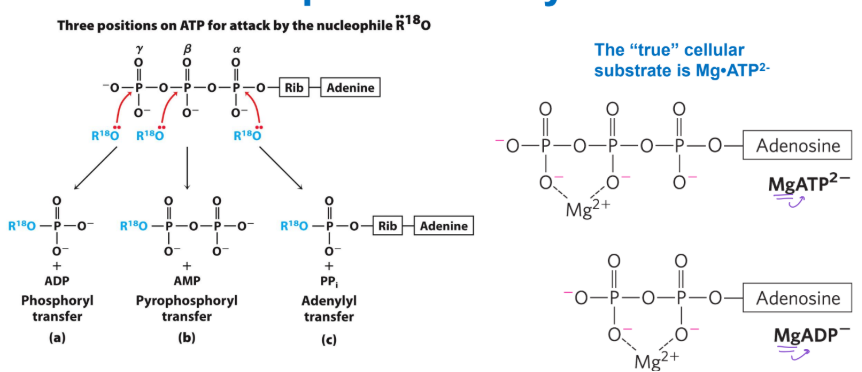

<p><strong><u>Group Transfer by ATP 1 </u></strong></p><ul><li><p>each of the three phosphates of ATP is susceptible to _________ attack </p></li></ul><p></p>
63
New cards

free energies

Group Transfer by ATP 2

  • Recall in thermodynamics, what matters is the relative energies of the reactants and the products

  • The pathway from reaction to products is not important.

  • Therefore, you can add the _____ of the two reactions to get the overall free energy for the system of coupled reactions
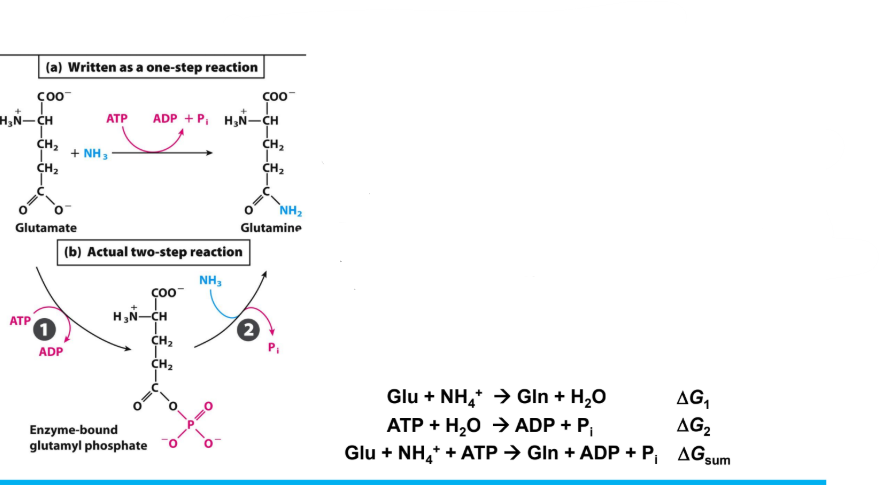

<p><strong><u>Group Transfer by ATP 2</u></strong></p><ul><li><p>Recall in <strong>thermodynamics</strong>, what matters is the<strong> relative energies of the reactants and the products </strong></p></li><li><p><mark data-color="yellow" style="background-color: yellow; color: inherit;">The pathway from reaction to products is not important. </mark></p></li><li><p>Therefore, you can add the _____ of the<span style="color: red;"><strong> two reactions to get the overall free energy for the system of coupled reactions </strong></span></p></li></ul><p></p>
64
New cards

Carbohydrates

What is the most abundant biomolecule on earth?

65
New cards

Oxidized

Carbohydrates

  • _____ to produce energy in non-photosyntehtic organisms


66
New cards
  • Structural

  • Protective


Carbohydrates

  • Polymers are both ____ and _________ in some organisms
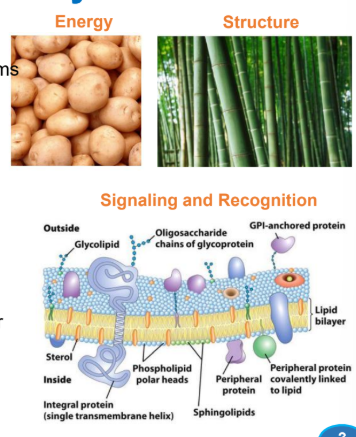

<p><strong><u>Carbohydrates </u></strong></p><ul><li><p>Polymers are both ____ and _________ in some organisms </p></li></ul><p></p>
67
New cards

hydroxyl groups

Carbohydrates

  • Lubricates joints, involved in cell-cell adhesion and recognition

  • Glycoprotein or glycolipid acts as signal for intra and intracellular transport

  • Aldehydes or ketones with at least two ___________, or substances that yield such compounds on hydrolysis
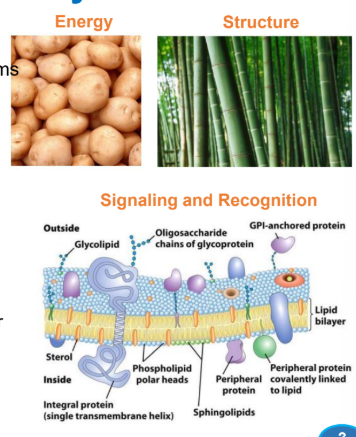

<p><strong><u>Carbohydrates</u></strong></p><ul><li><p><span style="color: blue;"><strong><u>Lubricates </u></strong></span>joints, involved in <strong>cell-cell adhesion and recognition </strong></p></li><li><p><strong>Glycoprotein </strong>or <strong>glycolipid</strong> acts as <strong><u>signal </u></strong>for<mark data-color="yellow" style="background-color: yellow; color: inherit;"> intra and intracellular transport </mark></p></li><li><p><strong>Aldehydes </strong>or <strong>ketones </strong>with at least two ___________, or substances that <u>yield such compounds on hydrolysis </u></p></li></ul><p></p>
68
New cards
term image

Many carbohydrates have the empirical formula → ______

*Carbohydrates by themselves → not usually signaling molecule: intract with lipids/proteins

69
New cards

Carbohydrates s

Introduction to ________

<p>Introduction to ________</p>
70
New cards

Monosaccharides

Classification of Carbohydrates

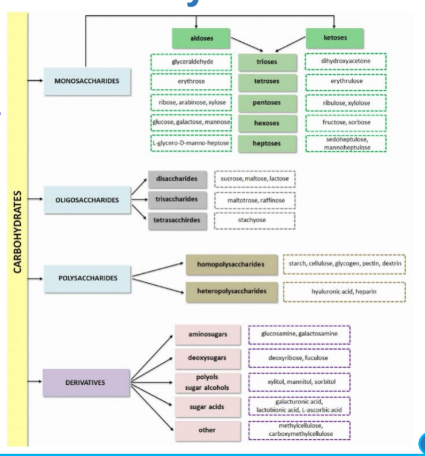
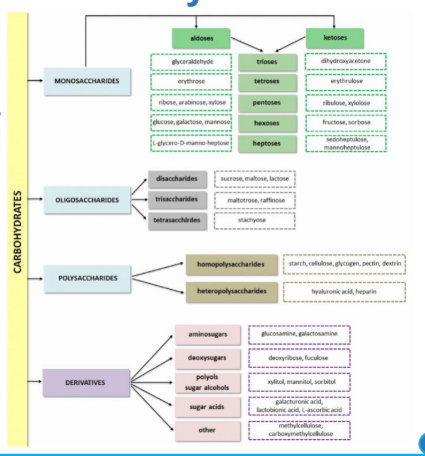
  • _________ = simple sugars, consist of a single polyhydroxy aldehyde or ketone unit, example D-glucose

    • Carbohydrates D isomers, Amino Acids L isomers


<p><strong><u>Classification of Carbohydrates </u></strong></p><ul><li><p>_________ = simple sugars, consist of a single <strong>polyhydroxy<u> aldehyde</u> or <u>ketone</u> unit, example</strong><span style="color: blue;"><strong> D-glucose </strong></span></p><ul><li><p>Carbohydrates D isomers, Amino Acids L isomers </p></li></ul></li></ul><p></p>
71
New cards

Oligosaccharides

_________ = short chains of monosaccharide units, or residues, joined by glycosidic bonds.
<p>_________ = short chains of <strong>monosaccharide units, or residues, joined by glycosidic bonds. </strong></p>
72
New cards

Disaccharides

_________ = oligosaccharides with two monosaccharide units

example: sucrose (D-glucose and D-fructose)

<p>_________ = <strong>oligosaccharides</strong> with <span style="color: blue;"><strong>two monosaccharide units</strong></span> </p><p><u>example:</u> sucrose (D-glucose and D-fructose)</p>
73
New cards

Polysaccharides

___________ = sugar polymers with 10+ monosaccharide units

examples: cellulose (linear), glycogen (branches)
<p>___________ = sugar polymers with <strong>10+ monosaccharide units </strong></p><p>examples: cellulose (linear), glycogen (branches) </p>
74
New cards
  • Aldose

  • Ketose


Monossacharides

  • _____ = aldehyde group is at an end of the carbon chain

  • ______ = ketone group is at any other position other than the end.

    • Contains 2 or more hydorxyl groups - steroisomeric forms


<p><strong><u>Monossacharides</u></strong></p><ul><li><p>_____ = <strong><u>aldehyde group </u></strong>is at an <strong>end of the carbon chain </strong></p></li><li><p>______ = <strong><u>ketone group</u></strong> is <strong>at any other position other than the end. </strong></p><ul><li><p>Contains 2 or more hydorxyl groups - steroisomeric forms </p></li></ul></li></ul><p></p>
75
New cards

D-Glyceraldehyde an aldotriose

knowt flashcard image
76
New cards

Dihydroxyacetone a ketotriose

knowt flashcard image
77
New cards

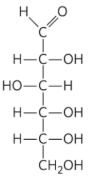
D-Glucose an aldohexose

knowt flashcard image
78
New cards

D-fructose, a ketohexose

knowt flashcard image
79
New cards

D-Ribose an aldopentose

knowt flashcard image
80
New cards

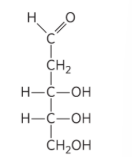
2-Deoxy-D-ribose an aldopentose

knowt flashcard image
81
New cards

chiral carbon atom

Stereochemistry of Monossacharides

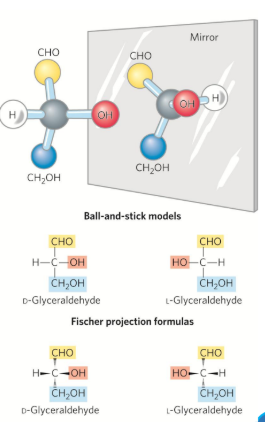
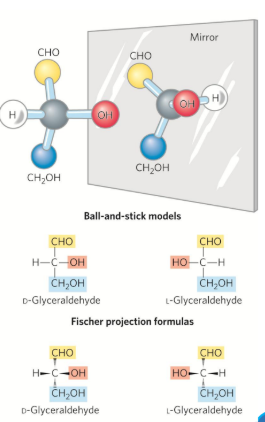
  • All monosaccharides (expect dihydroxyacetone) contan 1+ ____

    • Occur in optically isomeric forms (D,L enantiomers)

<p><strong>Stereochemistry of Monossacharides</strong></p><ul><li><p>All <strong>monosaccharides </strong>(expect <strong>dihydroxyacetone</strong>) contan 1+ ____</p><ul><li><p>Occur in optically isomeric forms (D,L enantiomers) </p></li></ul></li></ul><p></p>
82
New cards

Enantiomers

_______= two different optical isomers that are non-superposable mirro images.

<p>_______= two different optical isomers that are<strong> non-superposable mirro images. </strong></p>
83
New cards

2^n

In general, a molecule with n chiral centers can have __ stereoisomers
<p>In general, a molecule with <strong>n </strong><u>chiral centers</u> can have __ <strong>stereoisomers </strong></p>
84
New cards

carbon atoms

Sugar stereoisomers - _____ to which the hydroxyl groups are attached are chiral centers.

  • Enzymes that act on sugars are stereospecific (most common sugars in nature → D_


<p><strong><u>Sugar stereoisomers</u></strong> - _____ to which the <strong>hydroxyl groups are attached are <mark data-color="blue" style="background-color: blue; color: inherit;">chiral centers</mark>.</strong></p><ul><li><p>Enzymes that act on <strong>sugars </strong>are <strong>stereospecific </strong>(most common sugars in nature → D_ </p></li></ul><p></p>
85
New cards

Aldoses and Ketoses

________

<p>________</p>
86
New cards

The position of the carbonyl carbon

What chemical feature determines if a sugar is an aldose or ketose?

87
New cards

Epimers

_______: two sugars that differ only in the configuration around one carbon atom

<p>_______: two sugars that differ only in the <strong>configuration around one carbon atom </strong></p>
88
New cards

cyclic (ringed) structures

Cyclization

  • In aqueous solution, aldotetroses and all monosaccharides with 5+ backbone carbon atoms occur as ________

  • Formed by a covalent bond between the carbonyl group and the oxygen of a hydroxyl group


89
New cards

ring/cyclic

Cyclization

  • Hemiacetals or hemiketals

    • reaction between alcohols and aldehydes or ketones

    • product of the first alcohol molecule addition

    • a five or six membered ____ structure forms if the -OH and carbonyl groups are on the same molecule.


90
New cards

glycosidic bond

Cyclization

Acetal or ketal = product of the second alcohol molecule addition - forms a _______

91
New cards

Review

Formation of Hemiacetals or Hemiketals
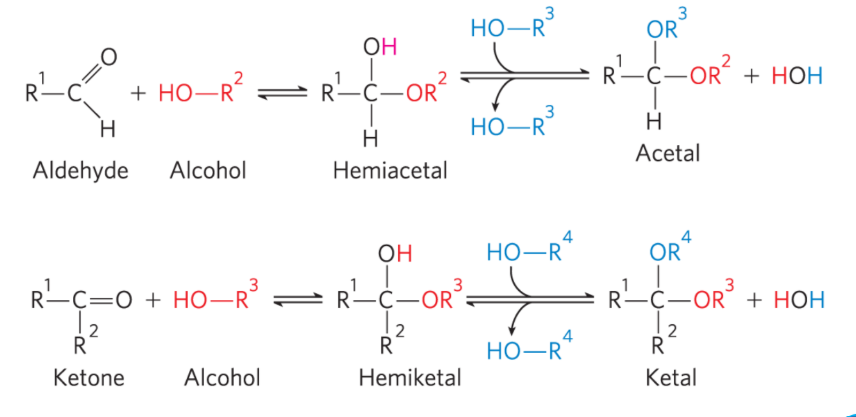
<p>Formation of Hemiacetals or Hemiketals </p>
92
New cards

hemiacetal linkage

Formation of the Two Cyclic Forms of D-Glucose

  • Reaction between the aldehyde group at C-1 and the hydroxyl group at C-5 forms a ______

  • Mutarotation = the interconversion of alpha and Beta anomers


<p><strong><u>Formation of the Two Cyclic Forms of D-Glucose </u></strong></p><ul><li><p>Reaction between the <span style="color: blue;"><strong><u>aldehyde group at C-1 and the hydroxyl group at C-5 forms a ______</u></strong></span></p></li><li><p><strong><em><u>Mutarotation </u></em></strong>= the interconversion of alpha and Beta anomers </p></li></ul><p></p>
93
New cards

Pyranoses

Pyranoses and Furanoses

  • _______ = six membered ring compounds

    • form when the hydroxyl group at C-5 reacts with the aldehyde group at C-1
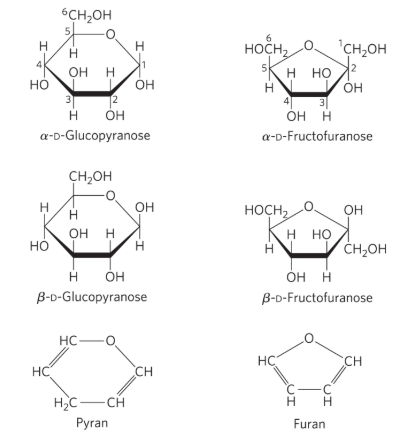

<p><strong><u>Pyranoses and Furanoses</u></strong></p><ul><li><p>_______ = <strong>six membered ring compounds</strong></p><ul><li><p>form when the <strong>hydroxyl group</strong> at <mark data-color="yellow" style="background-color: yellow; color: inherit;">C-5</mark> reacts with the aldehyde group at <mark data-color="yellow" style="background-color: yellow; color: inherit;">C-1</mark></p></li></ul></li></ul><p></p>
94
New cards

Furanoses

Pyranoses and Furanoses

  • _______ = five-membered ring compounds

    • form when the hydroxyl group at C-5 reacts with ketone group at C-2


<p><strong><u>Pyranoses and Furanoses </u></strong></p><ul><li><p>_______ =<strong> five-membered ring compounds </strong></p><ul><li><p>form when th<strong>e hydroxyl group</strong> at <mark data-color="yellow" style="background-color: yellow; color: inherit;">C-5</mark> reacts with ketone group at <mark data-color="yellow" style="background-color: yellow; color: inherit;">C-2 </mark></p></li></ul></li></ul><p></p>
95
New cards

perpendicular

Hawroth Projection

  • Haworth perspective formulas = more accurate representation of cyclic sugar structure than Fischer prohections

    • six-membered ring is titled to makes it plane almost ____ to that of the paper

    • bonds closets to the reader are drawn thicker than those farther away


<p><strong><u>Hawroth Projection </u></strong></p><ul><li><p><strong>Haworth perspective formulas</strong> = more accurate representation of <span style="color: blue;"><u>cyclic sugar structure than Fischer prohections </u></span></p><ul><li><p><strong>six-membered ring</strong> is titled to makes it plane almost ____ to that of the paper</p></li><li><p><strong>bonds closets to the reader are drawn thicker than those farther away </strong></p></li></ul></li></ul><p></p>
96
New cards
<p>Review </p>

Review

Symbols and Abbreviations for Monosaccharides and Derivatives

  • Review


<p>Symbols and Abbreviations for Monosaccharides and Derivatives </p><ul><li><p>Review </p></li></ul><p></p>
97
New cards
<p>Review </p>

Review

Glycosidic Bonds - Acetals and Ketals Review
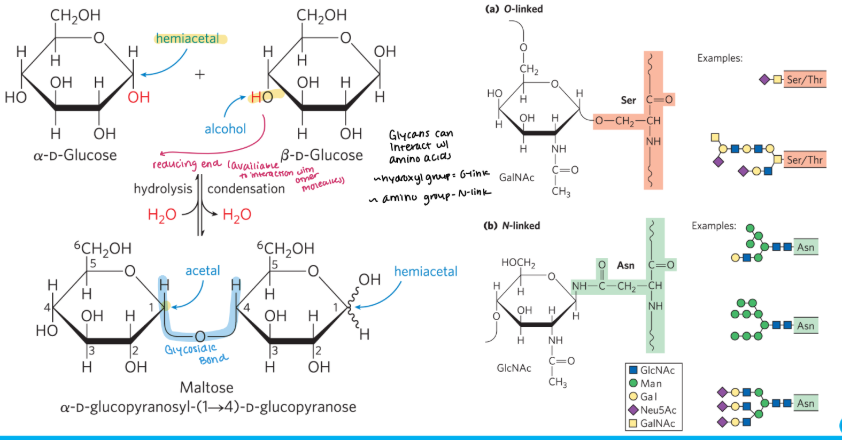
<p>Glycosidic Bonds - Acetals and Ketals Review </p>
98
New cards

Aldehydes

The Reducing End

  • ________ - formation of a glycosidic bond renders a sugar nonreducing


<p><strong><u>The Reducing End </u></strong></p><ul><li><p>________ - formation of a <strong>glycosidic bond renders a sugar </strong><span style="color: red;"><strong><u>nonreducing</u></strong></span></p></li></ul><p></p>
99
New cards

Anomeric

Reducing end - the end of a disaccharide or polysaccharide chain with a free_______ carbon
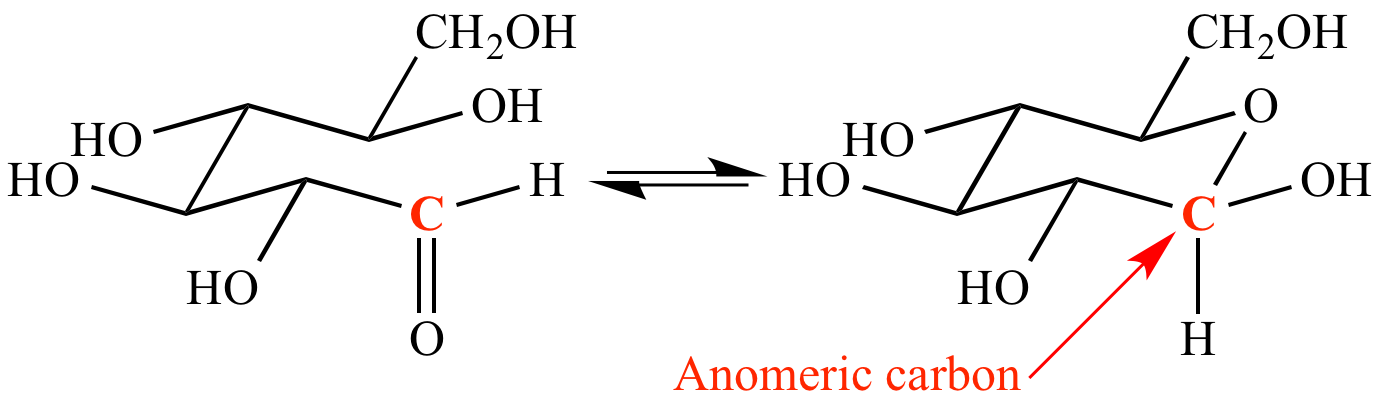
<p><strong><u>Reducing end </u></strong>- the <strong>end of a disaccharide or polysaccharide chain</strong> with a free_______ carbon </p>
100
New cards

Lactose

Disaccharides

  • _____ - is a reducing disaccharide - anomeric carbon is availiable for oxidation
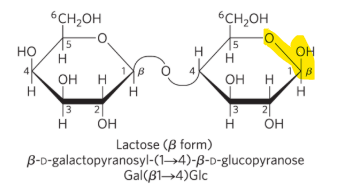

<p><strong>Disaccharides </strong></p><ul><li><p>_____ - is a <strong>reducing disaccharide</strong> - <strong><mark data-color="yellow" style="background-color: yellow; color: inherit;">anomeric carbon</mark></strong> is availiable for oxidation </p></li></ul><p></p>